XPL не выдержал конкуренции с XRP и потерял половину стоимости

cryptonews.ruPublished on 2025-10-13Last updated on 2025-10-13

Конкурент криптовалюты XRP (XRP) токен Plasma (XPL), выпущенный компанией Plasma, подешевел на 50% на фоне слухов об инсайдерской торговле.

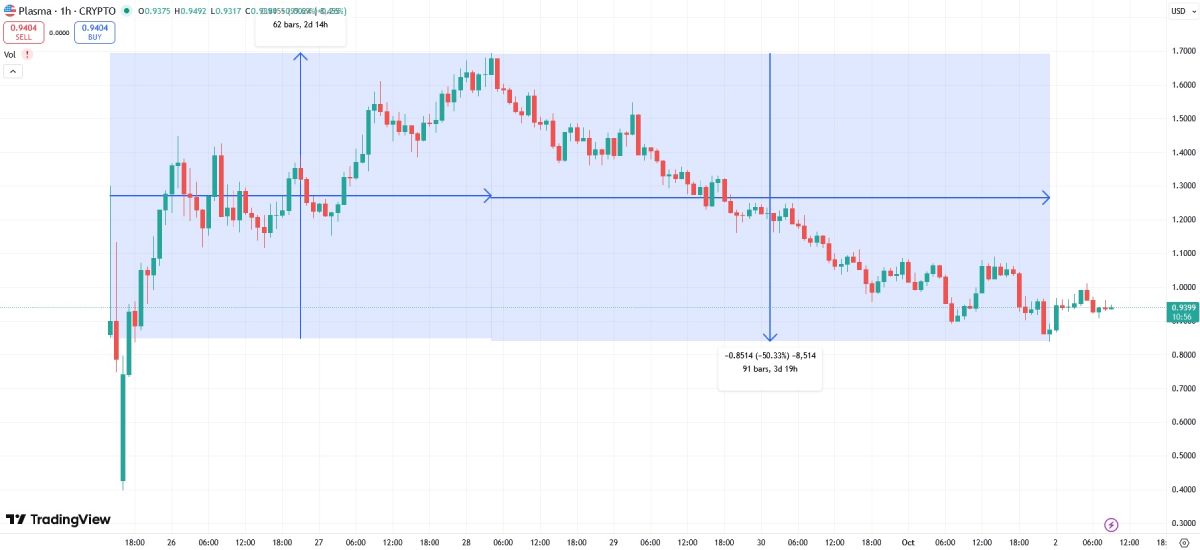
После листинга на биржах, состоявшегося 25 сентября, XPL подорожал почти вдвое за два с половиной дня, и в воскресенье цена монеты достигла пика на отметке $1,69. Затем возникла нисходящая тенденция, в ходе которой цифровой актив подешевел на 50%, и его стоимость опустилась до значения, зафиксированного на старте торговли.

xpl-price-2-october

Рост и падение курса XPL

Вину за снижение цены XPL возложили на инсайдеров, работников Plasma и людей, сотрудничающих с ними. Появилась информация о том, что они избавились от большого количества токенов, чтобы зафиксировать прибыль. Среди замешанных в дампе предположительно оказались сотрудники блокчейн-стартапа Blast, NFT-рынка Blur и маркетмейкера Wintermute.

Однако директор Plasma Пол Фэкс опроверг эти данные и сообщил, что:

  • Принадлежащие ранним инвесторам и работникам Plasma монеты XPL заблокированы на три года, поэтому их невозможно продать;
  • В штате фирмы действительно работают экс-специалисты Blast, Blur и Wintermute, но это не говорит о том, что они передавали своим бывшим коллегам инсайдерскую информацию;
  • Представители Plasma официально не сотрудничали с Wintermute.

Тем не менее заявление Фэкса не оказало позитивного влияния на рынок XPL, на котором продолжается медвежий тренд из-за низкого спроса на цифровые активы. По этой причине трейдерам стоит готовиться к дальнейшему снижению цены криптовалюты.

Trending Cryptos

Related Reads

Pantera Capital: As Perpetual Contracts Move Towards the Financial Center, Hyperliquid Aims to Be All-Encompassing

Perpetual futures ("perps"), once a crypto-native phenomenon, are becoming a dominant global financial instrument, evolving into a fundamental market structure shift that traditional finance can no longer ignore. This article outlines the advantages of perpetual contracts over traditional futures, highlighting their simplicity (no expiry/rollover), easier risk management, and native 24/7 operation. While the concept is not new, digital assets provided the ideal environment for its explosive growth. Initially dominated by centralized exchanges (CEX), perps have recently migrated significantly to decentralized exchanges (DEX), with Hyperliquid emerging as the leading DEX for perps, capturing ~40% of the on-chain volume. Hyperliquid, built on its own purpose-built L1 blockchain, has successfully expanded beyond crypto into traditional assets like stocks, commodities, and indices, driven by its permissionless listing framework (HIP-3) and 24/7 availability. It has become a crucial price discovery venue during off-hours and for pre-IPO companies, attracting attention from traditional hedge funds and major exchanges like ICE, which now views it as serious competition. The investment thesis for Hyperliquid's token, HYPE, rests on its large and growing total addressable market (TAM) across all finance, strong execution, superior user experience, and direct value accrual via aggressive token buybacks using 99% of protocol revenue. Key risks remain, primarily regulatory uncertainty in the U.S., though recent CFTC actions approving certain regulated crypto perp contracts signal a potential shift toward broader acceptance. The core question is no longer if perpetuals matter beyond crypto, but whether blockchain-based infrastructure like Hyperliquid can become the primary venue for pricing, trading, and discovering risk across all financial domains.

marsbit1h ago

Pantera Capital: As Perpetual Contracts Move Towards the Financial Center, Hyperliquid Aims to Be All-Encompassing

marsbit1h ago

Tiger Research: Zuckerberg Begins Betting on Prediction Markets, While Asian Nations Still View Them as Gambling

This article examines the rise of prediction markets, contrasting their growing institutional acceptance in the West with their restrictive regulation in Asia. It details how prediction markets, which originated from informal political betting and academic experiments like the Iowa Electronic Market, aggregate crowd wisdom into probabilistic prices through binary contracts. Their growth accelerated around 2020, reaching over $14 billion in monthly volume. A key driver is the "skin in the game" principle, where users risk their own capital, leading to high accuracy in predicting events like Fed rate decisions and elections, as demonstrated by platforms like Polymarket. Meta's entry, with Mark Zuckerberg reportedly leading the development of the Arena app, signals the market's maturation. In the U.S., court rulings have distinguished prediction markets from gambling, facilitating entry by traditional financial institutions. However, most Asian jurisdictions still classify them as gambling, focusing on social control rather than financial innovation. The article argues this stance creates three problems for Asia: 1) regulatory arbitrage pushes users to riskier offshore platforms, 2) loss of sovereign information infrastructure as valuable social sentiment data accumulates abroad, and 3) abandonment of user protection. It concludes that Asia needs a policy shift from prohibition to constructive regulation, integrating these markets into the formal system to harness their data as a national asset, as initiatives like Limitless Research are beginning to do.

marsbit4h ago

Tiger Research: Zuckerberg Begins Betting on Prediction Markets, While Asian Nations Still View Them as Gambling

marsbit4h ago

Trading

Spot

Hot Articles

What is PLASMA

Plasma: A Cutting-Edge Solution for Blockchain Scalability Introduction to Plasma As the cryptocurrency landscape evolves, so too does the need for enhanced efficiency within blockchain networks. Plasma, a Layer 2 scaling solution, emerges as a pioneering player in this sphere, particularly in the realm of Web3 development. By strategically shifting a substantial portion of tasks from the main chain to a series of smaller chains, Plasma vows to significantly boost the scalability and performance of Ethereum—a widely-used blockchain platform at the forefront of decentralised applications. What is Plasma? Plasma is an innovative off-chain scaling solution particularly designed for the Ethereum blockchain. It was introduced in August 2017 by Vitalik Buterin, co-founder of Ethereum, and Joseph Poon, a prominent advocate of scaling solutions like the Lightning Network. Plasma serves as a framework that enables the creation of scalable applications by establishing a hierarchical structure of child chains above the main Ethereum chain. At its core, Plasma allows for the development of potentially infinite side chains that can operate independently while still relying on the Ethereum network for security and consensus. This architecture is underpinned by smart contracts and Merkle Trees, which efficiently handle transactions and data storage. Core Objectives of Plasma The primary aim of Plasma is to increase the throughput of the Ethereum network. By diverting a substantial volume of transactions away from the congested main chain, Plasma's architecture offers higher transaction speeds, more efficient data processing, and lower transaction costs. This is particularly vital in an age where demand for decentralised applications—especially in finance, gaming, and supply chain management—is reaching unprecedented levels. Creator of Plasma Plasma is the brainchild of two renowned figures in the blockchain community: Vitalik Buterin and Joseph Poon. Buterin is celebrated primarily for co-founding Ethereum and pushing the boundaries of what blockchain technology can achieve. Poon, on the other hand, is known for advocating scalable solutions, which enable faster and more cost-effective transactions on blockchain networks. Their collaboration on the Plasma framework has greatly contributed to its innovative nature, combining advanced technical insights with practical applications. Investors of Plasma While the specific investment foundations or organizations supporting Plasma remain undisclosed, the project has garnered interest from various prominent figures and players in the blockchain and cryptocurrency space. With its potential for enhancing scalability within Ethereum, it has caught the attention of various entities aiming to push the boundaries of blockchain technology. How Does Plasma Work? Plasma's unique functionality is attributed to its architectural framework that relies on child chains and their interaction with the main Ethereum network. Below are some key factors that contribute to Plasma's innovative approach: Child Chains: Plasma establishes numerous child chains that can execute transactions independently of the main Ethereum chain. Each child chain operates as a separate smart contract with unique features, allowing developers to create tailored solutions based on their specific requirements. Smart Contracts and Merkle Trees: The framework utilises smart contracts, which are self-executing agreements with predefined conditions, paired with Merkle Trees that enable efficient verification of data. This technology allows Plasma to achieve both high scalability and security. Transaction Compression: By batching transactions on the child chains, Plasma reduces the data load on the Ethereum network. This means that fewer transactions need to be recorded on the main chain—thereby freeing up space and reducing congestion. Enhanced Security: Despite being off-chain, Plasma leverages the security measures of the main Ethereum network, ensuring that all transactions on child chains maintain a high level of integrity and security. Timeline of Plasma Understanding the development of Plasma involves tracing its significant milestones: August 2017: Plasma was first introduced by Vitalik Buterin and Joseph Poon as a scalable solution to address Ethereum's performance challenges. 2018: The Plasma framework was officially developed and made available on GitHub, marking a crucial step towards its implementation in practical applications. 2019: As awareness about Plasma grew, it began to attract developers interested in scaling Ethereum applications, thus increasing its adoption. 2020: Plasma continued evolving, with substantial enhancements made to its architecture and functionality—making it even more appealing to developers. Key Features of Plasma Plasma boasts several characteristics that make it a transformative solution in the blockchain space: Scalability: By creating multiple child chains, Plasma can handle a higher volume of transactions without further taxing the main Ethereum chain. Speed: Each child chain can process transactions more swiftly, providing users with better experience and service. Lower Transaction Costs: Plasma's structure effectively reduces the costs associated with transactions by minimizing the burden on the main chain. Interoperability: The architecture allows Plasma to seamlessly interact with multiple blockchains, enhancing cross-network functionality. Security: By harnessing the security of Ethereum’s main chain, Plasma ensures the integrity of its operations while utilising its child chains. Use Cases for Plasma The innovative architecture of Plasma opens the door for various practical applications across different sectors: Decentralized Finance (DeFi): Plasma has the capacity to enhance the scalability and efficiency of DeFi applications, creating smoother and more effective trading processes. Gaming: The framework facilitates the development of quick and cost-efficient gaming experiences, making it appealing to developers in the gaming industry. Supply Chain Management: With the ability to archive efficient transaction processing, Plasma can foster the development of decentralised supply chain management solutions. Conclusion Plasma stands at the forefront of blockchain technology, positioned as a pivotal Layer 2 scaling solution aimed at enhancing the efficiency of the Ethereum network and beyond. Through its unique structure of child chains, smart contracts, and Merkle Trees, Plasma offers a compelling solution to the scalability crisis that has long plagued blockchain networks. As blockchain technology continues to advance, solutions like Plasma promise to reshape how developers approach scalability challenges, potentially revolutionising how decentralised applications function. The ongoing efforts by its creators and the interest of various stakeholders signal a bright future for Plasma as it seeks to elevate blockchain capabilities to new heights in the digital realm.

1.7k Total ViewsPublished 2024.12.03Updated 2024.12.03
What is PLASMA

How to Buy XPL

Welcome to HTX.com! We've made purchasing Plasma (XPL) simple and convenient. Follow our step-by-step guide to embark on your crypto journey.Step 1: Create Your HTX AccountUse your email or phone number to sign up for a free account on HTX. Experience a hassle-free registration journey and unlock all features.Get My AccountStep 2: Go to Buy Crypto and Choose Your Payment MethodCredit/Debit Card: Use your Visa or Mastercard to buy Plasma (XPL) instantly.Balance: Use funds from your HTX account balance to trade seamlessly.Third Parties: We've added popular payment methods such as Google Pay and Apple Pay to enhance convenience.P2P: Trade directly with other users on HTX.Over-the-Counter (OTC): We offer tailor-made services and competitive exchange rates for traders.Step 3: Store Your Plasma (XPL)After purchasing your Plasma (XPL), store it in your HTX account. Alternatively, you can send it elsewhere via blockchain transfer or use it to trade other cryptocurrencies.Step 4: Trade Plasma (XPL)Easily trade Plasma (XPL) on HTX's spot market. Simply access your account, select your trading pair, execute your trades, and monitor in real-time. We offer a user-friendly experience for both beginners and seasoned traders.

3.2k Total ViewsPublished 2025.09.26Updated 2026.06.02

How to Buy XPL

Discussions

Welcome to the HTX Community. Here, you can stay informed about the latest platform developments and gain access to professional market insights. Users' opinions on the price of XPL (XPL) are presented below.

活动图片