SOL traders smash buy ahead of SEC Solana ETF decision: Is $250 back on the table?

CointelegraphPublished on 2025-09-30Last updated on 2025-09-30

Abstract

SOL traders saw the drop to $190 as the perfect buy opportunity and with the SEC set to decide on Solana ETFs by October 10, the altcoin could be en-route to new highs.

Key takeaways:

SOL aggregate volumes show retail traders piling into spot positions as the altcoin rebounded from $190.

Traders could be positioning ahead of an anticipated favorable SEC Solana ETF decision on Oct. 10.

SOL price rallied to $213 on Monday, gaining nearly 12% over the past 3 days and suggesting that the recent sell-off to $190.85 was viewed as a discounted buying opportunity by traders. With the SEC’s final Solana ETF decision expected by Oct. 10, SOL charts suggest that traders intend to frontrun the decision and possibly send the altcoin’s price to new highs over the next 2 weeks.

Let’s take a brief peek behind the curtain to see what’s happening with SOL.

Retail longs bought entire dip

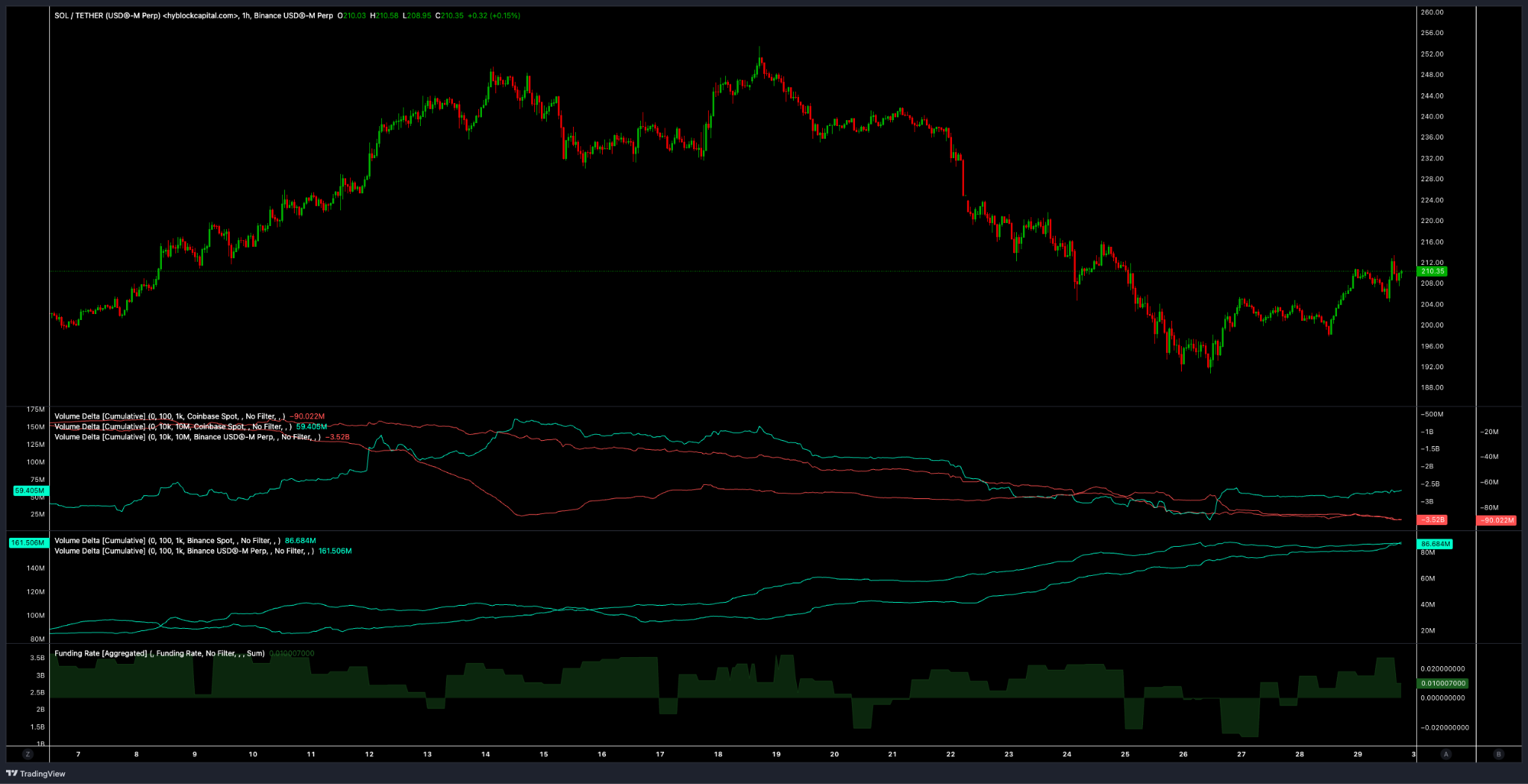
As Bitcoin price and the broader crypto market sold-off last Monday, the cumulative volume delta for Binance spot and futures traders shows retail-size (100 to 1,000) traders at Binance buying the decline. A similar trend is seen in the institutional investor-size spot CVD (10,000 to 10 million) at Coinbase.
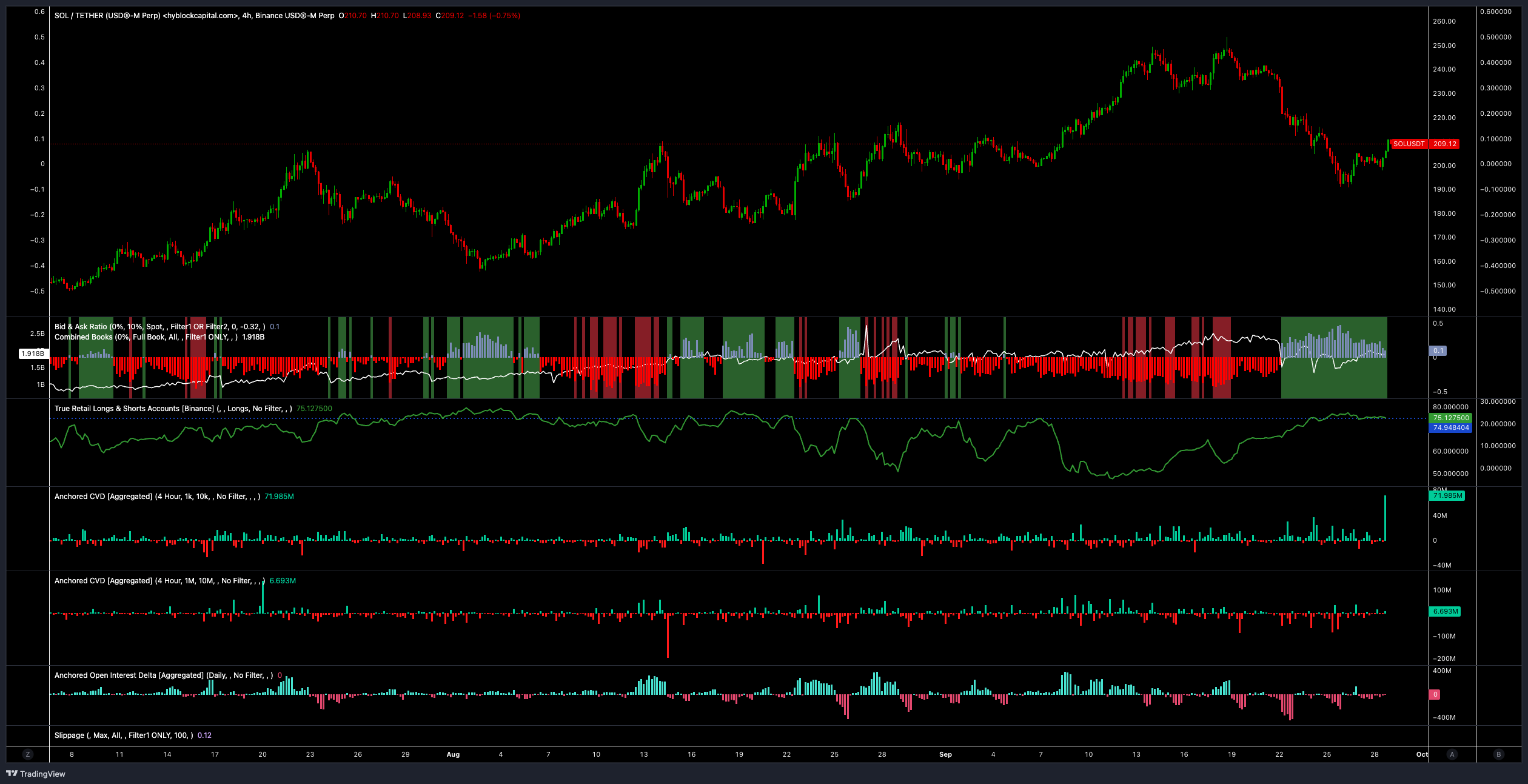
Further proof of retail investors’ appetite for SOL can be seen in the chart below in Hyblock’s True Retail Longs and Shorts Accounts metric, an indicator that tracks the percentage of Binance retail accounts that are holding long versus short positions, rising to 78.2 (at the peak of the sell-off) from 54.3.

As these retail traders positioned long, Solana’s aggregate spot orderbook bid-ask ratio (set at 10% orderbook depth) pushed above 0, to 0.47, indicating an orderbook tilted toward buyers. Looking at the anchored 4-hour cumulative volume delta shows buyers in the retail cohort voraciously buying SOL, with $71.98 million in volume in the most recent 4-hour interval.
What else is needed for SOL to reach new highs?

Beyond the day-to-day price action of the recent rebound, ahead of the Oct. 10 Solana ETF decision, bullish traders betting on new SOL highs will want to keep an eye on the altcoin’s aggregate open interest at centralized exchanges, along with the CME open interest and CME futures volume.

Ideally, a return to the levels reached on Sept. 18, when SOL rallied to a yearly high of $253, will build up over the next two weeks. SOL’s CME future open interest stood at $2.12 billion, and its CME futures volume ticked to $1.57 billion on Sept. 18, and according to Sept. 26 data from Velo.xyz, each respective category is $1.72 billion and $400 million.
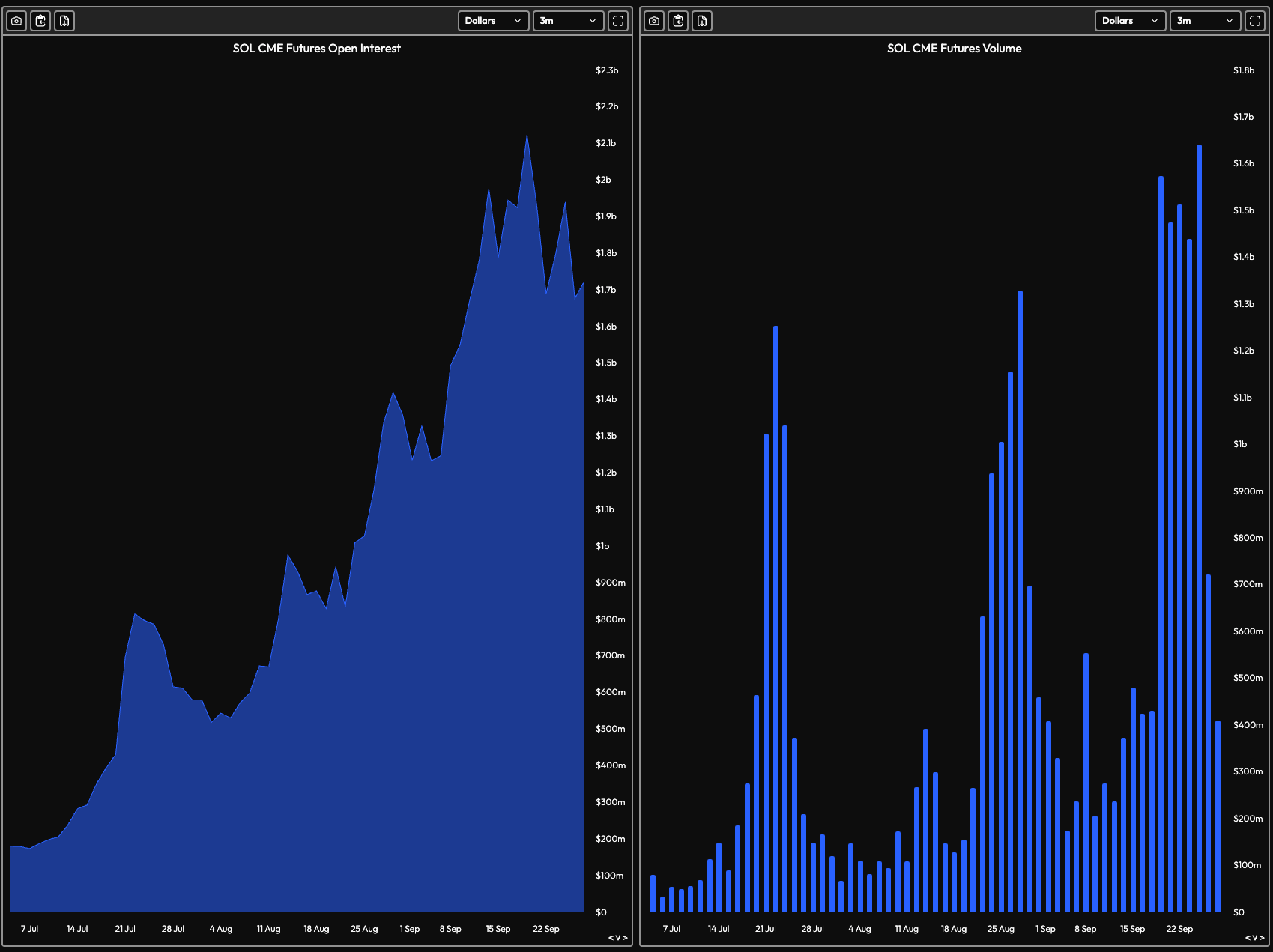
Similarly, SOL’s aggregate open interest currently sits below the pre-yearly price high run-up, which saw its OI top out at $3.65 billion.

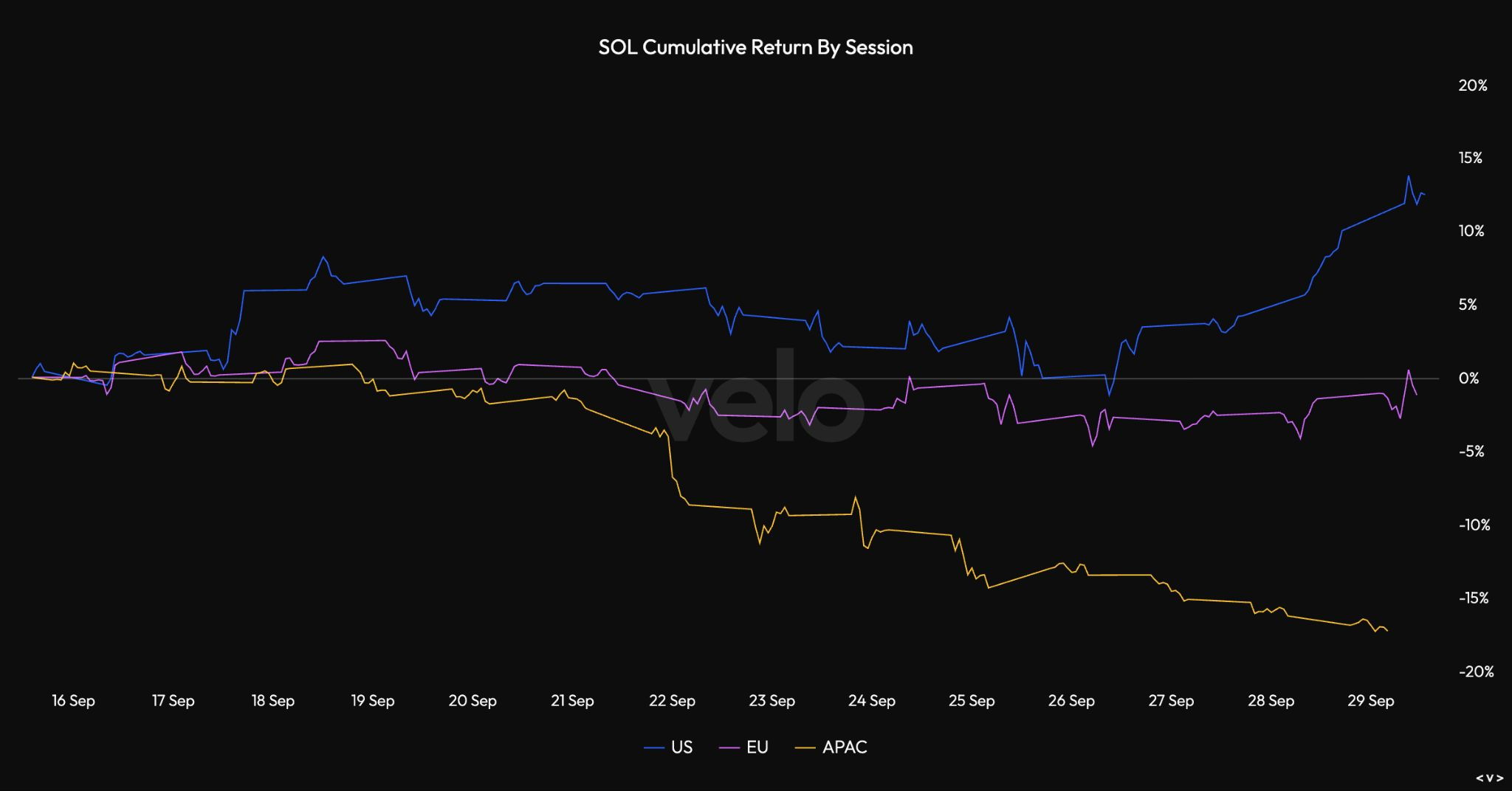
Another metric to watch is SOL cumulative returns per session, particularly in the US, as this is where the spot ETFs are pending a final decision. As shown in the chart below, returns during the US session have turned positive since Friday.

Ideally, if SOL is becoming a sticky rotation trade that traders intend to frontrun ahead of the ETF decision, it would also be good to see cumulative returns in APAC and EU sessions rise to align trend-wise with the US trading session.
Trending Cryptos

Related Reads

Report Interpretation: J.P. Morgan Details Micron's Pre-Earnings Sentiment, Current Hardware Sector Dynamics

Morgan Stanley analyst Joshua Meyers' report (June 21, 2026) highlights key trends in the hardware and semiconductor sector ahead of Micron's earnings. The core takeaways are: 1. **Micron & Memory:** Memory remains a high-conviction long theme, driven by strong AI demand and rising ASPs. However, investor focus is shifting to the sustainability of Micron's >80% gross margins and the specifics of potential new long-term supply agreements (SCAs). 2. **Hardware Supply Chain:** AI-related demand for servers, networking, and storage remains robust, but company performance is diverging. Celestica (CLS) shows improved margin confidence, Western Digital and Seagate benefit from pricing, Fabrinet (FN) sees predictable AI optics growth, and Teradyne (TER) anticipates a new Google customer. 3. **AI Capex & WFE Forecasts:** JPMorgan increased its Wafer Fab Equipment (WFE) market growth forecasts to 28% in 2026 and 29% in 2027. AI infrastructure financing is evolving, with higher project-level debt reducing constraints on capex expansion. The report signals that while the AI-driven hardware cycle is strong, the market is entering a phase focused on execution verification (e.g., Micron's SCA details, Fabrinet's ramp with Amazon) and valuation sustainability. Key near-term signals include Micron's guidance, Arista Networks' outlook, and the pace of demand normalization post potential tariff-related pull-ins.

marsbit5h ago

Report Interpretation: J.P. Morgan Details Micron's Pre-Earnings Sentiment, Current Hardware Sector Dynamics

marsbit5h ago

Research Report Analysis: The Fed's New Chair's Debut – New Leader, But Same Script?

Report Analysis: Federal Reserve's New Chair Debut – A New Captain, But the Same Script? Morgan Stanley's chief global economist Seth B. Carpenter analyzes the first FOMC meeting under new Fed Chair Kevin Warsh in a June 21 report. Warsh deliberately avoided providing forward guidance on interest rates, aligning with his philosophy. However, market expectations for a rate hike this year were reinforced. Key signals lie elsewhere: inflation may fall more than expected, and quantitative tightening (QT) could be more aggressive than anticipated. The FOMC's "dot plot" suggests only one rate hike in 2026. Carpenter argues that if inflation undershoots forecasts, the logic for even a single hike weakens, especially as projections indicate potential rate cuts in 2027. On QT, Warsh's stance is clear. Carpenter notes that measures like halving the Treasury's account balance could shrink the Fed's balance sheet by around $500 billion with minimal market impact. Combined with adjustments to reserve interest and liquidity rules, the ultimate QT scale may exceed expectations, though its market effect might be less disruptive unless the Fed actively sells Mortgage-Backed Securities (MBS). While Warsh initiated a review of the Fed's policy framework, the 2% inflation target remains intact for now. The report concludes that the market may be overestimating the significance of reduced forward guidance and the near-term rate hike risk, while potentially underestimating the scope and manageable nature of the coming balance sheet reduction. The key debates will hinge on upcoming core PCE data, the specifics of the QT path, and the framework review's findings.

marsbit6h ago

Research Report Analysis: The Fed's New Chair's Debut – New Leader, But Same Script?

marsbit6h ago

Critical Game Week: BTC Retracement Confirmation vs. HYPE Support Battle | Guest Analysis

This weekly analysis outlines a critical juncture for BTC and HYPE markets, focusing on key price level confirmations. **BTC Analysis:** BTC is at a pivotal point after a five-wave rally from the June 5th low of $59,100. The price has broken below a short-term rising channel's lower boundary, with the current move seen as a pullback to test this breakdown. Failure to reclaim this level could lead to a retest of the $59,000-$60,000 support zone. The core scenario hinges on this channel retest outcome. * **Key Levels:** Resistance at $64,500-$65,000 (channel boundary) and $69,500-$70,500. Support at $59,000-$60,000 and $55,000. * **Strategy:** A core bearish stance is maintained (20% short from last week), with short-term plans for tactical trades. Three detailed contingency plans (A/B/C) are provided for short positions on resistance tests or breakdowns, emphasizing strict stop-loss discipline. **HYPE Analysis:** HYPE shows strong momentum but is currently in a corrective phase after hitting a new high of $76.94. The price is retesting the crucial $64-$66 support area. * **Key Levels:** Resistance near $77 and $80-$82. Support at $64-$66 and $52-$54. * **Strategy:** The short-term approach is "buy on dips, avoid chasing rallies." A long position is considered only if clear stabilization signals appear at the $64-$66 or deeper $52-$54 support zones, with tight risk controls. **General Risk Management:** A standardized trailing stop-loss protocol is emphasized: set initial stop, breakeven at +1% profit, then trail stops upward to lock in gains. *Disclaimer: All analysis is presented as a personal trading framework, not investment advice. Market conditions are complex and require dynamic adjustment.*

marsbit6h ago

Critical Game Week: BTC Retracement Confirmation vs. HYPE Support Battle | Guest Analysis

marsbit6h ago

Trading

Spot
Futures

Hot Articles

Discussions

Welcome to the HTX Community. Here, you can stay informed about the latest platform developments and gain access to professional market insights. Users' opinions on the price of SOL (SOL) are presented below.

活动图片