Ethereum Founder Buterin Defends Coinbase Amid Fierce Debate: Here’s Why

bitcoinistPublished on 2025-09-23Last updated on 2025-09-23

Abstract

Ethereum co-founder Vitalik Buterin has waded directly into a fast-escalating dispute over the role and risk profile of Coinbase’s Layer-2...

Trusted Editorial content, reviewed by leading industry experts and seasoned editors. Ad Disclosure

Ethereum co-founder Vitalik Buterin has waded directly into a fast-escalating dispute over the role and risk profile of Coinbase’s Layer-2 (L2) network, Base, arguing that critics are conflating core concepts and overlooking concrete guarantees that protect users on modern L2s. “Base is doing things the right way: an L2 on top of Ethereum, that uses its centralized features to provide stronger UX features, while still being tied into Ethereum’s decentralized base layer for security,” Buterin wrote, adding that L2s like Base “are non-custodial… not glorified servers that happen to submit hashes.”

Ethereum’s Buterin Clarifies L2 Security

Buterin’s post arrived after Coinbase’s chief legal officer Paul Grewal pushed back on commentary likening L2 sequencers to “exchanges,” and Base creator Jesse Pollak published a detailed thread explaining what a sequencer actually does. Pollak described Base’s sequencer as a system that “collects user transactions, orders them on a first-in/first-out basis, computes the resulting state changes, and batches them to Ethereum’s L1 for final settlement that’s faster and cheaper than transacting on L1.”

In his words, sequencers “do NOT act as ‘matching services’ or engines like those in traditional exchanges… the sequencer ensures these transactions are executed in a consistent, ordered manner, but it doesn’t decide matches or control trade logic. That’s up to the code.”

The crux of the controversy is custody and control: if an L2 can re-order, censor, or halt, does that make it functionally similar to a centralized intermediary? Buterin’s answer is that the Ethereum base layer ultimately governs user funds and provides the escape hatches that matter.

“Base does not have custody over your funds, they cannot steal funds or stop you from withdrawing funds (this is part of the L2beat stage 1 definition),” he wrote, pointing readers to L2BEAT’s taxonomy and to concrete examples of “force-exit” and anti-censorship pathways implemented at the L1 contract layer. He emphasized that these are not theoretical niceties: “There are concrete pathways implemented in smart contract logic on Ethereum L1… that ensure that the L2 users’ funds are ultimately controlled by L1, they cannot be stolen or blocked by the L2 operator.”

Buterin also addressed a recurring point of confusion: the notion that L2BEAT is some kind of ideological gatekeeper rather than a scorecard of objective assurances. “Many people have been confused by recent cynicism and think that things like L2beat are a weird sort of nerd-sharia compliance authority. This is NOT what is going on. The security that L2s provide, that L2beat measures, reflects concrete properties that protect you as a user from being rugged.”

To illustrate, he linked to a walkthrough of user withdrawals when an L2 shuts down, and to a censorship-resistance incident earlier this year where an L2’s design allowed transactions to bypass an uncooperative operator—examples meant to make the guarantees tangible.

The “stage-1” designation, often cited to critique Base’s current decentralization, was another flashpoint Buterin tackled head-on. “Yes stage 1 means that a security council with a 75% vote can override the onchain code,” he conceded. “However, stage 1 also requires that a quorum-blocking (>=26%) portion of the council sits outside the org that is managing the L1. Hence, the org cannot unilaterally censor or steal via a security council vote, so they are not a custodian.”

Base Is Eying ‘Stage 2’

The Ethereum co-founder again pointed readers to his framework for when and how projects should progress to “stage-2,” where even a unanimous council cannot override functioning on-chain logic. The policy implication is explicit: the presence of an emergency-brake governance layer does not, in itself, transform an L2 into a custodian under normal operation, provided minority independence and L1-enforced exits are real.

For Base, Pollak sketched a roadmap that aligns with that trajectory. “We’ve progressed Base to stage 1 decentralization over the last 2 years and enabled permissionless block proposals. Today, we’re actively working towards stage 2 and investing in further decentralizing block building. Still day one.” Framed this way, the debate is not whether Base is an exchange—Pollak was blunt: “so no, @base isn’t an unlicensed securities exchange”—but how quickly and credibly it can reduce governance and operator powers while preserving the UX advantages that made L2s popular.

Underneath the rhetoric are two technical assurances that determine whether users are actually protected. First is inclusion: even if a sequencer refuses a transaction, L2s like Base expose direct submission routes through Ethereum L1, letting users force their transactions into the rollup and inherit the censorship-resistance of the L1 validator set.

Second is exit: if an L2 halts or misbehaves, users can initiate withdrawals enforced by L1 contracts—without the operator’s cooperation. Buterin’s point is that these are “concrete properties,” and both L2BEAT’s framework and recent real-world incidents exist to verify that they work in practice.

The stakes are larger than a single network. How regulators and market participants interpret “sequencer,” “custody,” and “decentralization stage” will shape the next phase of Ethereum scaling.

Buterin’s intervention was, at core, an attempt to reset definitions to what the code guarantees.“This is what we mean when we say that L2s are non-custodial, they are extensions of ethereum… There are concrete pathways… that ensure that the L2 users’ funds are ultimately controlled by L1.”

Whether that reframing cools the fevered discourse—or accelerates Base’s push to stage-2—now rests on how convincingly these assurances are demonstrated in production and audited by neutral frameworks.

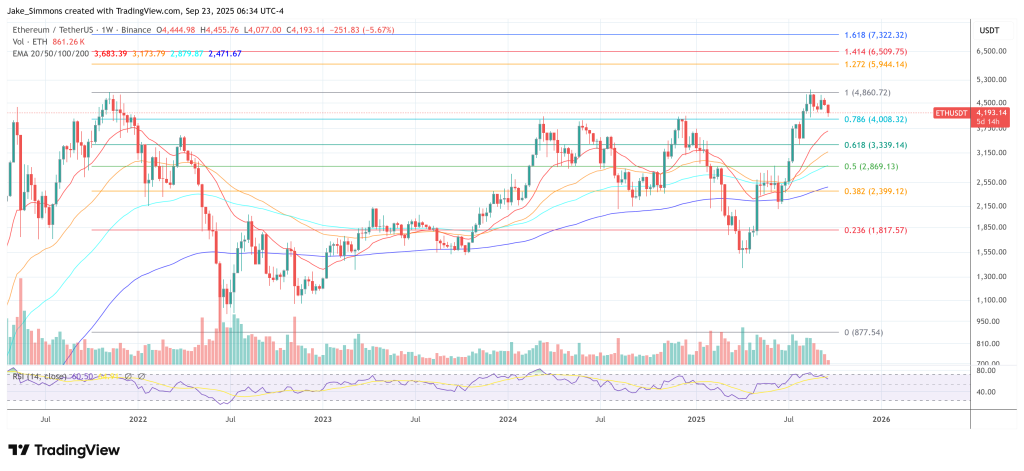
At press time, ETH traded at $4,193.
Ethereum price
ETH remains above the 0.786 FIb, 1-week chart | Source: ETHUSDT on TradingView.com
Featured image created with DALL.E, chart from TradingView.com
Editorial Process for bitcoinist is centered on delivering thoroughly researched, accurate, and unbiased content. We uphold strict sourcing standards, and each page undergoes diligent review by our team of top technology experts and seasoned editors. This process ensures the integrity, relevance, and value of our content for our readers.

Jake Simmons has been a Bitcoin enthusiast since 2016. Ever since he heard about Bitcoin, he has been studying the topic every day and trying to share his knowledge with others. His goal is to contribute to Bitcoin's financial revolution, which will replace the fiat money system. Besides BTC and crypto, Jake studied Business Informatics at a university. After graduation in 2017, he has been working in the blockchain and crypto sector. You can follow Jake on Twitter at @realJakeSimmons.

Trending Cryptos

Related Reads

Jensen Huang's Daughter: From Chef to an $8 Million Annual Salary

Madison Huang, daughter of NVIDIA founder Jensen Huang, recently made a rare public appearance in Beijing during the 2026 World Robot Conference. As the Senior Director of Product and Technology Marketing for NVIDIA's Physical AI Platform, with an annual salary of approximately $1.2 million, her visit focused on evaluating leading Chinese robotics companies like UBTech, Unitree, and others. This highlights NVIDIA's strategic interest in the burgeoning Chinese robotics ecosystem, a key battleground for the development of Physical AI—technology that enables machines to understand and interact with the physical world. Huang's career path is unconventional. Initially pursuing her passion, she studied culinary arts, worked as a chef, and later held a marketing role at LVMH. She joined NVIDIA as an intern in 2020 after completing an MBA, quickly rising through the ranks. Her brother, Spencer Huang, followed a similar path, closing a cocktail bar he co-founded to also join NVIDIA, where he now works on robotics software. Jensen Huang has publicly addressed nepotism concerns, humorously noting that some "second-generation" employees outperform their parents. The conference itself underscored China's vibrant robotics sector, marked by Unitree's recent blockbuster IPO and a pipeline of companies preparing to go public. While hardware development and manufacturing are advancing rapidly, industry leaders like Wang Xingxing of Unitree point to the next critical challenge: developing the "brain" or AI that allows robots to perform diverse, unseen tasks based on simple instructions. With massive manufacturing scale and diverse real-world testing scenarios, China is positioned as a central player in the global race to define the future of robotics.

marsbit45m ago

Jensen Huang's Daughter: From Chef to an $8 Million Annual Salary

marsbit45m ago

He Gave Wang Xingxing the First 2 Million, Now Serves as Chairman for the Next 'Unitree'

On August 19, 2024, Unitree Robotics, China's "first humanoid robotics stock," went public. Its founder, Wang Xingxing, started a decade ago with his self-developed XDog. In 2016, at a critical funding juncture, he received his first angel investment of 2 million RMB from Yin Fangming. This bet has since yielded a return of over 140 times. Yin Fangming is more than just a key investor. He was a co-founder of the AI robotics company ROOBO, whose own venture ultimately struggled. This firsthand experience with the hardware challenges in robotics gave him unique insight when backing Unitree, a company renowned for its hardware R&D and cost control. While his own company faltered, Yin continued investing shrewdly. He partially cashed out some Unitree shares early, reinvesting the proceeds into sectors like energy (e.g., solid-state battery firm TaiLan) and commercial aerospace (e.g., small launch vehicle developer XianDeng Aerospace). However, his most significant move after Unitree is his deep involvement with Galaxy General, a leading embodied AI unicorn. In July 2024, Yin stepped from behind the scenes to officially become its Chairman, indicating a role far beyond a typical investor. This comes as Galaxy General is viewed as preparing for future capital moves. Yin's career has consistently been ahead of the curve—from mobile internet to AI and robotics. Known for his foresight and low profile, he declined an interview for this story, offering only a statement encouraging support for visionary entrepreneurs like Wang Xingxing.

marsbit1h ago

He Gave Wang Xingxing the First 2 Million, Now Serves as Chairman for the Next 'Unitree'

marsbit1h ago

Coldcard Theft Reflection: Source Code Visibility Does Not Equal Security

The article examines the open-source vs. closed-source debate in crypto, prompted by a theft of over $100M in Bitcoin from Coldcard hardware wallets. It clarifies key terminology: true "Free and Open Source Software" (FOSS) grants four essential freedoms (use, study, share, modify), while "source available" code, like Coldcard's firmware, may have usage restrictions. The piece argues that visible source code alone does not guarantee security; actual safety depends on the economic incentives for thorough, ongoing review by skilled individuals. Using Bitcoin Core as a model, the article describes a successful, transparent open-source development culture built on public review and consensus. It contrasts this with the Coldcard case, where a critical bug in a lightly-reviewed, source-available library went undetected for years, highlighting a "tragedy of the commons" scenario where assumed but absent scrutiny creates vulnerability. The economics of licensing are crucial: restrictive licenses can limit the pool of motivated commercial reviewers. Finally, the article explores AI's impact. It cites the Bitcoin Red Team's use of AI to rapidly audit codebases and find vulnerabilities at scale, demonstrating a powerful new tool for security. However, AI also floods projects with low-quality code, straining maintainers. The piece concludes that in high-stakes crypto, only well-audited projects—whether open or closed-source—can withstand evolving threats, with AI both challenging and aiding security practices.

marsbit1h ago

Coldcard Theft Reflection: Source Code Visibility Does Not Equal Security

marsbit1h ago

Trading

Spot

Hot Articles

Discussions

Welcome to the HTX Community. Here, you can stay informed about the latest platform developments and gain access to professional market insights. Users' opinions on the price of ETH (ETH) are presented below.

活动图片