Bitcoin Hyper Not Far from $20M, Whales Keep Buying: See What This $BTC Layer-2 Plans

bitcoinistPublished on 2025-09-22Last updated on 2025-09-22

Abstract

To the uninitiated, Bitcoin and crypto are synonymous – and it's only fair, given that the granddaddy of all crypto...

Trusted Editorial content, reviewed by leading industry experts and seasoned editors. Ad Disclosure

To the uninitiated, Bitcoin and crypto are synonymous – and it’s only fair, given that the granddaddy of all crypto has been the face of the industry ever since it burst onto the scene a few years back.

Since 2020, Bitcoin has generated over 1,500% in returns. Basically, crypto is so much about Bitcoin.

All the chatter in crypto, since forever, has been around Bitcoin, from stories of people misplacing their cold wallets with $BTC bought at $10, now worth over $110K, to headlines about its dominance.

Until now, Bitcoin has really only been looked at as an investment vehicle, but a new contender is aiming to redefine what the Bitcoin blockchain can do. Enter Bitcoin Hyper ($HYPER).

$HYPER is a new cryptocurrency project that aims to turbocharge Bitcoin with Solana-like speed, scalability, and Web3 support. It’s about finally bringing digital gold up to true gold blockchain standards.

Currently in presale, $HYPER has already accumulated over $17.5M from early investors, including $30.5K from crypto whales just yesterday.

Read on as we unpack $HYPER in detail, explaining why it’s arguably the best crypto to buy in 2025.

Bitcoin’s Place in Crypto & Prevalent Problems

The total public Bitcoin holdings are now $116B, whereas other top altcoins like Ethereum and Solana only have around $14B and $3B in public company treasuries, respectively.

That’s a huge gap and a clear indicator of Bitcoin’s place in the industry.
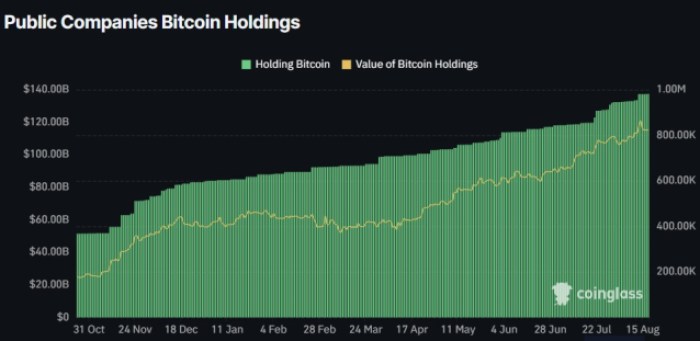
Public Companies Bitcoin Holdings
Source: CoinGlass

But while Bitcoin dominates the space in terms of popularity and online chatter, other blockchains like Ethereum and Solana are actually doing the work to form the basis of the crypto infrastructure.

It’s very important to separate crypto from just a returns perspective or investment avenue, and to also see what it truly stands for: a hedge against macroeconomic instability, decentralization, anonymity, and simply offering users a much better alternative to today’s handicapped traditional fiat banking system.

In that regard, Ethereum and Solana dominate the DeFi space, the Web3 ecosystem, and the altcoin launchpad sector. It’s easy to argue they’re just as important to the core blockchain fundamentals of the industry as Bitcoin is.

However, Bitcoin will remain the granddaddy, and it’s understandable (but maybe not) that with so many returns and its mainstream presence, it has fallen off in terms of innovation.

Bitcoin’s Technical Stagnation: The Problem Waiting to Be Solved

Bitcoin is currently the 29th fastest blockchain in the world, with the ability to process just 7 transactions per second.

Compare that with Solana, which can theoretically process 65K transactions per second, and you can see why Bitcoin is nowhere in developer conversations.
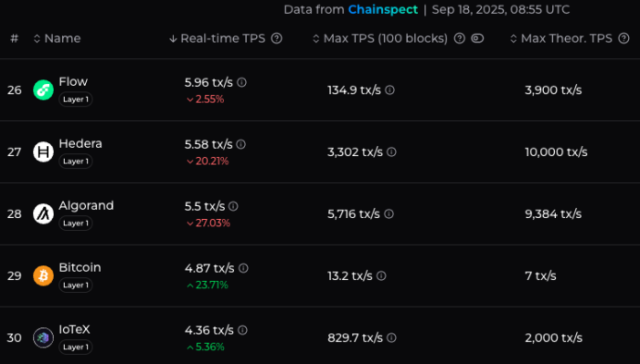
Blockchain speeds compared.

Its scripting language is deliberately restrictive, making it nearly impossible to build complex applications directly.

As a result, almost every talented developer has pivoted toward Ethereum, Solana, and other smart contract platforms where they can build and experiment freely.

In short, Bitcoin is financially dominant but technically stagnant.

Now, here’s the kicker: In any business, if you can identify a true, industry-wide problem and solve it, success is all but guaranteed. That’s why it’s important we have a conversation around Bitcoin Hyper ($HYPER).

Bitcoin Hyper Brings Solana’s Performance & Programmability to Bitcoin

Bitcoin Hyper is building a brand-new Layer 2 solution for Bitcoin that will integrate with the Solana Virtual Machine (SVM).

Unlike the very popular Ethereum Virtual Machine (EVM), the SVM is capable of executing thousands of transactions in parallel – the only condition being they’re not related to each other.

This becomes $HYPER’s core problem-solving bottom line, as it essentially cranks up Bitcoin’s sluggish speeds to modern blockchain standards.

Most importantly, despite this being a Layer 2 solution – with transactions happening off-chain, almost like on a sidechain – there’s no compromise in security, which Bitcoin’s Layer 1 is widely regarded for.

Bitcoin Hyper simply batches the results of its transactions and submits a summary to the Bitcoin mainchain, ensuring both lightning-fast execution and Bitcoin’s native security.

$HYPER’s Canonical Bridge Ensuring Seamless Interaction with New BTC Web3

Hyper’s SVM integration will also allow developers to build smart contracts and decentralized applications on the network.

This brings in an entirely new layer of use cases for developers and users on Bitcoin: think high-speed DeFi trading, NFTs, DAOs and governance, lending, staking, swapping, and blockchain gaming.

Bitcoin Hyper's layer-2 ecosystem explained, step by step.

Even better, Bitcoin Hyper makes it incredibly seamless for users to interact with this SVM-powered Web3 environment.

  • All you have to do is submit your Layer 1 Bitcoin into Hyper’s non-custodial, decentralized, canonical bridge.
  • It will then verify the transaction, lock your original Layer 1 $BTC, and then mint an equivalent amount of $BTC tokens on Hyper’s Layer 2.
  • These tokens are compatible with Layer 2 and can be used to interact with the newly unlocked Bitcoin Web3 ecosystem.

Don’t Miss the $HYPER Presale: Early Investors Reap the Biggest Rewards

Let’s fully understand Bitcoin Hyper’s potential. Consider why people buy different altcoins.

People buy Ethereum, Solana, and XRP for what they mean to the crypto infrastructure, not solely because they could 10x or 100x in the next five or ten years.

However, people buy Bitcoin because of what they believe crypto as a whole could become in the next five to ten years.

While this is a positive, since Bitcoin is the face of the industry, it also shows that there’s very little native reasoning to buy Bitcoin itself from a utility standpoint.

That is what Bitcoin Hyper is changing. It can actually crank up Bitcoin’s real-world utility, essentially igniting a fire under its belly, while also potentially becoming one of the next cryptos to explode.

Currently in presale, $HYPER has already raised over $17.5M in early investor funding, with each token priced at just $0.012955.

This is a golden opportunity, as you might never see Hyper at such a low price again, with a listing just around the corner.
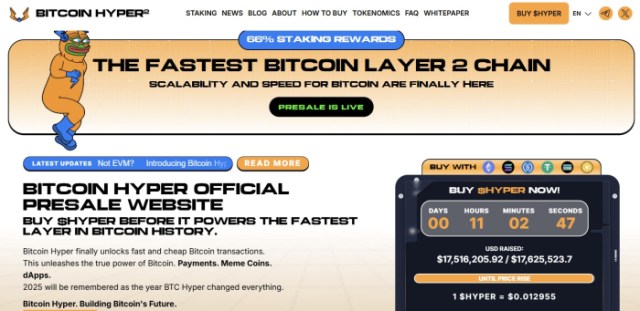
$HYPER live presale info

According to our Bitcoin Hyper price prediction, the token could reach $0.32 by the end of 2025, which would represent a staggering 2,300% return on your investment if you get in now.

If you need help with the purchase process, check out our step-by-step guide on how to buy Bitcoin Hyper.

Visit Bitcoin Hyper’s official website to learn more about its potential impact on the broader crypto economy.

Disclaimer: Crypto investments are highly risky. This article is not financial advice, so kindly always do your own research before investing.

Authored by Krishi Chowdhary, Bitcoinist — https://bitcoinist.com/bitcoin-hyper-not-far-from-20m-as-whales-keep-accumulating

Editorial Process for bitcoinist is centered on delivering thoroughly researched, accurate, and unbiased content. We uphold strict sourcing standards, and each page undergoes diligent review by our team of top technology experts and seasoned editors. This process ensures the integrity, relevance, and value of our content for our readers.

As a crypto writer, Krishi splits his time between decoding the chaos of the markets and writing about it in a way that doesn’t put you to sleep. He’s been at it for nearly two years in the crypto trenches. Yes, he regrets missing the magnificent rallies that came before that (who doesn’t!), but he’s more than ready to put his money where his words are. Before diving headfirst into crypto, Krishi spent over five years writing for some of the biggest names in tech, including TechRadar, Tom’s Guide, and PC Gaming, covering everything from gadgets and cybersecurity to gaming and software. When he’s not scouring and writing about the latest happenings in crypto, Krishi trades the forex market while keeping crypto in his long-term HODL plans. He’s a Bitcoin believer, though he never lets that bias creep into his writing.

Trending Cryptos

Related Reads

The Full Story of How Crypto Unicorn Blockstream Is Mired in Serious Fraud Allegations

This article details serious allegations of fraud against Bitcoin infrastructure company Blockstream, founded by Bitcoin pioneer Adam Back. In June 2024, investigative account NatInfoSec published a report accusing Blockstream's mining note (BMN) program of potentially operating a multi-billion dollar scheme with Ponzi-like characteristics. The core allegations focus on Blockstream Mining Notes (BMNs), which offer investors fixed annual yields up to approximately 20% from Bitcoin mining. NatInfoSec's investigation raises several key issues: 1. **Suspicious Hashrate & Payout Capacity**: The analysis suggests Blockstream would need 20-45 EH/s of mining power to cover its BMN obligations, but its public dashboard shows only around 15 EH/s. Furthermore, no verifiable public evidence (e.g., grid connection records, import data) was found to support the massive mining operation required. 2. **Questionable Payout Source**: The BMN contract allows Blockstream to use Bitcoin from *any source* (Substitute Performance BTC) to fulfill investor payouts, raising concerns that payouts may not come from actual mining revenue. 3. **High-Risk, Fixed Returns**: Offering ~20% fixed yields in the volatile, cyclical Bitcoin mining industry is viewed as highly unusual and requires clear explanation. 4. **Undisclosed Criminal Record of Key Figure**: Christopher William Cook, a key figure in Blockstream's mining operations and CEO of spin-off Exacore, was found to have a federal felony conviction for mail fraud in 2008, a fact not disclosed in BMN offering documents. His background was also allegedly embellished. 5. **Potential Contagion to BSTR SPAC**: Questions were raised about whether these liabilities and Cook's record should have been disclosed in the SEC filings for Bitcoin Standard Treasury Company (BSTR), a separate Adam Back-associated firm planning a SPAC merger. The crypto community is divided. BitMEX Research validated Cook's criminal record and expressed concern over the high yields but found other evidence lacking or misleading, noting the legal separation between BMN, Blockstream, and BSTR. Blockstream defenders, like Samson Mow, argue the mining is real. Critics, however, emphasize the lack of independent, verifiable proof of the mining operation's scale and the true source of investor payouts. The article concludes that BMN remains shrouded in key unanswered questions regarding its actual size, the verifiability of its underlying mining assets and payouts, the source of its high yields, and the full role and disclosure concerning Chris Cook. Blockstream had not issued a comprehensive response at the time of writing.

marsbit6h ago

The Full Story of How Crypto Unicorn Blockstream Is Mired in Serious Fraud Allegations

marsbit6h ago

Trading

Spot
Futures

Hot Articles

What is $BITCOIN

DIGITAL GOLD ($BITCOIN): A Comprehensive Analysis Introduction to DIGITAL GOLD ($BITCOIN) DIGITAL GOLD ($BITCOIN) is a blockchain-based project operating on the Solana network, which aims to combine the characteristics of traditional precious metals with the innovation of decentralized technologies. While it shares a name with Bitcoin, often referred to as “digital gold” due to its perception as a store of value, DIGITAL GOLD is a separate token designed to create a unique ecosystem within the Web3 landscape. Its goal is to position itself as a viable alternative digital asset, although specifics regarding its applications and functionalities are still developing. What is DIGITAL GOLD ($BITCOIN)? DIGITAL GOLD ($BITCOIN) is a cryptocurrency token explicitly designed for use on the Solana blockchain. In contrast to Bitcoin, which provides a widely recognized value storage role, this token appears to focus on broader applications and characteristics. Notable aspects include: Blockchain Infrastructure: The token is built on the Solana blockchain, known for its capacity to handle high-speed and low-cost transactions. Supply Dynamics: DIGITAL GOLD has a maximum supply capped at 100 quadrillion tokens (100P $BITCOIN), although details regarding its circulating supply are currently undisclosed. Utility: While precise functionalities are not explicitly outlined, there are indications that the token could be utilized for various applications, potentially involving decentralized applications (dApps) or asset tokenization strategies. Who is the Creator of DIGITAL GOLD ($BITCOIN)? At present, the identity of the creators and development team behind DIGITAL GOLD ($BITCOIN) remains unknown. This situation is typical among many innovative projects within the blockchain space, particularly those aligning with decentralized finance and meme coin phenomena. While such anonymity may foster a community-driven culture, it intensifies concerns about governance and accountability. Who are the Investors of DIGITAL GOLD ($BITCOIN)? The available information indicates that DIGITAL GOLD ($BITCOIN) does not have any known institutional backers or prominent venture capital investments. The project seems to operate on a peer-to-peer model focused on community support and adoption rather than traditional funding routes. Its activity and liquidity are primarily situated on decentralized exchanges (DEXs), such as PumpSwap, rather than established centralized trading platforms, further highlighting its grassroots approach. How DIGITAL GOLD ($BITCOIN) Works The operational mechanics of DIGITAL GOLD ($BITCOIN) can be elaborated on based on its blockchain design and network attributes: Consensus Mechanism: By leveraging Solana’s unique proof-of-history (PoH) combined with a proof-of-stake (PoS) model, the project ensures efficient transaction validation contributing to the network's high performance. Tokenomics: While specific deflationary mechanisms have not been extensively detailed, the vast maximum token supply implies that it may cater to microtransactions or niche use cases that are still to be defined. Interoperability: There exists the potential for integration with Solana’s broader ecosystem, including various decentralized finance (DeFi) platforms. However, the details regarding specific integrations remain unspecified. Timeline of Key Events Here is a timeline that highlights significant milestones concerning DIGITAL GOLD ($BITCOIN): 2023: The initial deployment of the token occurs on the Solana blockchain, marked by its contract address. 2024: DIGITAL GOLD gains visibility as it becomes available for trading on decentralized exchanges like PumpSwap, allowing users to trade it against SOL. 2025: The project witnesses sporadic trading activity and potential interest in community-led engagements, although no noteworthy partnerships or technical advancements have been documented as of yet. Critical Analysis Strengths Scalability: The underlying Solana infrastructure supports high transaction volumes, which could enhance the utility of $BITCOIN in various transaction scenarios. Accessibility: The potential low trading price per token could attract retail investors, facilitating wider participation due to fractional ownership opportunities. Risks Lack of Transparency: The absence of publicly known backers, developers, or an audit process may yield skepticism regarding the project's sustainability and trustworthiness. Market Volatility: The trading activity is heavily reliant on speculative behavior, which can result in significant price volatility and uncertainty for investors. Conclusion DIGITAL GOLD ($BITCOIN) emerges as an intriguing yet ambiguous project within the rapidly evolving Solana ecosystem. While it attempts to leverage the “digital gold” narrative, its departure from Bitcoin's established role as a store of value underscores the need for a clearer differentiation of its intended utility and governance structure. Future acceptance and adoption will likely depend on addressing the current opacity and defining its operational and economic strategies more explicitly. Note: This report encompasses synthesised information available as of October 2023, and developments may have transpired beyond the research period.

444 Total ViewsPublished 2025.05.13Updated 2025.05.13

What is $BITCOIN

Discussions

Welcome to the HTX Community. Here, you can stay informed about the latest platform developments and gain access to professional market insights. Users' opinions on the price of BTC (BTC) are presented below.

活动图片