Fed’s 25bps cut sparks Bitcoin repricing: October breakout ahead?

ambcryptoPublished on 2025-09-17Last updated on 2025-09-18

Key Takeaways

How is BTC reacting to the Fed’s rate cut?

Bitcoin is grinding +0.72%, range-bound, with flows measured and a potential long squeeze in play.

What’s setting up Bitcoin for year-end?

Dovish Fed signals, seasonal tailwinds, and aligned macro flows keep BTC primed for a potential ATH.


No parabolic moves, just Bitcoin [BTC] grinding +0.72% intraday as the FOMC delivers its first 25 bps cut of 2025. The tape is cautious, with range-bound action signaling traders are sitting tight.

What’s the takeaway?

Market participants are still sizing up Q4, with Fed Chair Powell’s mixed signals on future rate cuts keeping flows measured, as Matt Mena, Crypto Research Strategist at 21Shares, told AMBCrypto.

“The cut itself was widely priced in – what mattered more was the Fed’s updated dot plot. Futures markets had been discounting only a 50% chance of 4–5 cuts through the end of next year.”

He added,

“While today’s 25bps cut provided the spark, it is the path implied by the dots – more than the cut itself – that may set the stage for Bitcoin to challenge new highs into year-end.”

Fed’s dot plot shapes BTC’s long-term positioning

Bitcoin traders are leaning on the Fed’s dot plot to size up positioning. 

According to the latest projections, the Fed is signaling two more 25bps cuts by year-end, pushing the target range down to 3.50%–3.75% from 4.00%–4.25%. In short, Bitcoin’s long-term positioning remains dovish.

Powell’s inflation caution capped the short-term squeeze, keeping the tape range-bound. Yet the dot plot shows most Fed officials leaning toward two more cuts, keeping BTC positioned to grind toward new highs by year-end.

“The dots leaned more dovish, signaling the Fed is open to accelerating the pace of easing if conditions demand it. That repricing risk is now front and center – creating an asymmetric setup for Bitcoin.”
Seasonal strength supports Bitcoin grind

October has historically been one of Bitcoin’s strongest months. 

In its 16-year history, only four Octobers have seen negative returns. That means 12 out of 16 Octobers have been positive for Bitcoin.

Most of those months posted double-digit gains, providing a strong seasonal tailwind.

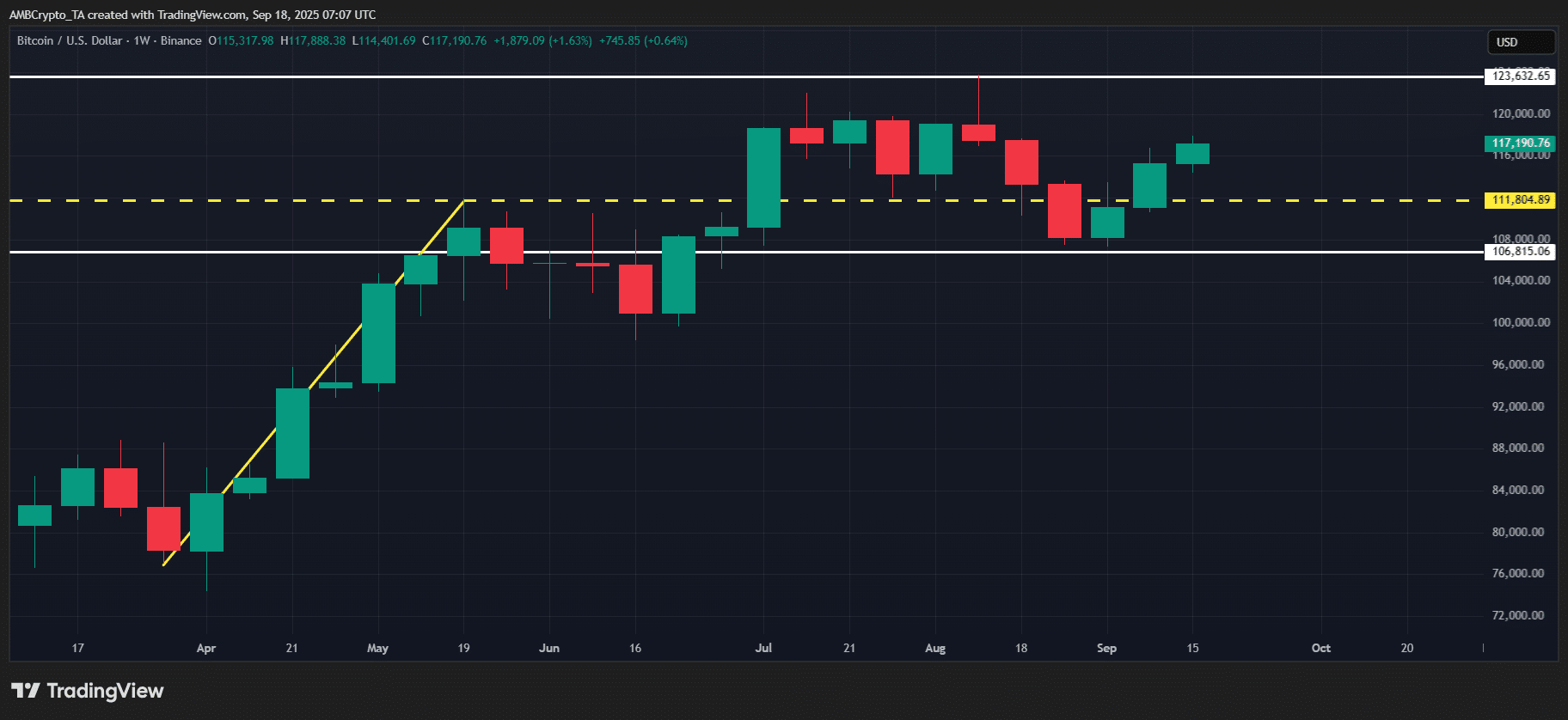
Technically, BTC has tagged higher highs the first two weeks of September, with the latest week (the 15th-22nd of September) closing at $117,250, potentially marking a third consecutive higher high. 

BitcoinBitcoin

Source: TradingView (BTC/USDT)

Historically, BTC has leveraged weekly setups like this to tag new ATHs.

Notably, the tape is showing similar signs again. With the broader market digesting Powell’s volatile signals, BTC holding $117k keeps flows measured. A long squeeze remains a real possibility, supported by steady OI.

Long-term positioning, however, remains firmly bullish. With the Fed dovish on rate cuts, macro flows and sentiment aligned, the stage is set for a potentially strong October grind toward new Bitcoin highs.

Share

Trending Cryptos

Related Reads

Jensen Huang: Prompts are Becoming Obsolete, Loops are the New Paradigm

Jensen Huang, alongside AI leaders like Peter Norvig, Boris Cherny, and Andrew Ng, is advocating for a shift from "prompt engineering" to "loop engineering" as the new paradigm for AI development. Instead of manually crafting individual prompts, the focus is now on designing autonomous loops—systems where AI agents execute tasks, self-validate results, and iterate until completion without constant human oversight. A loop is a management framework that enables agents to operate independently. Key implementations are seen in Claude Code (with features like /loop, /goal, and /schedule) and OpenAI Codex, which employ multiple agents working in parallel within isolated environments. A core principle is the separation of roles: one agent (or model) performs the task, while an independent agent (or a smaller, separate model) validates the output to ensure objectivity. The article outlines a practical roadmap for implementing loops, starting with a "four-condition test" to assess suitability, building a minimal viable loop, and emphasizing critical pitfalls to avoid, such as lacking hard stop conditions or allowing loops to handle tasks requiring human judgment. This evolution is framed as the fourth major shift in AI interaction: from Prompt Engineering (crafting instructions) to Context Engineering (providing background information), then to Harness Engineering (building tool-enabled environments), and finally to Loop Engineering (creating self-sustaining systems). This progression reflects a consistent trend of increasing abstraction, moving human involvement from direct instruction to system design and rule-setting. The concept has academic roots in frameworks like ReAct, which formalized the "reason-act-observe" cycle. While loop engineering promises greater automation, experts caution about managing token costs and warn against outsourcing understanding—AI can assist, but deep problem comprehension remains essential.

marsbit1h ago

Jensen Huang: Prompts are Becoming Obsolete, Loops are the New Paradigm

marsbit1h ago

Trading

Spot
Futures

Hot Articles

Discussions

Welcome to the HTX Community. Here, you can stay informed about the latest platform developments and gain access to professional market insights. Users' opinions on the price of S (S) are presented below.

活动图片