16.5亿美元融资落地,Multicoin、Jump、Galaxy联手建立史上最大规模的SOL财库

marsbitPublished on 2025-09-08Last updated on 2025-09-09

北京时间 9 月 8 日下午,纳斯达克上市公司 Forward Industries(NASDAQ: FORD)正式宣布,已获得总额 16.5 亿美元的现金与稳定币承诺,将通过一项 PIPE 交易(公开上市公司私募融资)启动以 SOL 为核心的数字资产财库战略。本次融资由 Galaxy Digital(NASDAQ:GLXY)、Jump Crypto 和 Multicoin Capital领投,该公司现有最大股东之一 C/M Capital Partners 参投。

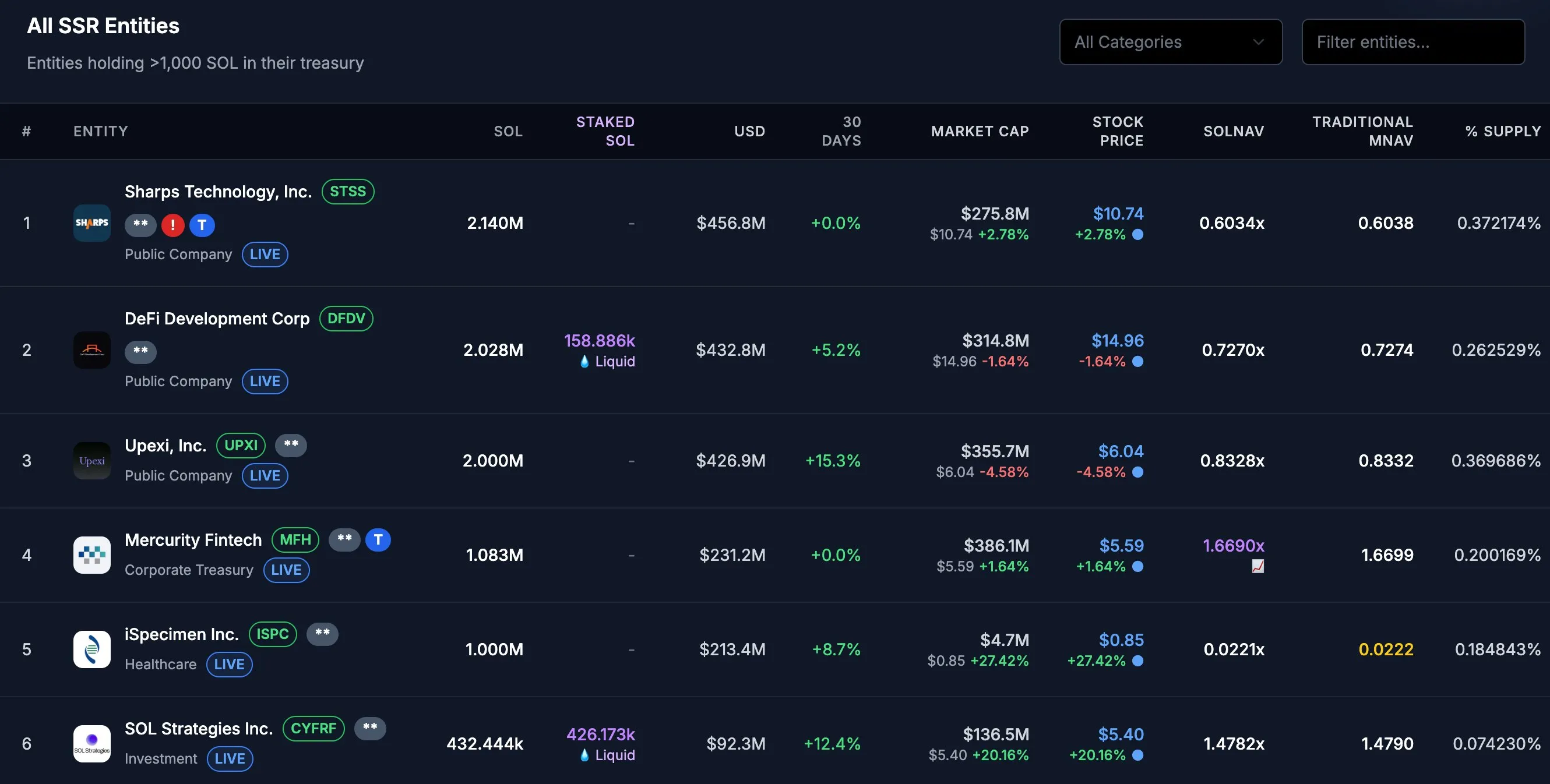
Strategic SOL Reserve 数据显示,目前 SOL 财库公司中,持仓规模最大的依次为 Sharps Technology(STSS)、DeFi Development Corp(DFDV)、Upexi(UPXI),分别持仓 214 万枚(4.57 亿美元)、203 万枚(4.33 亿美元)、200 万枚(4.27 亿美元)。以此计算,若Forward Industries 后续买入动作够快,其将凭借着 16.5 亿美元的筹码快速成为规模最大的 SOL 财库。
Galaxy Digital

Forward Industries 在融资公告中指出, Galaxy、Jump Crypto 与 Multicoin 将同时提供资金与战略支持,帮助 Forward Industries 设计并执行其 SOL 财库战略,目标是使其成为 SOL 生态系统中领先的上市机构参与者。Forward Industries 将借助这些资方的资源,力求在 Solana 生态内获取差异化的链上收益,并通过积极参与生态发展为股东创造长期价值。

作为本次融资的三大领投方, Galaxy、Jump Crypto 与 Multicoin 在 Solana 生态内都有着举足轻重的地位,甚至可被视作当下 Solana 话语权最强的几大机构。

  • Galaxy:当前为 Solana 生态最大的验证者之一,运行着成熟的机构级数字资产服务系统。Galaxy 未来将为 Forward Industries 提供交易、借贷、结构设计、质押及区块链基础设施等服务,同时也将利用其全套产品与风控系统积极管理 Forward Industries 的财库战略。
  • Jump Crypto:长期致力于建设和维护支撑 Solana 增长的核心基础设施。Jump Crypto 目前正在开发 Firedancer,这是 Solana 的新一代高性能客户端,旨在提升 Solana 网络的吞吐量、韧性与效率;与此同时,Jump Crypto 也是 DoubleZero 和 Shelby 等关键基础设施项目的核心工程与网络贡献者。
  • Multicoin:成立于 2017 年的业界顶级 VC,专注于长周期、高信念的投资。Multicoin 是 Solana 的早期种子投资者,曾领投了 Solana 在 2018 年上线前的前三轮融资,并在 Solana 生态系统内投资了超过 25 个项目。

本次融资完成后,Multicoin 联合创始人兼管理合伙人 Kyle Samani 预计将出任 Forward Industries 的董事会主席。考虑到 Kyle Samani 多年来一直在高频输出对行业发展的各种理论思考及叙事畅想,其本人在整个加密货币领域都具备着极强的个人魅力及号召力,预计后续会成为 Solana 生态中 Tom Lee(ETH 最大财库公司 BitMine 董事会主席)那般的话事人角色。

受此利好影响,SOL 的价格短线得到了有效提振,截至发文暂报 215.3 USDT,24 小时涨幅 5.87%。展望远期,随着 Forward Industries 正式开始买入储备,预计 SOL 的价格在一定时间也均会得到较强的买盘支撑。


Trending Cryptos

Related Reads

Same $5 Rate, Bill Differs by 30%, OpenAI Exec: Token Pricing Is Never Directly Comparable

Here is a summary of the article in English: **Title: Priced at $5, Bills Vary by 30%. OpenAI Executive: Token Prices Are Not Directly Comparable** A key takeaway from OpenAI's Codex lead, Tibo, is that a "token" is not a standardized unit for comparing AI model costs, akin to grams or kilowatt-hours. He uses an analogy: two identical pizzas priced per slice can yield different total costs depending on how they're cut. Similarly, different models use different "tokenizers" to segment text, meaning the same input text can produce vastly different token counts. For instance, the same text was tokenized as 766 tokens by GPT-5.6 Sol and 1170 tokens by Claude Opus 5—a 34.5% difference—despite both models advertising the same input price of $5 per million tokens. This discrepancy arises because each company trains its own tokenizer based on its training data, affecting how common or rare word combinations are split. The problem isn't cross-vendor only. Even Anthropic warns that its newer models (Claude 4.7+) use a different tokenizer, producing roughly 30% more tokens for the same text than earlier versions, so cost estimates shouldn't be reused across model generations. Bill differences stem from four main factors: 1) Tokenizer efficiency (input token count), 2) Caching (e.g., GPT-5.6 Sol offers a much lower cache input rate), 3) Output pricing (which can outweigh input savings in agent workflows), and 4) Context length pricing tiers (e.g., GPT-5.6 Sol charges double the input rate for entire requests exceeding 272K tokens). Tibo also addressed user reports of GPT-5.6 Sol's context window being limited in practice, sharing configuration code to manually expand it to 1 million tokens. However, he cautioned that larger windows increase the risk of hitting higher pricing tiers as longer session histories are processed repeatedly. The article concludes that the true metric should shift from "price per million tokens" to "price per successful outcome." The most accurate way to compare costs is to run identical real-world tasks (with the same prompts, tools, and data) through different models, accounting for all variables like tokenization, caching, output length, and context pricing. Ultimately, what matters is the total cost to complete a specific job, not the nominal token price.

marsbit4m ago

Same $5 Rate, Bill Differs by 30%, OpenAI Exec: Token Pricing Is Never Directly Comparable

marsbit4m ago

Are Big VC Funds Monopolizing the Seed Round, Leaving Small VCs with No Choice but to Give Up?

**Title: Are Big VCs Monopolizing Seed Rounds? Is Giving Up the Only Path for Small VCs?** In a frank and critical commentary, the author argues that the venture capital landscape has shifted dramatically: large, multi-stage funds are aggressively moving into seed-stage investing, leveraging their brand recognition, massive capital, and resources to dominate deals. They outcompete smaller, specialized funds for stakes in even the earliest startups, as founders increasingly prefer established names. The piece asserts that success in VC now hinges almost entirely on securing a position in the handful of globally transformative companies each year (e.g., OpenAI, Anthropic). For funds that miss these "winner-takes-most" opportunities, relevance fades. The author sarcastically suggests small fund managers should advise their portfolio companies to seek acquisition by such giants and then invest via SPVs, or abandon early-stage investing altogether to chase less ambiguous growth rounds. Further, the author claims the "best" founders—those from elite backgrounds—command premium valuations and align with top-tier funds, leaving little room for others. The relentless focus on AI is presented as another pressure point; not dedicating a fund entirely to AI is deemed a path to irrelevance, akin to missing prior cycles like SaaS or crypto. Ultimately, the letter delivers a cynical conclusion: with capital and power concentrating, true differentiation is nearly impossible. It suggests that for many small VCs, surrendering to this new reality—rather than evolving, competing, or trying something different—might be the most rational, if grim, course of action. The piece serves as a stark warning about capital concentration and the existential challenges facing smaller investment firms.

marsbit5m ago

Are Big VC Funds Monopolizing the Seed Round, Leaving Small VCs with No Choice but to Give Up?

marsbit5m ago

Bank of Russia: 12 Largest Banks to Connect Digital Ruble from September 1, 2026

The Central Bank of Russia (CBR) announced that all 12 of the country's systemically important banks will be ready to offer clients digital ruble accounts and transactions starting September 1, 2026. According to Alla Bakina, director of the CBR's national payment system department, these banks cover over 80% of the domestic payment market. The digital ruble is described as a new form of the existing currency, functioning as a cashless payment method but held directly in a user's wallet on the CBR platform. Nine other banks designated as significant payment market participants are also expected to provide access, with most aiming to complete integration by autumn 2026. Starting from the September launch date, major retail chains with annual revenue exceeding 120 million rubles will be required to accept digital ruble payments, though adoption for citizens remains voluntary. The rollout follows a delayed pilot phase, with mass implementation postponed from 2025. The CBR's model currently offers basic account functionality without interest accrual, unlike China's digital yuan, which began paying interest in early 2026. The announcement positions Russia among dozens of countries testing Central Bank Digital Currencies (CBDCs), though the digital ruble's potential role in cross-border settlements, particularly within BRICS, remains an open question for its future international relevance.

cryptonews.ru10m ago

Bank of Russia: 12 Largest Banks to Connect Digital Ruble from September 1, 2026

cryptonews.ru10m ago

Trading

Spot

Hot Articles

Discussions

Welcome to the HTX Community. Here, you can stay informed about the latest platform developments and gain access to professional market insights. Users' opinions on the price of SOL (SOL) are presented below.

活动图片