The Ripple Swell 2025 Agenda Is Out—These Are The Highlights

bitcoinistPubblicato 2025-09-05Pubblicato ultima volta 2025-09-05

Introduzione

Ripple has published the full program for its ninth annual Swell conference, confirming a two-day, invite-only gathering in New York...

Trusted Editorial content, reviewed by leading industry experts and seasoned editors. Ad Disclosure

Ripple has published the full program for its ninth annual Swell conference, confirming a two-day, invite-only gathering in New York City on November 4–5, bracketed by a welcome reception on Monday, November 3. Sessions run in Eastern Time and span tokenization, market structure, regulation, payments, custody, stablecoins, and security.

Ripple flagged the release on X, directing the community to the detailed agenda: “The Ripple Swell 2025 agenda is live! From stablecoins and payments to regulation and real-world adoption, Swell brings together the conversations shaping the future of finance. Don’t miss your chance to join us in NYC.”

Ripple Swell Day 1 Agenda

Swell opens Tuesday with President Monica Long’s “Opening Remarks”—“Welcome to Ripple Swell!”—framing the event as Ripple’s showcase for financial-utility crypto. That flows directly into a headline fireside chat with Nasdaq Chair and CEO Adena Friedman on “the potential of digital assets and blockchain across the financial industry.” The morning then pivots to market infrastructure, with BlackRock’s Maxwell Stein and Moody’s Rory Callagy examining “the transformative influence of tokenized assets on the landscape of capital markets,” before a coffee break.

The late morning drills into two areas now shaping both liquidity and access. First, a panel on “Stablecoins and Blockchain: Revolutionizing Cross-Border Payments,” featuring AMINA Bank Chief Product Officer Myles Harrison and Schuman Financial founder and CEO Martin Bruncko, focuses on cost, speed, and financial inclusion in cross-border flows. Next, Bitwise CEO Hunter Horsley, Canary Capital CEO Steven McClurg and Bitnomial founder & CEO Luke Hoersten track how “crypto ETFs and on-chain funds are popularizing access to digital assets.” Ripple follows with a product keynote demo centered on “stablecoin payments,” spotlighting where the firm wants customers to see near-term utility.

Tuesday afternoon turns to the institutional spine of the market. “Building Secure Foundations for the Digital Asset Economy” addresses custody frictions, legacy alignment and interoperability. A cross-border view on “International Regulatory Perspectives on Digital Assets” brings together European lawmaker Billy Kelleher, Argentina’s CNV Chair Roberto E. Silva and Ripple’s Matthew Osborne.

Market plumbing takes center stage in “Unlocking the Future of Prime Brokerage and Clearing with Ripple,” with Hidden Road’s Michael Higgins, XTX Markets’ Jeremy Smart, BNY’s Carolyn Weinberg, CME Group’s Giovanni Vicioso and Ripple’s Jack McDonald and Nigel Khakoo exploring re-wiring trade finance, remittance and FX rails. A separate session on how global banks are approaching tokenization and custody features Citi’s Ryan Rugg, Franklin Templeton’s Sandy Kaul and Fidelity’s Cynthia Lo Bessette. An afternoon keynote remains TBA, before the evening “Swellebration,” which folds in the Innovation Awards.

Day 2 Agenda

Day two begins with a yet-to-be-announced morning keynote and a panel on “Maturity in Digital Asset Adoption,” reflecting that institutions are at different points on the curve from pilots to scaled integration. The policy centerpiece arrives late morning: “US Regulatory Leadership in Crypto — Global Comparisons and 2025 Priorities,” introduced with the line that “The Trump Administration has opened new opportunities for the crypto industry,” and framed around what can be done via legislation, rulemaking, supervision, international coordination and public-private pilots. The agenda lists perspectives from Summer Mersinger (Blockchain Association), Ananya Kumar (Atlantic Council) and Ripple’s policy leadership.

Ripple also places consumer-oriented adoption on the stage. In “Meet the National Cryptocurrency Association,” Ripple CLO and NCA President Stuart Alderoty outlines how the new body aims to bridge “crypto curiosity and confidence,” joined by users including a real-estate investor and a caregiver to ground the discussion in real-world use.

A marquee fireside follows: José Andrés—chef, restaurateur and humanitarian—joins Ripple Executive Chairman and Co-Founder Chris Larsen to discuss innovation in disaster relief and “delivering impact at scale.” The afternoon security block—“Decentralized Defense: Combatting Crypto Crime”—brings Elliptic CEO Simone Maini, Coinbase CISO Jeff Lunglhofer and Duke finance professor Campbell Harvey onstage.

Stablecoins recur throughout the program, culminating with “Driving Global Growth and Trust with RLUSD,” in which leading exchanges discuss integrating Ripple’s dollar-pegged token and balancing regional growth with user trust. Brad Garlinghouse delivers the event’s final substantive keynote—a fireside chat on “what’s ahead for Ripple, key crypto trends for 2026 and why he’s doubling down on crypto infrastructure for financial utility”—before the closing remarks.

At press time, XRP traded at $2.84.
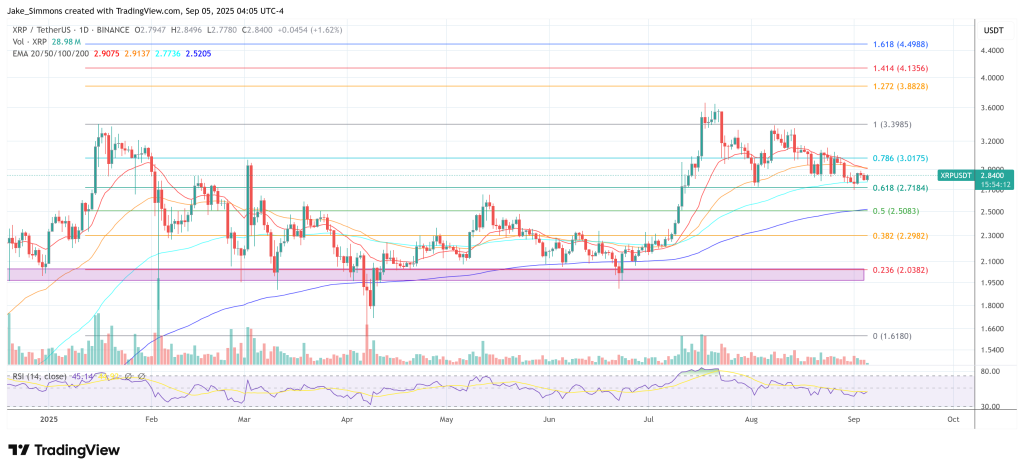
XRP price
XRP price, 1-day chart | Source: XRPUSDT on TradingView.com
Featured image created with DALL.E, chart from TradingView.com
Editorial Process for bitcoinist is centered on delivering thoroughly researched, accurate, and unbiased content. We uphold strict sourcing standards, and each page undergoes diligent review by our team of top technology experts and seasoned editors. This process ensures the integrity, relevance, and value of our content for our readers.

Jake Simmons has been a Bitcoin enthusiast since 2016. Ever since he heard about Bitcoin, he has been studying the topic every day and trying to share his knowledge with others. His goal is to contribute to Bitcoin's financial revolution, which will replace the fiat money system. Besides BTC and crypto, Jake studied Business Informatics at a university. After graduation in 2017, he has been working in the blockchain and crypto sector. You can follow Jake on Twitter at @realJakeSimmons.

Crypto di tendenza

Letture associate

Ethereum Q1 2026 Report: Fees Decline, Users and Transaction Volume Hit New Highs

Ethereum Q1 2026 Report: Fees Down, Users & Transactions Hit New Highs Token Terminal's Q1 2026 report on Ethereum presents a pivotal development: the network achieved record highs in monthly active users (13.2M, +85.9% YoY), total transactions (200.4M, +81.5% YoY), and throughput (25.78 TPS), while transaction fees on the mainnet plummeted by 47.9% quarter-over-quarter. This shift is attributed to the network's strategic move into a "low fees for scale" phase, exemplified by the Fusaka upgrade which increased data capacity and lowered block space costs, releasing pent-up demand (a manifestation of Jevons's Paradox). The report highlights a core narrative shift for Ethereum: from a DeFi-centric blockchain to a global financial settlement layer. It maintains a dominant position in tokenized assets, holding majority market shares among top chains in stablecoins (61.8%), tokenized funds (73.0%), and tokenized commodities (84.0%). Growth in tokenized funds (+73.1% YoY) and commodities (+325.9% YoY) was particularly strong, driven by institutions like BlackRock and JPMorgan entering the space. Contrasting these usage gains, several USD-denominated value metrics declined in Q1: fully diluted market cap fell 30.3% QoQ, total value locked (TVL) dropped 11.0%, and ecosystem transaction volume decreased 24.0%. The report interprets this as Ethereum prioritizing long-term network expansion and cementing its role as the default settlement layer for finance over short-term fee capture. The commentary from Etherealize argues that, much like the early internet, Ethereum's open, permissionless model is poised to win over closed alternatives as institutional tokenization accelerates.

marsbit43 min fa

Ethereum Q1 2026 Report: Fees Decline, Users and Transaction Volume Hit New Highs

marsbit43 min fa

He Just Raised 2.7 Billion, and Li Fei-Fei Also Invested

Pete Florence, a former senior research scientist at Google DeepMind and a key contributor to the Vision-Language-Action (VLA) model architecture, is deliberately distancing his startup, Generalist AI, from the trendy "world model" label. He argues that the industry should prioritize concrete goals over buzzwords. His goal is to create robots that can perform a vast range of unseen tasks with high speed and success rates, without needing task-specific training data. Recently, his company raised $400 million (¥2.7 billion) at a $2 billion valuation. Notable investors include NVIDIA's NVentures, Bezos Expeditions, NFDG, as well as Xiaomi co-founder Lin Bin, Zoom founder Eric Yuan, and renowned AI scientist Fei-Fei Li. Florence's approach stems from his academic background at MIT under Professor Russ Tedrake, focusing on understanding the physical world. After joining DeepMind, he developed models like Transporter Network and co-created the VLA framework. He left in 2025 to found Generalist AI. The company has launched two models: GEN-0, which demonstrated that scaling laws apply to physical motion, and GEN-1. GEN-1 was trained on over 500,000 hours of physical interaction data collected via a specialized wearable device. It achieves a 99% success rate on precise mechanical tasks like folding boxes and maintains performance three times faster than its predecessor. Florence believes GEN-1 is reaching a commercial utility threshold similar to the GPT-3 inflection point. The substantial funding round, following GEN-1's release, signifies strong investor confidence in Generalist AI's practical, goal-driven path to creating versatile, useful robots, regardless of the "world model" terminology.

marsbit50 min fa

He Just Raised 2.7 Billion, and Li Fei-Fei Also Invested

marsbit50 min fa

Two Legends Lost in Three Days: Is Google's AI Talent Dam Cracking?

In three days, Google lost two AI legends. On June 18, Noam Shazeer, co-author of the seminal "Attention is All You Need" paper and Gemini co-lead, left for OpenAI. Just 48 hours later, John Jumper, 2024 Nobel laureate and AlphaFold lead, departed DeepMind for Anthropic. This follows Andrej Karpathy joining Anthropic in May. These moves highlight a structural trend: top AI talent is concentrating at mission-driven, pre-IPO firms like OpenAI and Anthropic, while Google becomes a primary source. The exodus stems from a core mission mismatch. Google's ad-centric model often subordinates AI research to product and revenue goals, creating friction for pioneers like Shazeer, who returned in 2024 only to leave again. In contrast, OpenAI and Anthropic offer singular focus on pushing AI boundaries, whether towards AGI or safety-aligned models, which deeply appeals to top researchers like Jumper. Financial incentives amplify the pull. With both OpenAI and Anthropic nearing IPO, employees stand to gain immensely from equity, an upside Google's mature stock cannot match. Furthermore, the 2023 merger of Google Brain and DeepMind, intended to consolidate strength, has instead created cultural tension and slowed the path from research to product, as evidenced by Gemini's pace. This talent redistribution is reshaping the AI landscape. While Google retains vast data and compute resources, its true crisis is the quiet, continuous loss of the people who define the field's future. The real moat in AI is not infrastructure, but the concentration of brilliant minds—a battle Google is currently losing.

marsbit2 h fa

Two Legends Lost in Three Days: Is Google's AI Talent Dam Cracking?

marsbit2 h fa

Behind the AI Report Card, Lies a Chinese 'Exam Setter'

Beyond the familiar performance charts like MMLU-Pro and MMMU, which major AI models strive to ace, stands a key "examiner": Chinese-Canadian researcher Wenhu Chen. An assistant professor at the University of Waterloo and founder of TIGERLab, Chen addresses the crucial need for more rigorous AI evaluation. As models like GPT-4 began scoring near-perfect results on older benchmarks like MMLU, it became difficult to distinguish their true capabilities. In response, Chen introduced MMLU-Pro in 2024, featuring harder, more reasoning-focused questions with more answer choices, successfully reintroducing meaningful performance gaps. His work extends to multi-modal evaluation with MMMU and its enhanced version, MMMU-Pro. These benchmarks test a model's ability to understand and reason with complex information from images, charts, and text across diverse academic subjects, exposing the significant challenges even top models face in genuine comprehension. Chen's background in complex QA, table reasoning, and his experience at Google DeepMind on projects like Gemini inform his approach. He understands that effective benchmarks must anticipate how models might "cheat" by memorizing data or avoiding visual analysis. His lab also actively researches video understanding and generation models (e.g., UniVideo, Vamba), ensuring his evaluation work is grounded in practical model-building challenges. Now at Meta's Super Intelligence Lab, Chen continues his focus on multi-modal data and evaluation, representing the deep yet often unseen contributions of Chinese talent in shaping the fundamental tools of the AI industry.

marsbit3 h fa

Behind the AI Report Card, Lies a Chinese 'Exam Setter'

marsbit3 h fa

Trading

Spot
Futures

Articoli Popolari

Come comprare SWELL

Benvenuto in HTX.com! Abbiamo reso l'acquisto di Swell Network (SWELL) semplice e conveniente. Segui la nostra guida passo passo per intraprendere il tuo viaggio nel mondo delle criptovalute.Step 1: Crea il tuo Account HTXUsa la tua email o numero di telefono per registrarti il tuo account gratuito su HTX. Vivi un'esperienza facile e sblocca tutte le funzionalità,Crea il mio accountStep 2: Vai in Acquista crypto e seleziona il tuo metodo di pagamentoCarta di credito/debito: utilizza la tua Visa o Mastercard per acquistare immediatamente Swell NetworkSWELL.Bilancio: Usa i fondi dal bilancio del tuo account HTX per fare trading senza problemi.Terze parti: abbiamo aggiunto metodi di pagamento molto utilizzati come Google Pay e Apple Pay per maggiore comodità.P2P: Fai trading direttamente con altri utenti HTX.Over-the-Counter (OTC): Offriamo servizi su misura e tassi di cambio competitivi per i trader.Step 3: Conserva Swell Network (SWELL)Dopo aver acquistato Swell Network (SWELL), conserva nel tuo account HTX. In alternativa, puoi inviare tramite trasferimento blockchain o scambiare per altre criptovalute.Step 4: Scambia Swell Network (SWELL)Scambia facilmente Swell Network (SWELL) nel mercato spot di HTX. Accedi al tuo account, seleziona la tua coppia di trading, esegui le tue operazioni e monitora in tempo reale. Offriamo un'esperienza user-friendly sia per chi ha appena iniziato che per i trader più esperti.

91 Totale visualizzazioniPubblicato il 2024.12.10Aggiornato il 2026.06.02

Come comprare SWELL

Discussioni

Benvenuto nella Community HTX. Qui puoi rimanere informato sugli ultimi sviluppi della piattaforma e accedere ad approfondimenti esperti sul mercato. Le opinioni degli utenti sul prezzo di SWELL SWELL sono presentate come di seguito.

活动图片