Sparkvia AI Gains Momentum as Creators Embrace On-Chain Content Tools

bitcoinistPublished on 2025-09-04Last updated on 2025-09-04

Abstract

A new AI-powered platform is making waves in the Ripple community, showing how blockchain infrastructure and artificial intelligence can pair...

Trusted Editorial content, reviewed by leading industry experts and seasoned editors. Ad Disclosure

A new AI-powered platform is making waves in the Ripple community, showing how blockchain infrastructure and artificial intelligence can pair to solve every day creative challenges.

Sparkvia AI is an AI-driven writing platform built on the XRP Ledger. It offers fast, transparent, pay-as-you-go access to advanced content creation tools using on-chain credits.

Launched just days ago, Sparkvia AI has already drawn more than 500 users who are putting its tools to work across blogs, websites, and social campaigns.
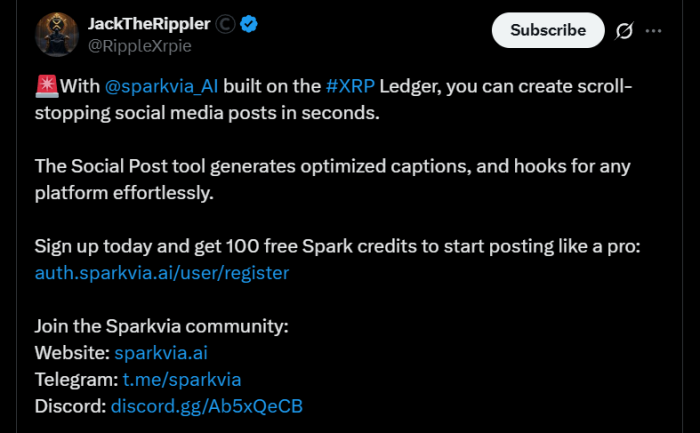
Jack the Rippler's Sparkvia AI post on X.
Popular crypto analyst JackTheRippler recently spoke about this project in a tweet.

The appeal is simple: it combines the XRP Ledger’s speed and transparency with automated writing workflows that feel familiar but move much faster.

From Brief to Publishable Content in Minutes

At the heart of Sparkvia AI is a suite of focused writing applications:

  • AI Writer – Generates full drafts from a short input brief.
  • Creative Home Page – Input six fields (brand, offer, audience, tone, style, language) and generate a home page with conversion-ready site copy.
  • Advanced Blog Post Writer – Builds structured long-form content with headlines, outlines, and SEO-tuned paragraphs.
  • Grammar & Style Editor – Refines tone, clarity, and readability.
  • All-in-One Social Post Tool – Creates platform-specific captions and hashtags in seconds.

The design is geared toward eliminating bottlenecks between an idea and a polished draft.

That’s something that resonates strongly with independent creators and digital marketing teams with packed schedules and tight deadlines.

Pay-As-You-Go Model, On-Chain

Unlike many AI platforms that lock users into subscriptions, Sparkvia AI uses an on-demand credit model settled directly on XRPL.

Thanks to the ledger’s fast settlement and minimal fees, you can also top up credits instantly and cheaply. Each purchase is recorded on-chain, creating a transparent and auditable billing trail.
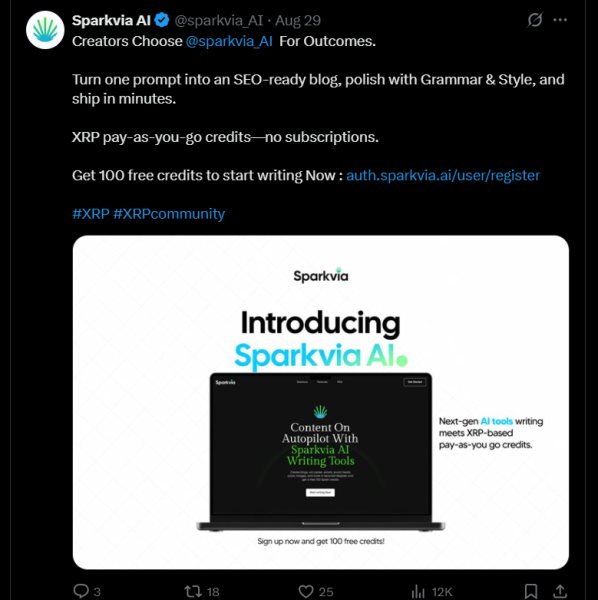
Sparkvia's credit system, explained in a recent tweet.

For solo creators and agencies alike, this offers a clear link between spend and output — a feature that could prove critical for campaign budgeting and ROI tracking.

And by bringing everything on-chain, Sparkvia AI also provides an innovative use case for both $XRP and the ledger. It’s next-gen AI with blockchain applications.

Momentum around Sparkvia has been amplified on X, where early adopters are sharing live demos and end results. The formula is consistent: show the input, generate the content, tweak and publish.

Unlike ChatGPT and other off-blockchain solutions, Sparkvia also doesn’t require endless prompting trial and error.
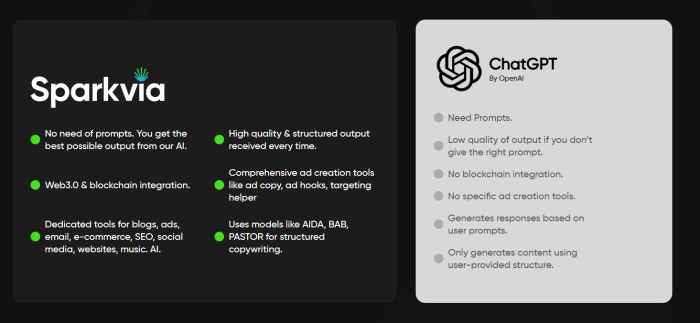
Sparkkvia AI vs GPT comparison.

LLMs might be alright for a broad range of applications. But Sparkvia’s AI is specifically tailored to create natural-sounding, impactful, and conversion-optimized copy.

Visit Sparkvia’s official website to learn more.

Why This Matters for XRP

For the XRP ecosystem, Sparkvia AI represents a tangible use case where blockchain infrastructure meets practical utility.

Rather than focusing on speculative hype, the app positions $XRP as the backbone of a transparent, creator-first payment model.

Writers and marketers gain a single workspace, native to the blockchain, to ideate, draft, and refine content, while $XRP ensures predictable, low-friction settlement.

If adoption continues, Sparkvia could become a reference point for XRP-based applications that compete on usability and function rather than novelty.

A Signal of Maturing Markets

In a crypto market often crowded with untested experiments, Sparkvia’s traction suggests durability.

Its value is straightforward: shorten the distance between an idea and a finished paragraph, while keeping costs visible and accountable.

To learn more about Sparkvia AI, follow its Telegram, Discord, and X.

As always, do your own research — this isn’t financial advice.

Authored by Bogdan Patru, Bitcoinist — https://bitcoinist.com/sparkvia-ai-momentum-creators-adopt-on-chain-tools/

Editorial Process for bitcoinist is centered on delivering thoroughly researched, accurate, and unbiased content. We uphold strict sourcing standards, and each page undergoes diligent review by our team of top technology experts and seasoned editors. This process ensures the integrity, relevance, and value of our content for our readers.

As a crypto writer, Bogdan’s responsibilities are split between researching and writing articles and entertaining the team with his humor bordering on the politically incorrect, an aspiring Bill Burr, if you will. Thanks to his 12+ years of writing experience in just as many fields, including tech, cybersecurity, modelling, fitness, crypto, and other topics-that-shall-not-be-named, he's become a genuine asset to the team. While his position as a senior writer at PrivacyAffairs thought him valuable lessons about the power of self-management, his entire writing career was and is an exercise in self-improvement. Now, he's ready to sink his teeth into crypto and teach people how to take control of their own money on the blockchain. With fiat as an eternally devaluing currency, Bitcoin and altcoins seem like the best-fitting alternative for Bogdan. Bogdan’s biggest professional accomplishment, aside from securing a position as a main writer for Bitcoinist, was his 5-year run as a writing manager at Blackwood Productions, where he coordinated a team of four writers. During that time, he learned the value of teamwork and that of creating a working environment that breeds efficiency, positivity, and friendship.

Trending Cryptos

Related Reads

Apple and the Power Rebalancing with 'The Microns': Dissecting the Profit Ledger Behind the iPhone

The article analyzes the shifting profit dynamics and power balance between Apple and memory suppliers like Micron within the iPhone supply chain. It highlights a social media post criticizing Apple for raising iPhone prices while blaming memory chip cost increases, despite historically paying suppliers like Micron very little. An estimated iPhone 18 cost breakdown is referenced. Historically, memory was a minor cost component. In 2017's iPhone X, memory accounted for only about 1.6-2.3% of the price, with Apple capturing nearly 50% net profit. Over time, memory's share of the Bill-of-Materials (BOM) cost has grown significantly, reaching an estimated 12-15% for the iPhone 17 series. The core driver of this change is soaring demand for memory from the AI industry, particularly for High Bandwidth Memory (HBM) and AI servers, which is diverting production capacity and squeezing supply for consumer electronics. Memory manufacturers, after enduring periods of low profits, now hold greater pricing power. This is reflected in their recent strong financials, like Micron's 84.6% gross margin. Apple CEO Tim Cook initially described the memory price pressure as unprecedented in his 40-year career, later calling it a "once-in-a-century flood," before Apple announced price hikes across several product lines, causing a significant stock drop. Elon Musk echoed Cook's sentiment about the dramatic cost surge. The article concludes that the era of memory suppliers being at the mercy of Apple's pricing power has temporarily reversed, thanks to AI-driven demand. It notes Apple is reportedly seeking to diversify its supply chain, including exploring chips from China's CXMT.

Odaily星球日报1h ago

Apple and the Power Rebalancing with 'The Microns': Dissecting the Profit Ledger Behind the iPhone

Odaily星球日报1h ago

Conversation with the Founder of 42 Macro: The Fed's 'Boiling the Frog Slowly' and the K-Shaped Economy

In a conversation with Anthony Pompliano, Darius Dale, founder of 42 Macro, discusses the Federal Reserve's monetary policy and the K-shaped U.S. economy. Dale characterizes new Fed Chair Kevin Warsh as a "dove in hawk's clothing," expecting the Fed to signal or enact policy tightening in the coming quarters to create room for later easing. He argues current economic signals, including high deficit spending, debt monetization, and credit growth, strongly indicate inflation is not on a credible path back to 2%, forcing the Fed to act. The discussion highlights the stark "K-shaped" economic reality. While top earners, buoyed by massive cash savings (up ~$8 trillion since pre-pandemic), continue robust spending, those at the bottom face severe financial strain, with delinquency rates on consumer loans reaching crisis-era highs. Dale attributes much of the current social and political anxiety to this divergence, driven by the "Cantillon effects" of monetary expansion, which disproportionately benefits asset owners. He emphasizes that in this environment of "financial repression," individuals must participate in asset markets to avoid being left behind. On equities, Dale notes a rotation from the "Magnificent Seven" tech giants into broader AI-exposed companies, while warning that the tech giants' massive capital expenditure cycles could eventually puncture over-optimistic cash flow projections. Dale concludes by stressing that the core desire across all economic strata is simply the dignity to provide for one's family, a goal currently undermined by systemic policies that act as a "wealth siphon" from the bottom to the top.

marsbit1h ago

Conversation with the Founder of 42 Macro: The Fed's 'Boiling the Frog Slowly' and the K-Shaped Economy

marsbit1h ago

The Domestic Answer to Space Computing Power: Photonics Are More Efficient, Musk and Huang's Approaches Are Too Roundabout

The Space Computing Race: A Photonic Advantage The competition for space-based computing has intensified, with figures like Elon Musk and NVIDIA's Jensen Huang highlighting its potential. Musk predicts solar-powered AI satellites could offer the most cost-effective computing by 2032. However, space presents extreme challenges for traditional electronic chips: radiation from cosmic particles can cause errors, the vacuum environment hinders heat dissipation, and limited solar power constrains energy-hungry systems. Photonic computing, using light instead of electrons, offers a promising solution. Its core advantages for space are threefold: 1) **Radiation Resistance**: Photons are charge-neutral, making them inherently immune to particle interference. 2) **Low Heat Generation**: Light propagation in waveguides generates minimal heat, bypassing critical thermal management issues. 3) **Low Power Consumption**: Photonic chips have near-zero static power draw, aligning perfectly with the energy constraints of satellites. Furthermore, for a given payload weight and volume, photonic systems can potentially deliver higher total compute density. Since they require less bulky cooling and power infrastructure, more space can be allocated to the compute units themselves. While photonic computing holds great promise, current industry approaches face hurdles like the memory-compute bottleneck (separate storage and processing) and challenges in large-scale integration. Engineering for space—withstanding launch vibrations and validating full system operation in orbit—remains a critical step. The path forward resembles the evolution from single GPUs to computing clusters, but via a photonic route. As electronic chips approach physical limits in miniaturization, photonic computing and optical interconnects (光算光联) may provide a key alternative to bypass these constraints and define the next generation of space-based computing capabilities.

marsbit2h ago

The Domestic Answer to Space Computing Power: Photonics Are More Efficient, Musk and Huang's Approaches Are Too Roundabout

marsbit2h ago

Trading

Spot

Hot Articles

Discussions

Welcome to the HTX Community. Here, you can stay informed about the latest platform developments and gain access to professional market insights. Users' opinions on the price of AI (AI) are presented below.

活动图片