The race for space computing power has turned into a real arms race.
Musk estimates that by 2032, solar-powered space AI satellites will become the world's most cost-effective computing power solution.
NVIDIA CEO Jensen Huang's statement in March this year, in a way, defined the nature of this race — intelligence must exist wherever data is generated.
After these two giants made their moves, the battlefield of space computing power has been pushed to an unprecedented height, but the engineering challenges facing space computing are still far more brutal than those on the ground.
Without air convection, chips can't dissipate heat; the universe contains high-energy particles that can cause chip errors at any time......
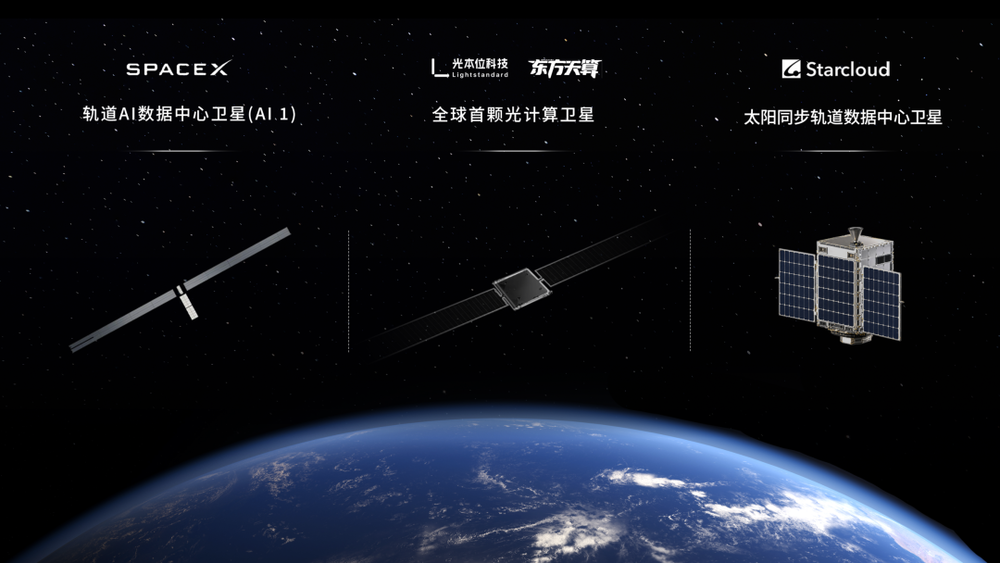
△Domestic and Foreign Computing Satellites (AI-assisted generation)
On the other side, Musk has also been revealed to have new developments — his company SpaceX is considering acquiring the optical module company Mesh.
The main business of Mesh, which caught Musk's eye, is the mass production of optical transceivers to improve the communication efficiency of AI data centers, thereby enhancing quality and efficiency.
Why Optical Computing is Naturally Suited for Space
In the space computing power race, chips face much harsher challenges than on the ground. Computing payloads must overcome three hurdles — radiation, heat dissipation, and power consumption.
Traditional electronic chips rely on charge storage and silicon-based transistors to operate, while space is filled with a large number of cosmic high-energy particles.
Once high-energy particles strike a chip, they can cause single-event upsets, single-event latch-ups, and other effects, leading to calculation errors or even device failure.
Optical computing chips fundamentally bypass this hurdle.
Optical computing uses photons as carriers for computational information. Photons themselves carry no charge, making them inherently immune to direct interference from high-energy particle impacts and eliminating the need for special radiation shielding designs.
Heat dissipation is the second hurdle, and arguably the trickiest one.
When traditional electronic chips operate, electron transport through wires and transistor switching inevitably generate heat. AI tasks place immense demands on data movement and computation, keeping the power consumption and heat generation of electronic chips high.
Space is a vacuum environment with no air convection, leaving only heat conduction and thermal radiation as heat dissipation pathways.
These stringent thermal constraints can easily lead to traditional chips throttling performance or even failing.
Optical computing chips operate in a fundamentally different way. Light propagates through waveguides to perform calculations, a process that generates almost no heat.
The third hurdle is power consumption.
Satellites in orbit rely heavily on solar panels for power. During orbital shadow periods, they depend solely on onboard batteries, making energy supply extremely limited.
The greater the energy consumption of high-performance computing chips, the larger the required solar panel area, which in turn increases satellite weight, volume, and launch costs.
The static power consumption of optical computing chips theoretically approaches zero, making them a natural fit for the stringent energy constraints of satellites, thus bypassing half of this hurdle.
The three characteristics of optical computing — radiation resistance, low heat generation, and low power consumption — are "killer features" in the space environment that help space computing directly leap over the technological obstacles of its initial stages.
After crossing these three hurdles, optical computing possesses another system-level advantage in space scenarios that is difficult for electronic computing to match —
Under the same payload weight, optical computing can deliver a higher total computing power.
The core constraint of moving ground-based data centers into space is the weight and volume of the payload.
The entire architecture of traditional servers is designed for terrestrial forms. Sending computing power into space — computing chips, storage, CPUs, along with the supporting cooling systems, radiation shielding layers... each component occupies precious payload space, leaving little room for actual computation.
NVIDIA's proposed solution is to integrate the CPU and GPU, achieving relatively impressive computing power within an extremely small size and weight. The Space-1 Vera Rubin module is a continuation of this approach.
But optical computing can go even further.
Because optical computing chips inherently generate low heat and consume little power, the required supporting cooling structures and power systems can be made lighter and smaller. Within a payload of equal weight, optical computing can accommodate more computing power.
Therefore, under the same energy supply and thermal conditions, optical computing achieves a higher total computing power than electronic computing.
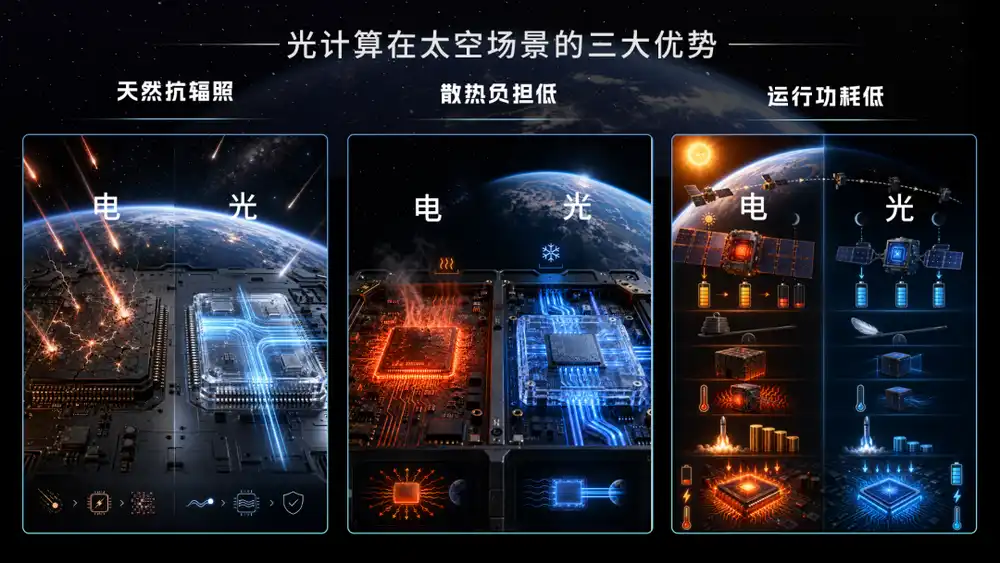
△Three Major Advantages of Optical Computing in Space Scenarios (AI-assisted generation)
According to Pu Huanan, Deputy Dean of the Photonics-Centric Science and Technology Research Institute, there is profound intrinsic motivation behind this advantage.
The performance progress of electronic computing chips has long relied on process node scaling — integrating more transistors in the same area to increase computational density through finer interconnects.
However, this path has a physical limit. When the gate spacing of transistors shrinks to a certain extent, the quantum tunneling effect inevitably emerges.
Electrons can tunnel through theoretically insurmountable potential barriers, causing leakage current and computational errors. This is an inherent physical ceiling that electronic computing cannot bypass.
Optical computing follows a completely different path.
The fabrication of optical computing chips does not rely on the advanced process system dominated by extreme ultraviolet (EUV) lithography machines. Existing 45nm and above, even sub-micron, processes can meet the fabrication needs of optical computing chips.
The improvement of optical computing power relies on scaling up the optical computing architecture and fully utilizing the multiple multiplexing dimensions inherent to photons themselves, such as wavelength, polarization, and optical modes.
On this path, the heat generation and power consumption of optical computing remain stable, costs can be effectively controlled, and the ceiling for computing power is far from being reached.
Photonics Breakthrough: From Ground to On-Orbit Inference
Photons are the core carriers of optical computing.
The fundamental idea of optical computing is to use photons instead of electrons to perform the most crucial part of AI inference computation — the vast number of matrix operations.
The advantage of optical computing chips is that a single light propagation can simultaneously complete a large batch of such multiplication operations, extremely fast, and generating almost no heat.
However, looking across the industry, most optical computing solutions still have a gap compared to electronic computing in terms of being truly scalable, general-purpose, and stably deployable.
Two of the most prominent issues are:
First, the separation of memory and computing persists. During AI inference, model parameters frequently need to be moved from external memory to the computing unit, making memory bandwidth the bottleneck of the entire system;
Second, challenges in scaling and integration. Limited by the physical constraints of silicon photonics platforms regarding chip size, warpage, and interconnect density, traditional optical computing solutions face difficulties in scaling computing power.
These two thresholds mean optical computing still has some distance to go to match the mature and comprehensive computing ecosystem of electronic chips.
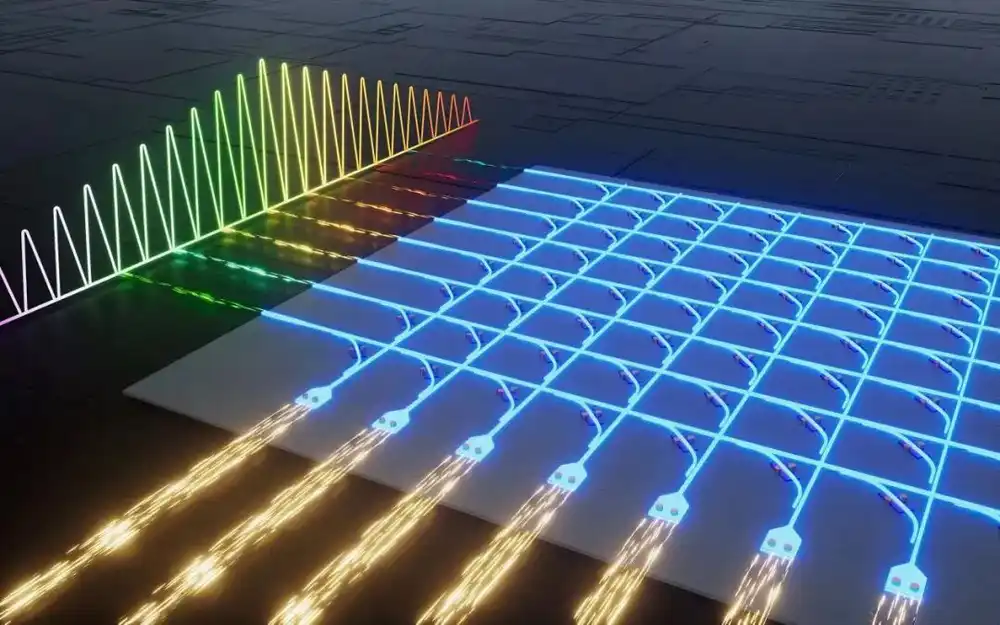
△Photonics-Centric Technology's Photonic In-Memory Computing Architecture
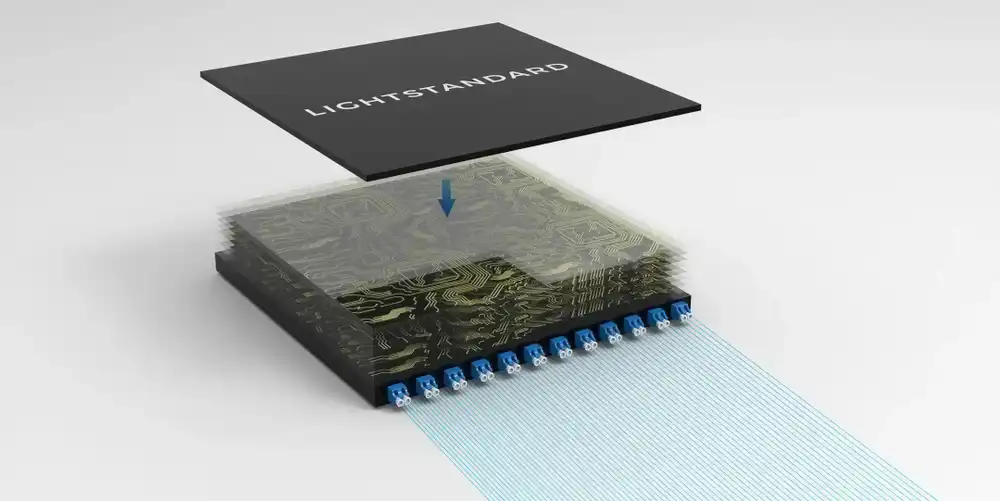
△Photonics-Centric Technology's Multi-Layer Packaged Glass-Based Optical Computing System
But from the ground to space, Pu Huanan believes that "optical computing needs to cross another hurdle of engineering."
The vibration during the rocket launch phase is extremely intense. Compared to pure electronic chips, optical structures introduce more packaging components, posing an additional test for the structural stability of chips under high-intensity vibration.
Once in orbit, the optical computing system needs to undergo system-level validation for power, thermal control, and communication in the real space environment.
Optical Computing & Optical Interconnects: The Next Trump Card for Space Computing Power
This path is similar in logic to NVIDIA's evolution from a single GPU to cluster-level solutions, but the underlying technological routes are fundamentally different.
Looking at the entire space-based computing industry, current development is still in an extremely early stage, with a considerable distance to go before large-scale commercial deployment.
Technology validation, system integration, and scale deployment — each link still has numerous engineering challenges to overcome.
Limited power resources on satellite platforms, iteration cycles for space chips, and low-cost large-scale orbit insertion are all thresholds that must be crossed for space-based computing to move from experimentation to commercialization.
Only when the comprehensive cost of space-based computing is lower than ground-based computing, or when space-based scenarios can provide high-value services irreplaceable by ground-based ones, will there be a real driving force for widespread commercialization.
The race for space computing power has just begun. The technological path chosen for computing chips and systems will determine the capability ceiling of future computing constellations.
As electronic computing gradually hits its ceiling facing process limits, optical computing and optical interconnects might be the crucial card in this race to bypass physical constraints and carve out a differentiated path.
This article is from WeChat Official Account: Quantum Bit , Author: Following Frontier Technology, Original Title: "The Domestic Answer to Space Computing Power: Photonics Are More Efficient! Musk and Huang's Approaches Are Too Roundabout"