Animoca и Antler объединяются для вывода аниме и манги на блокчейн

cryptonews.ruPublished on 2025-08-27Last updated on 2025-08-27

Компания Animoca Brands совместно с Ibex Japan, принадлежащей Antler, запускает специализированный инвестиционный фонд Web3 для индустрии развлечений. Фонд нацелен на вывод японской интеллектуальной собственности, связанной с аниме и мангой, на блокчейн.

Это партнерство открывает новые возможности для монетизации японской интеллектуальной собственности и ее глобального распространения через технологии распределенного реестра.

Объявление было сделано во вторник на конференции WebX в Токио, сообщила Animoca Brands в своем сообщении на платформе X.

Согласно сообщению японского криптоиздания CoinPost, соучредитель и председатель Animoca Ят Сиу, старший советник Кейван Пеймани и партнер Ibex Japan Сандип Каси рассказали о проекте во время конференции.

В отчете Каси отметил, что «от 90% до 99% японской интеллектуальной собственности простаивает на полках магазинов и представляет большую ценность». Он добавил, что глобальный охват Antler, включающий 22 города, активы под управлением на сумму $1,2 млрд и сеть из 250 000 предпринимателей, позволяет компании выйти на международный уровень.
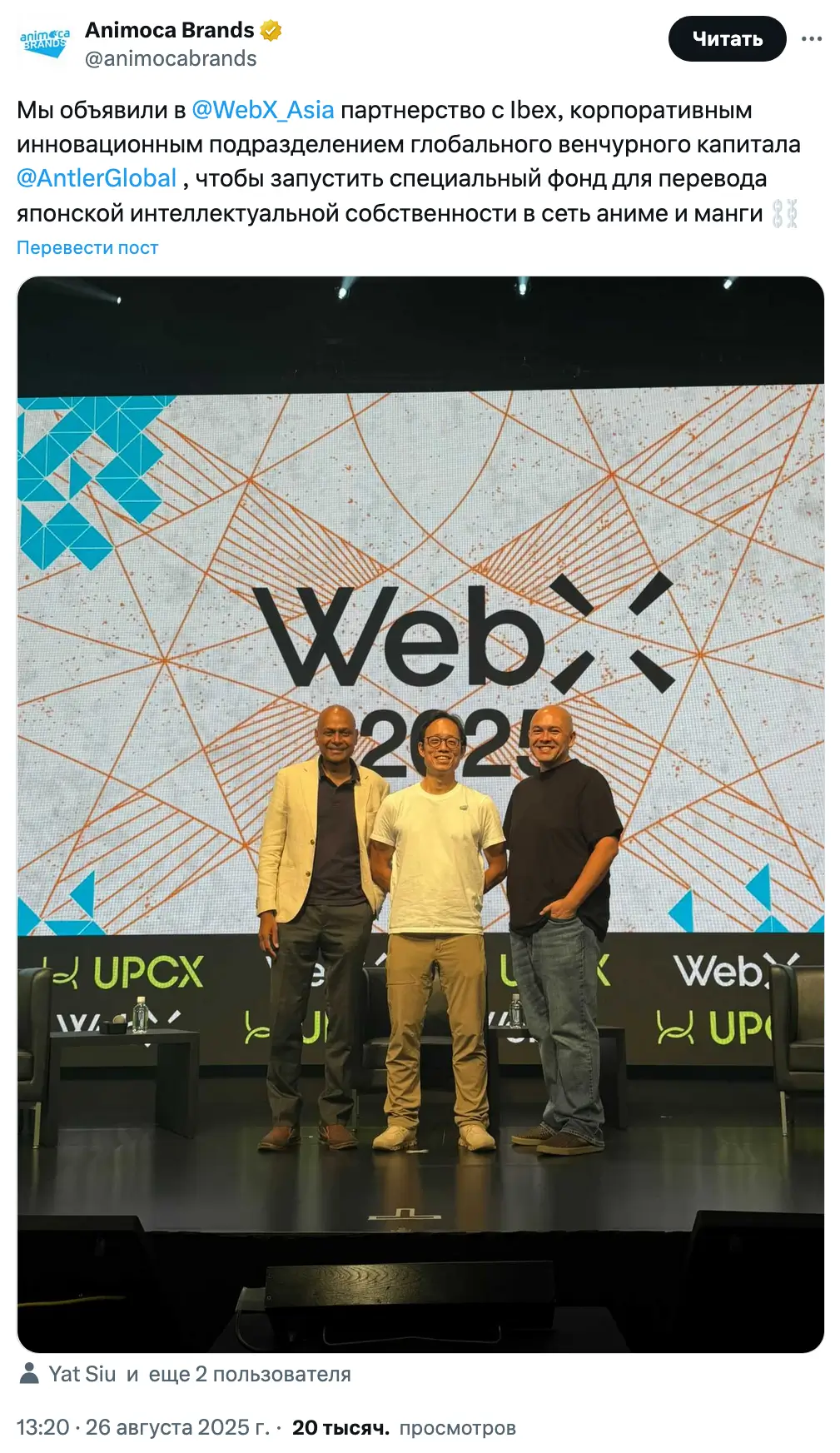

Источник: Animoca Brands.

Развитие японской интеллектуальной собственности выходит за рамки игровой индустрии

Сиу заявил, что Animoca уже присутствует в Японии через свою японскую дочернюю компанию ABKK.

«Это партнерство направлено на расширение японской интеллектуальной собственности на глобальном уровне», — добавил он, отметив, что усилия выходят за рамки игровой индустрии и будут также направлены на финтех, здравоохранение и медицинские технологии.

Каси и Пеймани выступят в качестве генеральных партнеров фонда, который будет лицензировать недостаточно используемые японские интеллектуальные права и поддерживать создание новых продуктов и услуг Web3. Планируется объявить о первоначальных планах в ближайшие месяцы.

Сиу заявил, что сейчас оптимальное время, ссылаясь на возрождение NFT и укрепление рынков цифровых активов. Данные NFT Price Floor показали, что общая рыночная капитализация NFT достигла пика в $9,3 млрд 13 августа, что на 40% больше, чем $6,6 млрд в июле.

Kraken встречается с представителями SEC для обсуждения токенизации

Тем временем в США криптовалютная биржа Kraken провела переговоры с рабочей группой по криптовалютам Комиссии по ценным бумагам и биржам США для обсуждения планов по созданию токенизированной торговой системы.

Как сообщалось, в меморандуме, поданном в понедельник, говорится, что сотрудники SEC встретились с представителями материнской компании Kraken, ее подразделения ценных бумаг и юристами WilmerHale, уделив особое внимание вопросам регулирования, юридическим требованиям и потенциальным преимуществам токенизации.

Kraken запустил свой сервис токенизированных акций 22 мая, позволив инвесторам из других стран торговать американскими акциями круглосуточно, а Robinhood представил аналогичный сервис в Европе 30 июня. Kraken также объявил на этой неделе о расширении предложения токенизированных акций на блокчейн Tron (TRX).


Related Reads

Upbit is Anxious: A Hasty Counterattack Aimed at Regaining Stablecoin Market Share

Title: Upbit's Rushed Counterattack to Reclaim Stablecoin Market Share Facing a dramatic shift in South Korea's stablecoin market, leading exchange Upbit launched a promotional campaign from July 26 to August 9, waiving the 0.05% trading fee for stablecoins paired with the Korean Won (KRW) and rapidly listing new stablecoins like RLUSD and USDG. This move is a direct response to its plummeting market share in this sector. Historically a duopoly with Bithumb, the market has been reshaped since October 2025 when Coinone permanently removed fees for USDC trading. By June 2026, Coinone led with 34.8% of stablecoin volume, followed by Bithumb (31.1%) and Upbit (30.1%). This contrasts sharply with the overall crypto market, where Upbit commands 60%. The data shows stablecoin demand is highly sensitive to fees, as users primarily buy them to transfer capital overseas for derivatives trading or forex arbitrage. South Korean exchanges have seen a net outflow of stablecoins for 18 consecutive months, totaling approximately 14.9 trillion KRW, underscoring their role as a cross-border capital conduit. Upbit's limited-time promotion initially boosted its daily stablecoin volume by 162%, but the surge was almost entirely in USDT (98.1% of volume). The newly listed stablecoins saw negligible, fleeting interest. Furthermore, the promotional effect quickly waned in the second week, with volume dropping 33% on weekdays. A concurrent weakening of the KRW also contributed to the trading spike, independent of the fee waiver. The analysis suggests that once the promotion ends, Upbit is unlikely to retain its temporary gains unless it matches Coinone's permanent zero-fee policy, forcing a choice between market share and fee revenue. Upbit's strategic push may be less about immediate profit and more about preparing for future regulatory shifts. With South Korea's *Digital Asset Basic Act* on the horizon, which will regulate KRW-backed stablecoins, and following Dunamu's (Upbit's parent) integration into Naver Financial to build a payment ecosystem, securing a dominant position in the dollar stablecoin distribution channel holds long-term strategic value. However, potential regulatory conflicts could prevent Upbit from listing a future Naver-issued KRW stablecoin, making the current fight for dollar stablecoin flow even more critical.

marsbit2h ago

Upbit is Anxious: A Hasty Counterattack Aimed at Regaining Stablecoin Market Share

marsbit2h ago

Michael Saylor Compares Bitcoin and Gold!

Michael Saylor, founder of MicroStrategy, argues that Bitcoin fundamentally changes how wealth is stored and transferred by transforming digital scarcity into economic value. He describes Bitcoin as the first digital monetary network, combining computers, digital networks, and cryptography. It digitizes monetary assets, allowing their supply to be controlled by public protocols rather than institutions, thus converting economic value into information transmissible over global networks. Comparing Bitcoin to gold, Saylor states that while increasing Bitcoin's supply is harder, its integration with software and transfer is easier. He highlights Bitcoin's proof-of-work mechanism, which ties it to the physical world by consuming real energy to secure the ledger, making past transactions immutable. This creates a shared security system involving miners, energy companies, and investors. Saylor suggests "digital monetary energy" is a more accurate term than "digital gold." He emphasizes that the Bitcoin network is an adaptive ecosystem of miners, nodes, developers, and users. Its core design is intentionally simple, focused on maintaining a secure ledger for scarce digital assets, with complex functionalities built in higher-layer applications. This architecture allows Bitcoin to serve as a foundation for transmitting value and fostering innovation in payments and financial services. Saylor notes Bitcoin's deeper impact lies in creating digital sovereignty, where private keys give individuals permissionless control over their economic power, with ownership verified mathematically, not by institutions. He concludes that while gold's physical scarcity makes it money, Bitcoin's digital scarcity does the same, characterizing Bitcoin as the monetary energy of the digital age.

cryptonews.ru3h ago

Michael Saylor Compares Bitcoin and Gold!

cryptonews.ru3h ago

Trading

Spot
活动图片



