加密财库战局升级!Solana正式成为新战场

深潮TechFlowPublished on 2025-08-26Last updated on 2026-05-28

Abstract

SOL 这次抄 BTC 和 ETH 的「作业」能抄对吗?

撰文:angelilu,Foresight News


前后两天里,Solana 就从管理着数十亿美元资产的机构投资者手中获得了超 20 亿美元的巨额押注。


上一轮在 Meme 行情中大放溢彩的 SOL 这次抄 BTC 和 ETH 的「作业」能抄对吗?


越来越多的上市公司开始在其资产负债表上持有 SOL,如今 Solana 总市值 1014 亿美元,据 The Block Dashboard 数据显示,目前上市公司持有的 SOL 共计 344 万枚,以发文时 190 美元的均价计算,这部分 SOL 的价值约 6.5 亿美元,其中 Upexi 一家就持有超过 182 万枚,价值约 3.5 亿美元。
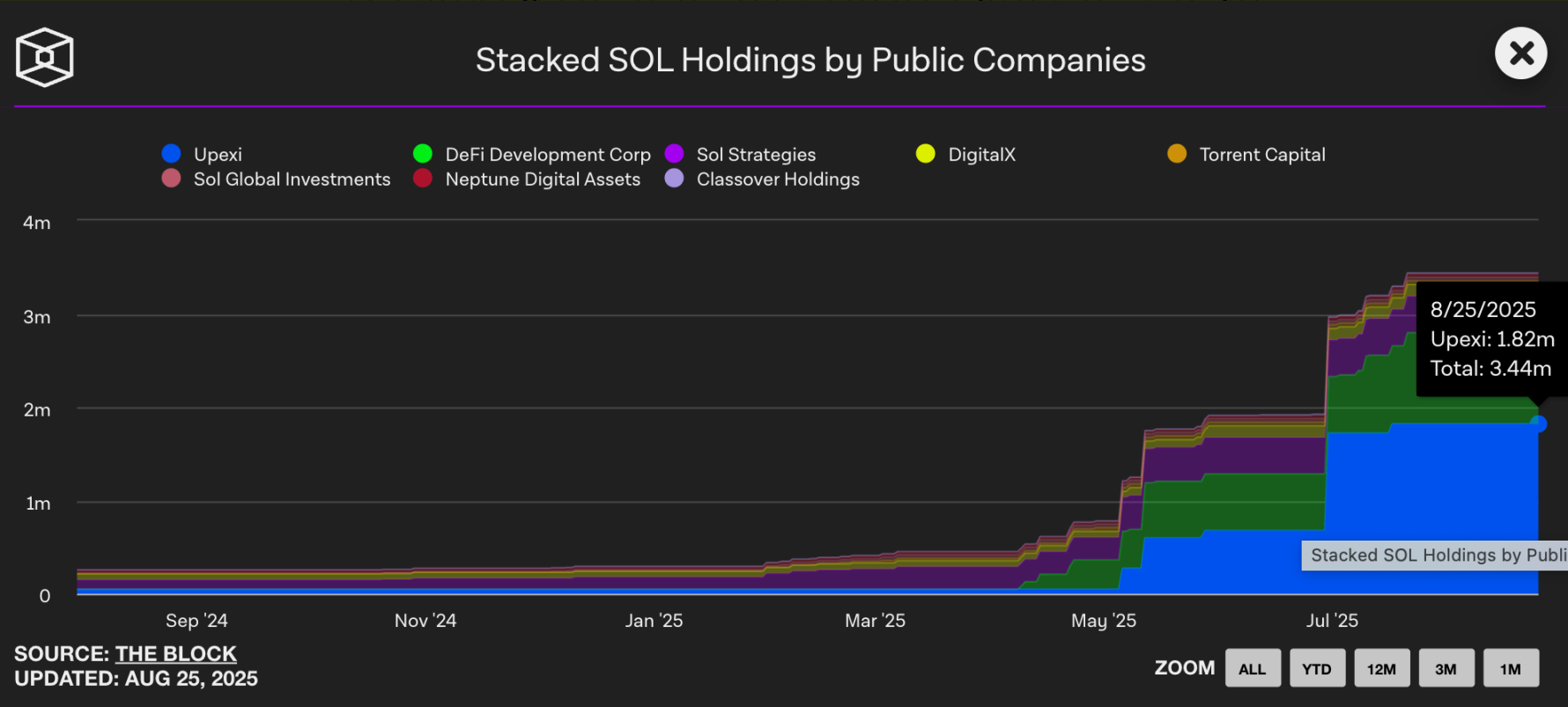
数据来源


但新的资本布局正在重塑当前的格局,当前上司公司持有的 SOL 仅占流通供应量的 0.69%,而近两日 Pantera Capital 的 12.5 亿美元以及 Galaxy、Multicoin 和 Jump 联合的 10 亿美元注入承诺,将是现有上市公司 SOL 持有体量的 3.5 倍。


大鳄入场,不动声色的资本较量


Galaxy Digital、Multicoin Capital 和 Jump Crypto 于 8 月 25 日官宣发起了一项联合行动,这三家加密投资巨头正在与潜在支持者谈判,计划筹集约 10 亿美元专门用于积累 Solana。


这不是简单的投资,而是一场精心策划的市场行动。三巨头已聘请华尔街老牌投行 Cantor Fitzgerald LP 担任牵头银行,计划通过收购一家未透露姓名的上市公司,创建一个专注于 Solana 的数字资产财务公司。


值得注意的是,Solana Foundation 已对此表示支持,而交易预计将于 9 月初完成。


这场行动并非孤立事件,而是一场长期布局。Multicoin 与 Jump 此前已对 Solana 生态项目对进行了大量投资。而 Galaxy Trading 此前为了从 FTX 的破产资产中折价购买 SOL 而专门筹集了约 6.2 亿美元资金。而现在,他们正联手加大赌注。


一天之后(8 月 26 日),由前 Tiger Management 高管 Dan Morehead 领导的 Pantera,也在 The Information 的报道中透露了其野心勃勃的计划——筹集高达 12.5 亿美元的资金,收购一家纳斯达克上市公司并将其转型为专注于 Solana 的投资公司并命名为「Solana Co.」。


这不是 Pantera 的即兴之作。早在 2024 年 4 月,他们就开始为新基金筹集超过 10 亿美元的资金。而现在,这只看似普通的基金背后的野心终于浮出水面——瞄准 Solana 生态系统。


最引人注目的是,Pantera 不仅自己加码,还联手 ParaFi Capital 支持 Sharps Technology,这家致力于开发 Solana 财务工具的公司正在筹集超过 4 亿美元。这一系列动作背后,透露出 Pantera 对 Solana 未来的坚定信心。


但 Pantera 的策略不止于此。据透露,他们已悄悄向「各种代币和地区」的数字资产财务 (DAT) 公司投资了约 3 亿美元。这种布局方式不仅能产生收益,还能增加净资产价值,显示出老牌投资机构在加密领域的成熟战略。


为什么是 Solana?机构资本的战略逻辑


聪明的投资者永远善于在危机中发现机遇,对比不难发现,在扎堆的比特币和以太坊财库公司这种玩法流行起来起来之前,Pantera 和 Galaxy 之前都从破产的 FTX 购买大幅折扣的 SOL 代币。简单来说,他们已经从 SOL 赚了不少钱。


FTX 破产资产中出售的首批 SOL 代币(数量介于 2500 万至 3000 万)当时以每枚 64 美元的价格售出,比当时 SOL 的市场价格低了 60% 以上,而第二批 SOL 的出售价在每枚代币 95 美元至 110 美元之间(比市场价低 15% 至 26%)。未有公开资料披露 Pantera 和 Galaxy 从 FTX 的破产重组中获利多少。但激进的新策略不难被解读为赚到钱的信号。


而数字资产财务 (DAT) 公司模式的兴起,则为这些机构投资者提供了一种全新的价值捕获方式。通过这种模式,他们不仅能够持有 SOL 获取潜在的升值收益,还能通过各种 DeFi 协议获得稳定的收益,实现资产的多重增值。


机构资本的大规模进入,无疑将对 SOL 的价格形成强劲支撑。从历史经验看,当机构投资者开始系统性积累某种加密资产时,往往会推动其进入一个相对稳定的上升通道。


以太坊的例子已经证明了这一点。随着 ETF 的推出和机构投资者的入场,ETH 不仅价格上涨,其波动性也明显降低,市场结构更加成熟。当前 69 家以太坊财库实体的 ETH 储备持仓已达 410 万枚,占以太坊流通供应量的 3.39%,持仓价值约为 200 亿美元。以太坊最近突破近四年来的最高纪录,部分原因正是这些实体的购买。


现在,Solana 似乎正在复制这一路径,但体量还远远追不上 BTC、ETH。随着更多机构持有者的加入,SOL 的流动性结构将发生质变,可能形成更加稳定但也更加集中的持有模式。此外,在 BTC、ETH 的现货 ETH 获批一年之久后,分析师曾语言 SOL 现货 ETH 将在今年获批。


传统金融机构看中 Solana,绝非一时冲动,而是基于其无可比拟的技术优势。在区块链三大难题(去中心化、安全性和可扩展性)的平衡中,Solana 以其惊人的交易处理能力和低廉的 Gas 费用脱颖而出。


当以太坊还在为高昂的交易费用而苦恼时,Solana 已经能够以每秒数千笔的速度处理交易,同时保持几乎可以忽略不计的成本。对于习惯了传统金融效率的机构投资者而言,这种性能无疑更符合他们的期望。


更重要的是,Solana 不断壮大的去中心化应用 (dApp)、NFT 和 DeFi 协议生态系统,为其提供了丰富的应用场景和增长潜力。这种全方位的生态系统繁荣,正是吸引机构投资者的关键因素之一。


对于 Solana 上的开发者和项目方而言,这无疑是一个好消息。更多的资本意味着更多的实验、创新和应用场景,生态系统有望进入一个加速发展的新阶段。


特别是,数字资产财务公司模式的成功,可能会催生更多类似的投资载体。这种模式不仅为机构投资者提供了便利的进入渠道,也为传统金融与加密世界的融合提供了一种可行的路径。


未来几年,我们可能会看到更多专注于特定区块链生态系统的投资公司涌现,形成一个全新的机构投资版图。


权力再分配的潜在风险


当 Solana 诞生之初,很少有人能预见它会在短短几年内吸引如此多的机构资本关注。从险些因 FTX 崩盘而消亡,到如今成为机构巨头青睐的投资标的,Solana 的故事本身就是加密世界不可思议魅力的写照。


当前的机构投资浪潮很可能只是一个开始。随着 Pantera、Galaxy 等先行者树立标杆,更多传统金融机构可能会跟进,将 Solana 纳入其多元化的投资组合。


然而,机构资本的大规模进入也带来了新的忧虑。当一小群机构持有大量 SOL 时,这将在某种程度上重新集中了原本去中心化的资产,也可能影响 Solana 网络的去中心化程度。SOL 财库公司 DeFi Dev Corp. 在积极囤积代币的同时,也在推特上表示将对 Solana 本周将启动 Alpenglow 投票投赞成票。这项提案简单来说是让 Solana 「更快」的投票,当普通用户面对这些复杂的技术术语,是否会跟票,让 Solana 变成更符合大机构利益的 Solana?


此外,兴许价格操纵的风险也将增加,一旦这些大型持有者决定调整其持仓,市场可能面临剧烈波动。

Related Reads

Cross-strait Regulators Jointly Block Hong Kong Stock Account Openings: Where Can Your Money Go Now?

**Summary:** On May 22, 2026, financial regulators in mainland China and Hong Kong launched a synchronized crackdown targeting informal channels used by mainland investors to trade in Hong Kong and US stocks via Hong Kong-based securities firms. The Hong Kong Securities and Futures Commission (SFC) issued a stringent circular to licensed brokers, mandating stricter onboarding procedures for mainland clients. New requirements include a mandatory written declaration stating that all investment funds originate from *outside* mainland China and are from legal sources. The SFC also demanded the closure of accounts opened with suspicious documents and dormant accounts. Simultaneously, China's securities regulator, along with seven other ministries, initiated a two-year rectification plan, penalizing firms like Futu and Tiger Brokers for illegal cross-border operations. This effectively ends the previously common grey-area practice for mainlanders. Immediate impacts are evident. Social media reports show mainland investors traveling to Hong Kong for in-person account openings are now frequently denied after signing the new declaration, even at firms like uSMART that still accept applications. The declaration acts as both a compliance shield for brokers and a filter for clients. While major internet brokers have halted new mainland accounts, limited options remain. A few Hong Kong-licensed firms like uSMART, Fosun Wealth, and Cheerful still offer avenues, but approval is not guaranteed and hinges on proving offshore fund sources. Crucially, funding accounts must now be in the investor's own name at qualified Hong Kong or international banks, blocking previous informal methods like third-party transfers. For compliant access, official channels like Stock Connect, QDII, and the Cross-boundary Wealth Management Connect remain open. Individuals with verifiable overseas residency or status have better prospects. The crackdown signals the definitive end of the loosely regulated expansion period, forcing mainland investors toward stricter, fully compliant pathways for overseas asset allocation.

marsbit3m ago

Cross-strait Regulators Jointly Block Hong Kong Stock Account Openings: Where Can Your Money Go Now?

marsbit3m ago

Iran and the Fed -- Three Scenarios That Will Impact Global Markets Next

"Three Scenarios for Iran and the Fed Shaping Global Markets" Iranian geopolitics and the Fed's monetary policy path are two dominant themes for markets. Deutsche Bank Research outlines three scenarios linking Iran ceasefire outcomes to Fed policy, with oil prices as the key transmission channel. **Scenario 1: Peace Deal.** A breakthrough leading to the Strait of Hormuz reopening would ease near-term Fed tightening pressure. Recent inflation would be viewed as a temporary energy shock. However, medium-term risks remain; rate hikes could resurface in 2027 if inflation persists. **Scenario 2: Stalemate.** A breakdown in talks and a prolonged Strait closure, but no major escalation, is deemed the scenario with the *highest* Fed hike risk. Sustained high oil prices would feed into core inflation and threaten inflation expectations, while not severely damaging demand enough to give the Fed a reason to pause. This environment could necessitate multiple Fed rate hikes in 2026. **Scenario 3: Conflict Escalation.** Renewed conflict and sharply higher oil prices create a two-way risk for Fed policy. On one hand, it would risk severe inflation expectations de-anchoring, forcing a hawkish response. On the other, extreme oil prices could severely damage demand and the labor market, potentially shifting the Fed's focus toward easing. The ultimate policy decision would depend on which risk materializes first. Overall, Deutsche Bank's framework emphasizes that the path for oil prices, dictated by Iran, will define the nature of inflation pressures and ultimately determine the Fed's policy space. Key signals to watch include ceasefire progress, whether Brent crude stabilizes below $100, and any shift in Fed officials' rhetoric from discussing cuts to potential hikes.

marsbit12m ago

Iran and the Fed -- Three Scenarios That Will Impact Global Markets Next

marsbit12m ago

Hash Global Founder: Why I Also Choose to Liquidate All My ETH Holdings?

Hash Global founder explains his decision to sell all ETH holdings, despite recognizing the potential regulatory clarity from the US CLARITY Act as a positive development. He argues against the narrative that such clarity would automatically grant ETH a "monetary premium" comparable to Bitcoin or gold. The core of his critique is that market valuation for ETH remains tied to fundamental network metrics—like mainnet revenue, DeFi activity, staking yield, and competition—rather than a pure store-of-value narrative. He contends that legal classification solves compliance issues for institutions but does not inherently create the deep, historical consensus required for monetary status. Furthermore, Ethereum's complexity and role as a multi-functional infrastructure asset (gas, collateral, settlement layer) work against the simple narrative needed for such a premium. Looking forward, he suggests that the rise of DeFi and tokenized real-world assets (RWA) will mean ETH is not the only yield-bearing asset; tokenized gold, treasuries, and others will also offer programmable yield. Thus, ETH's "yielding" advantage diminishes. He believes monetary premium will likely remain with Bitcoin, physical gold, and potentially tokenized gold, while ETH's value is more accurately framed as a crucial infrastructure asset. Ultimately, he views CLARITY's benefit as reducing a "regulatory discount" on ETH, not unlocking trillions in monetary re-rating. ETH's long-term value is significant but stems from its network effects, developer ecosystem, and role in on-chain finance—not from being a direct substitute for gold.

marsbit15m ago

Hash Global Founder: Why I Also Choose to Liquidate All My ETH Holdings?

marsbit15m ago

Elon Musk's 'Granny Drain'

Title: Musk "Milking the Old Folks" Author: Nancy, PANews As the memory sector surges with Micron and SK Hynix each surpassing a trillion-dollar market cap, Elon Musk is accelerating his own myth of becoming the world's first trillionaire. SpaceX, with its astronomical valuation, is speeding toward the capital markets. This potentially wealth-history-rewriting super IPO is pushing Musk toward that unprecedented personal fortune and delivering hundredfold or even thousandfold returns to early backers like Google, Valor Equity Partners, Founders Fund, and others. However, to sustain this most expensive space narrative in human history, new buyers are ultimately needed. As massive pension funds are set to be "forced to buy," the retirement savings of Americans are becoming the fuel for Musk's space dreams. Wall Street has begun paving a fast track for such super IPOs. Major indices like Nasdaq and S&P have recently eased rules, allowing mega-companies like SpaceX to be incorporated into key benchmarks like the Nasdaq 100 much faster post-listing. This matters because a vast portion of the U.S. retirement system—trillions in 401(k)s and pension funds—relies on passive index investing. Once a company enters a major index, all funds tracking it are compelled to buy its shares automatically, regardless of valuation, profitability, or risk. This has sparked significant backlash. Teacher unions and major public pension funds (collectively managing trillions) have warned the SEC and written to Musk, opposing SpaceX's extreme governance structure where Musk holds 85% voting control. They argue workers' lifelong savings could be tied to a company resembling a Musk family office more than a transparent public entity. In essence, after early investors reap immense rewards, the potential "bag-holding" cost is being transferred onto passive investors—the ordinary American retirees—through the mechanism of index inclusion.

marsbit18m ago

Elon Musk's 'Granny Drain'

marsbit18m ago

This Xiaohongshu Graphic Layout AI Skill Has Found a Route to Bypass AI Labeling for Graphic Generation

A new open-source tool called "guizang-social-card-skill" has emerged, offering a unique workaround for AI content labeling rules on platforms like Xiaohongshu. Instead of using AI models to generate images, it employs AI to make layout decisions, then uses HTML/CSS to render the final graphic. Photographic assets are sourced from libraries like Unsplash. The output is a rasterized browser screenshot, not an "AI-generated image." This approach is a direct response to platform policies. In early 2026, Xiaohongshu mandated labeling for AI-generated synthetic content and deployed audio-visual recognition models to detect AI-generated pixels based on statistical patterns. This tool bypasses those pixel-level detectors by not using diffusion or GAN models for image generation. The tool provides 28 predefined layout templates across two visual styles. Users input a topic, and the AI selects a template, positions text, and integrates elements like maps (using OpenStreetMap). The system prioritizes user-uploaded photos before falling back to stock image searches. The article outlines three divergent technical paths for social media graphic tools: 1) AI models directly generating pixels (highest detection risk), 2) API template engines (risk of anti-spam rules for homogeneity), and 3) this HTML-rendering method. The longevity of this workaround depends on whether platforms broaden their definition of "AI-generated content" to include programmatically rendered, AI-designed graphics. While effective for structured content like travel itineraries, the tool's 28 templates may be too restrictive for creative fields like fashion or beauty. Its future hinges on an ongoing cat-and-mouse game between platform detection models and tool developers, highlighting the tension between "AI-assisted" creativity and "AI-replaced" mass production.

marsbit25m ago

This Xiaohongshu Graphic Layout AI Skill Has Found a Route to Bypass AI Labeling for Graphic Generation

marsbit25m ago

Trading

Spot
Futures

Hot Articles

Discussions

Welcome to the HTX Community. Here, you can stay informed about the latest platform developments and gain access to professional market insights. Users' opinions on the price of SOL (SOL) are presented below.

活动图片