Spot XRP ETFs Set To Crush Ethereum’s, Predicts Canary Capital CEO

bitcoinistPublished on 2025-08-12Last updated on 2025-08-12

Abstract

In a wide-ranging conversation with Paul Barron, Canary Capital CEO Steven McClurg laid out a blunt, three-pronged case for why...

Trusted Editorial content, reviewed by leading industry experts and seasoned editors. Ad Disclosure

In a wide-ranging conversation with Paul Barron, Canary Capital CEO Steven McClurg laid out a blunt, three-pronged case for why spot XRP ETFs could debut with stronger demand than their Ethereum counterparts—and keep it. His core argument rests on the absence of staking yield cannibalizing ETF demand, XRP’s category leadership in traditional financial rails, and what he describes as unusually deep community and institutional interest ready to convert into flows the moment approvals land.

Why XRP Could Beat ETH From The Start

McClurg’s first point is mechanical and immediate: Ethereum’s native yield is a headwind for its ETFs; XRP has no such drag. “If you’re actually a bit more cryptonative, you’re not going to buy an ETH ETF because you can … get a 2 to 3% yield,” he said, noting that investors comfortable with self-custody or on-chain tools can harvest staking rewards that a plain beta ETF does not deliver [thus far].

By contrast, “since XRP doesn’t offer that … you’re not losing out on anything,” which, in his view, removes a key reason for yield-sensitive buyers to bypass the fund wrapper. The way he frames it, Ethereum’s best feature for on-chain holders is precisely what limits the appeal of an off-chain ETF, at least until regulators permit staking within the funds—a change he says issuers are actively discussing: “We are all talking to the SEC and then trying to get staking allowed in the ETFs.”

From there, he shifts to positioning. McClurg casts XRP as the clear leader in a different category than Ethereum, and one he believes aligns more directly with how incumbent finance actually moves money. “I really see XRP as the leader in more traditional financial services rails,” he said, describing cross-border payments, remittances and institutional settlement as the network’s center of gravity.

He contrasts that with Ethereum, which he places in a broader, more competitive bucket of “open-source protocols,” arguing that its relative advantage has narrowed: “Ethereum did a lot … but Ethereum is now old technology … older, slower, less secure, more expensive to run. And there’s a lot better opportunities out there in my opinion,” he added, reaching for a consumer-tech analogy—“this is basically the Palm Pilot and we already have the iPhone.”

Whether readers agree with the jab or not, the logic of his ETF call is straightforward: category leaders with crisp narratives tend to attract adviser due-diligence and model-portfolio allocations more quickly than platforms facing an expanding set of like-for-like competitors.

The third leg of his thesis is demand-side. McClurg argues the bid for XRP exposure has been building for years and is ready to express through regulated wrappers as soon as they are available. He puts a number on it that will raise eyebrows: “I think XRP is $5 billion the first month … across the board,” he said, before making the explicit comparison—“out of the gate it’s definitely going to outperform what ETH did out of the gate.”

Part of that confidence comes from what he sees as a different investor base composition. In his telling, financial advisers who now routinely pair a “big and safe” issuer with a crypto-native specialist will be comfortable adding XRP once the pathway is clear, and the online community already tracking the asset will finally have a mainstream channel that fits retirement accounts and institutional mandates.

Why A XRP ETF May Be Imminent

All of this presupposes one thing: that an XRP ETF can get to market in short order. On that timing, McClurg is unambiguous. Reacting to the end of Ripple’s litigation with the SEC, he said, “I absolutely believe that there’ll be an XRP ETF this year … it really is just a matter of time.”

He then pointed to an underappreciated structural tailwind: the exchanges’ proposed “generic listing standards” for single-asset crypto ETFs. “There is a generic listing standard that was published in the last week by NASDAQ, New York Stock Exchange and Cboe … under the new generic listing standard … any token that has a futures market in the US on a CFTC-regulated exchange for more than 6 months does qualify,” he explained, while emphasizing the rule still sits in a public-comment phase.

On that criterion, he added, “XRP has had a six-month futures market here in the next couple of months.” The implication is clear: once the standard is approved, multiple assets—including XRP—could move through the process in a batch, avoiding the bespoke rulemaking that slowed non-Bitcoin ETFs for years.

McClurg also argues that XRP’s architecture—often criticized by crypto purists—is a feature, not a bug, for the buyers who matter most to ETF uptake. “I think that centralization actually works for certain industries,” he said, citing password resets, compliance stops and jurisdictional controls that banks and broker-dealers require in payments and tokenized securities workflows.

“A more centralized framework for a blockchain actually makes a lot of sense,” he said, especially in countries with stringent financial-crime rules. That framing serves a practical ETF point: if the institutions who allocate through ETFs prefer systems that mirror existing controls, XRP’s DNA could ease adoption on trading desks and in risk committees where the first question is not throughput but operational and regulatory fit.

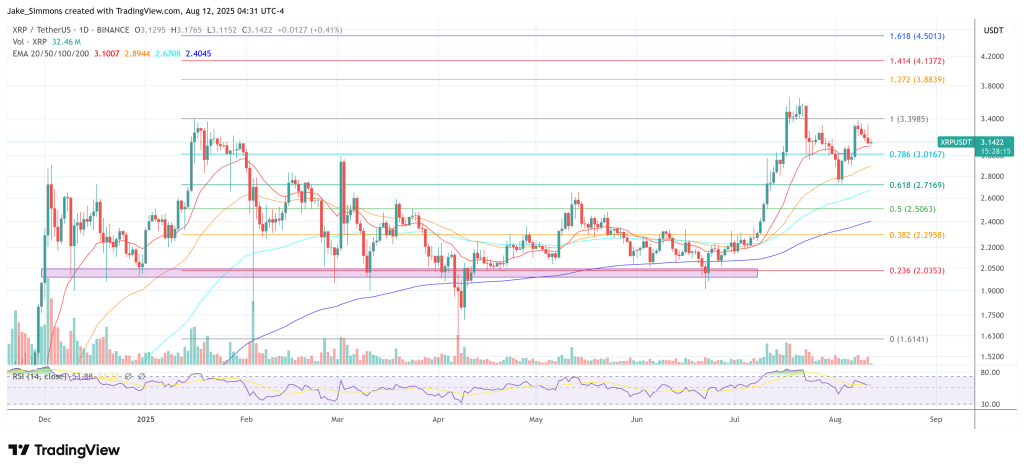
At press time, XRP traded at $3.14.
XRP price
XRP price, 1-day chart | Source: XRPUSDT on TradingView.com
Featured image created with DALL.E, chart from TradingView.com
Editorial Process for bitcoinist is centered on delivering thoroughly researched, accurate, and unbiased content. We uphold strict sourcing standards, and each page undergoes diligent review by our team of top technology experts and seasoned editors. This process ensures the integrity, relevance, and value of our content for our readers.

Jake Simmons has been a Bitcoin enthusiast since 2016. Ever since he heard about Bitcoin, he has been studying the topic every day and trying to share his knowledge with others. His goal is to contribute to Bitcoin's financial revolution, which will replace the fiat money system. Besides BTC and crypto, Jake studied Business Informatics at a university. After graduation in 2017, he has been working in the blockchain and crypto sector. You can follow Jake on Twitter at @realJakeSimmons.

Trending Cryptos

Related Reads

Crypto Payment Cards with $1.5 Billion Monthly Transaction Volume, Stuck in the 1990s

Monthly crypto payment card transaction volume has reached $15 billion, but the industry's development stage is comparable to debit cards in the 1990s, before they became a mainstream financial staple. A key limitation is the lack of established daily financial relationships, such as direct salary deposits and recurring bill payments, with crypto wallets. Despite annualized transaction volumes of approximately $18 billion, the market is concentrated and immature. The leading provider, RedotPay, commands over half the market share. User adoption is heavily skewed towards emerging markets like Bangladesh, India, and Nigeria, where access to USD and stable financial services is limited, rather than developed economies. The sector features four primary business models: 1) Card-issuing infrastructure providers, 2) Exchange-affiliated cards for user retention, 3) Decentralized wallet/DeFi cards with self-custody but high complexity, and 4) Stablecoin-focused digital banks, which dominate transaction volume by offering integrated financial services. The article argues that a pure payment functionality is insufficient for long-term success, mirroring the historical trajectory of traditional debit cards. Future winners will need to: 1) Control the upstream flow of funds, 2) Secure defensible niches in underserved markets, and 3) Most crucially, build core account relationships that integrate into users' daily financial lives. Without this evolution, crypto cards risk remaining niche prepaid tools rather than becoming universal financial infrastructure.

Foresight News6m ago

Crypto Payment Cards with $1.5 Billion Monthly Transaction Volume, Stuck in the 1990s

Foresight News6m ago

$7.8 Billion in Theft and Losses Reveals the Truth: Security Costs Have Become an Unavoidable Liquidity Tax for DeFi

"7.8 Billion in Thefts Reveals the Truth: Security Costs Have Become DeFi's Unavoidable 'Liquidity Tax'" A summary of Q2 2026 data reveals that security risks are now a fundamental capital cost in DeFi, directly impacting user returns and liquidity decisions. DeFiLlama recorded 88 hacking incidents with quantified losses totaling $780.3 million in Q2. April was the worst month with $644.8 million lost. DeFi protocol attacks accounted for $735.8 million, while cross-chain bridge exploits resulted in $354.4 million in losses (note: some event categorizations overlap). Cumulatively, DeFi hacks have reached $7.85 billion, with bridge losses at $3.26 billion. The quarter highlighted two primary risk categories: high-value infrastructure vulnerabilities (e.g., bridges, oracles, admin keys) causing massive single losses, and more frequent contract logic bugs. This signals a critical market shift: from post-incident analysis to preemptive pricing of risk. Users and liquidity providers now implicitly factor in the security of the entire asset pathway—not just pool APY—into their decisions. This hidden "risk premium" manifests through wider spreads, higher liquidity incentives, and capital migration towards perceived safer routes. Cross-chain bridge risks, responsible for over $353 million in Q2 losses, exemplify this change. Asset routing credibility is now part of the transaction. Following incidents like KelpDAO and THORChain, markets are demanding safer bridges, asset insurance, and clearer risk disclosure, increasing the cost of capital for riskier pathways. Consequently, security spending is transforming from a defensive cost into a core distribution cost for attracting liquidity. Protocols must invest more in audits, bug bounties, real-time monitoring, and insurance to remain competitive. Users are increasingly demanding transparency about fund flow paths, associated risks, and contingency plans. The key indicators for the industry's direction will be whether capital continues consolidating in trusted channels, if projects delay launches for enhanced audits, if insurance premiums rise, and if aggregators start displaying security risk metrics. Q2 2026 may be remembered not just as a bad period, but as the point when DeFi underwent a fundamental asset risk repricing, where security became a persistent,隐性 tax on all on-chain activity.

Foresight News35m ago

$7.8 Billion in Theft and Losses Reveals the Truth: Security Costs Have Become an Unavoidable Liquidity Tax for DeFi

Foresight News35m ago

Breaking News: The "Worker's Edition" Claude 5 Is Here, Everyone Can Use It

BREAKING: Claude Sonnet 5, dubbed "Fennec," is now the default model for all Free and Pro users. This mid-tier model boasts the strongest Agent capabilities in the Sonnet line yet, with performance rivaling the flagship Opus 4.8. It features autonomous planning and can utilize browser and terminal tools—capabilities previously exclusive to costly, large models. Key benchmarks highlight significant gains over its predecessor, Sonnet 4.6, in reasoning, tool use, coding, and knowledge work. Sonnet 5 scores 63.2% on SWE-bench Pro (surpassing GPT-5.5's 58.6%), 80.4% on Terminal-Bench 2.1, and 57.4% on Humanity's Last Exam (just 0.5% behind Opus 4.8). It even slightly outperforms Opus 4.8 in some knowledge tasks. Anthropic positions it as delivering ~90% of Opus's capability at a fraction of the cost. Pricing is aggressive: a limited-time promotional rate of $2 per million input tokens and $10 per million output tokens (reverting to $3/$15 after August 31). This undercuts Opus 4.8 ($5/$25) and GPT-5.5 ($5/$30). However, a new tokenizer may increase token counts by 1.0-1.35x, affecting final costs post-promotion. Notably, Sonnet 5 excels in security, with a mere 0.93% browser injection attack success rate, outperforming Mythos 5 and Opus 4.8. Its prompt injection defense matches Opus 4.8 at 0.19%. Launching amid uncertainty around the region-restricted Fable 5, Sonnet 5 is globally available. It targets the mid-market, offering near-flagship performance at a competitive price, effectively lowering the barrier for multi-Agent development and presenting a compelling alternative for cost-conscious developers.

marsbit50m ago

Breaking News: The "Worker's Edition" Claude 5 Is Here, Everyone Can Use It

marsbit50m ago

Trading

Spot

Hot Articles

Discussions

Welcome to the HTX Community. Here, you can stay informed about the latest platform developments and gain access to professional market insights. Users' opinions on the price of S (S) are presented below.

活动图片