Safety Shot Secures 10% Stake in LetsBONK.fun, Propels Snorter Token’s Outlook

bitcoinistPublished on 2025-08-12Last updated on 2025-08-12

Abstract

Nasdaq-listed Safety Shot has secured a 10% revenue stake in LetsBONK.fun, one of the largest memecoin launchpads on Solana. As...

Trusted Editorial content, reviewed by leading industry experts and seasoned editors. Ad Disclosure

Nasdaq-listed Safety Shot has secured a 10% revenue stake in LetsBONK.fun, one of the largest memecoin launchpads on Solana.

As part of the deal, Safety Shot will add $25M worth of $BONK to its treasury. Effectively, this’ll make the public company a direct beneficiary of the platform’s growth and the token’s success.

It’s also bullish for Solana-based crypto projects like Snorter Token ($SNORT). The reason is that it underscores growing mainstream and institutional interest in the Solana ecosystem, so it’s bound to boost liquidity, visibility, and investor confidence across the network.

LetsBONK.fun Attracted $2M+ Daily Revenue in July

Demonstrating LetsBONK.fun’s market sway, the Solana launchpad saw a sharp revenue climb at the beginning of July, with multiple days generating over $2M in revenue.

During this period, it captured the lion’s share of daily revenue among Solana launchpads, frequently outpacing its main rival Pump.fun, thereby cementing its dominance.
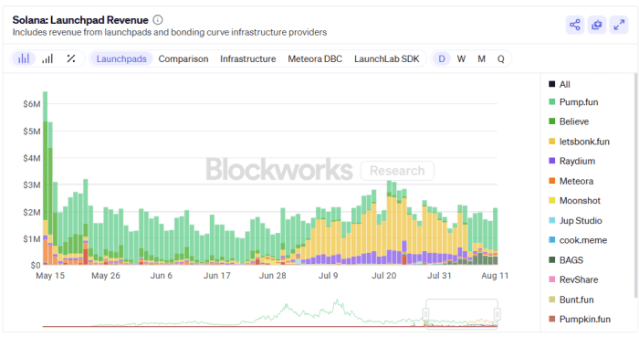
LetsBONK.fun outpaced Pump.fun in daily revenue in July.
Source: Blockworks

Following such success, Safety Shot is now issuing preferred shares that can be converted into common stock. Plus, it’ll reinvest about 90% of its LetsBONK.fun revenue into buying $BONK, the fifth largest meme coin with a whopping $1.98B market cap.

With no debt and $15M+ in cash, the company is well-positioned to benefit from both the token’s price performance and the launchpad’s growth.

Such strengthening might also significantly benefit projects building on Solana, like Snorter Token ($SNORT).

Snorter Token to Launch Telegram Trading Bot on Solana

While $SNORT is an ERC-20 token, it’s the utility token of Snorter Bot, a Telegram trading bot preparing to launch on Solana this quarter initially.

In fact, it promises the lowest fees on the Solana network at just 0.85% and executes faster than rival bots like Maestro and Trojan.

Snorter Bot competitors.
Source: Snorter Token

Following its Solana launch, it’ll then go multi-chain, tapping into Ethereum, BNB Chain, Polygon, and Base. By doing so, you’ll be able to trade various promising projects across top networks from a single, streamlined interface.

From day one, it’ll give you access to advanced trading tools like copy trading, limit orders, and automated sniping. Its ultimate goal is to give you a leg up in the trading arena, after all.

And all will be achieved without compromising security. Snorter Bot will have MEV protection and leverage scam filters to detect honeypots and rug pulls, ensuring you don’t fall victim to common crypto scams.

When purchasing $SNORT, you’ll also be granted additional perks, like unlimited sniping, staking rewards at a 144% APY, and membership to its upcoming DAO.

Joining the DAO could be a major boon, as it’ll give you a voice in critical decisions that shape the bot’s future features, upgrades, and strategy.

Verdict – Safety Shot’s LetsBONK.fun Stake Boosts Snorter Bot’s Outlook

Safety Shot’s stake in LetsBONK.fun highlights how institutional players and publicly traded companies are moving beyond simply holding crypto; they’re buying into platforms to generate revenue.

Naturally, this is excellent news for Solana-based projects like the upcoming Snorter Bot. As more attention and investment flow into the network, it’s bound to witness greater adoption and trading activity.

To get the most out of the bot, you can grab $SNORT on presale for just $0.1011, using either $USDT, $ETH, $BNB, or fiat.

This could be the best moment to jump in, as its price is anticipated to reach $0.94 after being listed on major exchanges – a 829%+ rise compared to its current price.

We’re not financial advisors. DYOR and never invest more than you’d be sad to lose.

Editorial Process for bitcoinist is centered on delivering thoroughly researched, accurate, and unbiased content. We uphold strict sourcing standards, and each page undergoes diligent review by our team of top technology experts and seasoned editors. This process ensures the integrity, relevance, and value of our content for our readers.

Leah is a British journalist with a BA in Journalism, Media, and Communications and nearly a decade of content writing experience. Over the last four years, her focus has primarily been on Web3 technologies, driven by her genuine enthusiasm for decentralization and the latest technological advancements. She has contributed to leading crypto and NFT publications – Cointelegraph, Coinbound, Crypto News, NFT Plazas, Bitcolumnist, Techreport, and NFT Lately – which has elevated her to a senior role in crypto journalism. Whether crafting breaking news or in-depth reviews, she strives to engage her readers with the latest insights and information. Her articles often span the hottest cryptos, exchanges, and evolving regulations. As part of her ploy to attract crypto newbies into Web3, she explains even the most complex topics in an easily understandable and engaging way. Further underscoring her dynamic journalism background, she has written for various sectors, including software testing (TEST Magazine), travel (Travel Off Path), and music (Mixmag). When she's not deep into a crypto rabbit hole, she's probably island-hopping (with the Galapagos and Hainan being her go-to's). Or perhaps sketching chalk pencil drawings while listening to the Pixies, her all-time favorite band.

Trending Cryptos

Related Reads

Crypto Payment Cards with $1.5 Billion Monthly Transaction Volume, Stuck in the 1990s

Monthly crypto payment card transaction volume has reached $15 billion, but the industry's development stage is comparable to debit cards in the 1990s, before they became a mainstream financial staple. A key limitation is the lack of established daily financial relationships, such as direct salary deposits and recurring bill payments, with crypto wallets. Despite annualized transaction volumes of approximately $18 billion, the market is concentrated and immature. The leading provider, RedotPay, commands over half the market share. User adoption is heavily skewed towards emerging markets like Bangladesh, India, and Nigeria, where access to USD and stable financial services is limited, rather than developed economies. The sector features four primary business models: 1) Card-issuing infrastructure providers, 2) Exchange-affiliated cards for user retention, 3) Decentralized wallet/DeFi cards with self-custody but high complexity, and 4) Stablecoin-focused digital banks, which dominate transaction volume by offering integrated financial services. The article argues that a pure payment functionality is insufficient for long-term success, mirroring the historical trajectory of traditional debit cards. Future winners will need to: 1) Control the upstream flow of funds, 2) Secure defensible niches in underserved markets, and 3) Most crucially, build core account relationships that integrate into users' daily financial lives. Without this evolution, crypto cards risk remaining niche prepaid tools rather than becoming universal financial infrastructure.

Foresight News5m ago

Crypto Payment Cards with $1.5 Billion Monthly Transaction Volume, Stuck in the 1990s

Foresight News5m ago

$7.8 Billion in Theft and Losses Reveals the Truth: Security Costs Have Become an Unavoidable Liquidity Tax for DeFi

"7.8 Billion in Thefts Reveals the Truth: Security Costs Have Become DeFi's Unavoidable 'Liquidity Tax'" A summary of Q2 2026 data reveals that security risks are now a fundamental capital cost in DeFi, directly impacting user returns and liquidity decisions. DeFiLlama recorded 88 hacking incidents with quantified losses totaling $780.3 million in Q2. April was the worst month with $644.8 million lost. DeFi protocol attacks accounted for $735.8 million, while cross-chain bridge exploits resulted in $354.4 million in losses (note: some event categorizations overlap). Cumulatively, DeFi hacks have reached $7.85 billion, with bridge losses at $3.26 billion. The quarter highlighted two primary risk categories: high-value infrastructure vulnerabilities (e.g., bridges, oracles, admin keys) causing massive single losses, and more frequent contract logic bugs. This signals a critical market shift: from post-incident analysis to preemptive pricing of risk. Users and liquidity providers now implicitly factor in the security of the entire asset pathway—not just pool APY—into their decisions. This hidden "risk premium" manifests through wider spreads, higher liquidity incentives, and capital migration towards perceived safer routes. Cross-chain bridge risks, responsible for over $353 million in Q2 losses, exemplify this change. Asset routing credibility is now part of the transaction. Following incidents like KelpDAO and THORChain, markets are demanding safer bridges, asset insurance, and clearer risk disclosure, increasing the cost of capital for riskier pathways. Consequently, security spending is transforming from a defensive cost into a core distribution cost for attracting liquidity. Protocols must invest more in audits, bug bounties, real-time monitoring, and insurance to remain competitive. Users are increasingly demanding transparency about fund flow paths, associated risks, and contingency plans. The key indicators for the industry's direction will be whether capital continues consolidating in trusted channels, if projects delay launches for enhanced audits, if insurance premiums rise, and if aggregators start displaying security risk metrics. Q2 2026 may be remembered not just as a bad period, but as the point when DeFi underwent a fundamental asset risk repricing, where security became a persistent,隐性 tax on all on-chain activity.

Foresight News34m ago

$7.8 Billion in Theft and Losses Reveals the Truth: Security Costs Have Become an Unavoidable Liquidity Tax for DeFi

Foresight News34m ago

Breaking News: The "Worker's Edition" Claude 5 Is Here, Everyone Can Use It

BREAKING: Claude Sonnet 5, dubbed "Fennec," is now the default model for all Free and Pro users. This mid-tier model boasts the strongest Agent capabilities in the Sonnet line yet, with performance rivaling the flagship Opus 4.8. It features autonomous planning and can utilize browser and terminal tools—capabilities previously exclusive to costly, large models. Key benchmarks highlight significant gains over its predecessor, Sonnet 4.6, in reasoning, tool use, coding, and knowledge work. Sonnet 5 scores 63.2% on SWE-bench Pro (surpassing GPT-5.5's 58.6%), 80.4% on Terminal-Bench 2.1, and 57.4% on Humanity's Last Exam (just 0.5% behind Opus 4.8). It even slightly outperforms Opus 4.8 in some knowledge tasks. Anthropic positions it as delivering ~90% of Opus's capability at a fraction of the cost. Pricing is aggressive: a limited-time promotional rate of $2 per million input tokens and $10 per million output tokens (reverting to $3/$15 after August 31). This undercuts Opus 4.8 ($5/$25) and GPT-5.5 ($5/$30). However, a new tokenizer may increase token counts by 1.0-1.35x, affecting final costs post-promotion. Notably, Sonnet 5 excels in security, with a mere 0.93% browser injection attack success rate, outperforming Mythos 5 and Opus 4.8. Its prompt injection defense matches Opus 4.8 at 0.19%. Launching amid uncertainty around the region-restricted Fable 5, Sonnet 5 is globally available. It targets the mid-market, offering near-flagship performance at a competitive price, effectively lowering the barrier for multi-Agent development and presenting a compelling alternative for cost-conscious developers.

marsbit49m ago

Breaking News: The "Worker's Edition" Claude 5 Is Here, Everyone Can Use It

marsbit49m ago

Trading

Spot

Hot Articles

Discussions

Welcome to the HTX Community. Here, you can stay informed about the latest platform developments and gain access to professional market insights. Users' opinions on the price of S (S) are presented below.

活动图片