Bitcoin Hyper Blows Through $8.5M in Crazy-Fast Presale

bitcoinistPublished on 2025-08-12Last updated on 2025-08-12

Abstract

Bitcoin is riding a wave of strength. Following a brief stretch well above $121K yesterday, the world’s largest token has...

Trusted Editorial content, reviewed by leading industry experts and seasoned editors. Ad Disclosure

Bitcoin is riding a wave of strength. Following a brief stretch well above $121K yesterday, the world’s largest token has come back down to Earth, currently trading around $118K.
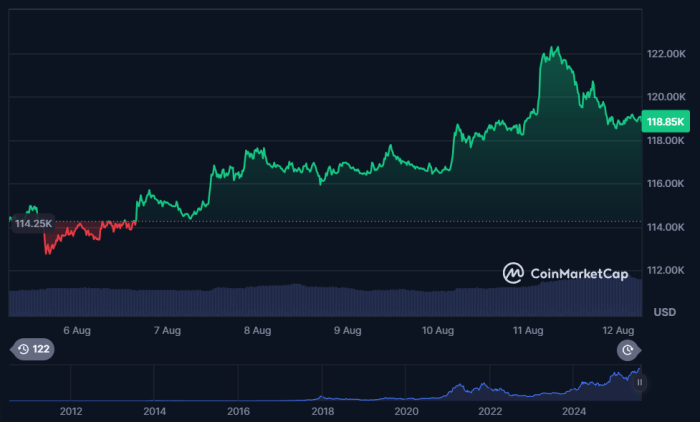
Bitcoin's seven-day performance.
Source: CoinMarketCap

Overall, momentum for Bitcoin (and the broader crypto market, nearing a $4T total market cap) remains bullish. But what if there’s something even bigger than Bitcoin on the horizon?

That’s the setting for the unveiling of Bitcoin Hyper ($HYPER), a Layer‑2 solution aiming to propel Bitcoin well beyond its current limitations. This project’s success would reinforce Bitcoin’s dominance in the crypto ecosystem, while setting up $HYPER for unprecedented success.

The Problem: Scalability, Speed, and Functional Limitations Holding Bitcoin Back

No one doubts Bitcoin’s resilience and function as a store of value. That said, there are a few things holding Bitcoin back.

Because it was the first blockchain and the OG crypto, some of the innovations that power later chains like Ethereum and Solana simply weren’t present when Bitcoin launched.

  • Low Throughput: Bitcoin processes around seven transactions per second (TPS), which pales in comparison to networks like Solana, capable of executing thousands of TPS in real time.
  • High Costs & Delays: During periods of heavy network congestion, fees can surge dramatically and confirmation times may stretch to 30 minutes or more. That makes micro‑transactions or retail payments cost prohibitive.
  • Limited Programmability: Bitcoin lacks native smart contract and DeFi support, closing off innovations such as decentralized finance, token minting, and automated applications.

Without these capabilities, Bitcoin remains less competitive for everyday transactions or cutting-edge blockchain applications, even as rival platforms build vibrant ecosystems.
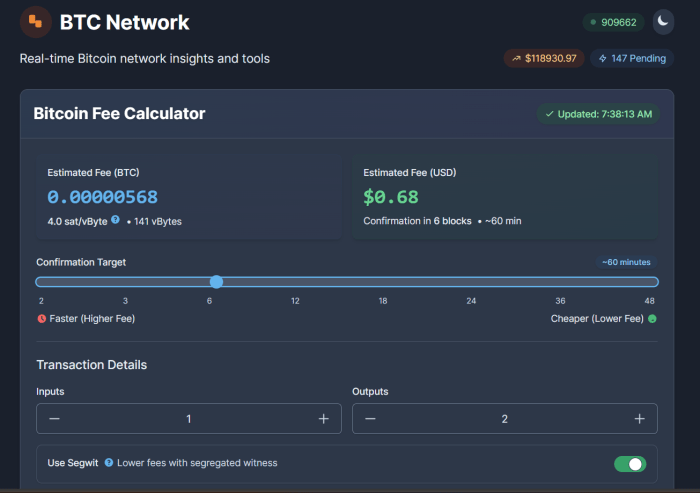
Bitcoin transaction fee calculator.

These structural problems remain for Bitcoin no matter how big its market cap gets.

Fundamentally, Bitcoin could become the biggest, best asset in the entire world – and it would still be difficult to build good dApps on it.

Structurally, there are at least two reasons for Bitcoin’s limits.

The first one is its limited smart-contract functionality. dApps require complex smart contracts to execute, but Bitcoin’s Layer-1 supports only simple smart contracts.

Secondly, the network has limited programmability. Why only simple smart contracts? Because of the limited programmability of Bitcoin’s scripting language.

That weakness does reduce programming errors and reduce the risk of denial of service attacks, but it hinders development.

So how do you keep everything that makes Bitcoin great, but also push the ecosystem to the next level? By building something beyond the original Bitcoin layer.

The Solution: Bitcoin Hyper’s Layer-2 Reinvention

Bitcoin Hyper ($HYPER) introduces an innovative Layer‑2 protocol. The goal is to transform Bitcoin into a fast and scalable platform, where transactions are cheap and resolve quickly.

How to pull that off? Bitcoin Hyper leverages the high-performance Solana Virtual Machine.

This SVM integration enables rapid transaction processing, low costs, and near-instant finality – all while anchoring security to Bitcoin’s mainnet.

Key features include:

  • A Canonical Bridge Mechanism: Users deposit $BTC into a trustless Canonical Bridge, which locks $BTC on the Layer‑1 chain and mints equivalent wrapped $BTC on the Layer‑2.
  • The Solana Virtual Machine (SVM): Think of the SVM as a smart contract execution hub, based on the Solana blockchain. Smart contracts deployed here benefit from Solana’s higher transaction speeds and smart contracts.
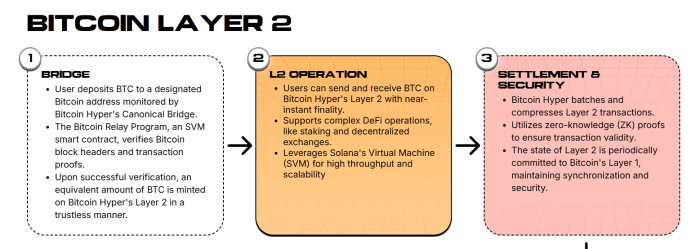
Bitcoin Hyper architecture.

Bitcoin Hyper: Hybrid Modular Architecture

Bitcoin Hyper tackles the scalability issue by separating the two key aspects of the blockchain’s function – smart contracts and final settlement.

Smart contracts execute through the SVM. That allows transactions to benefit from the Solana-like speed and scalability.

It also enables complex smart contracts, which in turn power DeFi, token issuance, micro-payments, and more – all with ultra-low gas fees and fast confirmation.

Final settlement and security rely on Bitcoin’s Layer-1, taking advantage of the reliability and stability of the Bitcoin network.

By separating the actions of the two layers into a modular architecture, the Bitcoin Hyper project takes the best aspects of both worlds.

$HYPER: Native Token + Wrapped Bitcoin on the Bitcoin Hyper Layer-2

What about the tokens?

When Bitcoin is deposited into the canonical bridge, it emerges on the other end as a wrapped Bitcoin on the Hyper Layer-2.

There, powered by the SVM, it becomes eligible for native on-chain staking, DeFi deployment, and all the other tools of the growing crypto economy.

Want to move your $BTC back to the Layer-1? Simply reverse the process.

But that’s not the only token on the Bitcoin Hyper Layer-2. There’s also the project’s native $HYPER, currently available as an ERC-20 token in the ongoing presale.
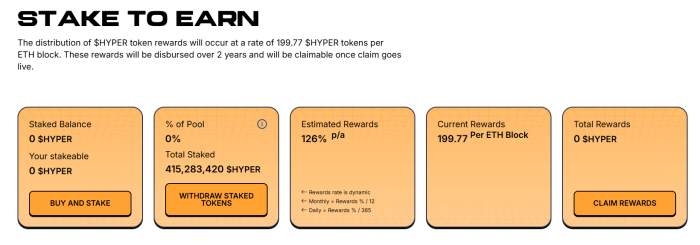
Bitcoin Hyper's staking stats.

What is $HYPER? It’s the Bitcoin Hyper utility token, and holding $HYPER unlocks its own benefits:

  • Transaction Payments: Pay gas fees with $HYPER for transfers, smart contract execution, and dApp interactions.
  • Staking Access: During the presale, stake $HYPER to earn rewards (currently 126% APY).
  • Ecosystem Access: Use $HYPER for early access to potential dApps, DeFi protocols, or premium services.
  • Developer Grants: Bitcoin Hyper builders can receive discounts by holding and using $HYPER in smart contracts.

The Bitcoin Hyper presale rocketed off to a strong start, raising millions in mere weeks.

To date, $8.6M+ has been raised, and our $HYPER price prediction shows the token price could reach $0.32 by 2025 EOY (from its current price of $0.01265).

Visit the Bitcoin Hyper ($HYPER) presale to learn more.

The Use Cases: Real-World Examples

Imagine purchasing a coffee with wrapped $BTC or $HYPER for minimal fees, or developers launching DeFi protocols and meme coins directly on a Bitcoin-centric network.

Entire applications – from yield farming to NFT marketplaces – are now feasible within Bitcoin’s ecosystem. The potential implications for Bitcoin and Bitcoin Hyper are staggering.

For the first time, Bitcoin could become a programmable network.

By unlocking complex smart contracts and DeFi on the top blockchain asset, Bitcoin Hyper could attract developers and capital to the Bitcoin ecosystem.

It could even change the narrative of $BTC as “digital gold.”

And for Bitcoin Hyper, there’s a key first-mover advantage. As the fastest Bitcoin L2 and the first to deploy its unique modular architecture, Bitcoin Hyper may seize developer initiative and integration.

There’s no doubt that a successful Layer-2 would reinforce Bitcoin’s dominance.

With enhanced utility, Bitcoin’s role could extend beyond a passive store-of-value to a dynamic foundation for innovation – accelerating further adoption, adding new utility for growing Bitcoin strategy reserves, and potentially challenging leaders like Ethereum in the DeFi space.

Bitcoin Hyper has the power to not only scale Bitcoin, but also redefine what Bitcoin is capable of becoming.

And you can still join the Bitcoin Hyper presale to support the project.

Bitcoin + Layer-2: Whales Alerted to $HYPER’s Potential

Bitcoin’s price uptick this week – around 4% – provides an energizing backdrop for the Bitcoin Hyper presale. It could explain why whale interest is growing, with a $12,079 $HYPER purchase recently rolling in.

By addressing Bitcoin’s long-standing pain points with a scalable, smart contract-capable Layer-2, Bitcoin Hyper ($HYPER) is poised to amplify Bitcoin’s utility and reignite ecosystem growth.

As always, though, be sure to do your own research before making any investment. This isn’t financial advice.

Editorial Process for bitcoinist is centered on delivering thoroughly researched, accurate, and unbiased content. We uphold strict sourcing standards, and each page undergoes diligent review by our team of top technology experts and seasoned editors. This process ensures the integrity, relevance, and value of our content for our readers.

Ben is a freelance writer specializing in crypto developments (mainly altcoins) and the intricate ways global economics shape the digital asset space. His B.Ed. in Education provides a unique foundation for his writing, enabling him to distill complex crypto concepts and market shifts into clear, digestible insights. This skill is key to helping readers adapt and apply their understanding to the ever-evolving world of crypto investment. Passionate about making crypto accessible, Ben crafts content designed to educate a broad audience, from current market events to the essential foundational knowledge that underpins them. His goal is to empower readers through understanding. When he’s not immersed in crypto analysis and breaking down complex topics, Ben is an avid Pokémon fan and enjoys all things Disney.

Trending Cryptos

Related Reads

The Invisible Force in Bitcoin's Bear Market: Accelerating On-Chain Payments and Institutional Adoption

Amidst ongoing Bitcoin price volatility, the quiet acceleration of on-chain payments and tokenized trading holds significant importance for investors and policymakers, especially with legislation like the CLARITY Act on the horizon. Major traditional financial institutions adopting these technologies are driving crucial discussions on compliance, security, and transparency, which are vital for broader market adoption. Key developments are shaping this evolution. First, blockchain traceability is moving beyond a simple "public vs. private" debate. New frameworks aim to standardize how financial data from immutable ledgers is analyzed and interpreted, making it as crucial as standardized financial reporting for building institutional trust. Second, while traditional finance supports clear digital asset regulation, they emphasize that an asset's economic function should dictate its regulatory treatment, advocating for robust consumer protections over broad exemptions. Furthermore, the growth of on-chain deposits at regulated institutions signals a shift. Major banks are leveraging blockchain not to replace but to upgrade existing services—like deposits and cross-border settlements—with benefits like 24/7 operations and programmable treasury management. This trend focuses more on modernizing financial infrastructure than creating speculative assets. Despite market turbulence, these underlying advancements in on-chain infrastructure point toward a more robust foundation for the industry's future.

Foresight News49m ago

The Invisible Force in Bitcoin's Bear Market: Accelerating On-Chain Payments and Institutional Adoption

Foresight News49m ago

Crypto Payment Cards with $1.5 Billion Monthly Transaction Volume, Stuck in the 1990s

Monthly crypto payment card transaction volume has reached $15 billion, but the industry's development stage is comparable to debit cards in the 1990s, before they became a mainstream financial staple. A key limitation is the lack of established daily financial relationships, such as direct salary deposits and recurring bill payments, with crypto wallets. Despite annualized transaction volumes of approximately $18 billion, the market is concentrated and immature. The leading provider, RedotPay, commands over half the market share. User adoption is heavily skewed towards emerging markets like Bangladesh, India, and Nigeria, where access to USD and stable financial services is limited, rather than developed economies. The sector features four primary business models: 1) Card-issuing infrastructure providers, 2) Exchange-affiliated cards for user retention, 3) Decentralized wallet/DeFi cards with self-custody but high complexity, and 4) Stablecoin-focused digital banks, which dominate transaction volume by offering integrated financial services. The article argues that a pure payment functionality is insufficient for long-term success, mirroring the historical trajectory of traditional debit cards. Future winners will need to: 1) Control the upstream flow of funds, 2) Secure defensible niches in underserved markets, and 3) Most crucially, build core account relationships that integrate into users' daily financial lives. Without this evolution, crypto cards risk remaining niche prepaid tools rather than becoming universal financial infrastructure.

Foresight News1h ago

Crypto Payment Cards with $1.5 Billion Monthly Transaction Volume, Stuck in the 1990s

Foresight News1h ago

Trading

Spot

Hot Articles

What is $BITCOIN

DIGITAL GOLD ($BITCOIN): A Comprehensive Analysis Introduction to DIGITAL GOLD ($BITCOIN) DIGITAL GOLD ($BITCOIN) is a blockchain-based project operating on the Solana network, which aims to combine the characteristics of traditional precious metals with the innovation of decentralized technologies. While it shares a name with Bitcoin, often referred to as “digital gold” due to its perception as a store of value, DIGITAL GOLD is a separate token designed to create a unique ecosystem within the Web3 landscape. Its goal is to position itself as a viable alternative digital asset, although specifics regarding its applications and functionalities are still developing. What is DIGITAL GOLD ($BITCOIN)? DIGITAL GOLD ($BITCOIN) is a cryptocurrency token explicitly designed for use on the Solana blockchain. In contrast to Bitcoin, which provides a widely recognized value storage role, this token appears to focus on broader applications and characteristics. Notable aspects include: Blockchain Infrastructure: The token is built on the Solana blockchain, known for its capacity to handle high-speed and low-cost transactions. Supply Dynamics: DIGITAL GOLD has a maximum supply capped at 100 quadrillion tokens (100P $BITCOIN), although details regarding its circulating supply are currently undisclosed. Utility: While precise functionalities are not explicitly outlined, there are indications that the token could be utilized for various applications, potentially involving decentralized applications (dApps) or asset tokenization strategies. Who is the Creator of DIGITAL GOLD ($BITCOIN)? At present, the identity of the creators and development team behind DIGITAL GOLD ($BITCOIN) remains unknown. This situation is typical among many innovative projects within the blockchain space, particularly those aligning with decentralized finance and meme coin phenomena. While such anonymity may foster a community-driven culture, it intensifies concerns about governance and accountability. Who are the Investors of DIGITAL GOLD ($BITCOIN)? The available information indicates that DIGITAL GOLD ($BITCOIN) does not have any known institutional backers or prominent venture capital investments. The project seems to operate on a peer-to-peer model focused on community support and adoption rather than traditional funding routes. Its activity and liquidity are primarily situated on decentralized exchanges (DEXs), such as PumpSwap, rather than established centralized trading platforms, further highlighting its grassroots approach. How DIGITAL GOLD ($BITCOIN) Works The operational mechanics of DIGITAL GOLD ($BITCOIN) can be elaborated on based on its blockchain design and network attributes: Consensus Mechanism: By leveraging Solana’s unique proof-of-history (PoH) combined with a proof-of-stake (PoS) model, the project ensures efficient transaction validation contributing to the network's high performance. Tokenomics: While specific deflationary mechanisms have not been extensively detailed, the vast maximum token supply implies that it may cater to microtransactions or niche use cases that are still to be defined. Interoperability: There exists the potential for integration with Solana’s broader ecosystem, including various decentralized finance (DeFi) platforms. However, the details regarding specific integrations remain unspecified. Timeline of Key Events Here is a timeline that highlights significant milestones concerning DIGITAL GOLD ($BITCOIN): 2023: The initial deployment of the token occurs on the Solana blockchain, marked by its contract address. 2024: DIGITAL GOLD gains visibility as it becomes available for trading on decentralized exchanges like PumpSwap, allowing users to trade it against SOL. 2025: The project witnesses sporadic trading activity and potential interest in community-led engagements, although no noteworthy partnerships or technical advancements have been documented as of yet. Critical Analysis Strengths Scalability: The underlying Solana infrastructure supports high transaction volumes, which could enhance the utility of $BITCOIN in various transaction scenarios. Accessibility: The potential low trading price per token could attract retail investors, facilitating wider participation due to fractional ownership opportunities. Risks Lack of Transparency: The absence of publicly known backers, developers, or an audit process may yield skepticism regarding the project's sustainability and trustworthiness. Market Volatility: The trading activity is heavily reliant on speculative behavior, which can result in significant price volatility and uncertainty for investors. Conclusion DIGITAL GOLD ($BITCOIN) emerges as an intriguing yet ambiguous project within the rapidly evolving Solana ecosystem. While it attempts to leverage the “digital gold” narrative, its departure from Bitcoin's established role as a store of value underscores the need for a clearer differentiation of its intended utility and governance structure. Future acceptance and adoption will likely depend on addressing the current opacity and defining its operational and economic strategies more explicitly. Note: This report encompasses synthesised information available as of October 2023, and developments may have transpired beyond the research period.

538 Total ViewsPublished 2025.05.13Updated 2025.05.13

What is $BITCOIN

Discussions

Welcome to the HTX Community. Here, you can stay informed about the latest platform developments and gain access to professional market insights. Users' opinions on the price of BTC (BTC) are presented below.

活动图片