加密货币炙手可热的股票交易显示出降温迹象

深潮Published on 2025-08-10Last updated on 2025-08-11

今年迄今为止,美国上市公司已宣布计划筹集超过 910 亿美元用于购买比特币和其他加密货币。

撰文:Yueqi Yang

编译:Block unicorn

像迈克尔·塞勒的 Strategy 这样主要持有比特币等加密货币的公司股票市场正在出现裂痕。这些股票成为投资者投机比特币以及最近一些更奇特的加密货币的一种非常流行的方式。

Strategy 以及其他公司(包括比特币持有者 Semler Scientific 和 Solana 持有者 Upexi)的估值均有所下降,而持有投机性代币较多的公司估值则大幅下跌,有些甚至跌破了其持有的加密货币的价值。这些公司的结构以及其中一些公司使用的杠杆意味着抛售可能会迅速加速。

Galaxy Digital 全球资产管理负责人史蒂夫·库尔茨表示:「市场有些疲惫的迹象。我不认为它已经失去了动力。未来将会出现差异化,不同垂直领域将出现赢家通吃的局面。」

Strategy 等全球超过 160 只此类股票现被称为加密货币库存股,允许投资者在不直接购买代币的情况下获得加密货币敞口。在这方面,它们类似于自 2024 年初在美国推出以来变得流行的加密货币交易所交易基金(ETF)。

尽管 Strategy 多年来一直在购买比特币,但飙升的加密货币价格引发了新产品的热潮。根据加密咨询公司 Architect Partners 的数据,今年迄今为止,美国上市公司已宣布计划筹集超过 910 亿美元用于购买比特币和其他加密货币。

Dealogic 的数据显示,这远远超过了今年美国公司通过首次公开募股筹集的 380 亿美元。与此同时,今年私募股权和私募信贷的筹资活动有所放缓。

加密基金 Pantera 的普通合伙人科斯莫·江表示:「这些数字资产工具已经从其他所有领域中抢走了风头。这几乎是人们唯一讨论的事情。」今年 Pantera 已向超过 10 只加密货币库存股投资了数亿美元。

大型投资者仍在向这些工具注入资金。据知情人士透露,由肯·格里芬创立的对冲基金 Citadel 是积极考虑投资精选加密货币库存股的公司之一。亿万富翁投资者斯坦利·德鲁肯米勒和凯西·伍德的 Ark Invest 最近投资了以太坊库存股 BitMine,这在一份文件和公告中有所体现。

Citadel 的代表拒绝置评。

放缓的迹象在观察 Strategy(前身为 MicroStrategy)的股票时显而易见。作为加密货币库存市场的先驱,Strategy 现持有价值 730 亿美元的比特币。5 月,其股票交易价格为其持有比特币价值的 2 倍。现在,其交易价格为其持有比特币的 1.75 倍。

根据 Blockworks 的数据,Strategy 的模仿者在过去两周也普遍下跌,在某些情况下抹去了溢价或使股票价格低于其持有的加密货币价值。

ParaFi 副总裁乔什·索尔斯伯里表示,由于夏季交易量减少以及产品数量增加,股票溢价有所下降。
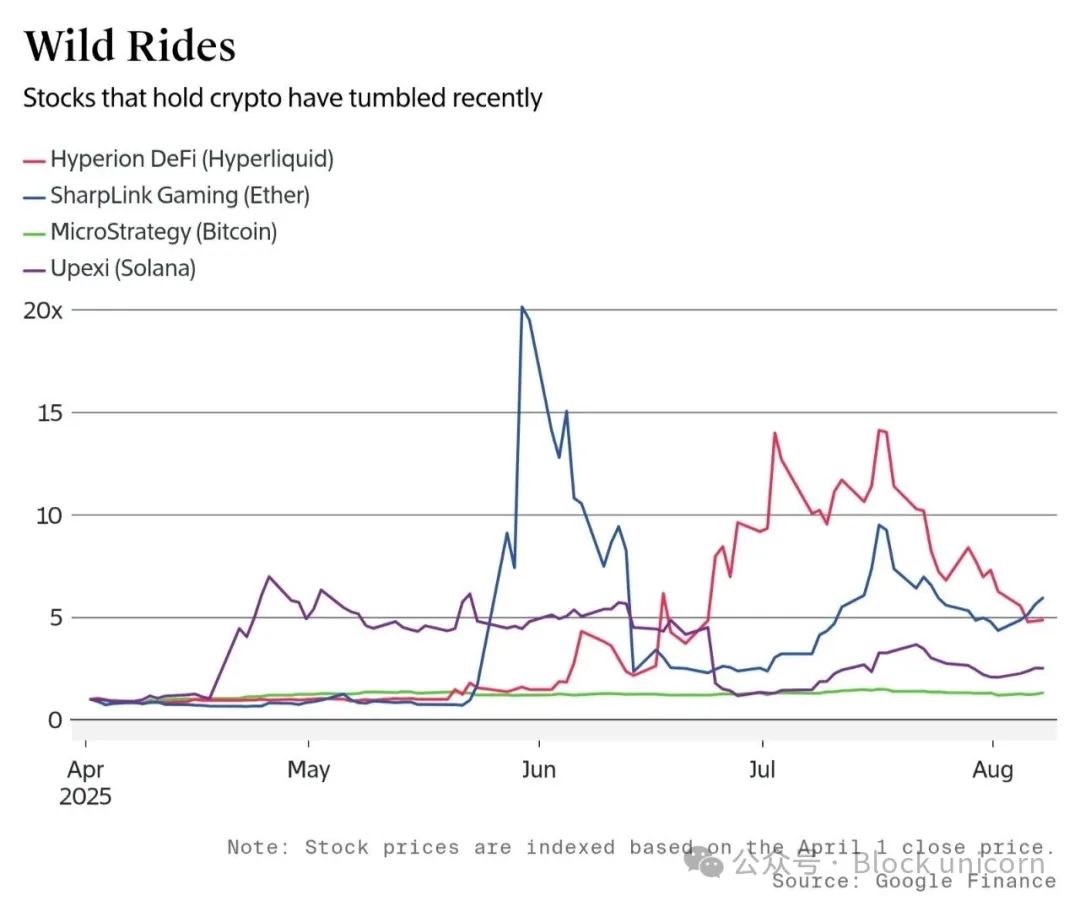
Hyperion DeFi(前身为 Eyenovia 的生物制药股票)在 6 月开始购买 hyperliquid 代币。Hyperliquid 是增长最快的加密货币交易所之一的同名代币。Hyperion 目前的市值为 3050 万美元,尽管根据当前代币价格,它持有的 hyperliquid 代币价值近 6000 万美元。自 7 月 2 日更名为 HYPD 并更改股票代码以来,Hyperion 的股价已下跌 62%。

当这些公司以高于其资产的溢价交易时,筹集资金很容易——但当它们以折扣交易时,情况则相反。这使得它们难以筹集资金购买更多加密货币。在这种情况下,hyperliquid 等基础代币的价值下降可能会进一步压低公司股价。

持有比特币等热门代币的公司表现远优于持有较小代币的公司。根据 Architect Partners 统计的数据,持有比特币、以太坊或 Solana 代币的加密货币库存股自各自公告以来的中位回报率为 92.8%。

相比之下,投资于不太受欢迎代币的加密货币库存股群体的中位回报率为负 24%。

市场疲软可能会降低 Pantera、Hivemind、ParaFi 和 Galaxy Digital 等加密资产管理公司的收益。这些公司会在股票宣布计划之前,通过私募的方式投资那些计划购买加密货币的企业。这些交易几乎总是能带来收益,因为股票通常在公告发布后上涨。

加密货币库存股的兴起增加了传统市场与加密货币之间的联系,可能为股票增加波动性。Hivemind 创始人马特·张表示:「随着这种整合的加深,传统股票投资者将面临他们以前未见过的更多风险。他们可能还不习惯某些代币一天下跌 15%,而这在加密货币领域经常发生。」

加密货币风险投资公司 Castle Island Ventures 的创始合伙人尼克·卡特 (Nic Carter) 表示,该公司一直避免投资加密货币库存股。「我们认为,本质上属于零和博弈的企业存在一定的声誉风险,这类企业的回报主要来自于加杠杆或散户股东以不利价格买入。」


Related Reads

Why Not Short Even When Bearish? Munger Did the Math on a 'Losing Trade'

Why Not Short Even When Bearish? Charlie Munger's Calculated "Loss-Making Account" Many traders, drawn to speculative tools like futures contracts, often face repeated failures. As the article notes, unless one is a genius, such instruments should be avoided for long-term profit-seeking. Similarly, the practice of short selling is viewed with caution. The author firmly states a policy of not shorting, even when bearish, preferring to simply wait. The core reason? Successful short selling requires exceptionally difficult conditions to profit. Legendary investors Warren Buffett and Charlie Munger have themselves reflected on painful short-selling experiences. Munger highlights two critical flaws in the mathematical logic of shorting: 1. Asymmetrical Risk/Reward: A long position has a maximum loss of 100% but unlimited upside. A short position caps profit at 100% (if a stock falls to zero) but carries theoretically unlimited loss potential. 2. The "Promoter" Problem: Fraudulent or struggling companies can prolong their decline. As Munger said, "You can run out of money before the promoter runs out of ideas," meaning short sellers may be forced to cover positions at a loss before the company's true fate unfolds. The article cites Stanley Druckenmiller, a famed hedge fund manager. He once shorted 12 companies that all eventually went bankrupt. However, intense market rallies forced him to cover his positions within three weeks, resulting in massive losses—$200 million of his capital plus an additional $600 million. He concluded he likely never made money shorting in his career. His experience perfectly illustrates Munger's points: facing unlimited losses and being wiped out before being proven right. The conclusion is clear: for most investors, complex instruments like short selling and derivatives are not viable paths to stable, long-term gains. Self-reflection is advised before repeatedly wasting time and capital on such speculative strategies.

marsbit23m ago

Why Not Short Even When Bearish? Munger Did the Math on a 'Losing Trade'

marsbit23m ago

For Hedging, Buy Gold and Oil; For Explosive Growth, Buy AI; Bitcoin, the 'Outdated' Asset, Enters a Bear Market

Bitcoin’s price has recently fallen sharply, hitting a two-month low near $66,000, with Ethereum also dropping to a three-month low. While surface explanations point to ETF outflows, geopolitical tensions, and corporate selling, a deeper issue is emerging: Bitcoin is losing a crucial asset competition. For years, Bitcoin thrived in a low-rate environment where investors sought alternatives amid inflation fears and dissatisfaction with traditional options. Now, the market landscape has shifted, leaving Bitcoin stuck in an "awkward middle ground," facing challenges on three fronts: 1. **As an inflation hedge, gold is winning.** Investors worried about persistent inflation are turning to tangible assets like gold, energy stocks, and commodity producers, which offer more direct pricing power and physical backing. 2. **For growth exposure, AI is winning.** Those seeking high growth now favor AI-related companies with actual revenues and profits, an area where Bitcoin's lack of cash flow puts it at a disadvantage. 3. **Within crypto, infrastructure and stablecoins are winning.** Even investors wanting crypto exposure have alternatives like exchanges, stablecoin issuers, and tokenization firms, whose performance is directly tied to real-world adoption and offers clearer operational leverage. The recent market reaction to inflation warnings highlights this shift. Instead of boosting Bitcoin as "digital gold," such news now drives flows toward traditional inflation-sensitive assets. Therefore, recent events like ETF outflows and corporate selling are seen not as causes, but as symptoms of this new reality. Capital has more compelling options, and investors are becoming more selective. The emerging bear case for Bitcoin is no longer about it being a fraud or failed technology, but rather that **scarcity alone is no longer enough**. It is no longer seen as the best hedge, the best growth asset, or the only crypto play.

marsbit39m ago

For Hedging, Buy Gold and Oil; For Explosive Growth, Buy AI; Bitcoin, the 'Outdated' Asset, Enters a Bear Market

marsbit39m ago

SaaS Battle Royale: The Survivors Who Win All Share One Common Trait

**Summary** The AI revolution has triggered a "SaaS apocalypse," forcing a brutal market shakeout. The key dividing line is the pricing model. Companies like Snowflake and Datadog, which charge based on consumption (e.g., data processed or compute used), are thriving. AI workloads actively *generate* more demand for their services, fueling growth. Datadog's accelerating revenue is a prime example. Microsoft and Palantir, as platform/ecosystem players, also benefit by acting as essential channels for AI deployment. In contrast, traditional SaaS firms built on per-seat or per-task licensing (e.g., Intuit, Adobe) face direct pressure, as AI threatens to automate the very human tasks their software supports. Companies like Salesforce, a per-seat giant, are caught in the middle. While showing strong AI monetization (e.g., its Agentforce platform) and experimenting with consumption-based "Flex Credits," its stock remains under pressure, illustrating that the market rewards *completed* transitions, not just the intent. The recent Microsoft Build conference underscored key trends: AI is evolving from an assistant to an autonomous "agent," and platform providers like Microsoft are consolidating their control. The market's recovery is highly selective, focused on identifying which companies are "fed by AI" versus "eaten by AI." Future focus will be on the diffusion of this recovery to transforming companies and the real-world adoption data of AI agents like Microsoft Copilot.

marsbit56m ago

SaaS Battle Royale: The Survivors Who Win All Share One Common Trait

marsbit56m ago

Trading

Spot
Futures

Hot Articles

What is $BITCOIN

DIGITAL GOLD ($BITCOIN): A Comprehensive Analysis Introduction to DIGITAL GOLD ($BITCOIN) DIGITAL GOLD ($BITCOIN) is a blockchain-based project operating on the Solana network, which aims to combine the characteristics of traditional precious metals with the innovation of decentralized technologies. While it shares a name with Bitcoin, often referred to as “digital gold” due to its perception as a store of value, DIGITAL GOLD is a separate token designed to create a unique ecosystem within the Web3 landscape. Its goal is to position itself as a viable alternative digital asset, although specifics regarding its applications and functionalities are still developing. What is DIGITAL GOLD ($BITCOIN)? DIGITAL GOLD ($BITCOIN) is a cryptocurrency token explicitly designed for use on the Solana blockchain. In contrast to Bitcoin, which provides a widely recognized value storage role, this token appears to focus on broader applications and characteristics. Notable aspects include: Blockchain Infrastructure: The token is built on the Solana blockchain, known for its capacity to handle high-speed and low-cost transactions. Supply Dynamics: DIGITAL GOLD has a maximum supply capped at 100 quadrillion tokens (100P $BITCOIN), although details regarding its circulating supply are currently undisclosed. Utility: While precise functionalities are not explicitly outlined, there are indications that the token could be utilized for various applications, potentially involving decentralized applications (dApps) or asset tokenization strategies. Who is the Creator of DIGITAL GOLD ($BITCOIN)? At present, the identity of the creators and development team behind DIGITAL GOLD ($BITCOIN) remains unknown. This situation is typical among many innovative projects within the blockchain space, particularly those aligning with decentralized finance and meme coin phenomena. While such anonymity may foster a community-driven culture, it intensifies concerns about governance and accountability. Who are the Investors of DIGITAL GOLD ($BITCOIN)? The available information indicates that DIGITAL GOLD ($BITCOIN) does not have any known institutional backers or prominent venture capital investments. The project seems to operate on a peer-to-peer model focused on community support and adoption rather than traditional funding routes. Its activity and liquidity are primarily situated on decentralized exchanges (DEXs), such as PumpSwap, rather than established centralized trading platforms, further highlighting its grassroots approach. How DIGITAL GOLD ($BITCOIN) Works The operational mechanics of DIGITAL GOLD ($BITCOIN) can be elaborated on based on its blockchain design and network attributes: Consensus Mechanism: By leveraging Solana’s unique proof-of-history (PoH) combined with a proof-of-stake (PoS) model, the project ensures efficient transaction validation contributing to the network's high performance. Tokenomics: While specific deflationary mechanisms have not been extensively detailed, the vast maximum token supply implies that it may cater to microtransactions or niche use cases that are still to be defined. Interoperability: There exists the potential for integration with Solana’s broader ecosystem, including various decentralized finance (DeFi) platforms. However, the details regarding specific integrations remain unspecified. Timeline of Key Events Here is a timeline that highlights significant milestones concerning DIGITAL GOLD ($BITCOIN): 2023: The initial deployment of the token occurs on the Solana blockchain, marked by its contract address. 2024: DIGITAL GOLD gains visibility as it becomes available for trading on decentralized exchanges like PumpSwap, allowing users to trade it against SOL. 2025: The project witnesses sporadic trading activity and potential interest in community-led engagements, although no noteworthy partnerships or technical advancements have been documented as of yet. Critical Analysis Strengths Scalability: The underlying Solana infrastructure supports high transaction volumes, which could enhance the utility of $BITCOIN in various transaction scenarios. Accessibility: The potential low trading price per token could attract retail investors, facilitating wider participation due to fractional ownership opportunities. Risks Lack of Transparency: The absence of publicly known backers, developers, or an audit process may yield skepticism regarding the project's sustainability and trustworthiness. Market Volatility: The trading activity is heavily reliant on speculative behavior, which can result in significant price volatility and uncertainty for investors. Conclusion DIGITAL GOLD ($BITCOIN) emerges as an intriguing yet ambiguous project within the rapidly evolving Solana ecosystem. While it attempts to leverage the “digital gold” narrative, its departure from Bitcoin's established role as a store of value underscores the need for a clearer differentiation of its intended utility and governance structure. Future acceptance and adoption will likely depend on addressing the current opacity and defining its operational and economic strategies more explicitly. Note: This report encompasses synthesised information available as of October 2023, and developments may have transpired beyond the research period.

363 Total ViewsPublished 2025.05.13Updated 2025.05.13

What is $BITCOIN

Discussions

Welcome to the HTX Community. Here, you can stay informed about the latest platform developments and gain access to professional market insights. Users' opinions on the price of BTC (BTC) are presented below.

活动图片