“炒币养老”成真!特朗普拉全美国人民上”赌桌”

比推Published on 2025-08-07Last updated on 2025-08-07

23d54303-2965-4ced-8936-ba33e8ff5999.png

2025年8月7日,一项注定在美国金融史上留下浓墨重彩的一笔悄然落下。

特朗普签署了一份行政命令,允许美国退休储蓄账户401(k)正式投资包括加密货币、私募股权和房地产在内的“另类资产”。从此,一个曾被主流金融体系排斥的边缘资产类别,被正式写入了美国近9万亿美元规模的退休金计划中。

这不仅是监管态度的一次关键转向,更可能是数字资产迈向真正主流化的临界点。

从边缘资产到主流渠道:一纸行政令的撬动效应

长期以来,美国401(k)计划——这项为9000万劳动者服务的退休储蓄工具——主要投资于传统资产:股票、债券、以及指数基金,如S&P500的ETF。另类资产,比如加密货币,虽然在市场上愈发活跃,却被长期排除在退休金系统之外,监管机构也始终抱持谨慎甚至敌意的态度。

但2025年,一切开始变化。华盛顿对数字资产释放出前所未有的善意,特朗普政府积极推动了一场“去监管化”浪潮,而加密资产成为这场浪潮中最受宠的角色之一。

特朗普的新行政令要求劳工部重新评估《员工退休收入保障法案》(ERISA)中的相关规定,为401(k)计划纳入数字资产和私募投资“提供路径”,也为监管机构“调试规则”预留空间。

据《金融时报》披露,特朗普与加密行业的深度绑定在其中发挥了作用:“如果只有私募股权,命令很可能无法推进,是加密货币让特朗普最终拍了板。”

能有多少配比?会带来多少资金?

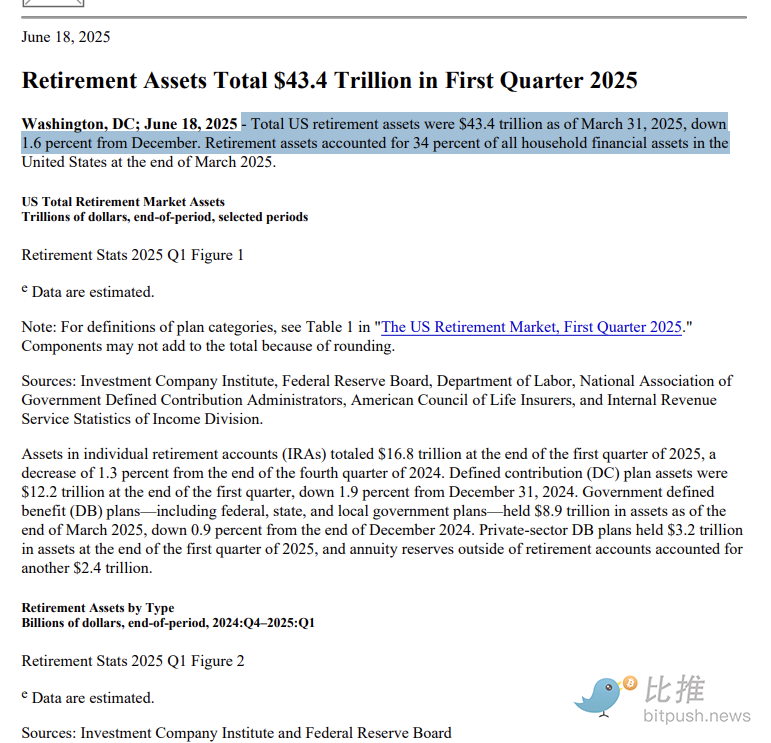
根据最新的数据,美国401(k)计划的市场规模极为庞大。截至2025年第一季度末,美国雇主提供的401(k)计划资产总额约为8.7万亿美元。整个美国退休市场(包括401(k)、IRA等)的资产总额更是高达43.4万亿美元

b5df99ce-2e6e-447c-9295-68e63874d221.png

那么,能够分配给加密货币的资金能有多少呢?目前还没有一个确切的数字。

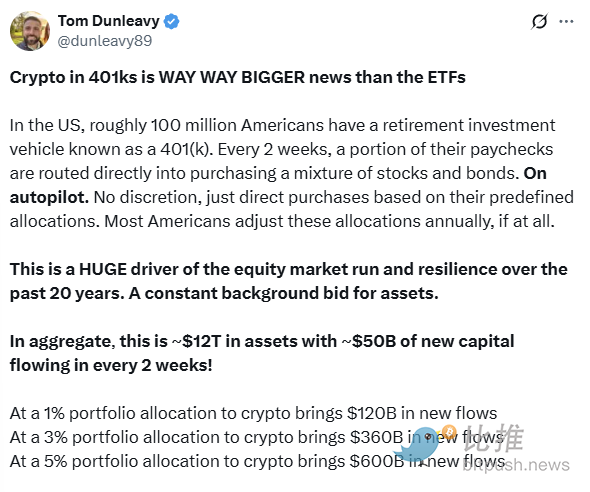
Varys Capital风险投资总监Tom Dunleavy给出了一个假设:

“如果每个美国人的401(k)账户,将现有资产中的1%配置到加密货币,那么将有1200亿美元涌入加密市场。若是3%,就是3600亿;5%,则高达6000亿美元。”
4a0b0260-5def-4947-b0aa-91d9c0432e84.png

这是一种长期且稳定的资金流入路径:大多数美国人每两周从工资中提取一部分自动转入401(k),而一旦数字资产被纳入资产池,就意味着持续性的被动买入行为。

对于一个仍以波动性著称的市场,这不仅是资金,更是一种情绪托底。“这将为比特币和以太坊带来更稳定的价格支撑区间。”Dunleavy表示。

Bitwise研究主管Ryan Rasmussen则补充道:

“短期来看,这项行政令向市场传达了一个信号:加密资产已经从边缘走向制度性认同。”

ETF:最佳桥接方式

除了直接纳入401(k)资产池外,加密ETF成为最被看好的通道。

截至2025年中,比特币和以太坊相关ETF已吸引超过130亿美元的净流入。BlackRock推出的iShares Bitcoin Trust(IBIT)和VanEck的Ethereum ETF(ETHV)分别取得了20%和11%的年内回报。

ETF的好处显而易见:

  • 不需要开设加密钱包;

  • 无需操作去中心化交易所;

  • 由受监管基金公司发行;

  • 可与传统资产并列纳入投资组合。

就像买GLD黄金ETF远比购买实物金条方便一样,ETF成为退休投资者进场加密的首选工具。

真正执行还有多远?

特朗普行政命令可以释放方向信号,但从“写在纸上”到“出现在账户中”,中间隔着多个现实层面的障碍。这场加密资产进401(k)的改革,正处在“政策意图”与“执行现实”之间的落差中。

我们可以从三个维度来分析这条落地路径的复杂性:

法规障碍尚未彻底清除

虽然总统签署了行政命令,但该命令本身不具备立即改变法规的效力。它的作用是指令美国劳工部(DoL)、证券交易委员会(SEC)等机构“重新评估并修改”当前监管规则。

据CNBC报道,当前401(k)计划受《员工退休收入保障法》(ERISA)管辖,该法明确要求计划受托人遵循“审慎人标准”(prudent man rule),以最大限度保障参与者利益。但加密资产的高波动性、流动性差、估值不透明等特点,使其难以通过审慎性测试,2022年Fidelity曾推出401(k)比特币配置选项,结果立即遭到劳工部公开质疑并面临审查压力。尽管2025年政策方向转变,细则尚未发布,基金提供商若贸然行动,仍面临潜在合规诉讼风险。

计划提供商的现实顾虑:不想当“替罪羊”

401(k)计划大多由雇主与第三方服务商合作运营,涉及Vanguard、Fidelity、Empower等大型平台。但截至目前,很多平台对加密选项普遍持谨慎观望态度。

原因主要包括:

  • 法律责任重:若投资者亏损,基金管理人和雇主可能因“未尽受托责任”而遭到起诉。

  • 投资者教育缺失:大多数401(k)用户对加密资产缺乏理解,容易误判风险。

  • 技术集成成本高:引入新资产类别需要重新对接风控系统、报告逻辑、KYC流程,非小工程。

因此,短期内即便政策允许,多数加密投资仍需依托“自选券商窗口(Self-Directed Brokerage Window)”渠道进行,该机制目前主要存在于部分大型公司的401(k)计划中。这种方式通常只被少数对投资有深入了解的员工使用。而作为核心投资选项,最可能的载体将是现货比特币和以太坊ETF,因为这些产品相对成熟,且受监管程度更高。

加密市场自身的不确定性仍是最大变量

即使监管放松、执行意愿具备,加密市场是否真的准备好承接长期资本仍是未知数。

  • 比特币、以太坊年内反弹显著,但仍伴随30%以上的日内高波动;

  • 杠杆ETF、链上合约产品层出不穷,进一步放大散户风险;

  • FTX等平台的爆雷阴影仍未完全散去,投资者信任重建仍在进行;

  • 对许多监管者而言,加密资产仍然缺乏可预测性和稳定收益逻辑。

在CNBC的《ETF Edge》节目中,Teucrium Trading总裁Sal Gilbertie指出:“杠杆加密 ETF 是激进的产品,不适合退休投资组合——它们旨在进行日内交易”。

“从边缘到核心”,走了十六年

从2009年中本聪挖出第一枚比特币,到2025年它被纳入美国养老金系统,用了16年。

这场“从边缘到核心”的变革不是偶然,而是多重力量——政治动机、投资共识、市场逻辑、技术进步——交织而成的结果。

一个必须承认的事实是,特朗普家族及其核心圈层与加密货币行业存在密切的商业往来。公开数据显示,其家族资产中已有数十亿美元投资于加密货币及相关企业。加密货币从边缘走向主流的过程,既反映了监管态度的转变,也引发了关于权力与资本关系的讨论。

如今,随着加密货币被纳入401(k)养老金计划,它的角色已经发生了根本性变化——不再只是一种投机性资产,而是逐渐融入国家金融体系的组成部分。不过,这场变革才刚刚开始。加密货币能否真正成为养老金投资的可靠选择?目前看来,它仍需面对市场波动、监管框架和长期价值等多重考验。最终,这场实验不仅关乎投资回报,更可能重塑未来金融体系的格局。


Twitter:https://twitter.com/BitpushNewsCN

比推 TG 交流群:https://t.me/BitPushCommunity

比推 TG 订阅: https://t.me/bitpush

说明: 比推所有文章只代表作者观点,不构成投资建议

Related Reads

Deconstructing the U.S. Stock Quantum Computing Sector: IonQ, Rigetti, D-Wave, Which of These Concept Stocks is Worth Betting On?

**Title:** Analyzing the US Quantum Computing Race: IonQ, Rigetti, D-Wave – Which Concept Stock is Worth Betting On? **Summary:** The podcast discusses the resurgence of quantum computing as a national priority for both the US and China, driven by its potential to break current encryption, revolutionize drug discovery, finance, and logistics. The core challenge is commercializing the technology, which is hampered by high error rates in quantum bits (qubits). Quantum error correction, requiring thousands of physical qubits per reliable logical qubit, is key but years away. The analysis compares three main publicly traded US quantum computing firms: * **IonQ (Ion Trap):** Considered the most financially stable with the fastest commercial progress (2025 revenue: $130M, +202%) and high-quality clients. Its valuation is very high, pricing in significant future growth. * **Rigetti (Superconducting):** Seen as the highest-risk, highest-potential-reward bet. It has the smallest revenue but recently launched a 108-qubit system. Its valuation multiples are extreme, making it highly sensitive to news. * **D-Wave (Quantum Annealing):** Has the most unique positioning with real-world enterprise clients today (e.g., Mastercard, Volkswagen) solving optimization problems. Its recent acquisition moves it into general-purpose quantum computing ("dual-platform"), adding execution risk. Major tech giants like Google, IBM, and Microsoft are also heavily invested, pursuing various technical approaches. Nvidia is positioning itself as the essential bridge between classical and quantum computing. The investment phase is likened to AI in 2018-2020: promising underlying technology with accelerating breakthroughs but a commercial inflection point still 3-7 years away, suggesting potential for a market correction ("bubble washout"). For investors, suggested approaches include gaining exposure through tech giants with quantum divisions (e.g., Google, IBM) or using niche ETFs like WQTM for pure-play quantum exposure, rather than direct stock picks in the highly volatile pure-play companies at this early stage.

marsbit22m ago

Deconstructing the U.S. Stock Quantum Computing Sector: IonQ, Rigetti, D-Wave, Which of These Concept Stocks is Worth Betting On?

marsbit22m ago

From Parallel Finance to Mainstream Finance: The On-Chain Securities Era Ushers in a Historic Window

From Parallel Finance to Mainstream: The Dawn of On-Chain Securities For over a decade, the crypto industry has operated as a parallel financial system with its own currencies, markets, and assets—from Bitcoin and ICOs to DeFi, NFTs, and memecoins. Despite building a robust internal ecosystem, a wall has separated it from the traditional financial world. That barrier is now crumbling. The industry's first act was one of internal evolution: ICOs streamlined fundraising, DeFi recreated financial services on-chain, and layer-2 networks competed for scalability—all within the crypto bubble. While innovative, this cycle remained closed, with capital and users circulating internally, leading to volatile boom-bust cycles. Even Bitcoin ETFs, while attracting Wall Street capital, merely provided a channel to buy crypto assets without bridging the systems. The next, larger narrative is Real-World Assets (RWA) moving on-chain. This involves tokenizing stocks, bonds, funds, and future cash flows. Blockchain can compress the complex traditional processes of trading, settlement, clearing, and custody into a seamless, automated network operating in seconds. This shift is creating a new financial gateway: the native crypto securities broker. This entity will combine functions of an exchange, broker, bank, and custodian into a unified global financial operating system. Consequently, the next major battleground won't be the "public chain wars" focused on speed and cost, but the competition to build the financial infrastructure capable of hosting high-quality, liquid real-world assets. Access to global equities, index funds, or stakes in companies like SpaceX could erase the boundary between crypto and traditional finance, unlocking a market orders of magnitude larger than crypto's current valuation. In summary, after years of creating a separate financial world, crypto's next decade will be defined by its integration into the existing global financial system, marking the true beginning of its largest growth story.

marsbit43m ago

From Parallel Finance to Mainstream Finance: The On-Chain Securities Era Ushers in a Historic Window

marsbit43m ago

Wang Chuan: When the Neighbor Old Wang Made 30x on Memory Stocks, How to Avoid Anxiety (Part Six) - The Trap of Commoditized Goods

Wang Chuan: When the Neighbor Lao Wang Made 30x on Storage Stocks, How to Stay Anxiety-Free (Part 6) - The Trap of Commoditized Goods. This essay uses historical and current examples to analyze the cyclical and high-risk nature of the data storage industry. It begins with the 1990s rise and dramatic fall of Iomega, whose stock soared over 160x in 18 months before collapsing 97% from its peak, illustrating the fleeting success of storage "meme stocks." The core problem is that storage products, like DRAM and flash memory, are highly commoditized. This leads to extreme volatility: prices have plummeted over 80% multiple times, and company stocks often crash 95% or go bankrupt. The industry's dynamic is defined by "elastic demand facing heavy-asset, long-cycle, rigid supply." When demand spikes and supply is fixed, prices skyrocket, as seen recently with AI-driven demand for High Bandwidth Memory (HBM). Companies like Sandisk and Micron have reported massive revenue and gross margin jumps (e.g., Sandisk's gross margin rising from 22.5% to 78.3%) despite minimal increases in production volume. However, these high margins are self-defeating. They incentivize massive new capacity investments (hundreds of billions planned from 2026), with supply expected to surge by late 2027. Once new supply meets demand, prices and profits will crash, potentially leading to a scenario where "selling more results in earning less." The article debunks the safety of long-term supply agreements, comparing them to fragile non-aggression pacts easily broken when market conditions shift. It warns that when an industry is highly profitable but trades at low P/E ratios, the risk is greatest, as plummeting prices quickly erase those earnings. Multiple asymmetric risks loom, including economic recession, reduced AI spending, faster-than-expected capacity expansion (especially from Chinese firms), and technological innovations that reduce memory requirements. In conclusion, the storage sector is a cyclical trap where periods of euphoric profits are often precursors to devastating downturns, luring unprepared investors into a "wealth incinerator."

marsbit53m ago

Wang Chuan: When the Neighbor Old Wang Made 30x on Memory Stocks, How to Avoid Anxiety (Part Six) - The Trap of Commoditized Goods

marsbit53m ago

Wang Chuan: When the neighbor Lao Wang earned thirty times from investing in memory storage stocks, how can you still avoid anxiety (6) - The trap of homogeneous products

The article, "Wang Chuan: How to Remain Unanxious After Neighbor Lao Wang's Thirty-Fold Gain on Storage Stocks (Part 6) - The Trap of Commoditized Goods," analyzes the cyclical and perilous nature of the data storage industry through historical and current case studies. It begins with the example of Iomega, whose Zip drives led to a stock surge of over 160x in the mid-1990s before collapsing over 97% from its peak due to competition from cheaper CD-R technology. This pattern is characteristic of storage, where products like DRAM are highly commoditized, leading to extreme price volatility. The sector has seen prices crash over 80% multiple times, with companies often facing bankruptcy. The core dynamic is "elastic demand facing heavy-asset, long-cycle, rigid supply." High prices attract new capacity, but the long lead time means supply eventually overshoots, causing sharp price corrections. The current AI-driven boom, exemplified by surging demand for High-Bandwidth Memory (HBM), has led to skyrocketing prices and profit margins for companies like SanDisk and Micron, despite relatively flat production volumes. However, the author warns this high-margin environment is self-defeating. The high profits are already triggering massive new capacity investments (hundreds of billions starting 2026), with supply expected to ramp up by late 2027. When supply catches up, total revenue and profits may fall even as more units are sold. Long-term supply agreements offer little protection, as buyers can find ways to renegotiate if market prices drop, similar to fragile political treaties. Key risks include economic downturns, cuts in AI spending, faster-than-expected capacity expansion (especially from Chinese firms), and innovations in chip/algorithm design that reduce memory needs. A critical trap is that at the cycle's peak, storage stocks often appear cheap with low P/E ratios, luring value investors just before an impending downturn where profits evaporate. The conclusion cautions that for commoditized goods like storage, high margins inevitably destroy themselves, and the current asymmetry favors downside risk over further upside. The neighbor's dream of easy wealth from storage stocks is portrayed as a precarious illusion.

链捕手1h ago

Wang Chuan: When the neighbor Lao Wang earned thirty times from investing in memory storage stocks, how can you still avoid anxiety (6) - The trap of homogeneous products

链捕手1h ago

Trading

Spot
Futures
活动图片