Ethereum Bears In Pole Position: $1,850 Could Be The Next Landing Spot

bitcoinistPublished on 2026-06-01Last updated on 2026-06-01

Abstract

Ethereum's price remained bearish in May, with analysts predicting a potential drop to around $1,850. Crypto analyst Burak Kesmeci notes that ETH is trapped in a descending channel on the 4-hour chart, indicating seller dominance. If it fails to break the $2,033 resistance, a decline to the $1,822-$1,850 range is likely. While a breakout above $2,033 could target $2,400, the downward move appears more probable. This bearish outlook is reinforced by significant outflows from spot Ethereum ETFs, totaling over $241 million in the past week—the third consecutive week of major outflows. ETH has lost nearly 15% of its value over the last three weeks and is currently trading around $2,023.

The price performance of Ethereum was disappointing for most of May, as the bears seemed to be in full control. It doesn’t seem like much will change for the “King of Altcoins” in the new month, which appears to be a mere continuation of the established downward trend. According to a popular analyst on the social media platform X, the Ethereum price could be on its way down to around $1,850.

Is ETH Price Stuck In A Descending Channel?

Crypto analyst Burak Kesmeci took to the X platform to share his projection for the Ethereum price over the coming days. The market pundit posited that the second-largest cryptocurrency could decline toward the $1,822-$1,850 range if it fails to break the $2,033 resistance in the next few days.

This bearish outlook is premised on the fact that sellers have been in a dominant position in the short term and for much of the past month. This dominance is evident in the formation of a descending channel on the four-hour timeframe of the Ethereum price chart.

A descending channel is a technical analysis chart pattern characterized by two major trendlines: the upper boundary connecting the lower highs and the lower line connecting the lower lows. This chart formation is often correlated to a bearish structure, with the upper trendline acting as resistance and the lower boundary as the price floor.
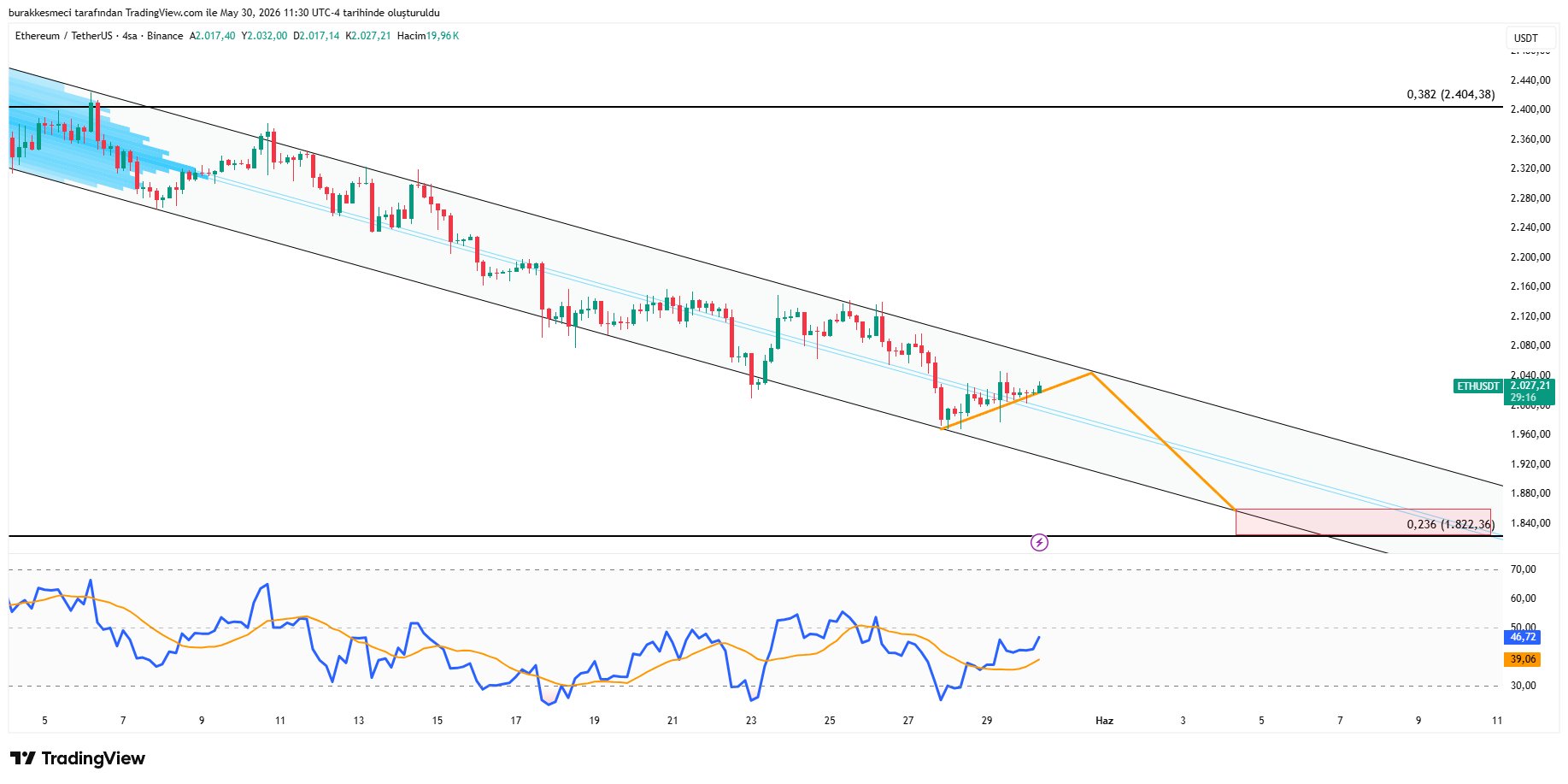
Source: @burak_kesmeci on X

According to Kesmeci, the persistence of the Ethereum price within the descending channel and the weak price momentum suggest that a downward move is on the cards. The crypto analyst highlighted that ETH could drop to the $1,822 – $1,850 range, so long as the overhead resistance at the upper boundary of $2,033 (Fibonacci 0.5) holds.

However, there is also the flipside scenario in which the price of Ethereum could break out toward $2,400 if the $2.033 resistance is breached. However, the decline toward the $1,850 region seems more likely, especially given current demand conditions.

Ethereum ETFs Post $241 Million In Outflows Over The Past Week

This dwindling demand in the Ethereum market is evident in rising spot ETF outflows, which climbed above $241 million over the past week. This past week’s record marked the third consecutive week with significant net outflows for the spot ETH exchange-traded funds.

The Ethereum price action over the past three weeks has been a fair reflection of this pessimistic market condition. According to CoinGecko data, the second-largest cryptocurrency has lost nearly 15% of its value in the last three weeks.

As of this writing, the price of ETH stands at around $2,023, with no significant change in the past 24 hours.

The price of ETH on the daily timeframe | Source: ETHUSDT chart on TradingView


Related Questions

QWhat is the main bearish price target for Ethereum mentioned in the article, and who provided this analysis?

AThe main bearish price target mentioned is a decline to the $1,822-$1,850 range. This analysis was provided by crypto analyst Burak Kesmeci on the social media platform X.

QWhat technical chart pattern is the analyst using to support the bearish outlook for Ethereum?

AThe analyst is using a descending channel pattern on the four-hour timeframe of the Ethereum price chart to support the bearish outlook.

QAccording to the article, what is the key resistance level Ethereum needs to break to invalidate the bearish scenario?

AThe key resistance level Ethereum needs to break is $2,033. If breached, the price could potentially break out toward $2,400.

QWhat recent market development reflects the dwindling demand for Ethereum, and what is the specific figure mentioned?

AThe recent market development reflecting dwindling demand is the rising outflows from spot Ethereum ETFs, which climbed above $241 million over the past week.

QHow much value has Ethereum lost in the last three weeks according to CoinGecko data cited in the article?

AAccording to CoinGecko data cited in the article, Ethereum has lost nearly 15% of its value in the last three weeks.

Related Reads

For Hedging, Buy Gold and Oil; For Explosive Growth, Buy AI; Bitcoin, the 'Outdated' Asset, Enters a Bear Market

Bitcoin’s price has recently fallen sharply, hitting a two-month low near $66,000, with Ethereum also dropping to a three-month low. While surface explanations point to ETF outflows, geopolitical tensions, and corporate selling, a deeper issue is emerging: Bitcoin is losing a crucial asset competition. For years, Bitcoin thrived in a low-rate environment where investors sought alternatives amid inflation fears and dissatisfaction with traditional options. Now, the market landscape has shifted, leaving Bitcoin stuck in an "awkward middle ground," facing challenges on three fronts: 1. **As an inflation hedge, gold is winning.** Investors worried about persistent inflation are turning to tangible assets like gold, energy stocks, and commodity producers, which offer more direct pricing power and physical backing. 2. **For growth exposure, AI is winning.** Those seeking high growth now favor AI-related companies with actual revenues and profits, an area where Bitcoin's lack of cash flow puts it at a disadvantage. 3. **Within crypto, infrastructure and stablecoins are winning.** Even investors wanting crypto exposure have alternatives like exchanges, stablecoin issuers, and tokenization firms, whose performance is directly tied to real-world adoption and offers clearer operational leverage. The recent market reaction to inflation warnings highlights this shift. Instead of boosting Bitcoin as "digital gold," such news now drives flows toward traditional inflation-sensitive assets. Therefore, recent events like ETF outflows and corporate selling are seen not as causes, but as symptoms of this new reality. Capital has more compelling options, and investors are becoming more selective. The emerging bear case for Bitcoin is no longer about it being a fraud or failed technology, but rather that **scarcity alone is no longer enough**. It is no longer seen as the best hedge, the best growth asset, or the only crypto play.

marsbit3m ago

For Hedging, Buy Gold and Oil; For Explosive Growth, Buy AI; Bitcoin, the 'Outdated' Asset, Enters a Bear Market

marsbit3m ago

SaaS Battle Royale: The Survivors Who Win All Share One Common Trait

**Summary** The AI revolution has triggered a "SaaS apocalypse," forcing a brutal market shakeout. The key dividing line is the pricing model. Companies like Snowflake and Datadog, which charge based on consumption (e.g., data processed or compute used), are thriving. AI workloads actively *generate* more demand for their services, fueling growth. Datadog's accelerating revenue is a prime example. Microsoft and Palantir, as platform/ecosystem players, also benefit by acting as essential channels for AI deployment. In contrast, traditional SaaS firms built on per-seat or per-task licensing (e.g., Intuit, Adobe) face direct pressure, as AI threatens to automate the very human tasks their software supports. Companies like Salesforce, a per-seat giant, are caught in the middle. While showing strong AI monetization (e.g., its Agentforce platform) and experimenting with consumption-based "Flex Credits," its stock remains under pressure, illustrating that the market rewards *completed* transitions, not just the intent. The recent Microsoft Build conference underscored key trends: AI is evolving from an assistant to an autonomous "agent," and platform providers like Microsoft are consolidating their control. The market's recovery is highly selective, focused on identifying which companies are "fed by AI" versus "eaten by AI." Future focus will be on the diffusion of this recovery to transforming companies and the real-world adoption data of AI agents like Microsoft Copilot.

marsbit20m ago

SaaS Battle Royale: The Survivors Who Win All Share One Common Trait

marsbit20m ago

Trading

Spot
Futures

Hot Articles

Discussions

Welcome to the HTX Community. Here, you can stay informed about the latest platform developments and gain access to professional market insights. Users' opinions on the price of ETH (ETH) are presented below.

活动图片