From Parallel Finance to Mainstream Finance: The On-Chain Securities Era Ushers in a Historic Window

marsbitPublished on 2026-06-01Last updated on 2026-06-01

Abstract

From Parallel Finance to Mainstream: The Dawn of On-Chain Securities For over a decade, the crypto industry has operated as a parallel financial system with its own currencies, markets, and assets—from Bitcoin and ICOs to DeFi, NFTs, and memecoins. Despite building a robust internal ecosystem, a wall has separated it from the traditional financial world. That barrier is now crumbling. The industry's first act was one of internal evolution: ICOs streamlined fundraising, DeFi recreated financial services on-chain, and layer-2 networks competed for scalability—all within the crypto bubble. While innovative, this cycle remained closed, with capital and users circulating internally, leading to volatile boom-bust cycles. Even Bitcoin ETFs, while attracting Wall Street capital, merely provided a channel to buy crypto assets without bridging the systems. The next, larger narrative is Real-World Assets (RWA) moving on-chain. This involves tokenizing stocks, bonds, funds, and future cash flows. Blockchain can compress the complex traditional processes of trading, settlement, clearing, and custody into a seamless, automated network operating in seconds. This shift is creating a new financial gateway: the native crypto securities broker. This entity will combine functions of an exchange, broker, bank, and custodian into a unified global financial operating system. Consequently, the next major battleground won't be the "public chain wars" focused on speed and cost, but the competition ...

Author: Climber, CryptoPulse Labs

For over a decade, the crypto industry has been like a financial experiment operating independently from the real world. It has its own monetary system, its own trading markets, its own logic for asset pricing, and its own set of beliefs and narratives.

From the birth of Bitcoin, through the ICO boom, to the explosion of DeFi, NFTs, Layer 2s, meme coins, and on-chain derivatives, the crypto world has gradually built an almost complete financial ecosystem.

But no matter how it has developed, one question has always remained. That is, a wall still separates the crypto world and the real-world financial system. Now, this wall is being dismantled. In the next decade, an era of native crypto securities brokerage that integrates with the global financial system is opening up.

I: The First Half of the Crypto Industry: The Self-Evolution of a Closed Ecosystem

In recent years, the U.S. CFTC has been gradually promoting a regulatory framework for compliant perpetual contracts, and the U.S. SEC has also begun to consistently signal policy support for tokenizing securities. The recent news about SpaceX's upcoming super IPO event has also made the market realize that the world's highest-quality assets in the future may be seeking new ways to circulate.

Scenarios that once sounded like science fiction are now step by step becoming reality. This means the crypto industry is about to enter a new stage.

However, looking back at the history of the crypto industry, it becomes clear that the past decade-plus has actually been an ongoing, escalating internal financial experiment.

The 2017 ICO frenzy essentially solved the fundraising problem. For the first time, startup projects didn't need traditional VCs or IPO approvals; with just a whitepaper and a token model, they could raise funds globally. The market saw for the first time the immense efficiency gains blockchain could bring to capital formation.

The subsequent DeFi Summer then began to address the issue of financial services. Lending, trading, market-making, yield aggregation began to move on-chain. Functions originally performed by banks, brokerages, and financial institutions were gradually replaced by smart contracts. The most important change during this period was not the emergence of a particular killer protocol, but the fact that the entire financial infrastructure began to be reconstructed.

Next, the industry entered the era of the public chain war. Due to Ethereum's performance limitations, numerous high-performance public chains began competing for developers, users, and liquidity. Faster speeds, lower costs, and higher TPS became the focus of market competition. However, looking back, this competition was still essentially internal.

Because the participants didn't change—users were still crypto users, capital was still crypto capital, and assets were still crypto assets.

Later, the NFT boom shifted the industry narrative from finance to culture and social interaction. Digital collectibles, on-chain identity, and gaming assets entered the market. This was followed by the meme coin frenzy, decentralized perpetual contracts, DAT, and other new models continuously emerging.

While the industry seems to have been evolving, most of these changes occurred within the same circle. The crypto world has been more like an ever-expanding closed economy, with capital flowing internally, users circulating internally, new assets constantly being created, and then being bought up by new capital.

This is also why every cycle has seen obvious bubbles and pullbacks—because truly massive external capital had never fully entered.

Even with Bitcoin ETFs starting to attract Wall Street capital, the crypto industry has still not truly connected with the real-world financial system. Because ETFs only allow traditional capital to buy crypto assets; real-world assets have not yet truly moved on-chain.

II. A Bigger Story than ETFs: Real-World Assets Begin Moving On-Chain

Many believe that Bitcoin ETFs opened the door for traditional finance to embrace crypto. But in reality, ETFs are only the first step.

Because they merely add a channel for the traditional financial system to purchase crypto assets. What could truly change the industry's structure is another matter—securities assets beginning to enter the on-chain world.
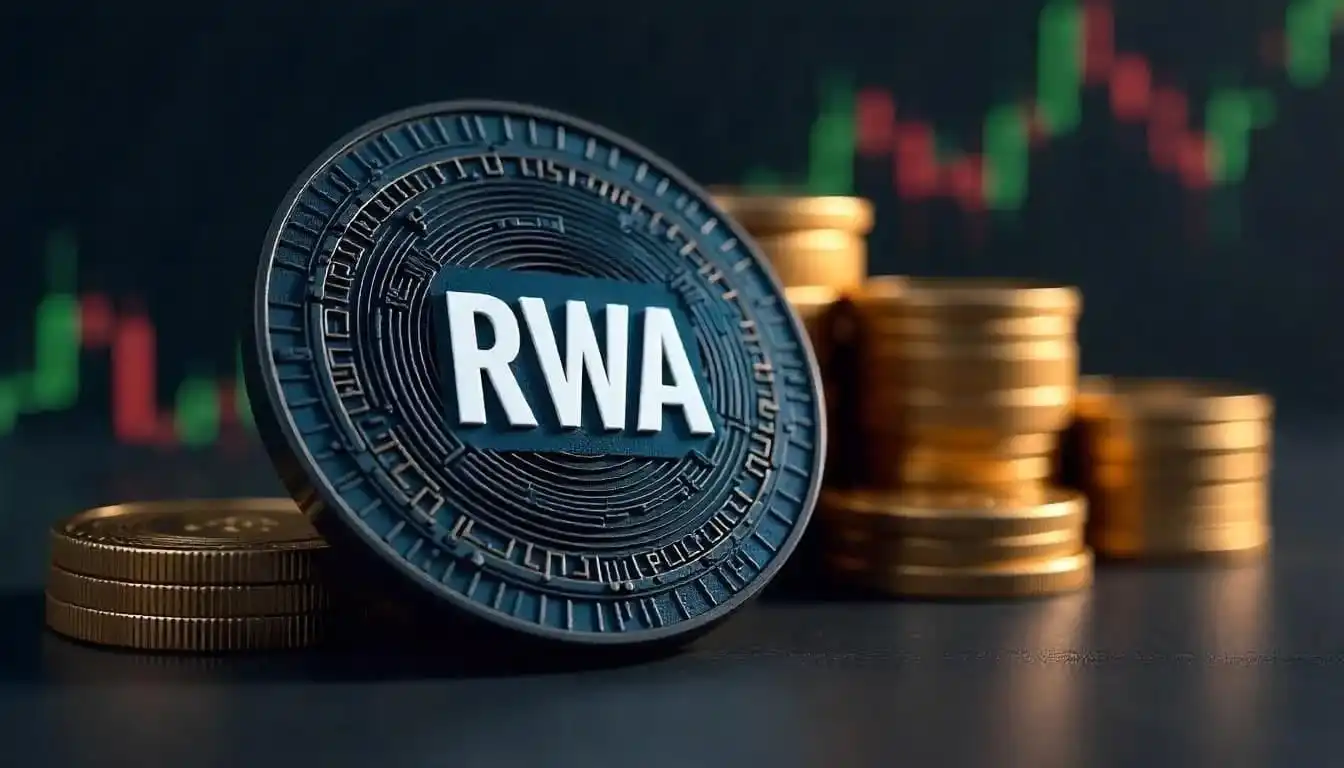
This means stocks, bonds, funds, income rights, and even future cash flows could all be digitized.

In the past, buying a stock required a securities account, cross-border trading required a broker, asset custody required a bank, and after trading, a clearinghouse was needed for final settlement—the entire system was extremely complex.

But blockchain offers a new perspective. If assets natively exist on-chain, then trading, settlement, clearing, custody, and even identity verification could all be completed within the same network.

Processes that used to take days to complete could end in seconds in the future. Work that previously relied on multiple institutions could potentially be executed automatically by smart contracts. This is actually changing the financial infrastructure itself.

What makes Wall Street truly powerful has never been just the scale of its capital. More importantly, it controls the underlying financial network. Exchanges, brokerages, banks, custodians, clearinghouses together constitute a vast system. And blockchain is gradually compressing these links.

In the future, many financial services may no longer be performed by multiple institutions, but run directly within a unified network.

Therefore, the protagonists of the crypto industry's next phase may no longer be trading platforms. They will be new financial gateways.

The so-called native crypto securities brokerage is essentially this new gateway. It not only handles trading functions but also assumes the roles of wallet, asset management, custody, clearing, and financial services.

It might be like an exchange, and also like a broker. Like a bank, and also like a payment system—even more like a global financial operating system.

III. The Next War: Not Public Chain Competition, but Financial System Competition

In recent years, the crypto market has been debating who will become the next king of public chains. The market compares TPS, gas fees, number of ecosystems, and developer size. But in the future, the importance of these metrics may gradually decline.

Because what truly matters in financial markets is not speed, but assets. Even if a chain has a million TPS, it's hard to create long-term value without high-quality assets entering.

What is truly valuable is liquidity. And the core of liquidity is asset quality.

If in the future, users can buy global stocks, index funds, bonds, and even shares in top-tier tech companies like SpaceX on-chain, the entire industry logic will change.

Because the boundary between the on-chain world and the real world will gradually disappear.

In the past, the crypto industry competed for the internal market; in the future, it will compete for the global capital market. These are two completely different stories.

Currently, the global crypto market remains in the multi-trillion dollar range, while the global stock market is close to a hundred trillion dollars, and the bond market is even larger. They are not on the same order of magnitude.

In the past, the industry discussed the next billion-dollar project; in the future, it may discuss how to accommodate the flow of tens of trillions of dollars in assets. The ICO era solved the fundraising problem; the DeFi era solved the on-chain finance problem; the ETF era solved the capital gateway problem; and the native crypto securities brokerage era may solve the problem of integrating real-world finance with crypto finance.

Conclusion

For over a decade, the crypto industry has been trying to create a new world. In the next decade, it may no longer need to recreate the world.

Because it will directly connect to the original world.

When traditional finance and the crypto ecosystem truly converge, the industry's biggest growth story may just be beginning.


Related Questions

QAccording to the article, what is the fundamental problem that the crypto industry has faced despite its development over the past decade?

AThe fundamental problem is that there has been a 'wall' separating the crypto world from the traditional real-world financial system. The crypto ecosystem developed independently with its own currency, markets, and logic, but remained largely disconnected from mainstream global finance.

QWhat event does the author suggest is an even bigger development than the introduction of Bitcoin ETFs?

AThe author suggests that the migration of traditional securities (like stocks, bonds, and funds) onto the blockchain is an even bigger story. This process of real-world asset tokenization has the potential to fundamentally change the industry's structure by blurring the lines between crypto and traditional finance.

QWhat new type of entity does the article predict will be a key player in the next phase of the crypto industry?

AThe article predicts that 'native crypto securities brokerages' will be key players. These entities will act as new financial gateways, combining functions of exchanges, brokers, banks, custodians, and payment systems, essentially serving as a global financial operating system.

QWhat does the author argue will be the primary focus of competition in the future, replacing the past focus on 'public chain wars'?

AThe author argues that future competition will shift from 'public chain wars' (focusing on TPS, fees, etc.) to a competition over financial systems. The true value will lie in attracting high-quality assets and liquidity, with the ultimate prize being a share of the global capital markets, which are orders of magnitude larger than the current crypto market.

QWhat is the core thesis of the article regarding the future relationship between crypto and traditional finance?

AThe article's core thesis is that the crypto industry is transitioning from being a parallel, closed financial experiment to becoming integrated into the mainstream global financial system. The next decade will be defined not by creating a separate new world, but by directly connecting to and reshaping the existing world of finance through the tokenization of real-world assets.

Related Reads

The Midlife Crisis of Crypto GPs: No PMF, No Next Check from LPs

The article "The Midlife Crisis of Crypto GPs: No PMF, No Next LP Check" analyzes the shifting crypto fundraising landscape. It argues the era of selling grand visions to LPs is over; GPs must now offer products with clear Product-Market Fit (PMF). The author categorizes crypto fundraising products into three types: Primary (VC funds), Liquid (trading strategies), and CeFi/DeFi Native Yield. This summary focuses on the Primary market. Key points include: * **Market Shift:** LPs are impatient, demand immediate returns, and are skeptical of future promises. The "easy money" narrative has faded. * **GP Value Erosion:** LP learning curves have shortened (aided by AI), reducing the value of a GP's basic "crypto knowledge." Superior judgment is now rare. * **Weakened LP Motivations:** Traditional reasons for LPs to invest in crypto VC funds (capturing industry beta, gaining access, leveraging GP judgment) have weakened due to new products like ETFs and increased LP sophistication. * **Surviving in Primary:** The primary market will likely persist for: 1) large funds in endowment mandates treating it as a lottery ticket, 2) family offices/HNWIs using proprietary capital, 3) a few funds with proven recent outperformance, and 4) funds with strong ecosystem "deal-making" capabilities. * **Conclusion:** For most GPs, rebuilding trust requires starting over in a niche, demonstrating alpha-generating ability, or providing concrete value/services to LPs.

marsbit44m ago

The Midlife Crisis of Crypto GPs: No PMF, No Next Check from LPs

marsbit44m ago

Crypto GPs' Midlife Crisis: No PMF, No LP's Next Check

The article "The Midlife Crisis of Crypto GPs: No PMF, No LP's Next Check" analyzes the shifting crypto fundraising landscape. It argues that the era of LPs funding vague "vision" is over; GPs must now offer products with clear Product-Market Fit (PMF) to secure capital. The market has matured. LPs, disillusioned by the last cycle's failures and wary of long lock-up periods, now demand tangible, near-term returns rather than speculative narratives. The proliferation of accessible crypto ETFs and other liquid products has reduced the need for VC blind pools as an entry point. The author categorizes crypto fundraising products into three types: Primary (VC funds, with blind pools or clear pipelines), Liquid (alpha/beta, directional/market-neutral strategies), and CeFi/DeFi Native Yield (crypto-specific mechanisms like staking, farming). Focusing on the Primary market, the piece details why traditional LP rationales for investing in crypto VCs have weakened: easier beta access via ETFs, diminished "access" and "judgement" premiums as LPs build internal teams, and a widespread lack of proven superior returns from GPs. Ultimately, only specific players are likely to remain at the primary VC table: large funds with access to patient endowment capital, family offices/HNWIs investing proprietary capital, the few funds with demonstrable excess returns from the last cycle, and those with clear "deal-making" or ecosystem resource advantages. For others, the path forward is to rebuild trust by proving alpha-generation capability in a niche or providing concrete, valuable services.

链捕手1h ago

Crypto GPs' Midlife Crisis: No PMF, No LP's Next Check

链捕手1h ago

The Age of Decoupling Has Arrived: Bitcoin is No Longer the Sole Compass of Crypto

The era of the cryptocurrency market moving in lockstep with Bitcoin is ending, as the industry splits into two distinct asset categories: endogenous and exogenous. Endogenous assets, like Bitcoin, derive value purely from the crypto market's cycles. Their narratives swing between being "interstellar money" in bull markets and "digital collectibles" in bear markets. Exogenous assets, however, are nominally crypto but operate with independent value drivers. Examples include: * **Venice:** An AI inference service using tokens for payments; its consumer-AI business model is decoupled from crypto price swings. * **Figure:** A fintech lender using blockchain to speed up loan approvals; its core value is in credit, not crypto. * **Stablecoin firms like BVNK:** Acquired by traditional finance giants (Mastercard, Stripe), their growth is tied to payment infrastructure, not market cycles. Hybrid projects like **Hyperliquid** (a decentralized exchange) show a shift, with a growing share of non-crypto trading (e.g., prediction markets). This divergence is fundamental. Endogenous assets remain highly correlated to Bitcoin, similar to gold miners to gold. Exogenous assets are evolving to have their own fundamentals, like the weak correlation between gold and the S&P 500. This changes investment analysis. Evaluating exogenous assets requires traditional fundamental research—assessing user bases, unit economics, and moats—more akin to fintech investing than charting Bitcoin. Promising exogenous sectors include: on-chain exchanges/brokers, AI-crypto fusion, privacy-focused digital banks, lending (institutional/private credit), stablecoins/real-world asset tokenization, payment rails, and non-financial crypto-consumer products. Currently, investing via equity is often safer than via tokens, as token value accrual mechanisms need further regulatory and industry development (e.g., the CLARITY Act). Nonetheless, the core trend is clear: crypto market drivers are diversifying from a single factor (Bitcoin) to multiple fundamentals, ending the era of uniform market moves.

marsbit2h ago

The Age of Decoupling Has Arrived: Bitcoin is No Longer the Sole Compass of Crypto

marsbit2h ago

Trading

Spot
Futures

Hot Articles

Ethena: Building a New Era of Web3‑Native Digital Dollars

Ethena is an Ethereum‑based synthetic dollar protocol that delivers crypto‑native monetary solutions, including USDe, a synthetic dollar, and sUSDe, a globally accessible U.S. dollar savings asset.

53.1k Total ViewsPublished 2026.03.16Updated 2026.03.16

Ethena: Building a New Era of Web3‑Native Digital Dollars

Discussions

Welcome to the HTX Community. Here, you can stay informed about the latest platform developments and gain access to professional market insights. Users' opinions on the price of ERA (ERA) are presented below.

活动图片