Cardano founder Charles Hoskinson has intensified the ecosystem’s push into regulated, privacy-preserving digital dollars, declaring on July 31 that “Moneta’s USDM is becoming the most advanced stablecoin ever built.” The remark, posted on X, came in the wake of a multi-day workshop in Buenos Aires that he said was “making progress on the first Private Stablecoin.”
Hoskinson’s endorsement dovetailed with a dense technical thread from Cardano developer Andrew Westberg that sketched how a privacy-enabled dollar could satisfy enterprise and legal requirements without turning public ledgers into open books. “The stablecoin is a small but important piece of the discussion in Argentina. That being said, the complexity is 10x to 20x that of USDM,” he wrote.
Why Cardano’s USDM Is A Next-Gen Stablecoin
Westberg walked the community through a role-based access model that would let a payroll recipient see only their own payment, an accountant see amounts without personal details, a CFO view the whole, and a court-ordered investigator gain full transparency during discovery. “Really cool tech, but it is a cambrian explosion of complexity to build out something where blockchain can truly eclipse and replace tradfi systems for the first time,” Westberg said.
Those comments follow months of public positioning by Input Output Global’s partner-chain Midnight, a zero-knowledge (“rational privacy”) network designed to let developers program selective disclosure and meet regulatory obligations while shielding counterparties and amounts. Midnight describes its approach as “programmable data protection” for enterprise-grade applications, with smart contracts written in a TypeScript-based language called Compact.
What Hoskinson hailed and what Westberg described are two closely related tracks. On Cardano’s base layer, Moneta Digital LLC issues USDM as a fiat-backed, regulated stablecoin. Moneta identifies itself as a US Money Services Business regulated at the federal level by FinCEN and relevant state authorities, and says reserves are held in bank deposits and money market funds managed by Fidelity and Western Asset Management.
Moneta also opened retail minting with a $1,000 minimum, a stated $0 minting fee, and availability in 19 US states, reflecting the incremental nature of state licensing. As of press time, DeFiLlama shows roughly $12 million USDM in circulation on Cardano.
In parallel, a privacy-preserving instrument is being built for Midnight. An X account branded “ShieldUSD” describes itself as a “fiat-backed privacy stablecoin on @MidnightNtwrk … issued by Moneta Digital LLC @USDMOfficial [and] built by @W3iSoftware,” the development studio where Westberg serves as CTO. While branding and final product details remain in flux, the direction is clear: a fiat-backed dollar with granular permissions that lives natively on a privacy chain and interoperates with public ledgers.
The core design debate—sparked by Westberg’s thread and community replies—turns on whether such complexity is overkill relative to today’s public stablecoins or the prerequisite for real-world finance to migrate on-chain. One respondent argued that USDC would be a “better fit” and that use cases for privacy coins without “government level integrations” are limited. Westberg countered bluntly: “Usdc is not capable of any of the above requirements. Everything it does is public.” He pointed to use cases beyond enterprise payroll—such as paying a public utility where the payer’s identity remains private while the public dataset is anonymized, or compliant remittances that disclose to a verifier only that the receiver is not in a sanctioned country.
Crucially, the privacy layer appears scoped to Midnight. Westberg and subsequent coverage have noted that once assets move off Midnight to public chains, users “lose the privacy,” even if the instrument remains interoperable with other stablecoins for liquidity or settlement. That trade-off—private by default where needed, public when bridged—tracks with Midnight’s own “selective disclosure” model and may reassure regulators that investigatory access can be granted “with a court order,” as Westberg’s payroll example emphasized.
Hoskinson’s choice of Buenos Aires as a backdrop is not incidental. Argentina has been a recurring stage for Cardano’s governance and adoption rhetoric, and for Hoskinson’s advocacy of “private money” that mimics the transactional privacy of cash while remaining auditable under law. The Buenos Aires workshop, framed by him as a milestone on the path to a “first Private Stablecoin,” underscores a push to marry compliance and confidentiality in a jurisdiction where inflation and dollarization have made stablecoins part of everyday economic life.
For Moneta and Cardano, the near-term milestones are prosaic but vital: expanding licensed jurisdictions, growing USDM’s fiat reserves and on-chain supply, integrating with Cardano DeFi venues, and, if the Midnight instrument launches as envisioned, proving that programmable privacy can slot into familiar workflows—payroll, bill payment, remittances—without recreating shadow banking on a blockchain. The longer-term test is market acceptance. USDM’s circulating supply—still modest relative to incumbents—will need to scale, and the privacy variant will need to demonstrate that role-based visibility and regulator-friendly access controls can survive contact with real compliance departments.
For now, the public signal from Cardano’s founder is unequivocal. “Moneta’s USDM is becoming the most advanced stablecoin ever built,” he wrote. The rest of the ecosystem—developers, enterprises, regulators, and users—will determine whether the architecture emerging on Midnight and Cardano can earn that superlative in production rather than in principle.
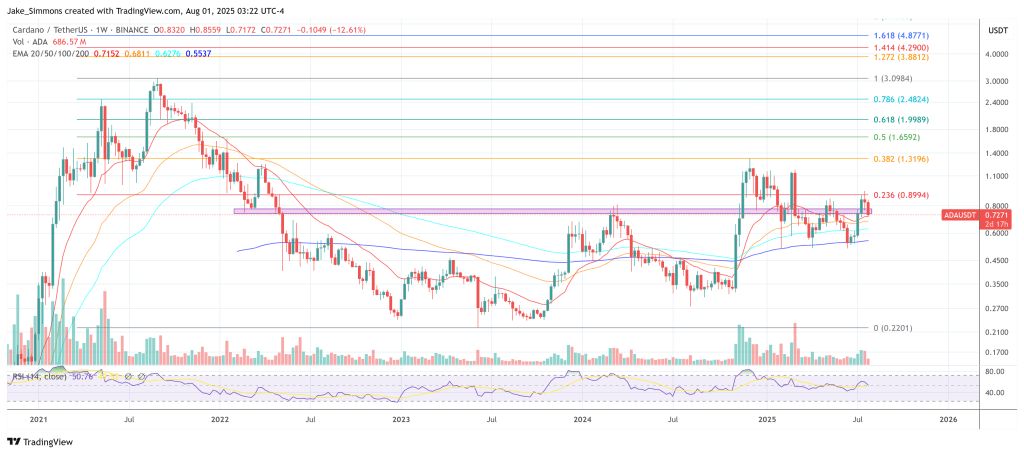
At press time, Cardano (ADA) traded at $0.72.

Related Posts