以太坊基金会架构改革:生态重塑与币价复苏的战略新局

Odaily星球日报Published on 2025-07-11Last updated on 2025-07-11

Abstract

以太坊的未来,基金会来当「舵手」。

原文作者:Pzai,Foresight News

7 月 10 日,以太坊基金会发布「生态系统发展的未来」,为以太坊基金会启动了一系列深刻的架构改革,旨在应对长期以来在项目支持、生态系统运营和资金管理方面面临的挑战。

在新愿景声明中,以太坊基金会阐述了两个首要的总体目标:首先,最大化直接或间接使用以太坊并受益于其底层价值观的人数;其次,最大化以太坊技术和社会基础设施的韧性。而本次架构改革的核心在于重新定义基金会在以太坊生态系统中的角色,通过引入四个战略支柱(加速、放大、支持和长期疏通)、建立新的治理框架以及改革其资金管理策略,以增强生态的可扩展性、韧性及去中心化程度。
以太坊基金会架构改革:生态重塑与币价复苏的战略新局

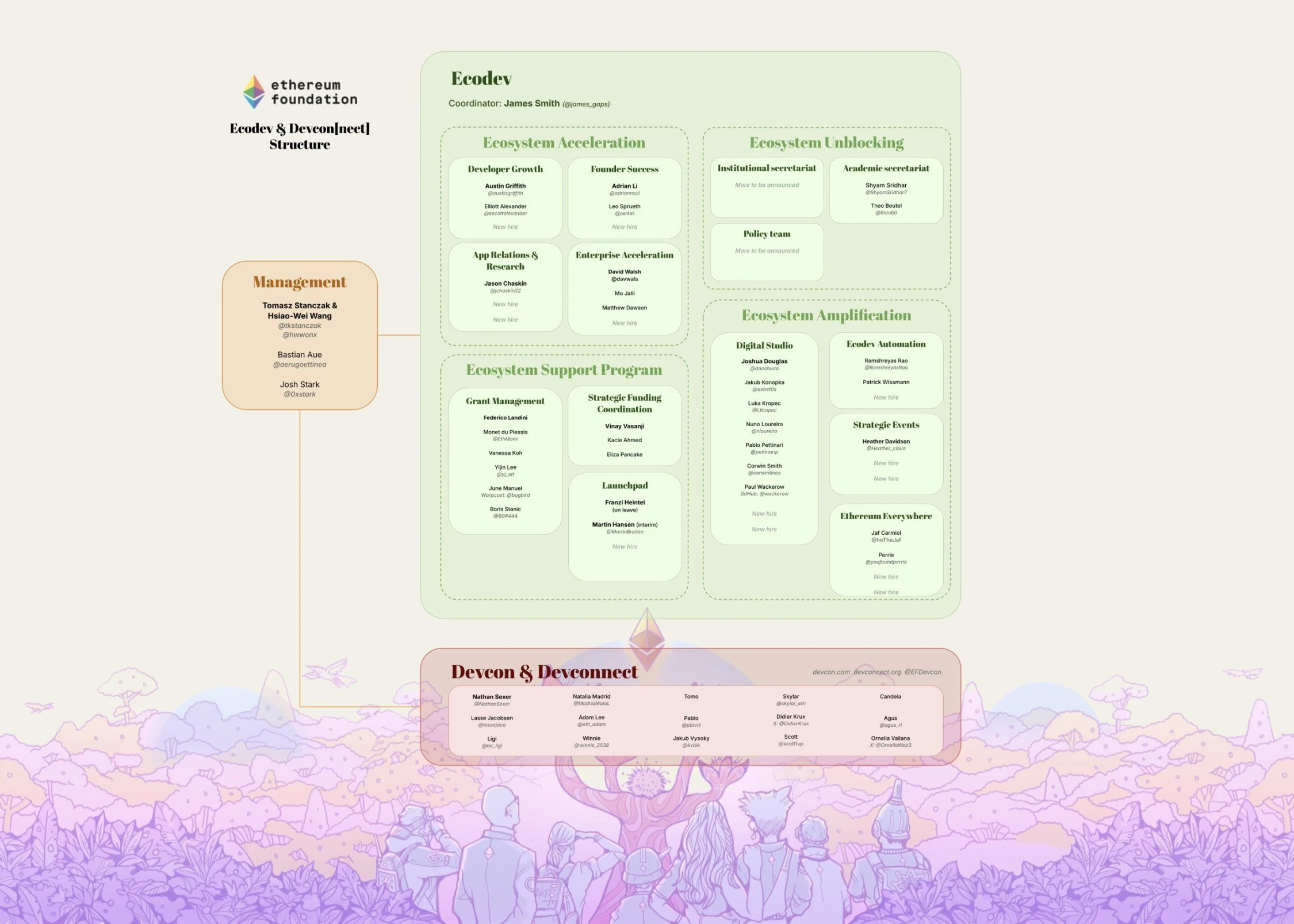
新 Ecodev 组织架构图

生态加速

此前,一些用户和开发者对以太坊基金会的指责在于:以太坊基金会长期「无为而治」的治理理念导致一系列生态分裂和叙事同一性的丧失。而随着越来越多企业正竞相建立加密储备,在储备战略上的攻城略地也成为了生态发展的关键因素。在生态加速上,以太坊基金会新成立了细分方向的支持模块,包括:

  • 企业关系:为希望采用以太坊的企业提供支持,团队将重点服务金融、供应链等垂直领域,推动实体资产(如房地产、债券)的链上代币化(RWA)。

  • 开发者成长:吸引并支持下一代以太坊生态开发者。该模块由 Gitcoin 研究主管 Austin Griffith 负责。

  • 应用程序支持:加速构建面向用户的有意义应用程序。

  • 创始人支持:非财务层面的项目相关支持,该模块由前 Consensys 前端技术主管 Adrian Li 负责。

而对之前生态加速的放大涵盖了宣传和生态系统发展方面的工作,包括:

  • Digital Studio(ethereum.org 团队):以太坊叙事引擎,制作叙事丰富的内容、视频、出版物和独特的可视化以展示以太坊的潜力。

  • 战略活动:设计和执行有针对性的活动。

  • 无处不在的以太坊:一个专注于扩展支持应用开发者的当地社区和中心的团队。

  • EcoDev 自动化:通过自动化和 AI 驱动的工具增强内部运营,使团队更有效地实现目标。

生态支持

长期以来,以太坊基金会一直因缺乏透明度而受到批评,例如在生态系统支持计划(ESP)方面,基金会此前仅披露受资助项目的名称,但未公布具体资助金额或项目进展的后续更新。而此前,以太坊早期开发者 @econoar 离职时也批评基金会“流程繁琐”、“耗时费力”,以及“领导层与更广泛社区脱节”。而在此之后,基金会也在 2025 年将未来运营支出占比从 15% 降至 5% ,逐步趋近捐赠型机构标准,并进行链上资产部署,确保长期财务缓冲(目标维持 2.5 年运营现金储备)。

而在新的架构改革中,基金会新的 ESP/ 资助支持计划强调更有针对性的申请和非财务支持,并通过战略资助计划共同资助重要的公共产品组织,使更广泛的以太坊生态系统受益。另外在新的支持架构中,Launchpad 将协助组织应对运营设计、可持续资金、治理和其他挑战。对 Launchpad 支持可以来自基金会、受资助者或其他生态系统组织的衍生产品(类似 Protocol Guild)。

在未来,以太坊基金会还将参与全球加密政策协调,监控与以太坊生态系统相关的全球问题,并与世界各地的政策组织合作,与政府和非政府组织建立持续的关系。另外,作为区块链学术的实践场之一,学术秘书处将积极促进以太坊与大学、教授和学生的合作,以推进区块链技术。

结语

7 月 11 日,以太坊正式突破 3000 美元。在币价攀升的过程中,生态发展也在逐步推进。从本次架构变革来看,以太坊基金会转型的核心目标是扩大用户基础和增强基础设施韧性。它意味着基金会将更积极地协调资源,引导叙事,弥合社区分歧,并在维护以太坊核心价值的同时,推动其在关键应用领域的规模化落地。当公链优势逐渐被追赶时,基金会试图通过体系化的支持和战略引导,为以太坊生态挖掘和塑造下一个增长引擎。


Trending Cryptos

Related Reads

Precious Metals Decline Alongside, What Signal is Gold Sending to the Market?

Gold and silver prices have declined recently, moving in tandem with a sell-off in risk assets like South Korean semiconductor stocks. This is unusual, as gold typically rises when equities fall due to its safe-haven status. The synchronized drop signals a shift in market focus: it's not about finding safety, but about the rising cost of holding assets that do not yield interest. This cost is the real interest rate. The key driver is a change in Federal Reserve policy expectations under new Chair Kevin Warsh. Despite holding rates steady, the Fed's rhetoric has turned more hawkish, emphasizing persistent inflation risks. This has led markets to price in a "higher for longer" rate environment, increasing the appeal of cash and bonds while pressuring zero-yield assets like gold and tech stocks with high future cash flow valuations. Technically, gold breached the $4,100/oz support level, approaching the critical $4,000 psychological and technical zone. A break below could trigger accelerated selling from momentum traders and ETFs. While long-term supportive factors like central bank buying and geopolitical risks remain, short-term price action is dominated by liquidity and opportunity cost dynamics. The South Korean market meltdown, driven by crowded AI-trade unwinding, is a symptom—not the cause—of this broader macro repricing. Both markets are reacting to the same pressures: higher real rates and a stronger US dollar. In summary, the concurrent decline in equities and precious metals highlights that diverse assets can share exposure to a common macro variable—the price of money. The near-term path for gold and silver depends primarily on the persistence of Fed hawkishness, dollar strength, and real yields, which currently override their traditional safe-haven narratives.

marsbit2m ago

Precious Metals Decline Alongside, What Signal is Gold Sending to the Market?

marsbit2m ago

Chip Stocks Lead U.S. Market Decline: Is AI Trading Being Hit by Both Interest Rates and Returns?

Chip stocks led a broad decline in US markets, with the Nasdaq dropping 2.2% and the S&P 500 falling 1.4%. This selloff reflects a dual challenge for the once-high-flying AI hardware trade: rising interest rate expectations and growing investor impatience for clear returns from massive AI capital expenditures. The pressure was most acute on hardware leaders. Nvidia fell about 4%, dipping below a $5 trillion market cap, while Micron plunged 13.2% ahead of its earnings report. Declines across memory, storage, AI, and mobile chips indicated a sector-wide retreat. The selloff spread globally, with South Korea's KOSPI index dropping nearly 10% as key suppliers SK Hynix and Samsung recorded double-digit losses. Investors appeared to be taking profits from the most crowded trades first. Macro headwinds intensified as market expectations shifted toward a more aggressive Federal Reserve. Forecasts for multiple rate hikes in 2026 pressured high-valuation tech stocks, which rely on long-term growth projections that become less attractive as discount rates rise. Concurrently, investors are scrutinizing the profit potential of the immense AI spending by cloud giants like Alphabet, Amazon, and Meta. While these expenditures drive demand for chips and hardware, the market is now questioning whether AI services will generate sufficient returns to justify the ongoing costs. This adjustment is not necessarily a bubble burst but a recalibration. AI demand fundamentals remain, but the narrative of endless growth can no longer fully offset concerns over higher interest rates and a longer path to profitability. Near-term direction may hinge on Micron's upcoming earnings guidance and incoming inflation data, which will influence both the AI demand outlook and the Fed's policy path. The market is transitioning from blindly buying growth to demanding clearer visibility on returns.

marsbit1h ago

Chip Stocks Lead U.S. Market Decline: Is AI Trading Being Hit by Both Interest Rates and Returns?

marsbit1h ago

OpenAI's New Paper: How to Train an AI that "Doesn't Deteriorate Under Pressure"?

OpenAI's new paper "Reinforcement Learning Towards Broadly and Persistently Beneficial Models" explores training AI to maintain safe, helpful, and honest behavior even under pressure, in unseen scenarios, or after being fine-tuned for harmful purposes. Moving beyond simple rule-based "don'ts," the research focuses on cultivating "beneficial traits" like honesty, risk-awareness, corrigibility, and transparency. It investigates if reinforcement learning (RL), often prone to "reward hacking" where models exploit loopholes, can instead be used to instill robust, generalized positive behaviors. Researchers created a multi-domain synthetic dialogue dataset covering areas like healthcare and law. They trained a model by replacing 5% of standard RL data with "beneficial trait" data. This model outperformed the baseline in 83% of 53 evaluations, showing average gains of 9.1% in alignment, safety, and helpfulness. Crucially, improvements generalized: a model trained only on healthcare "good behavior" data also performed better in 17 out of 19 non-healthcare alignment tests. The paper also tests "alignment persistence." When subjected to adversarial prompts or harmful fine-tuning, the beneficial trait model showed greater resilience, with smaller performance drops and less "spillover" of bad behavior to unrelated tasks. While not a complete solution, this work suggests a shift from post-hoc correction to proactively shaping robust, principled AI behavior, a critical step for deploying models in high-stakes, complex decision-making scenarios.

marsbit1h ago

OpenAI's New Paper: How to Train an AI that "Doesn't Deteriorate Under Pressure"?

marsbit1h ago

Trading

Spot
Futures

Hot Articles

Discussions

Welcome to the HTX Community. Here, you can stay informed about the latest platform developments and gain access to professional market insights. Users' opinions on the price of ETH (ETH) are presented below.

活动图片