Charles Hoskinson has laid out the broad contours of what he calls a “decentralized sovereign wealth fund” for Cardano, arguing in a 18-minute livestream on 12 June that the network’s treasury should be actively managed, diversified beyond ADA, and ultimately expanded into a multi-asset portfolio worth at least a billion dollars.
Speaking from Colorado, the Cardano founder said the chain’s current treasury—roughly 1.7 billion ADA, or about $1.2 billion at prevailing prices—is “nothing to laugh at,” yet remains a push-only pool funded by block inflation and fees with no yield-bearing instruments.
The Cardano Sovereign Wealth Fund
“What I’d like to see,” he explained, “is could we take about a hundred million worth of ADA in the treasury and convert it to a blend of a collection of stablecoins … and also convert some of it to Bitcoin to prime the Bitcoin DeFi.” That seed conversion, carried out gradually via time-weighted purchases, OTC desks, and iceberg orders, would—according to Hoskinson—barely ripple market depth, creating no more than “50 basis points worth of slippage.”
Hoskinson’s case rests on Cardano’s unusually thin dollar liquidity. On-chain, the network has just $33 million in stablecoins against roughly $330 million in total value locked, a ratio below 10 percent. Ethereum’s comparable figure, he noted, stands near 190 percent, while Solana is “about 110 percent.” Remedying that gap is critical both for user experience and for listings on “tier-two and tier-three exchanges,” which often require robust stablecoin volumes to support order-book depth.
The livestream migrated quickly from diagnosis to architecture. Hoskinson envisions a structure that mimics Norway’s or Abu Dhabi’s trillion-dollar sovereign wealth vehicles: a professionally managed fund directed by an elected oversight board, operating within a “BOR, or cybernetic, organization” that pairs smart contracts with an offshore management wrapper.
Yield—sourced from on-chain money markets, real-world-asset protocols, and Bitcoin-denominated DeFi—would flow back to the treasury, where it would be used to buy ADA and replenish the principal, creating a compounding flywheel. Over a five-to-ten-year horizon, he said, the program could “grow to a billion-dollar-plus stable-coin treasury and Bitcoin treasury to augment and enhance the ADA value we have.”
Governance remains the open question. Cardano’s community is still processing the chain’s first-ever budget vote—39 proposals totaling hundreds of millions in outflows—while rare-cohort delegates, or dReps, experiment with new on-chain voting tools. Hoskinson wants the sovereign fund proposal refined in time for Rare Evo, the ecosystem conference in August, so that it can be debated alongside a post-mortem constitutional update.
He floated quadratic voting, anonymous ballots, and multiple administrator regimes as potential safeguards.
Some competition amongst administrators” would sharpen fiduciary discipline, he argued, while regulated asset managers—“the GSRs and the Jane Streets and the Brevan Howards of the world”—could execute trades without retail-exchange slippage.
Critics on social media have already warned that selling $100 million in ADA could swamp order books, but Hoskinson dismissed that view as “inexperience.” Cardano’s spot and derivatives venues regularly handle half-a-billion to a billion dollars in daily turnover, he said, and far larger blocks change hands off-screen through OTC channels. “ADA does not have a liquidity problem,” he insisted.
Beyond stablecoins, the plan gestures at a broader multi-chain strategy. Midnight, Cardano’s forthcoming privacy-enabled sidechain, will pay block rewards in its native token alongside ADA, forcing the treasury to manage a portfolio rather than a single asset. Hoskinson also pitched Cardano as a potential DeFi venue for Bitcoin and even XRP, arguing that cross-chain fee flows and Babel-fee mechanisms would allow the treasury to accumulate BTC and other tokens as organic revenue.
Whether the community will approve a transformation of its treasury into something resembling a blockchain-native Norwegian oil fund remains uncertain, but Hoskinson framed the debate as a maturation milestone. “We are a sovereign entity,” he concluded. “We have to start treating ourselves that way.”
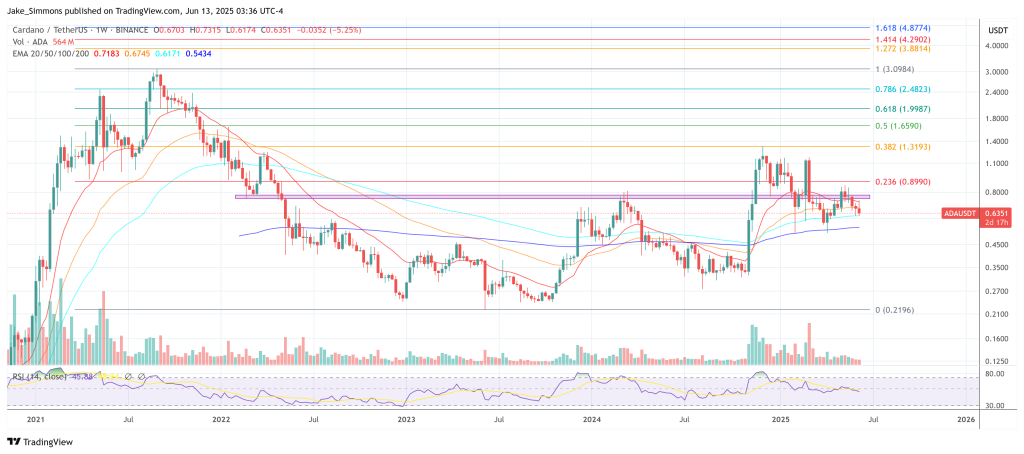
At press time, ADA traded at $0.635.

Related Posts