XRP To Capture 14% Of SWIFT’s Volume, Says Ripple CEO

bitcoinistPublished on 2025-06-12Last updated on 2025-06-12

Abstract

Ripple chief executive Brad Garlinghouse used XRPL Apex 2025 to set an audacious target for the company’s native asset. “If...

Trusted Editorial content, reviewed by leading industry experts and seasoned editors. Ad Disclosure

Ripple chief executive Brad Garlinghouse used XRPL Apex 2025 to set an audacious target for the company’s native asset. “If you’re driving all the liquidity, that’s good for XRP … so I’ll say five years, 14 percent,” he told the audience, distinguishing sharply between SWIFT’s well-known messaging layer and the liquidity rails that actually move money.

“SWIFT today, there’s two ways to think about SWIFT. There’s messaging and there’s liquidity. Liquidity is owned by the banks. I think less about the messaging and more about liquidity,” the Ripple CEO said.

Garlinghouse’s forecast came during a dialogue with Ripple’s chief technologist David Schwartz, who framed the broader prize: “We’re going to see many, many hundreds of billions of dollars in tokenized … assets fairly quickly.” Schwartz argued that blockchains solve a mundane but stubborn problem in corporate audits—“How do you know I don’t owe somebody money that isn’t in the records you’re checking?”—and that this built-in transparency will accelerate adoption.

What XRP’s 14% SWIFT Takeover Could Mean

Quantifying Garlinghouse’s projection depends on which slice of SWIFT’s activity one counts. From the daily lens, industry data widely quoted in payments-technology literature shows SWIFT messages directing almost $5 trillion every 24 hours. Fourteen percent of that flow is roughly $700 billion per day—a value that could, under Ripple’s thesis, migrate to XRP-based liquidity rails.

From the annual payments lens and the cross-border payment traffic alone, SWIFT has been estimated to settle about $150 trillion a year. Fourteen percent of that narrower baseline would still amount to $21 trillion annually, more than the combined 2024 GDP of Japan and Germany.

Either yard-stick underscores the scale of the ambition: if XRP were to intermediate even the lower $21 trillion figure, its settlement throughput would eclipse that of most major national payment systems.

Garlinghouse’s insistence on “liquidity” rather than “messaging” mirrors Ripple’s strategy since 2018, when it began pitching XRP as a real-time bridge asset for banks preferring to keep nostro-vostro balances lean. SWIFT itself, serving over 11,500 institutions, acknowledges it “sends trillions of dollars every day,” a breadth Ripple cannot ignore.

That focus also explains Ripple’s recent engineering milestones showcased in Singapore: Native support for institutional-grade tokenization modules, aimed at the “hundreds of billions” Schwartz referenced. A re-architected liquidity hub that auto-routes fiat and digital-asset trades to minimize slippage when large banks unwind positions intraday.

XRP is the fourth-largest cryptocurrency by market capitalization, hovering near $132 billion during the conference. Although the token has quadrupled in value since the 2024 US election cycle, turnover remains a fraction of what would be required to handle a multi-hundred-billion-dollar daily flow.

Ripple says its on-demand liquidity corridors processed “single-digit billions” last quarter; scaling to Garlinghouse’s target would therefore entail a two-order-of-magnitude jump.

At press time, XRP traded at $2.25.
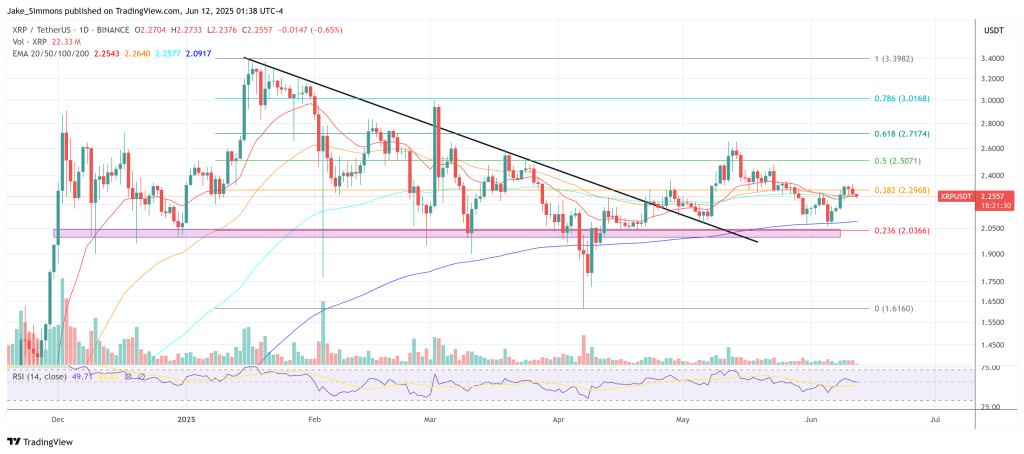
XRP price
XRP price, 1-day chart | Source: XRPUSDT on TradingView.com
Featured image created with DALL.E, chart from TradingView.com
Editorial Process for bitcoinist is centered on delivering thoroughly researched, accurate, and unbiased content. We uphold strict sourcing standards, and each page undergoes diligent review by our team of top technology experts and seasoned editors. This process ensures the integrity, relevance, and value of our content for our readers.

Jake Simmons has been a Bitcoin enthusiast since 2016. Ever since he heard about Bitcoin, he has been studying the topic every day and trying to share his knowledge with others. His goal is to contribute to Bitcoin's financial revolution, which will replace the fiat money system. Besides BTC and crypto, Jake studied Business Informatics at a university. After graduation in 2017, he has been working in the blockchain and crypto sector. You can follow Jake on Twitter at @realJakeSimmons.

Trending Cryptos

Related Reads

Pantera Capital: As Perpetual Contracts Move Towards the Financial Center, Hyperliquid Aims to Be All-Encompassing

Perpetual futures ("perps"), once a crypto-native phenomenon, are becoming a dominant global financial instrument, evolving into a fundamental market structure shift that traditional finance can no longer ignore. This article outlines the advantages of perpetual contracts over traditional futures, highlighting their simplicity (no expiry/rollover), easier risk management, and native 24/7 operation. While the concept is not new, digital assets provided the ideal environment for its explosive growth. Initially dominated by centralized exchanges (CEX), perps have recently migrated significantly to decentralized exchanges (DEX), with Hyperliquid emerging as the leading DEX for perps, capturing ~40% of the on-chain volume. Hyperliquid, built on its own purpose-built L1 blockchain, has successfully expanded beyond crypto into traditional assets like stocks, commodities, and indices, driven by its permissionless listing framework (HIP-3) and 24/7 availability. It has become a crucial price discovery venue during off-hours and for pre-IPO companies, attracting attention from traditional hedge funds and major exchanges like ICE, which now views it as serious competition. The investment thesis for Hyperliquid's token, HYPE, rests on its large and growing total addressable market (TAM) across all finance, strong execution, superior user experience, and direct value accrual via aggressive token buybacks using 99% of protocol revenue. Key risks remain, primarily regulatory uncertainty in the U.S., though recent CFTC actions approving certain regulated crypto perp contracts signal a potential shift toward broader acceptance. The core question is no longer if perpetuals matter beyond crypto, but whether blockchain-based infrastructure like Hyperliquid can become the primary venue for pricing, trading, and discovering risk across all financial domains.

marsbit2h ago

Pantera Capital: As Perpetual Contracts Move Towards the Financial Center, Hyperliquid Aims to Be All-Encompassing

marsbit2h ago

Tiger Research: Zuckerberg Begins Betting on Prediction Markets, While Asian Nations Still View Them as Gambling

This article examines the rise of prediction markets, contrasting their growing institutional acceptance in the West with their restrictive regulation in Asia. It details how prediction markets, which originated from informal political betting and academic experiments like the Iowa Electronic Market, aggregate crowd wisdom into probabilistic prices through binary contracts. Their growth accelerated around 2020, reaching over $14 billion in monthly volume. A key driver is the "skin in the game" principle, where users risk their own capital, leading to high accuracy in predicting events like Fed rate decisions and elections, as demonstrated by platforms like Polymarket. Meta's entry, with Mark Zuckerberg reportedly leading the development of the Arena app, signals the market's maturation. In the U.S., court rulings have distinguished prediction markets from gambling, facilitating entry by traditional financial institutions. However, most Asian jurisdictions still classify them as gambling, focusing on social control rather than financial innovation. The article argues this stance creates three problems for Asia: 1) regulatory arbitrage pushes users to riskier offshore platforms, 2) loss of sovereign information infrastructure as valuable social sentiment data accumulates abroad, and 3) abandonment of user protection. It concludes that Asia needs a policy shift from prohibition to constructive regulation, integrating these markets into the formal system to harness their data as a national asset, as initiatives like Limitless Research are beginning to do.

marsbit4h ago

Tiger Research: Zuckerberg Begins Betting on Prediction Markets, While Asian Nations Still View Them as Gambling

marsbit4h ago

Trading

Spot

Hot Articles

Discussions

Welcome to the HTX Community. Here, you can stay informed about the latest platform developments and gain access to professional market insights. Users' opinions on the price of S (S) are presented below.

活动图片