XRP and Solana Added to Nasdaq Crypto Index: Market Expansion Imminent?

bitcoinistPublished on 2025-06-09Last updated on 2025-06-09

Abstract

The Nasdaq Crypto US Settlement Price Index (NCIUS) was updated on June 2 to include four new cryptocurrencies: Solana ($SOL),...

Trusted Editorial content, reviewed by leading industry experts and seasoned editors. Ad Disclosure

The Nasdaq Crypto US Settlement Price Index (NCIUS) was updated on June 2 to include four new cryptocurrencies: Solana ($SOL), Cardano ($ADA), Stellar ($XLM), and XRP ($XRP). Earlier, it had only included $BTC and $ETH.

While this is great news for the development of the broader crypto market, it ‘s caused an issue for the Hashdex Nasdaq Crypto Index US ETF (NCIQ). This ETF tracks the NCIUS index to provide weighted exposure in $ETH and $BTC.

Until now, it could replicate the index with precision and minimum divergence. However, even though the composition of NCIUS has now changed, the ETF isn’t permitted to track any assets other than Bitcoin and Ethereum. This has caused a mismatch between the fund’s objective and the index it is tracking.

NASDAQ has submitted a proposal to let NCIQ track the Nasdaq Crypto Index (NCI) instead of the current NCIUS. The NCI index also includes $SOL, $ADA, $XLM, and $XRP, as well as $LINK, $LTC, and $UNI.

The SEC is expected to respond by November 2, 2025. In any case, there’s no denying Wall Street is now adopting a more inclusive approach to crypto, looking at assets other than Bitcoin and Ethereum.

Bitcoin is a Great Buy Even at $106K

In other pro-crypto developments, John Deaton, an ace Bitcoin investor and XRP supporter, took to X to voice his analysis that $BTC ‘s a safer buy at $106K than it was at $20K.’ He believes that the risk-to-reward ratio is more favorable now than when Bitcoin was trading much lower.

Deaton also said that the current macroeconomic conditions will gradually undermine people’s confidence in fiat currencies. For example, growing national debt and exorbitant tariffs are big red flags for the cash economy.
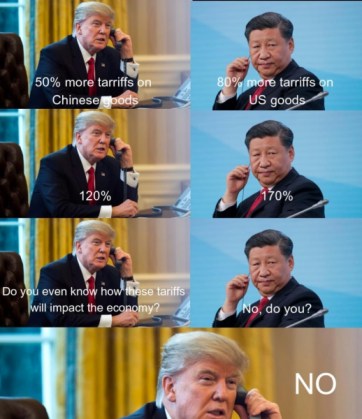
Tarriffs meme.

In such a scenario, ‘digital gold’ emerges as a clear alternative.

  • First, $BTC’s supply is limited, so corporations and governments can’t manipulate it.
  • Secondly, companies and countries, both large and small, are racing to add Bitcoin to their balance sheets, pushing up the price.

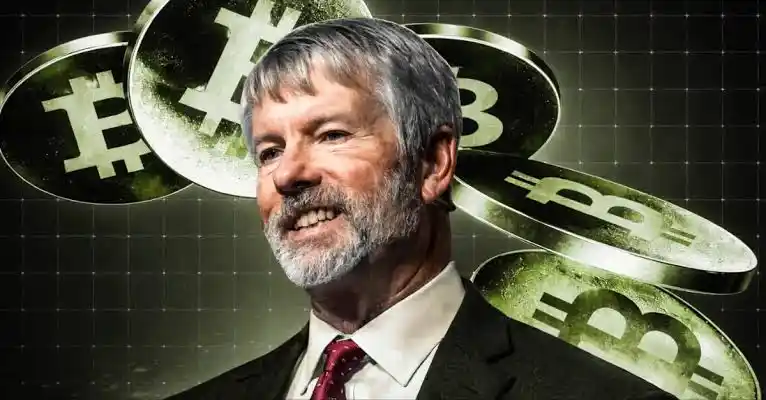
Michael Saylor’s Strategy, for instance, now owns more than 580K $BTC, and 16 firms added it to their balance sheets just last week.

Governments across the board, like Ireland, Pakistan, and Ukraine, are considering creating their own Bitcoin reserves after the US announced it would pursue one.

All these signals show that Bitcoin is here to stay and only goes from strength to strength. If you, too, are keen on milking $BTC to the last possible drop, we’d like to introduce you to BTC Bull Token.

What Is BTC Bull Token?

BTC Bull Token ($BTCBULL) has taken a simple idea – to cheer on the greatest digital asset, Bitcoin – and transformed it into one of the best meme coins on the market right now.

With a muscular bull as its mascot and a website theme that mimics Bitcoin’s bright gold color, BTC Bull Token wears its Bitcoin bullish badge with pride.

According to its whitepaper, it’s ‘the unstoppable force pushing Bitcoin towards $1M+.’

It does this by being the ONLY crypto today offering free (and completely legitimate) $BTC to its token holders.
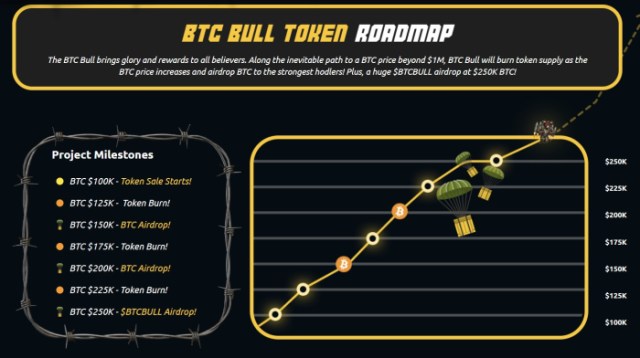
BTC Bull Token Roadmap

Every time Bitcoin claims a new major milestone, like $150K and $200K, $BTCBULL holders who have stored their tokens in Best Wallet will stand a chance to earn real Bitcoins.

Note: the $BTC amount you receive will depend on the number of $BTCBULL tokens you bought in the Community Sale. Also, subscribe to BTC Bull Token’s social media (X and Telegram) for updates about the airdrop events, as you’ll have to opt in to qualify.

Burn Tokens, Create Hype, and Enjoy Profits

The developers have done everything to ensure the project’s success, including using a deflationary approach, also known as a token burn mechanism, which sees the project shaving off a part of the total token supply to push the price.
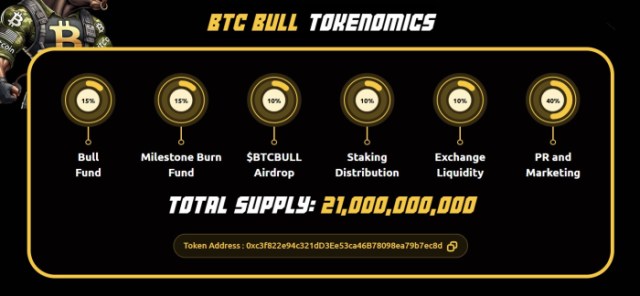
BTC Bull Token Tokenomics

These ‘token burn’ events will take place every time Bitcoin’s price increases by $50K, starting from $125K.

Incentives like these, combined with a chunky 40% of the total supply reserved for PR and marketing, suggest BTC Bull Token could become one of the top trending cryptos after its launch.

$BTCBULL Is Currently Cheaper than It Will Ever Be

Hell-bent on backing Bitcoin to $1M and beyond? Get BTC Bull Token!

According to our research, $BTCBULL can surge past $0.0497 by 2030 – a mind-boggling rise of over 1,800% in less than five years.

That’s aside from the chance to win real $BTC (currently worth over $105K) if you’re a $BTCBULL owner.

BTC Bull Token ($BTCBULL)

The good news is the token is still in presale, meaning you can grab it for just $0.002555. The project has already raised around $7M in early investor funding and is raring to go once it launches. You can read all about it in our What is BTC Bull Token guide.

More Cryptos Go Mainstream, but $BTC Remains the Greatest

New ETFs supporting modern cryptocurrencies like Solana and XRP represent a healthy diversification in the market, but the fact remains, there’s only one Bitcoin.

With an innovative approach towards airdrops, a classic token burn mechanism, and a lively community of crypto degens, BTC Bull Token nevertheless could emerge as the next big crypto coin to follow in Bitcoin’s footsteps.

That said, make sure to do your own research before investing. The market is unpredictable, and none of the above is financial advice.

Editorial Process for bitcoinist is centered on delivering thoroughly researched, accurate, and unbiased content. We uphold strict sourcing standards, and each page undergoes diligent review by our team of top technology experts and seasoned editors. This process ensures the integrity, relevance, and value of our content for our readers.

Bitcoinist is the ultimate news and review site for the crypto currency community!

Trending Cryptos

Related Reads

Ethereum's Next Decade in the Eyes of Vitalik

"Lean Ethereum" Long-Term Roadmap Unveiled by Vitalik Buterin On July 5, 2026, Vitalik Buterin published the "Lean Ethereum" roadmap, positioning it as Ethereum's third major evolution following the Merge. This multi-year, multi-phase upgrade aims to fundamentally transform Ethereum's core protocol through staged network upgrades extending to 2029. Key goals include achieving 1 gigagas per second L1 throughput (a massive increase from the current ~32 TPS), near-instant finality, and quantum-resistant cryptography. The plan involves transitioning Ethereum's security model from full transaction re-execution by all nodes to native verification via recursive STARK proofs. A major proposed change is replacing the EVM with a proof-friendly architecture like RISC-V or leanISA, though this remains a point of contention, especially with L2s like Arbitrum favoring alternatives like WASM. Other planned upgrades include a restructured state model with a large, cheap "warehouse" storage layer to drastically reduce fees for migrated applications, multi-dimensional gas pricing, and a new focus on making privacy a first-class, native protocol feature. While the roadmap significantly raises Ethereum's long-term technical ceiling, analysts note it does not directly address ETH's mid-term token economics or value capture. The plan's multi-year timeline means near-term price impact will likely depend on observable progress milestones, such as the successful deployment of the upcoming Glamsterdam gas limit increase, growth in L2 activity and blob usage, and trends in L1 fee revenue and ETH burn.

链捕手54m ago

Ethereum's Next Decade in the Eyes of Vitalik

链捕手54m ago

In Just 11 Days, Claude Rewrote Millions of Lines of Code, an Epic AI Engineering Feat Sparks Fury

In just 11 days, Bun's founder Jarred Sumner used Anthropic's Claude AI models to rewrite its million lines of code from Zig to Rust. This move sparked significant controversy, particularly from Zig's creator, Andrew Kelley, who publicly criticized Sumner's engineering practices and the decision to use AI for such a massive rewrite. Bun, a high-performance JavaScript/TypeScript runtime and rival to Node.js, was originally written in Zig. After Anthropic acquired Bun, the team encountered persistent stability and memory safety bugs in the Zig codebase. These issues, combined with Zig's strict policy against LLM-generated code, led to the decision to rewrite in Rust. The rewrite was executed using Claude AI tools at an estimated API cost of $165,000, dramatically reducing the expected time and financial cost. Andrew Kelley's response was scathing. He blamed the original bugs on poor engineering habits, calling Bun's Zig code a collection of "hacks on top of hacks." He expressed relief that Bun was no longer associated with Zig, fearing it would misrepresent the language and attract low-quality, AI-generated contributions. The tech community is divided; some view Kelley's critique as unprofessional, while others see it as a defense of engineering integrity. A major concern about the AI-driven rewrite is the resulting code quality. The translation from Zig left approximately 27,000 lines of unsafe Rust code, raising fears about long-term maintainability and technical debt. The debate centers on whether this project is a milestone in AI-assisted development or a future maintenance nightmare.

marsbit1h ago

In Just 11 Days, Claude Rewrote Millions of Lines of Code, an Epic AI Engineering Feat Sparks Fury

marsbit1h ago

From Auto Finance to Bitcoin to AI Engines: An Analysis of Cango's 'What Not to Do' Strategy

From Auto Finance to Bitcoin and Now AI: Cango's "What Not to Do" Strategy Cango, a Chinese auto finance platform that went public on the NYSE in 2018, is undergoing its third major transformation. After selling its entire auto business in 2024, it pivoted to become a large-scale Bitcoin miner, acquiring 50 exahash of mining rigs from Bitmain. However, its true goal was never Bitcoin, but owning and controlling energy infrastructure. Now, Cango is pivoting again. While most listed Bitcoin miners are leasing power to giant hyperscalers for AI training clusters, Cango is taking the opposite path. It has launched an AI inference subsidiary called EcoHash, focusing not on training but on distributed inference. The company's strategy hinges on the insight that over 70% of mining industry power is controlled by small, independent sites (10-50 MW), which are too small for hyperscalers but ideal for low-latency AI inference. Cango aims to partner with these small operators, providing the AI technology, customers, and financing through its EcoLink software layer, which can distribute workloads across sites for reliability. Cango maintains a hybrid model, running roughly 31.7 EH/s of Bitcoin mining for cash flow while aggressively cleaning its balance sheet—slashing long-term debt by 94.5% to $30.6 million and raising $75 million for its AI venture. Its first AI deployment will be at a 50 MW site in Georgia. The strategy faces skepticism, given the high costs of converting mining sites and the potential for an AI bubble. However, Cango's leadership believes discipline around "what not to do"—avoiding direct competition with hyperscalers in training—positions it to capture the long-tail demand for distributed AI inference power.

Foresight News2h ago

From Auto Finance to Bitcoin to AI Engines: An Analysis of Cango's 'What Not to Do' Strategy

Foresight News2h ago

Strategy's Bitcoin Sales Cap Far Exceeds $1.25 Billion: A Detail the Market Overlooked

The article discusses how MicroStrategy's potential Bitcoin sales go far beyond the announced $1.25 billion "reserve-building capacity." It clarifies a key distinction in the company's "BTC Monetization Program": selling Bitcoin to *build* a new dollar reserve (the $1.25B cap) versus selling to *replenish* the existing USD Reserve after it's used for expenses like preferred share dividends. The recent $216M BTC sale for dividend payments was a "replenishment," leaving the headline $1.25B building quota untouched. The plan actually outlines three potential funding pools from BTC sales: 1) Building the reserve ($1.25B cap), 2) Covering preferred share/ debt costs (no specified cap), and 3) Funding buyback programs (up to $20B). This means the structured sales potential exceeds $30 billion, not including uncapped replenishment sales. The piece argues this marks MicroStrategy's shift from a passive "buy-and-hold" Bitcoin proxy to an actively managed entity using BTC as a balance-sheet tool to manage its complex capital structure (common stock, preferred shares, debt, reserve). This creates new dynamics and potential conflicts, as actions benefiting one part (e.g., selling BTC to pay dividends) may pressure another (e.g., undermining the "never sell" narrative). Investors must now parse the company's specific terminology ("build" vs. "replenish") to understand the true scope of future BTC sales, which is significantly larger than the market initially perceived.

marsbit2h ago

Strategy's Bitcoin Sales Cap Far Exceeds $1.25 Billion: A Detail the Market Overlooked

marsbit2h ago

Trading

Spot

Hot Articles

What is XRP 2.0

XRP 2.0: A New Frontier in the Cryptocurrency Landscape Introduction to XRP 2.0 In the ever-evolving realm of cryptocurrency, new projects continuously emerge, vying for attention and adoption. One such promising initiative is XRP 2.0, a novel cryptocurrency project designed to leverage advanced blockchain technology and robust encryption methodologies. While the name draws parallels with Ripple’s XRP, it’s crucial to note that XRP 2.0 operates independently, focusing on enhancing transaction security, privacy, and scalability. As the digital financial landscape increasingly embraces decentralized solutions, XRP 2.0 aims to contribute meaningfully to web3 and the overall expansion of crypto projects. What is XRP 2.0? At its core, XRP 2.0 is a cryptocurrency project that aims to create a secure and decentralized digital currency ecosystem. Its foundational technology integrates sophisticated blockchain principles with cutting-edge encryption techniques. The overarching goal of XRP 2.0 is to establish itself as a reliable and efficient platform enabling swift transaction execution while prioritizing enhanced privacy protections for its users. The project is promoted as a solution to many limitations faced by existing cryptocurrencies, proposing a system that can handle a higher volume of transactions with improved speed and privacy. This versatility positions XRP 2.0 as a significant contender in a marketplace riddled with various digital currencies. Who is the Creator of XRP 2.0? The identity of the creator behind XRP 2.0 has been flagged as ‘Wilbur.’ However, comprehensive details regarding Wilbur or their associated entity remain elusive. The anonymity of many cryptocurrency creators is not an uncommon phenomenon in the industry, often designed to maintain a degree of privacy and security. Who are the Investors of XRP 2.0? As of now, specific information related to the investment foundations or organizations supporting XRP 2.0 is not publicly available. In the cryptocurrency sector, the backing by reputed investors can significantly influence a project's credibility and success, yet the transparency regarding the financial supporters of XRP 2.0 has not been established. How Does XRP 2.0 Work? XRP 2.0 stands out by employing a combination of blockchain technology and advanced encryption algorithms that ensures secure and decentralized transactions. Its innovative structure includes unique features designed to foster user engagement and broaden functionalities beyond conventional cryptocurrency transactions. Among these features, XRP 2.0 incorporates AI-powered capabilities, such as text-to-image and text-to-speech functionalities. These additions are designed to enhance the interactive experience for users, promoting broader applicability across various sectors. By bridging technological advancements with user-centered design, XRP 2.0 aims to capture the attention of a diverse range of individuals and enterprises looking to integrate cryptocurrency solutions into their operational frameworks. Timeline of XRP 2.0 Understanding XRP 2.0 requires examining the milestones that have defined its journey thus far: July 23, 2023: XRP 2.0 is introduced as a novel cryptocurrency project, aiming to revolutionize secure and decentralized transaction capabilities in the blockchain domain. September 8, 2023: The launching of another project, XRP20, occurs, marking the emergence of an ERC-20 token on the Ethereum blockchain that remains unrelated to XRP 2.0. November 13, 2023: The XRP Ledger undergoes a significant update with the release of rippled server software version 2.0.0. It is essential to note that this development is disconnected from the XRP 2.0 cryptocurrency project. Key Points About XRP 2.0 To distill the essence of XRP 2.0, several critical factors emerge: Unique Features: The inclusion of features like AI-powered text-to-image and text-to-speech further diversifies the potential applications of XRP 2.0. Blockchain Technology: The framework utilizes advanced blockchain mechanisms and encryption protocols, ensuring a secure and decentralized environment for transactions. Scalability and Privacy: XRP 2.0 prioritizes enhanced privacy protections in transaction processes and the scalability necessary to accommodate a growing user base. No Affiliation with Ripple: Importantly, despite its name, XRP 2.0 does not have any allegiance or collaboration with Ripple’s XRP, distinguishing its operational framework and objectives within the cryptocurrency ecosystem. Conclusion XRP 2.0 represents an ambitious venture into the cryptocurrency sphere, aiming to offer a combination of security, privacy, and efficiency in digital transactions. By integrating sophisticated technologies and user-friendly features, the project sets out to broaden the horizons of what cryptocurrency can achieve in today's digital economy. While the anonymity of its creator and lack of disclosed investors might raise questions for some, XRP 2.0's focus on advanced functionalities and decentralisation enhances its appeal amidst an increasingly crowded crypto market. As the cryptocurrency landscape continues to evolve, XRP 2.0 may yet emerge as a pivotal player in the expansion of secure and scalable blockchain solutions.

1.1k Total ViewsPublished 2024.04.01Updated 2024.12.03

What is XRP 2.0

Discussions

Welcome to the HTX Community. Here, you can stay informed about the latest platform developments and gain access to professional market insights. Users' opinions on the price of XRP (XRP) are presented below.

活动图片