Top 5 Meme Coins To Watch in June 2025 for Potential Gains

ccn.comPublished on 2025-05-31Last updated on 2025-05-31

Abstract

However, it could face resistance near $0.013. But by the look of things, demand for the token might soar, and this could drive the price as high as 0.018 by June.

Key Takeaways

  • SPX 6900 has formed a rounding bottom pattern while Gigachad is showing signs of accumulation.
  • Launch Coin is approaching oversold conditions, with RSI approaching 30; hence, a rebound could take it toward $0.29.
  • FARTCOIN has flashed a TD Sequential buy signal while the PENGU price is attempting a breakout.

Unlike their explosive run in 2024, memecoins have struggled to reclaim the spotlight in 2025. As a result, some of the coins that hit incredible levels are now down 60%, 70%, 80% from their all-time highs.

However, this doesn’t mean the memecoin supercycle is over. Several standout memecoins still show strong potential for gains.

In this analysis, CCN highlights the top 5 memecoins to watch in June and breaks down why they could be the next big winners.

SPX 6900 (SPX)

SPX tops the list of memecoins to watch in June. In May, the memecoin’s price climbed by over 100%, moving from $0.56 to $1.20.

Currently, SPX, a memecoin openly supported by crypto analyst Murad Mahmudov, trades at $1.16. Despite the brief decline, SPX’s price is likely to produce more gains.

On the daily chart, SPX has formed a rounding bottom, indicating that the memecoin could be going on a full recovery towards its all-time high. Amid this price action, the Money Flow Index (MFI) reading has continued to hit a higher reading.

If sustained, SPX’s price might break the resistance at $1.42. If achieved, then the memecoin’s price might experience a run to $1.78 in June.
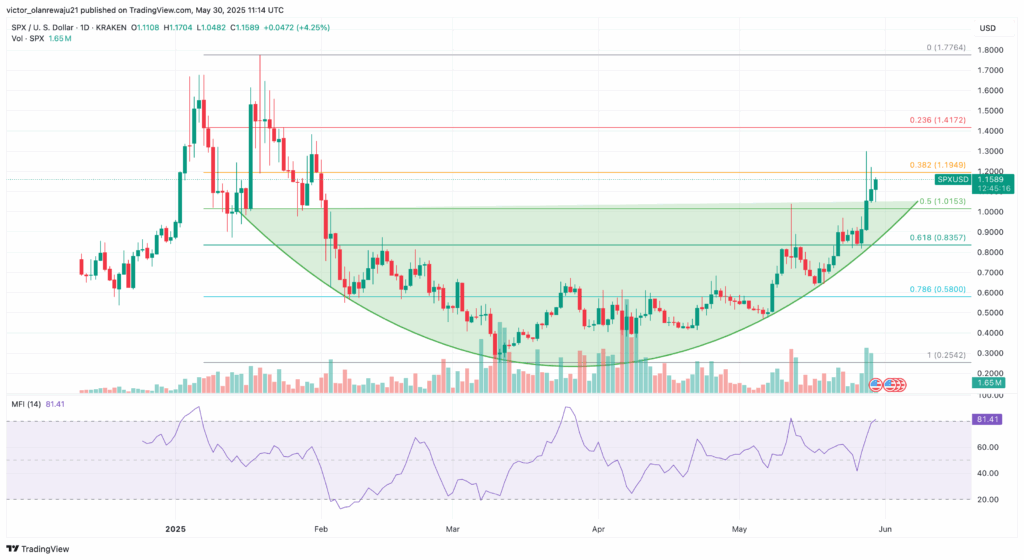
Should demand for the token increase, the price might hit $2. On the flip side, if the memecoin struggles to break the resistance at $1.42 and profit-taking rises, this forecast might not come to pass. If that happens, SPX price might slide to $0.84.

Gigachad (GIGA)

GIGA, another token promoted by Murad, is also part of the memecoins to watch in June 2025. As of this writing, GIGA’s price is down 72% from its all-time high.

But at the same time, it appears to be in an accumulation zone. At press time, GIGA’s price is trading in an ascending channel.

The Relative Strength Index (RSI) is above the neutral line, indicating bullish momentum. Like the RSI, the Awesome Oscillator (AO) is in the positive region, reinforcing the bullish thesis.

Should this trend continue into next month, GIGA’s price might break past the 0.618 golden ratio at $0.045. Once successful, the memecoin’s value might reach $0.068 near the 0.382 Fibonacci level.
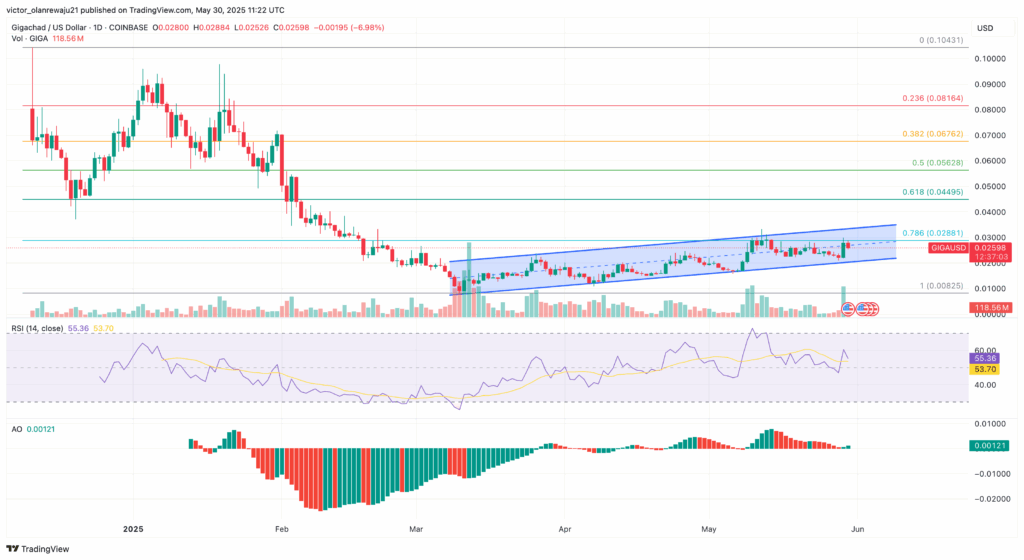
Meanwhile, a breakdown below the lower trendline of the ascending channel might invalidate this outlook. If that were to happen, GIGA might slide below $0.015.

Launch Coin (LAUNCHCOIN)

Launch Coin, a memecoin riding the wave of the “Internet Capital Markets” trend and backed by the Believe app, remains one to watch.

Although LAUNCHCOIN surged past $0.32 earlier this month, it has since pulled back to around $0.13. However, a closer look at the 4-hour chart reveals that it may soon enter oversold territory.

The Relative Strength Index (RSI), which gauges momentum and signals overbought or oversold conditions, is approaching the critical 30 level on the LAUNCHCOIN/USDT 4-hour chart. Given the recent selling pressure, the RSI could dip lower before buyers step in.

If buying interest picks up once oversold conditions set in, LAUNCHCOIN could bounce off its lows, potentially breaking above $0.15. Should demand strengthen further, the memecoin could rally toward $0.29.
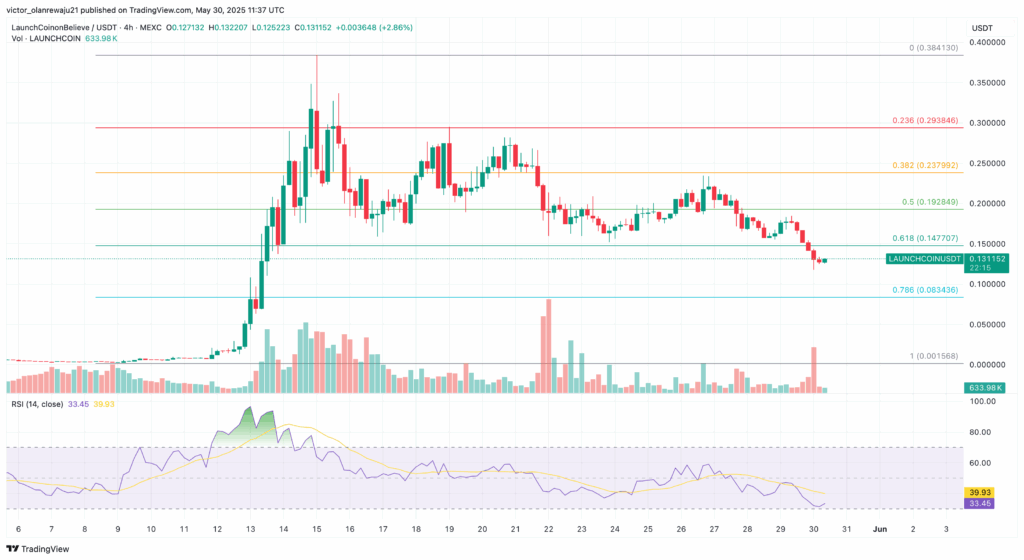
Alternatively, if buying pressure fails to increase, this prediction might not come to pass. If that is the case, the cryptocurrency’s value might drop below $0.10.

FARTCOIN

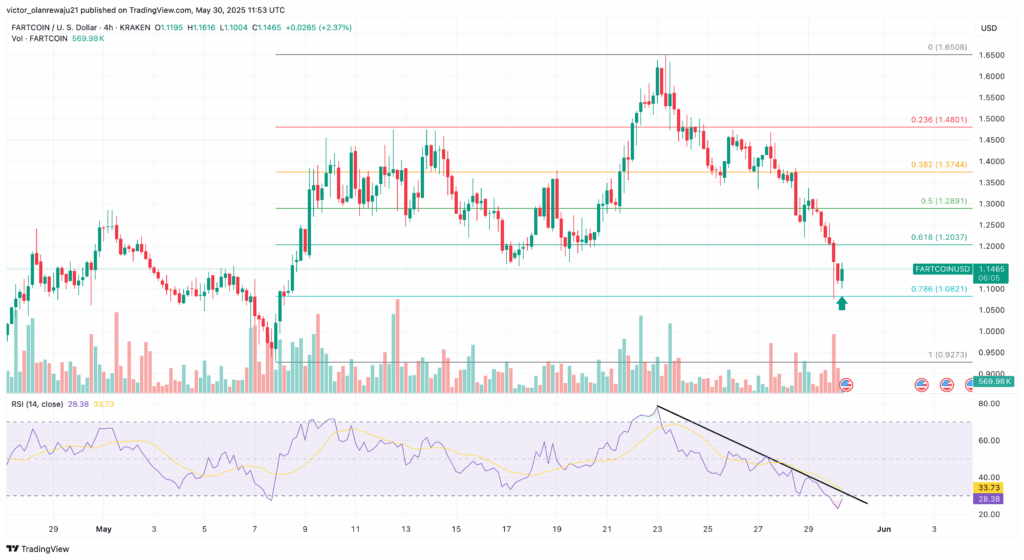
FARTCOIN is another meme coin that could climb higher in June. On the 4-hour chart, CCN observed that the Tom DeMark (TD) Sequential has printed a buy signal.

This position indicates that sellers are exhausted. As such, buyers might begin to take advantage of the cheap value. A closer look at the Relative Strength Index (RSI) is about to break above the downtrend.

If validated, FARTCOIN’s price could jump to $1.48. However, if FARTCOIN breaks below $1, the memecoin might not print gains in June. Instead, the cryptocurrency might slide toward $0.80.
Pudgy Penguins (PENGU)

Last on the list of memecoins to keep an eye on in June is PENGU. On the 4-hour chart, PENGU’s price is attempting to break above its recent correction.

However, it could face resistance near $0.013. But by the look of things, demand for the token might soar, and this could drive the price as high as 0.018 by June.
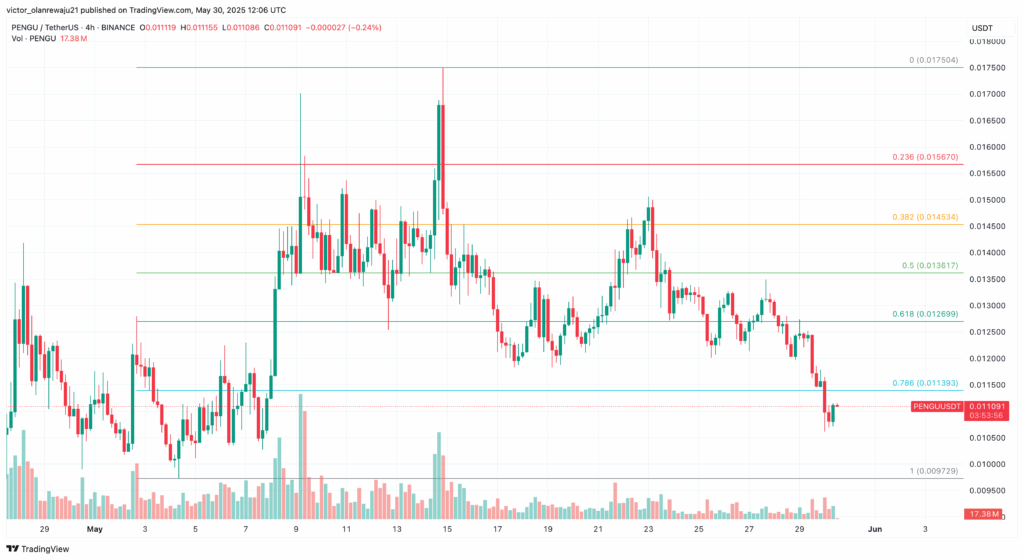
On the contrary, if buying pressure fails to outpace selling volume, this prediction might not come to pass. In that scenario, PENGU’s price might fall to $0.0097.


Trending Cryptos

Related Reads

After Aave's Exit and TVL's Sharp Fluctuation, Where Does MegaETH's Valuation Anchor Lie?

Following the withdrawal of Aave and a sharp drop in its Total Value Locked (TVL), the valuation of the high-performance DeFi blockchain MegaETH faces scrutiny. Once a highly anticipated project with a fully diluted valuation (FDV) reaching around $2 billion, MegaETH saw its TVL plummet from a May peak of $245 million to just over $30 million in July, a roughly 70% decline. Its native token, MEGA, currently trades around $0.048 with a market cap of approximately $54 million and an FDV of about $480 million. The report identifies a core vulnerability: MegaETH's TVL was heavily dependent on a single protocol, Aave V3, which at its peak contributed around 90% of the chain's TVL. A significant portion of this capital is attributed to leveraged yield-farming strategies involving stablecoins like USDe. When the profitability of these strategies diminished, capital rapidly exited, exposing the lack of diversified, sustainable activity. Three key mismatches between MegaETH's valuation and its fundamentals are highlighted: 1. **Valuation vs. Real Usage:** With an FDV of ~$4.8B but only ~$1M in annualized protocol revenue and ~2,600 daily active addresses, the valuation appears disconnected from current economic activity. 2. **Token Narrative vs. Ecosystem Reality:** Despite its DeFi narrative, nearly 80% of the chain's recent protocol revenue comes from a trading card game, Monster, not from core DeFi applications like Aave. The chain's native stablecoin, USDM, also shows low trading volume and a declining market cap. 3. **Short-Term Hype vs. Long-Term Delivery:** Initial hype from token generation, blue-chip integrations, and influencer support has faded. Major protocols like Uniswap now hold minimal TVL on the chain, indicating that early capital was largely transient and driven by incentives rather than organic demand. The situation reflects a broader market trend where investors are becoming less tolerant of valuations based on inflated TVL and narrative, demanding clearer evidence of sustainable transactions, revenue, and ecosystem development. While MEGA's price may experience short-term rebounds from market sentiment, a fundamental re-rating likely depends on the team's ability to convert its remaining resources into tangible, user-retaining applications and genuine ecosystem growth.

链捕手4h ago

After Aave's Exit and TVL's Sharp Fluctuation, Where Does MegaETH's Valuation Anchor Lie?

链捕手4h ago

Goldman Sachs In-Depth Report: Who Will Be the Long-Term Winners in China's AI Large Model Industry?

Goldman Sachs Report: China's AI Models at an Inflection Point China's open-source/open-weight large language models (LLMs) have reached performance parity with top global proprietary models, according to a Goldman Sachs report. This is driven by architectural innovations and higher parameter efficiency, allowing Chinese models to achieve comparable capabilities at 2%-10% the parameter size and significantly lower cost. The market is evolving into a two-tiered structure: a high-end segment (e.g., GLM5.2, Qwen3.7 Max) with premium pricing and a low-end, price-sensitive segment for global SMEs and individual users. Key points: * **Cost & Performance:** Innovations like Mixture of Experts (MoE) enable high performance with smaller models. Projects like Meituan's LongCat 2.0, trained on domestic hardware, highlight progress in tech self-sufficiency. * **Open-Source Strategy:** Most Chinese players use open-source/open-weight models for flexibility and ecosystem growth. However, Goldman notes this may underreport actual deployment and revenue. A shift toward "open-weight + community license" models with revenue sharing (e.g., MiniMax) could improve monetization. * **Market Shift & Global Expansion:** Enterprise AI adoption is shifting from "token maximization" to "ROI-first." International expansion, especially in non-US markets, is a major growth driver. Chinese models are increasingly available on global platforms like AWS Bedrock and Microsoft Copilot. * **Competitive Landscape:** Using a framework based on pricing power, cost advantage, and financial strength, Goldman identifies **Zhipu AI and DeepSeek** as the strongest in foundational text models, and **ByteDance** as the leader in multimodal/video generation. The report maintains Buy ratings on MiniMax and Kuaishou. * **Market Growth:** China's AI model API and subscription revenue is projected to grow from an estimated ¥35 billion in 2026 to ¥879 billion by 2030.

marsbit4h ago

Goldman Sachs In-Depth Report: Who Will Be the Long-Term Winners in China's AI Large Model Industry?

marsbit4h ago

Goldman Sachs Deep Dive Report: Who Will Become the Long-Term Winners in China's AI Large Model Industry?

Goldman Sachs Report: Who Will Be the Long-Term Winners in China's AI Large Model Industry? China's AI large model sector is at a historic inflection point. Goldman Sachs argues that the intelligence of Chinese open-source/open-weight models is approaching top global proprietary models. Rapid adoption by domestic enterprises and global SMEs is creating a data flywheel effect that will further drive model iteration. The evolution is summarized as moving from "DeepSeek's cost-efficiency moment last year to GLM's model-intelligence moment this year." Chinese models achieve near-state-of-the-art performance at significantly lower cost, primarily due to architectural innovations like Mixture of Experts (MoE) and higher parameter efficiency. Models like DeepSeek V4 Pro (1.6T params), GLM5.2 (0.7T), and MiniMax M3 (0.4T) are much smaller than global leaders. Recent advancements in coding capability are attributed to better data curation and RLHF. Landmarks like Meituan's LongCat 2.0, trained fully on domestic AI chips, demonstrate progress in hardware stack independence. The market is forming a "two-tiered structure." The high-end tier (e.g., GLM5.2, Alibaba's Qwen3.7 Max) prices around $1 per million tokens, about 10-25% of US top models, with estimated inference gross margins of 10-20%. The low-end tier (priced as low as $0.06-$0.2 per million tokens) targets price-sensitive global SMEs and individuals. MiniMax derives 60-70% of revenue overseas. Goldman forecasts China's AI model API/subscription revenue to grow from an estimated RMB 35bn in 2026 to RMB 879bn by 2030. Most Chinese players adopt open-source/open-weight strategies for deployment flexibility and community feedback, though this limits monetization as deployments on third-party platforms (e.g., Alibaba Cloud) may not generate direct revenue. A shift towards "open-weight + community license" models with revenue-sharing agreements (like MiniMax's approach) could improve unit economics. International expansion, particularly in non-US markets, is the key growth driver. The global enterprise AI paradigm is shifting from "token maximization" to "ROI prioritization." Chinese models are already hosted on major global platforms like AWS Bedrock and are under consideration for integration into Microsoft Copilot. Using a competitive framework based on pricing power, cost advantage, and financial strength, Goldman identifies the strongest players: In foundational text models, Zhipu AI (initiated coverage) and DeepSeek lead. In multimodal/video generation, ByteDance's Seed is the frontrunner, with Kuaishou's Kling and MiniMax's Hailuo also well-positioned. Goldman maintains a Buy rating on MiniMax, citing its attractive valuation.

链捕手4h ago

Goldman Sachs Deep Dive Report: Who Will Become the Long-Term Winners in China's AI Large Model Industry?

链捕手4h ago

Trading

Spot

Hot Articles

Discussions

Welcome to the HTX Community. Here, you can stay informed about the latest platform developments and gain access to professional market insights. Users' opinions on the price of ETH (ETH) are presented below.

活动图片