Is Bitcoin (BTCUSD) Decoupling From Strategy (MSTR)?

bitcoinistPublished on 2025-05-28Last updated on 2025-05-28

Abstract

Over the last several weeks, Bitcoin (BTCUSD) has decoupled from the stock market and made a new all-time high while...

Trusted Editorial content, reviewed by leading industry experts and seasoned editors. Ad Disclosure

Over the last several weeks, Bitcoin (BTCUSD) has decoupled from the stock market and made a new all-time high while major US indexes haven’t followed. Is Bitcoin also beginning to decouple from Strategy (MSTR) shares? According to high timeframe technical signals, the two tightly correlated assets could be beginning to diverge from one another.

Saylor’s Bitcoin 2025 Conference Blunder

During this week’s ongoing Bitcoin 2025 conference in Las Vegas, Strategy (formerly MicroStrategy) frontman and famed Bitcoin bull Michael Saylor shocked the audience by slamming the idea of “proof of reserves.” Saylor compared the practice to “publishing your kids’ bank account” online and warned that it could lead to hacks or worse. He outright called it a “bad idea.”

His comments are a departure from his usual Bitcoin-promoting self, prompting the cryptocurrency community to second-guess if the company holds as much BTC as they claim to.

The company’s most recent purchase of 4,020 BTC at $106,237 per BTC brought Strategy’s holdings to 580,250 BTC with a cost average of $69,979. Strategy’s holdings make the company among the top holders of BTC, behind only Satoshi Nakamoto and BlackRock’s IBIT ETF.

Proof-of-Risky Strategy

In the years, months, weeks, even days leading up to the ongoing conference, Michael Saylor has been pitched as the hero Bitcoin deserves, buying BTC at key inflection points and helping to prop up price.

Almost immediately following videos of Saylor’s response to a question from the audience, sentiment swiftly shifted against Saylor and Strategy. For example, the cover of a March 2000 edition of the Daily News is making rounds, with the headline reading “Lost $6B in a day: Hotshot tech CEO loses fortune as his company’s stock plunges 140 points.”

The headline is in reference to Michael Saylor being the biggest financial loser of the dot com bubble. At the time, MSTR share price fell by 99%.

A Correlation on the Cusp of Decoupling

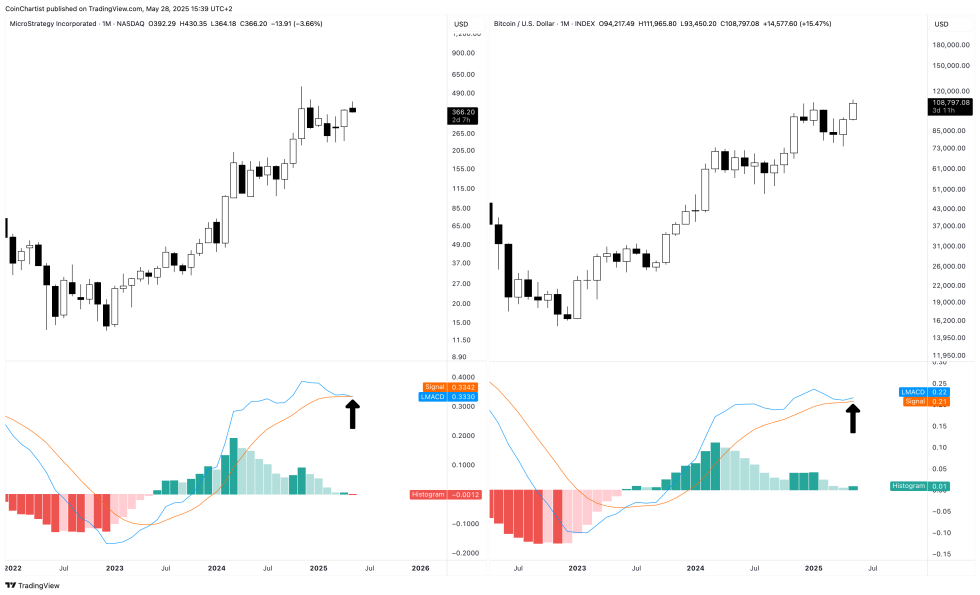
Because Strategy’s growth has been directly tied to Bitcoin’s price trajectory, BTCUSD and MSTR have been closely correlated. The monthly Correlation Coefficient is currently at a reading of 0.83, suggesting an extremely strong positive correlation.

However, previously similar technical signals on both assets have started to diverge, hinting at either a potential decoupling between BTCUSD and MSTR.
MSTR_2025-05-28_09-39-49
Left, MSTR has crossed bearish. Right, BTCUSD is still bullish.

The monthly LMACD is a momentum indicator. On the left, MSTR shows a bearish crossover. On the right, Bitcoin shows increasing bullish momentum. If MSTR crashes from here, and Bitcoin rallies, the decoupling event could come to fruition.

There still remains the possibility that the two assets stay tightly correlated, and MSTR’s bearish momentum could spill over into Bitcoin – pulling momentum over on the BTCUSD chart as well.

https://x.com/TonyTheBullCMT/status/1927717056754934251

Tony is the author of the CoinChartist (VIP) newsletter. Sign up for free. Please note: Content is educational and should not be considered investment advice. Featured image from Shutterstock, Charts from TradingView.com

Editorial Process for bitcoinist is centered on delivering thoroughly researched, accurate, and unbiased content. We uphold strict sourcing standards, and each page undergoes diligent review by our team of top technology experts and seasoned editors. This process ensures the integrity, relevance, and value of our content for our readers.

Tony "The Bull" Severino, CMT, a technical analyst and Head of Research at Bitcoinist. As the founder of CoinChartist.io, an educational platform for crypto traders focused on technical analysis, Tony provides his expertise to help others understand and apply this methodology. He has partnered with industry leaders like Elliott Wave International and TradingView. Through his partnerships, educational resources, and leadership roles, Tony has established himself as an authority on leveraging technical analysis to trade cryptocurrencies.

Trending Cryptos

Related Reads

Is Ethereum Truly a "World Computer"?

Title: Is Ethereum Really a "World Computer"? Ethereum, envisioned as a "world computer" by its founder Vitalik Buterin, aims to be a decentralized platform for global applications. However, a recent analysis by Four Pillars raises questions about whether it is more accurately a "Western computer," based on the geographical distribution of its validators. Currently, the United States dominates with 38.19% of all validators, followed by Germany at 13.04%. Combined, these two countries account for over half of the network. In contrast, Asian representation is minimal, with Singapore holding only 3.15%. The concentration is partly due to affordable cloud hosting services like Hetzner and OVH in Europe and North America, as well as the prevalence of residential validators in the U.S., where individuals run nodes via home internet connections. When examining professionally operated validators, the distribution becomes more balanced. The U.S. share drops to 25.81%, while Asian countries like Singapore (7.28%), Hong Kong (6.44%), Japan (6.38%), and South Korea (4.59%) collectively approach the U.S. level. This shift reflects strategic deployments by institutions to meet regulatory requirements and reduce latency for local users. However, regions like South America, the Middle East, and Africa remain underrepresented. Ethereum's peer-to-peer network mechanisms, such as gossipsub, disadvantage areas with low node density, creating a feedback loop where delayed message propagation reduces validator performance and rewards. This imbalance challenges Ethereum's promises of censorship resistance and global accessibility. Despite these issues, opportunities exist for growth in underrepresented regions. As demand for localized staking infrastructure rises, early entrants in areas like the Middle East could establish dominant positions by offering compliant, low-latency solutions. The evolving validator landscape highlights both the structural challenges and the potential for Ethereum to move closer to its "world computer" ideal.

Foresight News1h ago

Is Ethereum Truly a "World Computer"?

Foresight News1h ago

Trading

Spot

Hot Articles

What is $BITCOIN

DIGITAL GOLD ($BITCOIN): A Comprehensive Analysis Introduction to DIGITAL GOLD ($BITCOIN) DIGITAL GOLD ($BITCOIN) is a blockchain-based project operating on the Solana network, which aims to combine the characteristics of traditional precious metals with the innovation of decentralized technologies. While it shares a name with Bitcoin, often referred to as “digital gold” due to its perception as a store of value, DIGITAL GOLD is a separate token designed to create a unique ecosystem within the Web3 landscape. Its goal is to position itself as a viable alternative digital asset, although specifics regarding its applications and functionalities are still developing. What is DIGITAL GOLD ($BITCOIN)? DIGITAL GOLD ($BITCOIN) is a cryptocurrency token explicitly designed for use on the Solana blockchain. In contrast to Bitcoin, which provides a widely recognized value storage role, this token appears to focus on broader applications and characteristics. Notable aspects include: Blockchain Infrastructure: The token is built on the Solana blockchain, known for its capacity to handle high-speed and low-cost transactions. Supply Dynamics: DIGITAL GOLD has a maximum supply capped at 100 quadrillion tokens (100P $BITCOIN), although details regarding its circulating supply are currently undisclosed. Utility: While precise functionalities are not explicitly outlined, there are indications that the token could be utilized for various applications, potentially involving decentralized applications (dApps) or asset tokenization strategies. Who is the Creator of DIGITAL GOLD ($BITCOIN)? At present, the identity of the creators and development team behind DIGITAL GOLD ($BITCOIN) remains unknown. This situation is typical among many innovative projects within the blockchain space, particularly those aligning with decentralized finance and meme coin phenomena. While such anonymity may foster a community-driven culture, it intensifies concerns about governance and accountability. Who are the Investors of DIGITAL GOLD ($BITCOIN)? The available information indicates that DIGITAL GOLD ($BITCOIN) does not have any known institutional backers or prominent venture capital investments. The project seems to operate on a peer-to-peer model focused on community support and adoption rather than traditional funding routes. Its activity and liquidity are primarily situated on decentralized exchanges (DEXs), such as PumpSwap, rather than established centralized trading platforms, further highlighting its grassroots approach. How DIGITAL GOLD ($BITCOIN) Works The operational mechanics of DIGITAL GOLD ($BITCOIN) can be elaborated on based on its blockchain design and network attributes: Consensus Mechanism: By leveraging Solana’s unique proof-of-history (PoH) combined with a proof-of-stake (PoS) model, the project ensures efficient transaction validation contributing to the network's high performance. Tokenomics: While specific deflationary mechanisms have not been extensively detailed, the vast maximum token supply implies that it may cater to microtransactions or niche use cases that are still to be defined. Interoperability: There exists the potential for integration with Solana’s broader ecosystem, including various decentralized finance (DeFi) platforms. However, the details regarding specific integrations remain unspecified. Timeline of Key Events Here is a timeline that highlights significant milestones concerning DIGITAL GOLD ($BITCOIN): 2023: The initial deployment of the token occurs on the Solana blockchain, marked by its contract address. 2024: DIGITAL GOLD gains visibility as it becomes available for trading on decentralized exchanges like PumpSwap, allowing users to trade it against SOL. 2025: The project witnesses sporadic trading activity and potential interest in community-led engagements, although no noteworthy partnerships or technical advancements have been documented as of yet. Critical Analysis Strengths Scalability: The underlying Solana infrastructure supports high transaction volumes, which could enhance the utility of $BITCOIN in various transaction scenarios. Accessibility: The potential low trading price per token could attract retail investors, facilitating wider participation due to fractional ownership opportunities. Risks Lack of Transparency: The absence of publicly known backers, developers, or an audit process may yield skepticism regarding the project's sustainability and trustworthiness. Market Volatility: The trading activity is heavily reliant on speculative behavior, which can result in significant price volatility and uncertainty for investors. Conclusion DIGITAL GOLD ($BITCOIN) emerges as an intriguing yet ambiguous project within the rapidly evolving Solana ecosystem. While it attempts to leverage the “digital gold” narrative, its departure from Bitcoin's established role as a store of value underscores the need for a clearer differentiation of its intended utility and governance structure. Future acceptance and adoption will likely depend on addressing the current opacity and defining its operational and economic strategies more explicitly. Note: This report encompasses synthesised information available as of October 2023, and developments may have transpired beyond the research period.

706 Total ViewsPublished 2025.05.13Updated 2025.05.13

What is $BITCOIN

Discussions

Welcome to the HTX Community. Here, you can stay informed about the latest platform developments and gain access to professional market insights. Users' opinions on the price of BTC (BTC) are presented below.

活动图片