Crypto Bears Face $320 Million Squeeze As Bitcoin Breaks $110,000

bitcoinistPublished on 2025-05-23Last updated on 2025-05-23

Abstract

Data shows the cryptocurrency short holders have witnessed a mass liquidation event during the past day as Bitcoin and other...

Trusted Editorial content, reviewed by leading industry experts and seasoned editors. Ad Disclosure

Data shows the cryptocurrency short holders have witnessed a mass liquidation event during the past day as Bitcoin and other assets have rallied.

Bitcoin Has Set A New All-Time High Beyond $111,000

Despite pessimism surrounding Bitcoin during the earlier phase of decline, the cryptocurrency has defied expectations to not only recover to the previous all-time high (ATH), but also smash past it to set a new record around $111,800.

Below is a chart that shows how the recent bullish push from the asset has looked.

Bitcoin Price Chart

The price of the coin has broken past the previous ATH of about $109,200 | Source: BTCUSDT on TradingView

BTC seemed to be on the cusp after hitting $103,000 earlier in the month, but the coin couldn’t quite gather enough steam for that final push, leading to it falling prey to sideways consolidation. Naturally, this has changed in the last couple of days, with sustained momentum finally making an appearance.

The altcoins have also seen rallies of their own recently, but in terms of weekly returns, the original digital asset has managed to outperform most of the top ones. Ethereum, for example, has rallied about 3.5% in this period, less than half of BTC’s 8.5% return.

Crypto Liquidations Have Surpassed $500 Million In The Last 24 Hours

According to data from CoinGlass, the volatility led by the number one cryptocurrency has meant that a large number of positions on the derivatives exchanges have ended up finding liquidation during the past day. “Liquidation” here refers to the forceful closure that any open contract has to go through when its losses have exceeded a certain degree (as defined by the specific platform with which the position is open).

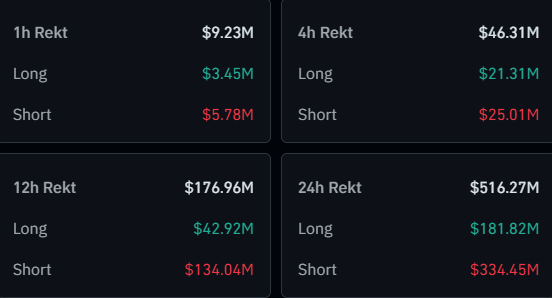
Here is a table that shows the relevant numbers related to the latest liquidations in the cryptocurrency market:
Bitcoin Liquidations

Looks like shorts have taken the brunt of the hit | Source: CoinGlass

As is visible above, the cryptocurrency sector as a whole has seen a whopping $516 million in liquidations over the last 24 hours. Considering the bullish price action, it’s not surprising to see that the shorts have made up for around 64% of the total liquidations ($334 million).

In terms of the breakdown by symbol, Bitcoin and Ethereum have been the top two contributors to the liquidations, as usual.

Bitcoin & Other Cryptos

The heatmap related to cryptocurrency liquidations in the past day | Source: CoinGlass

A mass liquidation event like the latest one is popularly known as a “squeeze.” Considering that the shorts have been hit the hardest in this event, it would be termed as a short squeeze.

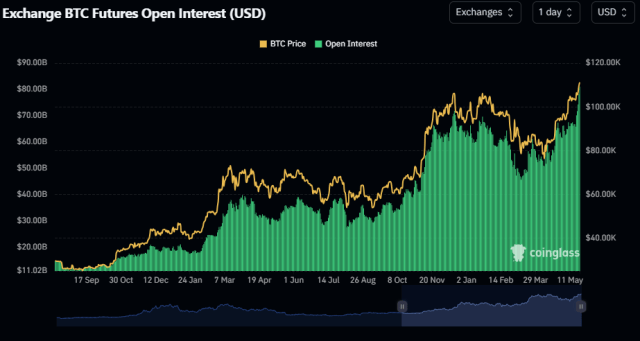
While a substantial amount of liquidations have occurred recently, it would appear that the speculators have still not been dissuaded, as the Bitcoin Open Interest has only continued to shoot up.
Bitcoin Open Interest

The data related to the BTC Open Interest | Source: CoinGlass

The “Open Interest” keeps track of the total number of positions related to BTC that are currently open on all derivatives platforms. At present, this indicator is sitting at $81 billion, a notable increase from the $65 billion value registered on May 18th.

Featured image from Dall-E, CoinGlass.com, charts from TradingView.com
Editorial Process for bitcoinist is centered on delivering thoroughly researched, accurate, and unbiased content. We uphold strict sourcing standards, and each page undergoes diligent review by our team of top technology experts and seasoned editors. This process ensures the integrity, relevance, and value of our content for our readers.

Keshav is a Physics graduate who has been employed as a writer with Bitcoinist since June 2021. He is passionate about writing and through the years, he has gained experience working in a variety of niches. Keshav holds an active interest in the cryptocurrency market, with on-chain analysis being an area he particularly likes to research and write about.

Trending Cryptos

Related Reads

From 2 Million Monthly Active Users to Zero: Zapper's Demise in the "Maturation" of DeFi

From 2M MAU to Zero: The Demise of Zapper in a Maturing DeFi Landscape On July 8, 2026, Zapper co-founder Seb Audet announced the platform's full shutdown. Once a DeFi star with 2 million monthly active users, $13B in processed transactions, and $16.5M in funding, Zapper's journey ends. Born in 2020 from the merger of DeFiZap and DeFiSnap, Zapper rode the "DeFi Summer" wave. It became essential for users to track complex, multi-protocol yield farming positions across chains. At its peak, it supported 14 chains, 450+ protocols, and 7000+ tokens, with its signature "Zap" feature simplifying multi-step DeFi actions. However, sustainable revenue never materialized. Its primary model—taking small fees from DEX aggregation—faced fierce competition and squeezed margins. Meanwhile, maintaining its extensive, real-time data indexing system was costly. Crucially, the DeFi ecosystem matured, with activity and liquidity concentrating in fewer top protocols. The core demand for a complex, multi-protocol dashboard waned as user behavior simplified. Zapper attempted multiple pivots that failed to gain traction: an NFT-based points system (2021), a social app called Chainchat (2023), and plans for a ZAP token and open protocol (2024). These efforts reflected a persistent "blockchain-native" mindset focused on creating new C端 (consumer) needs rather than addressing existing pain points or bolstering its revenue-generating products. The article contrasts Zapper with DeBank, which successfully narrowed its asset-tracking focus while developing Rabby Wallet—a revenue-stabilizing, competitive product. Zapper's story serves as a cautionary tale for tooling projects: over-immersion in a purist vision, coupled with an inability to adapt business models to market shifts—like the consolidation of DeFi activity—can be fatal, even for once-dominant platforms.

marsbit3m ago

From 2 Million Monthly Active Users to Zero: Zapper's Demise in the "Maturation" of DeFi

marsbit3m ago

Goldman Sachs Bans It, Google Bans It Too: The Gray Zone of Prediction Markets Is Shrinking Fast

Goldman Sachs has updated its personal trading policy, prohibiting employees from trading event contracts on prediction markets involving specific companies (including whether Goldman itself might restructure or initiate acquisitions in a quarter), election outcomes, financial market performance (including Bitcoin prices), macroeconomic data, geopolitical events, and regulatory results for pending M&A deals. Sports and entertainment bets remain allowed. Violations can lead to dismissal or account closure, and the firm may reclaim profits over $200 or donate them to charity. This follows a CFTC case against a Google engineer who allegedly used non-public data to profit $1.2 million on Polymarket. Simultaneously, Google's Chrome Web Store updated its policy, banning extensions that facilitate real-money trading on prediction market outcomes, effective August 1, 2026. While not affecting platforms' websites or mobile apps directly, this restricts a key user access channel. These actions occur amid growing regulatory pressure on prediction markets. The CFTC is investigating Polymarket for alleged misconduct, and a consumer group has filed a lawsuit. Over 30 countries, including Argentina, have blocked access. Despite this, trading volume has hit record highs, and major investments continue, such as ICE's $2 billion stake in Polymarket. The core debate remains whether prediction markets are financial instruments or gambling. CFTC argues for federal oversight as derivatives, while some states seek to regulate them under gambling laws. Multiple fronts—federal probes, political pressure, internal corporate bans, and platform restrictions—are narrowing the operational space for these markets.

Foresight News9m ago

Goldman Sachs Bans It, Google Bans It Too: The Gray Zone of Prediction Markets Is Shrinking Fast

Foresight News9m ago

Tsinghua AI Mathematician Emerges: From Intuition to Theorem, Contributing to an 84-Page Quantum Algorithm Paper

Tsinghua University’s Intelligent Industry Research Institute (AIR) has developed an AI mathematician agent named AIM, designed not just to solve math problems but to actively participate in early-stage research. In a recent study, researchers collaborated with AIM to develop "Sign Embedding Quantum Algorithms," resulting in an 84-page paper on quantum algorithms for matrix equations and functions. The research began with a human researcher's intuition: can rational approximation serve as a design principle for quantum algorithms? AIM helped expand this idea into multiple candidate research directions. Human researchers then filtered and focused on the most promising path. AIM assisted in organizing theorems, generating proof drafts, and performing complexity analysis, while humans maintained oversight, auditing assumptions and refining derivations. This case illustrates a human-AI collaborative workflow: AI rapidly explores and expands research avenues, generates draft materials, and aids in checking derivations; human researchers provide critical judgment on direction, value, and validity. The process emphasizes "high-throughput candidate generation + human value gating + AI-assisted audit and repair + human final integration." The resulting quantum algorithm framework offers a unified approach to several matrix problems, advancing quantum linear algebra under more general conditions. This work suggests AI's role in theoretical research is evolving from task-specific assistance to supporting the entire research lifecycle—enhancing exploration and efficiency while keeping human expertise central to guiding inquiry and ensuring rigor. *Paper & System Links:* - AIM application report: https://arxiv.org/abs/2606.24899 - Quantum algorithm paper: https://arxiv.org/abs/2604.25333 - AIM repository: https://github.com/TheoryFoundry/AIMv2

marsbit59m ago

Tsinghua AI Mathematician Emerges: From Intuition to Theorem, Contributing to an 84-Page Quantum Algorithm Paper

marsbit59m ago

Short-Lived Meme Mania: Can It Be the Icebreaker for Robinhood's RWA Narrative?

Robinhood recently launched its own Layer 2 network, Robinhood Chain, built on Arbitrum and focusing on tokenized stocks, RWA, DeFi, and AI finance. Shortly after launch, a meme coin called CASHCAT, named after an early unused Robinhood brand, surged in popularity, achieving a market cap near $150 million and high daily trading volume. It gained traction through third-party DEXs and launchpads like Uniswap and Noxa.fun, bypassing Robinhood's official listing process. This highlights a key feature of the permissionless chain: even assets not officially approved can achieve significant liquidity and trading activity. While CASHCAT currently dominates the chain's meme coin sector, its high turnover indicates speculative trading. The rapid proliferation of new meme coins risks dispersing liquidity. Meanwhile, the chain's core RWA sector remains relatively small at $12.5 million. CEO Vlad Tenev has expressed that the chain is well-suited for both RWA and meme coins. In the optimistic scenario, meme-driven activity could bootstrap the chain's user base and liquidity for its long-term RWA vision. However, if the meme frenzy fades quickly, the RWA narrative may struggle to gain traction independently. The incident demonstrates that on a permissionless platform, the market itself can create major assets, offering Robinhood a potential new growth avenue beyond its core crypto business as it navigates the long-term development of the tokenized asset market.

Foresight News1h ago

Short-Lived Meme Mania: Can It Be the Icebreaker for Robinhood's RWA Narrative?

Foresight News1h ago

Trading

Spot

Hot Articles

What is $BITCOIN

DIGITAL GOLD ($BITCOIN): A Comprehensive Analysis Introduction to DIGITAL GOLD ($BITCOIN) DIGITAL GOLD ($BITCOIN) is a blockchain-based project operating on the Solana network, which aims to combine the characteristics of traditional precious metals with the innovation of decentralized technologies. While it shares a name with Bitcoin, often referred to as “digital gold” due to its perception as a store of value, DIGITAL GOLD is a separate token designed to create a unique ecosystem within the Web3 landscape. Its goal is to position itself as a viable alternative digital asset, although specifics regarding its applications and functionalities are still developing. What is DIGITAL GOLD ($BITCOIN)? DIGITAL GOLD ($BITCOIN) is a cryptocurrency token explicitly designed for use on the Solana blockchain. In contrast to Bitcoin, which provides a widely recognized value storage role, this token appears to focus on broader applications and characteristics. Notable aspects include: Blockchain Infrastructure: The token is built on the Solana blockchain, known for its capacity to handle high-speed and low-cost transactions. Supply Dynamics: DIGITAL GOLD has a maximum supply capped at 100 quadrillion tokens (100P $BITCOIN), although details regarding its circulating supply are currently undisclosed. Utility: While precise functionalities are not explicitly outlined, there are indications that the token could be utilized for various applications, potentially involving decentralized applications (dApps) or asset tokenization strategies. Who is the Creator of DIGITAL GOLD ($BITCOIN)? At present, the identity of the creators and development team behind DIGITAL GOLD ($BITCOIN) remains unknown. This situation is typical among many innovative projects within the blockchain space, particularly those aligning with decentralized finance and meme coin phenomena. While such anonymity may foster a community-driven culture, it intensifies concerns about governance and accountability. Who are the Investors of DIGITAL GOLD ($BITCOIN)? The available information indicates that DIGITAL GOLD ($BITCOIN) does not have any known institutional backers or prominent venture capital investments. The project seems to operate on a peer-to-peer model focused on community support and adoption rather than traditional funding routes. Its activity and liquidity are primarily situated on decentralized exchanges (DEXs), such as PumpSwap, rather than established centralized trading platforms, further highlighting its grassroots approach. How DIGITAL GOLD ($BITCOIN) Works The operational mechanics of DIGITAL GOLD ($BITCOIN) can be elaborated on based on its blockchain design and network attributes: Consensus Mechanism: By leveraging Solana’s unique proof-of-history (PoH) combined with a proof-of-stake (PoS) model, the project ensures efficient transaction validation contributing to the network's high performance. Tokenomics: While specific deflationary mechanisms have not been extensively detailed, the vast maximum token supply implies that it may cater to microtransactions or niche use cases that are still to be defined. Interoperability: There exists the potential for integration with Solana’s broader ecosystem, including various decentralized finance (DeFi) platforms. However, the details regarding specific integrations remain unspecified. Timeline of Key Events Here is a timeline that highlights significant milestones concerning DIGITAL GOLD ($BITCOIN): 2023: The initial deployment of the token occurs on the Solana blockchain, marked by its contract address. 2024: DIGITAL GOLD gains visibility as it becomes available for trading on decentralized exchanges like PumpSwap, allowing users to trade it against SOL. 2025: The project witnesses sporadic trading activity and potential interest in community-led engagements, although no noteworthy partnerships or technical advancements have been documented as of yet. Critical Analysis Strengths Scalability: The underlying Solana infrastructure supports high transaction volumes, which could enhance the utility of $BITCOIN in various transaction scenarios. Accessibility: The potential low trading price per token could attract retail investors, facilitating wider participation due to fractional ownership opportunities. Risks Lack of Transparency: The absence of publicly known backers, developers, or an audit process may yield skepticism regarding the project's sustainability and trustworthiness. Market Volatility: The trading activity is heavily reliant on speculative behavior, which can result in significant price volatility and uncertainty for investors. Conclusion DIGITAL GOLD ($BITCOIN) emerges as an intriguing yet ambiguous project within the rapidly evolving Solana ecosystem. While it attempts to leverage the “digital gold” narrative, its departure from Bitcoin's established role as a store of value underscores the need for a clearer differentiation of its intended utility and governance structure. Future acceptance and adoption will likely depend on addressing the current opacity and defining its operational and economic strategies more explicitly. Note: This report encompasses synthesised information available as of October 2023, and developments may have transpired beyond the research period.

699 Total ViewsPublished 2025.05.13Updated 2025.05.13

What is $BITCOIN

Discussions

Welcome to the HTX Community. Here, you can stay informed about the latest platform developments and gain access to professional market insights. Users' opinions on the price of BTC (BTC) are presented below.

活动图片