别被中美握手骗了,真正的大戏才刚开始

Foresight NewsPublished on 2025-05-13Last updated on 2025-05-13

Abstract

建设性的力量,永远比破坏性的力量,更能帮助我们穿越周期。

撰文:刘润

引言

昨天,中美发布联合声明。

关于关税谈判的具体数字,网上有很多说法。其中一个流传比较广泛的,是:中国对美国,保留 10% 关税;美国对中国,保留 10% 对等关税和 20%「芬太尼关税」。还有 24% 关税,是否彼此加征,要等 90 天之后,根据后续的谈判结果定。

贸易战,终于有了阶段性的结果。不再像一个月前,剑拔弩张,让人松了口气。

但这口气,能松多久?90 天后,是皆大欢喜,还是新一轮加码?

不好说。

表面上看,中美博弈,在于关税壁垒。但其实,中美之争,争的是经济秩序的话语权,甚至世界新格局的主导权。

为什么这么说?

这是一个很大的话题,三言两语,很难说清楚。但还好,我知道这么一个人:瑞·达利欧(Ray Dalio)。

你可能听过他,桥水基金的创始人,掌管千亿美金资产,写过《原则》那本超级畅销书。但我觉得,他最厉害的,不光是这些成就,而是善于把特别宏观的事情,讲得明明白白。

这次,我推荐他的一个视频,《变化中的世界秩序》。视频里,瑞·达利欧研究了过往 500 年的历史,分享了很多对于大国博弈的看法,和有见地的思考。

看懂这个视频,或许对于你理解这次中美联合声明的弦外之音,以及中美博弈的走向,特别有帮助。

所以,我挑出了视频中几个非常重要的概念,试着为你做一些解释和说明。

准备好了吗?我们开始。

01 大周期

大周期。

这,是视频中,提到最多的一个概念。

人这一辈子,有年轻力壮的时候,也有老胳膊老腿的时候。国家,也差不多。翻阅过去 500 年,一个大国兴衰的全过程,通常是 250 年左右。
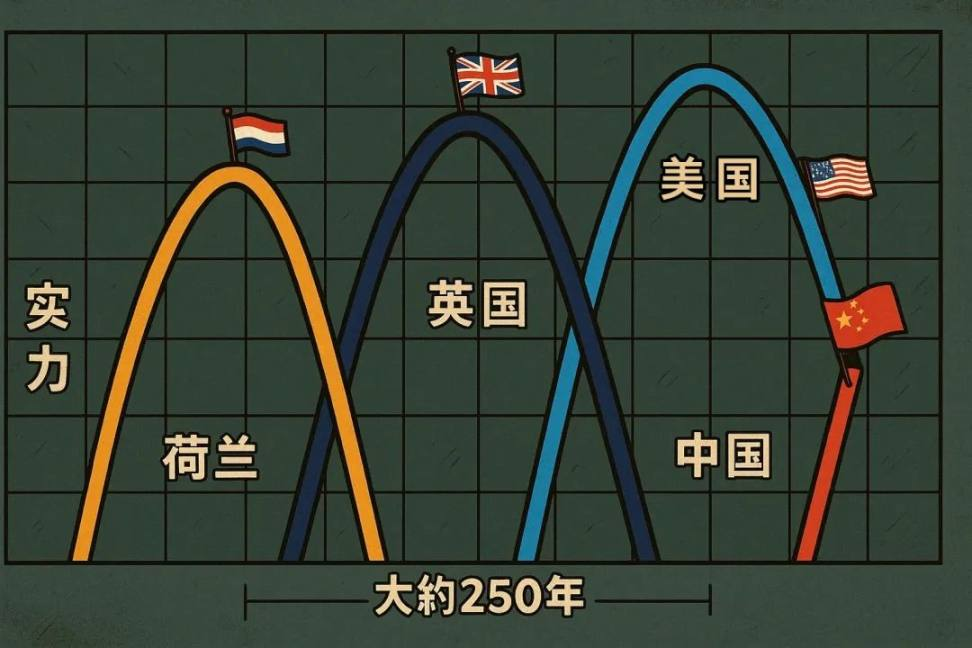
这 250 年,通常包括兴起、顶峰和衰落三阶段。

兴起,就像一个人的少年期。

老百姓努力工作,重视教育,就像当年的荷兰,迅速成为欧洲知识中心一样。科技创新,层出不穷,就像英国的工业革命一样。经济得以快速发展,进入顶峰。

顶峰,就像壮年期。

经济、军事、文化,世界顶尖。自家的货币,成了硬通货。无论是当年的荷兰盾、英镑,还是现在的美元。大家开始享受生活,借钱消费,这也为衰落埋下种子。

衰落,就像老年期。

维持「老大」地位的成本越来越高,入不敷出。就像当年荷兰英国到处殖民,反而拖垮了自己一样。贫富差距扩大,新崛起的大国又虎视眈眈。内忧外患之下,不得不黯然退场。

理解了这个模型,再回头看今天的世界,是不是清晰了一些?

现在的美国,可能过了壮年巅峰,开始显出老态。而中国,羽翼已经丰满,力争第一。

层出不穷的冲突,其底层原因,无关于某个领导人上台(如特朗普),也无关于某个政策颁布(如高达 200% 的关税政策)。

因为,「老大」地位的更迭,必然带来冲突。领先大国,在衰落之前,必定有一番挣扎。

好。现在,让我们把镜头拉得再近一点,仔细观察这个过程。

02 大国崛起

一个大国的崛起,要经历什么?

想象一下,你刚打赢了一场战争。国内一片和平,没人敢惹你。

这时候,你首先需要干一件大事:搞好教育。

因为教育,会带来更高的生产力。

举个例子,当年的荷兰。在打赢了哈布斯堡王朝之后,他们借助全民教育,获得了创新能力的爆发,贡献了全球 1/4 的重大发明。包括能环游世界的帆船。

由于生产力提高,你的产品就更有竞争力。产品卖的多,又能在教育上有更多投入。这个过程,就像滚雪球。

但要让这个雪球滚得更快,你还需要一个「加速器」:资本市场。

比如,贷款、债券和股票市场,使人们可以将储蓄转化为投资,从而给创新提供资金,分享成功。于是,荷兰人创办了第一家公开上市的公司,荷兰东印度公司,和为其融资的股票市场。

而所有崛起的国家,都会发展世界金融中心,来吸引和分配资本。

比如,荷兰时期,阿姆斯特丹就是世界金融中心。英国时期,是伦敦。现在,是纽约。中国,也正在迅速打造它的金融中心。

而随着一个国家成为全球最大贸易国,本国货币,就会成为全球首选的交易媒介。

这就是:储备货币。

03 储备货币

储备货币,就是荷兰强盛时期的荷兰盾,就是大英帝国宣称「日不落」时的英镑,就是二战至今,绿油油的美钞。

它的背后,是强大的经济、军事实力,和稳定的金融体系。

而当自家货币成为「储备货币」时,这个国家,就有了「开挂」的特权。

比如,你可以比其他国家更容易地借到钱。因为,全世界都想持有你的货币。

这也意味着,当你的钱不够花的时候,只要开动印钞机,「哗啦啦」地印钱,就能去外边花天酒地买买买,别人还认。

太爽了。

然而,当一个国家习惯了「繁荣」,其内部结构,往往会出现危机。

04 贫富差距

当霸主国家身处壮年后期,有一个问题,会像癌细胞一样,自我强化:

贫富差距。

你有了钱,当然想给孩子提供更好的教育,更高的起点。你有了钱,自然想要多配置一下资产,这边买买基金,那边搞一套房子。

这,可比打工赚钱快多了。

而当政府察觉到这一点,开始对富人征税,富人感到自己的财富受到威胁,就会把资产转移到更安全的地方,进一步削弱国家的经济基础和税收,形成恶性循环。

时间长了,社会阶层就开始固化。

想从白手起家,跨越阶层,越来越难。

而当大部分人开始觉得,游戏规则不公平,付出与回报不成正比时,怨恨、不满,就会像野火一样蔓延。

然后呢?社会就开始撕裂。

「我们」和「他们」的界限,变得越来越清晰。

左右两派,一派,要「劫富济贫」,一派,要「保护私产」。

撕裂,会极大消耗国家的体力。

回头看看荷兰「黄金时代」后期,和英国维多利亚时代末期。社会内部矛盾的激化,就是帝国由盛转衰的重要标志。

现在,你大概能理解,为什么今天的美国政治,如此极化和对立,社会议题争论不休。

因为,这正是壮年后期国家的典型特征,它不仅影响国内政策的制定执行,也削弱了美国与中国进行长期竞争时,能凝聚的共识和力量。

昔日霸主,因为储备货币的滥用,背负沉重债务,又因为日益扩大的贫富差距,变得虚弱。

那,面对这个困境,它最有可能,掏出什么「药方」来续命?

05 印钞机

历史,一次又一次地告诉我们。这个药方,大概率叫做:

印钞机。

哎。为什么不勒紧裤腰带,搞财政紧缩,或者干脆宣布破产,债务违约呢?

两个选择,理论上可行,但政治上太难了。

紧缩财政,意味着削减福利、公共开支。老百姓肯定不干。选票还要不要了?

债务违约,意味着国家信用彻底破产,金融体系可能直接崩溃。谁还敢借钱给你?

相比之下,印钞票,就成了一个看似「痛苦最小」的选择。

虽然,大家都知道这是「饮鸩止渴」,但至少能把眼前的债务压力顶过去。

再后边?顾不得了,相信后人的智慧。

至于通货膨胀的痛苦,让所有持有这个货币的人,包括国内老百姓和国外债权人,一起分担,也显得「公平」。

但,印钞真的是万能的吗?

当然不是。这会造成,一系列负面效果。

比如,钱不值钱了。

100 块,明天可能只能买 80 块的东西了。吃的、穿的、用的,价格不断上涨。

又比如,资产泡沫被进一步推高。

多印的钱,没有流向实体经济,创造就业,反而涌入了股市、房市、黄金,推高资产价格。

拥有资产的人,财富继续增加。没有资产的人,被通胀甩得更远。

现在,你大概能理解,为什么美国,在 2008 年次贷危机后和 2020 年疫情经济危机后,都会进行如此大规模的财政刺激了。

因为,面对巨大的不可持续的债务和维持全球竞争力,印钞成为了最容易做出的选择。

尽管,它可能加剧通胀、催生泡沫,并长期损害美元的信用。

一旦你实力下降,还不起债了,还一个劲儿地印钞票,谁还敢信你?信你的人越来越少,大家开始抛售你的货币和资产,金融崩溃就开始了。

荷兰盾和英镑的历史,都印证了这点。美元,虽然仍是主导货币,但日益沉重的债务负担,和潜在的信任危机,都隐隐透出不妙。

2024 年,美国商品进口总额 3.3 万亿,商品出口总额 2.1 万亿。去年美国人花的钱比挣的钱,多了 1.2 万亿美元,大约 9 万亿人民币。

此时,世界就进入了一个极其不稳定的阶段:

过渡期。

06 过渡期

我们前边提到,每个大周期,持续时间大概是 250 年,而期间,往往会出现 10-20 年的过渡期。过渡期,也是发生激烈冲突的时期。

而中美博弈,正是这次过渡期的核心。

而对于今天的美国来说,三件大事,已然出现。

第一个事件,是「钱只能靠印」 。

国家没有足够的钱,偿还债务。即便利率已经到底。央行,开始哗哗地印钱还债。每年的财政支出,甚至要靠举债来支持。

第二个事件,是「人心开始变散」。

社会上,「火药味」特别浓。根子,在于贫富差距太大。富人想守成,穷人希望重新分配,政治变成了互相攻击的战场。

第三个事件,是「外部的大国,虎视眈眈」。

中国,正在崛起。

当力量对比发生变化时,原有的世界秩序,已经不再适应。

国家之间,又缺乏一个像法庭那样,和平解决争端的机制。所以最终,往往只能通过各方面实力的较量,甚至是战争,来决定「老大」

相同的事情,曾经在历史上多次发生。

上一次出现这种情况,还是在 1930 年到 1945 年。二战后,美国主导建立了联合国、世界银行、国际货币基金组织以及布雷顿森林体系,确立了以美元为中心的战后世界秩序。

旧的周期结束,新的周期又开始。

历史,就在这样一个个兴衰循环中,滚滚向前。

那么,理解了这些规律,我们普通人又该怎么办?

07 2 条建议

达利欧的研究,并非只是为了满足好奇心,或者给投资提供参考。

他更希望通过揭示这些规律,帮助我们更好地理解自己所处的时代,做出更明智的选择。

于是,视频的最后,瑞·达利欧提了两个建议。

1)量入而出。2)善待彼此。

具体什么意思呢?

量入为出,就是:有多大能力办多大事,避免过度负债。

对国家来说,如果长期花的比挣的多,靠借债度日,必然会出问题。对个人来说,管理好自己的现金流和债务,是应对未来不确定性的基础。

在这个不确定性就是最大确定性的时代,手里有现金,心里才不慌。

善待彼此,就是:多点善意,少点戾气。

对一个社会来说,如果内部矛盾重重,就会消耗巨大的能量,变得脆弱不堪。只有促进公平,团结协作,才能保持凝聚力和竞争力。对个人来说,在观点多元的社会里,要努力寻求理解和沟通,而不是激化对立。

建设性的力量,永远比破坏性的力量,更能帮助我们穿越周期。

站在 2025 年的今天,回望 500 年,当下「乱糟糟」的世界,也似乎变得清晰了一点。

这个世界,正在经历一场深刻的转变。

当一个大国,不再用创新和进步来证明自己,而是靠加税、制裁、打压来显示实力;不再用团结和智慧来解决问题,而是靠印钞票、挑动对立来维持统治的时候,它的未来,或许已经不言自明了。

就像一艘曾经横扫天下的巨轮。船长不停地往引擎里加油,想让船开得更快。可他忘了,船舱已经开始漏水,船员们正在互相指责,而暴风雨,正在靠近。

这不是谁对谁错的问题,这是规律,是周期的力量。

作为个人,我们能做的,就是保持清醒,量入为出,善待彼此。

在这个充满不确定性的时代,最重要的,或许不是争论谁对谁错,而是守住内心的那份平和与理性。

暴风雨终将过去,太阳终将升起。

在那之前,我们静观其变。

Trending Cryptos

Related Reads

Bitmine Increases Holdings to 5.7 Million ETH, Included in Russell 1000 Index, Tom Lee Says Only One Step Away from '5% Target'

Bitmine Increases Ethereum Holdings, Nears 5% Supply Target and Joins Russell 1000 Bitmine Immersion Technologies (BMNR) acquired an additional 27,084 ETH last week, bringing its total holdings to 5,700,040 ETH, which represents 4.7% of Ethereum's total supply. This puts the company at 94% of its goal to own 5% of ETH's circulating supply. Despite a challenging week where ETH price fell 8% and BMNR's stock dropped 13%, Bitmine continues its accumulation strategy, with Chairman Tom Lee attributing the market weakness to quarter-end "window dressing" by investors. In a significant development, Bitmine was added to the Russell 1000 large-cap index on June 26. Lee expects this inclusion to attract hundreds of institutional investors, as passive funds and ETFs rebalance to match the index. The company's total assets, including crypto, cash, and securities, stand at $9.8 billion. Of its ETH holdings, 4,879,157 are currently staked, generating an estimated annualized revenue of $211 million. Lee projects this could rise to $246 million once all ETH is staked through its MAVAN network. Bitmine remains the world's largest corporate Ethereum treasury and the second-largest overall corporate crypto treasury, behind Strategy's substantial Bitcoin holdings. Lee reaffirmed the company's commitment to steady buying throughout 2026, expressing belief that the crypto market is still in the early stages of a spring cycle. At the time of writing, ETH was trading around $1,565, while BMNR stock was near $13.56, down over 90% from its 52-week high.

marsbit17m ago

Bitmine Increases Holdings to 5.7 Million ETH, Included in Russell 1000 Index, Tom Lee Says Only One Step Away from '5% Target'

marsbit17m ago

AGI Countdown: OpenAI's Chief Research Officer Makes Major Statement — The Window for Humanity is 'Very Small'

The countdown to AGI has begun, according to OpenAI's Chief Scientist Mark Chen, who states the window for human-centric progress is "very small." Chen argues that AI is reaching a point where models can perform "self-sustaining research," autonomously driving innovation in fields from mathematics to programming. He points to the proliferation of AI's "superhuman" insights—akin to AlphaGo's legendary "Move 37"—across disciplines as evidence of this shift. Chen firmly dismisses claims that scaling laws are plateauing or that pre-training is dead, asserting the field remains on an exponential curve. He cites OpenAI's successful bet on reasoning models like o1 as proof that fundamental breakthroughs are still possible. The future of research, he suggests, lies with "Vibe Researchers"—humans who provide high-level direction and "taste" while AI handles execution and orchestration of complex, long-horizon tasks. However, significant hurdles remain. Chen highlights a "benchmarking crisis," where models can overfit to existing tests without gaining true generalization. He also notes the "jagged frontier" of AI capabilities, where systems excel at advanced reasoning but struggle with contextual, continual learning from everyday experiences. Despite these challenges, he expresses confidence that these gaps will be closed. In a personal reflection, Chen shares that post-AGI, his wish is to open a noodle shop—a metaphor emphasizing that when AI masters knowledge and innovation, uniquely human experiences, warmth, and storytelling will become the ultimate form of value.

marsbit32m ago

AGI Countdown: OpenAI's Chief Research Officer Makes Major Statement — The Window for Humanity is 'Very Small'

marsbit32m ago

China's No.1, Closing in on OpenAI, Mysterious "Sweeping Monk" Rises to Top Seven Globally

A mysterious Chinese AI project named "MopMonk" (meaning "Sweeping Monk") has achieved a top-ranking result on the globally recognized CyberGym cybersecurity benchmark. With a 73.1% success rate, it ranks seventh worldwide and first among Chinese entries, performing closely behind OpenAI. The significance lies in the benchmark itself. CyberGym, created by UC Berkeley, is considered a premier "Olympics" for AI security. It tests models on over 1500 real-world software vulnerabilities, requiring them to not just identify but actually generate working exploits (PoCs) in a complex, offline environment. This moves beyond simple knowledge to testing an AI's practical "execution" capabilities. MopMonk's approach is notable. It uses the open-source MiniMax M3 model from Shanghai as its powerful reasoning "brain," leveraging its strong coding skills and long context window. However, the key to its performance is a custom-built, multi-agent security framework—its "Harness." This system uses structured "vulnerability memory" to efficiently guide the search for exploits, allowing multiple agents to explore in parallel while sharing lessons learned from failures. This engineering layer effectively translates the model's intelligence into actionable, iterative testing steps. The project remains highly secretive, with no official website or team information, embodying the "dark horse" spirit of its literary namesake. Its success highlights a potential industry shift: beyond simply scaling model size, the engineering of specialized agent systems (the Harness) is becoming a critical differentiator for real-world AI application performance, especially in complex domains like cybersecurity.

marsbit1h ago

China's No.1, Closing in on OpenAI, Mysterious "Sweeping Monk" Rises to Top Seven Globally

marsbit1h ago

Will History Repeat Itself? Fidelity Lists Five Catalysts to End the Crypto Winter

Fidelity's new report suggests that the current crypto winter for Bitcoin may be nearing its end, identifying five potential catalysts that could drive a market turnaround based on historical patterns. First, Bitcoin's approximately four-year cycle, driven by its halving mechanism, historically marks peaks and troughs. The last bottom was in November 2022, potentially pointing to the next around November 2026, though cycle length can vary. Second, clearer regulation has often preceded past bull markets. The focus is now on the CLARITY Act, which aims to clarify US digital asset oversight between the SEC and CFTC. Its passage could unlock domestic activity currently held back by legal uncertainty. Third, Federal Reserve monetary policy plays a role. A shift to lower interest rates tends to correlate with rising crypto prices by reducing borrowing costs and boosting risk appetite, though markets may price this in well ahead of any official change. Fourth, the emergence of breakthrough applications can fuel investor interest. Current trends like real-world asset tokenization, AI-related crypto infrastructure, and stablecoins are being watched, but history shows the biggest catalysts are often unexpected. Fifth, a new wave of institutional adoption could be a trigger. While ongoing adoption in 2026 hasn't sparked a new bull run, a major unexpected move—like a significant purchase by a tech giant or adoption as a hedge in a global crisis—could create a powerful new narrative. Fidelity concludes that while the market is in a downturn, historical turning points have often resulted from a combination of such factors, and the next phase for Bitcoin may depend on which of these catalysts materializes first.

Foresight News1h ago

Will History Repeat Itself? Fidelity Lists Five Catalysts to End the Crypto Winter

Foresight News1h ago

Trading

Spot

Hot Articles

What is $BITCOIN

DIGITAL GOLD ($BITCOIN): A Comprehensive Analysis Introduction to DIGITAL GOLD ($BITCOIN) DIGITAL GOLD ($BITCOIN) is a blockchain-based project operating on the Solana network, which aims to combine the characteristics of traditional precious metals with the innovation of decentralized technologies. While it shares a name with Bitcoin, often referred to as “digital gold” due to its perception as a store of value, DIGITAL GOLD is a separate token designed to create a unique ecosystem within the Web3 landscape. Its goal is to position itself as a viable alternative digital asset, although specifics regarding its applications and functionalities are still developing. What is DIGITAL GOLD ($BITCOIN)? DIGITAL GOLD ($BITCOIN) is a cryptocurrency token explicitly designed for use on the Solana blockchain. In contrast to Bitcoin, which provides a widely recognized value storage role, this token appears to focus on broader applications and characteristics. Notable aspects include: Blockchain Infrastructure: The token is built on the Solana blockchain, known for its capacity to handle high-speed and low-cost transactions. Supply Dynamics: DIGITAL GOLD has a maximum supply capped at 100 quadrillion tokens (100P $BITCOIN), although details regarding its circulating supply are currently undisclosed. Utility: While precise functionalities are not explicitly outlined, there are indications that the token could be utilized for various applications, potentially involving decentralized applications (dApps) or asset tokenization strategies. Who is the Creator of DIGITAL GOLD ($BITCOIN)? At present, the identity of the creators and development team behind DIGITAL GOLD ($BITCOIN) remains unknown. This situation is typical among many innovative projects within the blockchain space, particularly those aligning with decentralized finance and meme coin phenomena. While such anonymity may foster a community-driven culture, it intensifies concerns about governance and accountability. Who are the Investors of DIGITAL GOLD ($BITCOIN)? The available information indicates that DIGITAL GOLD ($BITCOIN) does not have any known institutional backers or prominent venture capital investments. The project seems to operate on a peer-to-peer model focused on community support and adoption rather than traditional funding routes. Its activity and liquidity are primarily situated on decentralized exchanges (DEXs), such as PumpSwap, rather than established centralized trading platforms, further highlighting its grassroots approach. How DIGITAL GOLD ($BITCOIN) Works The operational mechanics of DIGITAL GOLD ($BITCOIN) can be elaborated on based on its blockchain design and network attributes: Consensus Mechanism: By leveraging Solana’s unique proof-of-history (PoH) combined with a proof-of-stake (PoS) model, the project ensures efficient transaction validation contributing to the network's high performance. Tokenomics: While specific deflationary mechanisms have not been extensively detailed, the vast maximum token supply implies that it may cater to microtransactions or niche use cases that are still to be defined. Interoperability: There exists the potential for integration with Solana’s broader ecosystem, including various decentralized finance (DeFi) platforms. However, the details regarding specific integrations remain unspecified. Timeline of Key Events Here is a timeline that highlights significant milestones concerning DIGITAL GOLD ($BITCOIN): 2023: The initial deployment of the token occurs on the Solana blockchain, marked by its contract address. 2024: DIGITAL GOLD gains visibility as it becomes available for trading on decentralized exchanges like PumpSwap, allowing users to trade it against SOL. 2025: The project witnesses sporadic trading activity and potential interest in community-led engagements, although no noteworthy partnerships or technical advancements have been documented as of yet. Critical Analysis Strengths Scalability: The underlying Solana infrastructure supports high transaction volumes, which could enhance the utility of $BITCOIN in various transaction scenarios. Accessibility: The potential low trading price per token could attract retail investors, facilitating wider participation due to fractional ownership opportunities. Risks Lack of Transparency: The absence of publicly known backers, developers, or an audit process may yield skepticism regarding the project's sustainability and trustworthiness. Market Volatility: The trading activity is heavily reliant on speculative behavior, which can result in significant price volatility and uncertainty for investors. Conclusion DIGITAL GOLD ($BITCOIN) emerges as an intriguing yet ambiguous project within the rapidly evolving Solana ecosystem. While it attempts to leverage the “digital gold” narrative, its departure from Bitcoin's established role as a store of value underscores the need for a clearer differentiation of its intended utility and governance structure. Future acceptance and adoption will likely depend on addressing the current opacity and defining its operational and economic strategies more explicitly. Note: This report encompasses synthesised information available as of October 2023, and developments may have transpired beyond the research period.

524 Total ViewsPublished 2025.05.13Updated 2025.05.13

What is $BITCOIN

Discussions

Welcome to the HTX Community. Here, you can stay informed about the latest platform developments and gain access to professional market insights. Users' opinions on the price of BTC (BTC) are presented below.

活动图片