山寨币4月回暖大排查:超7成上涨,小市值代币占领涨幅榜

marsbitPublished on 2025-04-29Last updated on 2025-04-30

经历了前期的市场剧烈调整,4月份的加密货币市场似乎吹来一丝暖风。虽然比特币等主流资产仍在区间内寻求方向,但山寨币领域已显现出一定的复苏迹象,市场情绪较之前有所缓和。在这一个月(2025年4月1日至4月28日)的市场反弹中,各类代币表现如何?哪些赛道和生态更具韧性?PANews通过对币安上主流USDT现货交易对的数据进行了分析,试图揭示近期市场的真实图景。

数据说明:本次研究基于币安交易所USDT现货交易对,结合CoinGecko提供的代币分类、市值等基础信息,共纳入397个有效代币进行分析。时间范围为2025年4月1日至4月28日。涨跌幅以该时间段的起始价(4月1日开盘价)和结束价(4月28日收盘价)计算。

超七成代币上涨,但整体涨势温和

从整体数据来看,4月份市场确实呈现出一定的普涨格局。在我们分析的397个代币中:

平均涨幅为13.11%,中位数为7.73%。这表明虽然上涨是主旋律,但整体涨幅并不算强劲,多数代币涨幅有限。

上涨代币占比达到74.1%,近四分之三的代币在4月实现了向上反弹。下跌代币占比为25.7%。

不过从整体的涨幅情况来看,这波反弹行情当中,大涨的代币还是在少数情况,多数的代币反弹区间集中在50%以下。涨幅超过100%的代币占比仅为3.0%,只有12个,并且其中有6个是4月才上线币安因此涨跌幅是按照开盘计算,涨幅看起来比实际更高。涨幅在50%至100%之间的代币占比为3.3%。涨幅在0%至50%之间的代币占比最高,达到67.8%。

这组数据反映出市场情绪虽有回暖,但距离全面性的“山寨季”狂热仍有距离。大部分代币的上涨幅度相对克制,市场的结构性机会似乎大于普涨行情。
市值

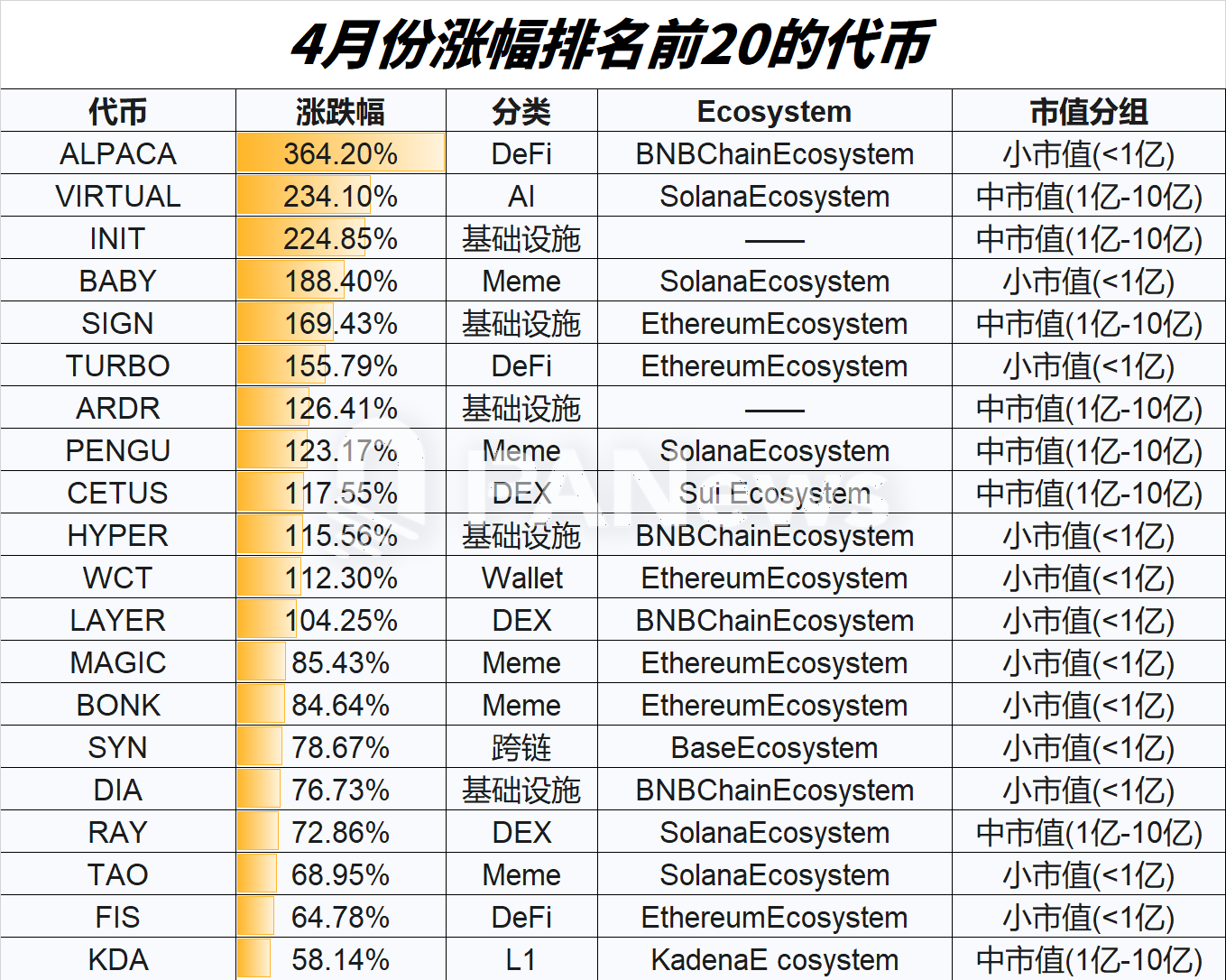
观察涨幅榜单,可以发现几个特点:

小市值代币占据主导:前20名中有大量代币属于小市值(<1亿)或中市值(1亿-10亿)范畴,显示出资金在寻求更高的弹性。

DeFi复苏迹象:ALPACA、TURBO、FIS等DeFi项目出现在榜单前列。

AI与Meme热度不减:VIRTUAL(AI)、BABYUSDT(Meme)、PENGUUSDT(Meme)等表现抢眼,延续了之前的市场热度。

基础设施与DEX:基础设施和DEX赛道也有多个代币上榜。

特定生态:Solana生态和BNBChain生态在本月贡献了较多涨幅居前的代币。

年份区别:新代币涨幅更大,老项目表现最差
市值

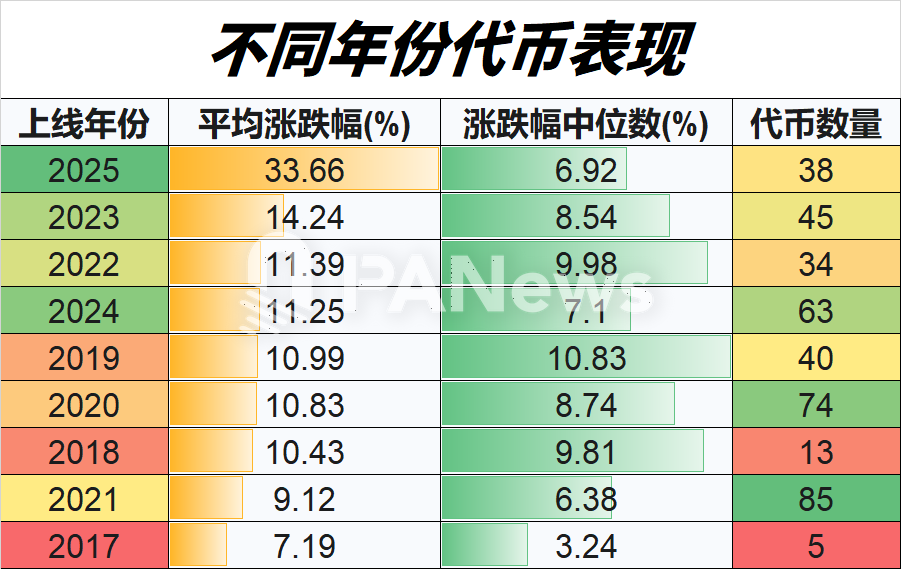
此外,本轮反弹当中,还呈现出一种趋势,那就是市场依旧“买新不买旧”,数据显示,2025年上线的新币平均表现依然最佳,平均涨幅达到33.66%,显著高于其他年份。这表明市场对新资产的偏好依然存在。而2023年和2022年上线的代币表现次之。有趣的是,2024年上线的代币虽然在数量上最多,为63个,但平均涨幅只有11.25%,在本月表现平平,平均涨幅甚至略高于2019、2020年的老币种。而更古早的项目,2017年的代币平均涨幅最低,2021年作为上一轮牛市,不知是牛市代币的泡沫更大的缘故还是其他原因,涨幅排在倒数第二。

从这个数据分布来看,2022年~2023年这种熊市上线的代币反而更具有后劲,而牛市的代币似乎缺乏长期的生命力。

基建、AI表现抢眼
市值

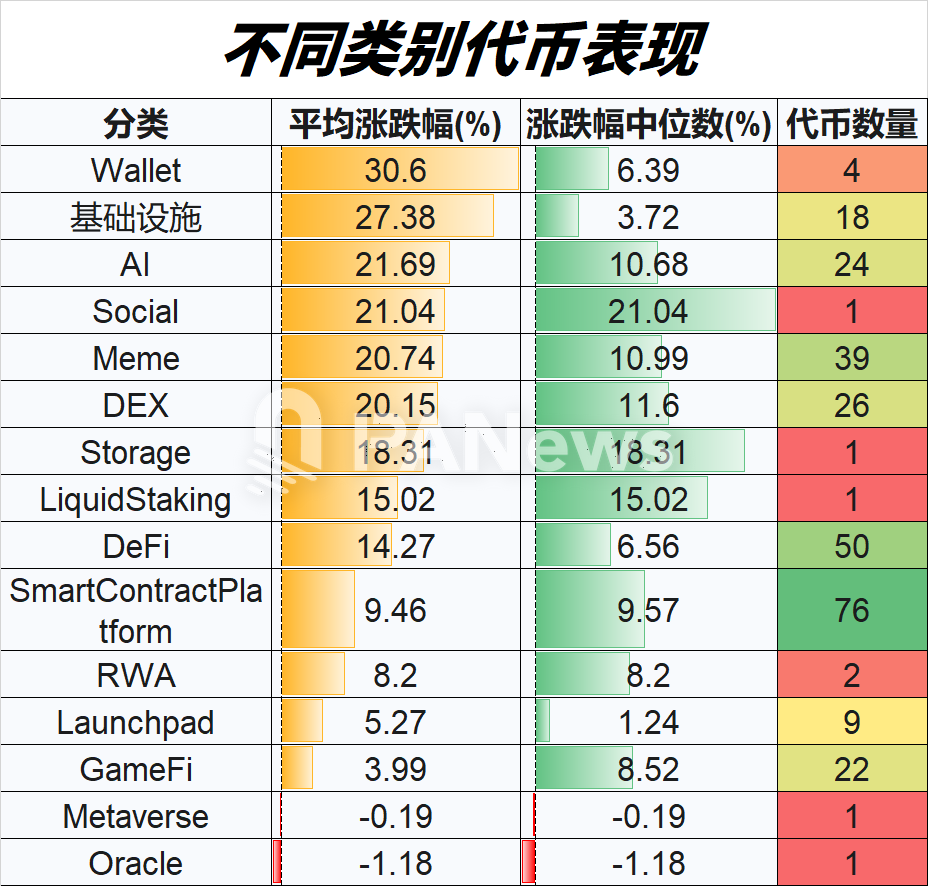
从赛道分类来看,钱包、基础设施(平均涨幅27.38%)和AI(平均涨幅21%)成为本月平均涨幅最高的三个赛道。不过,钱包赛道因为代币的样本只有4个,且主要是因为WCT是新上线项目拉高了整体水平,整体来看钱包赛道的真实涨幅可能只有5%左右。紧随其后的是Meme和DEX。这与涨幅榜前列代币的分布有一定关联。

DeFi作为最大的板块之一,平均表现尚可。而Smart Contract Platform(公链平台)类别虽然代币众多,但整体涨幅相对落后。近期备受关注的RWA赛道在本月表现平平。表现最差的则是Metaverse(元宇宙)和Oracle(预言机),不过这两个赛道在本次统计中有效样本量较少。

Sui、Base、Solana生态平均涨幅更大
市值

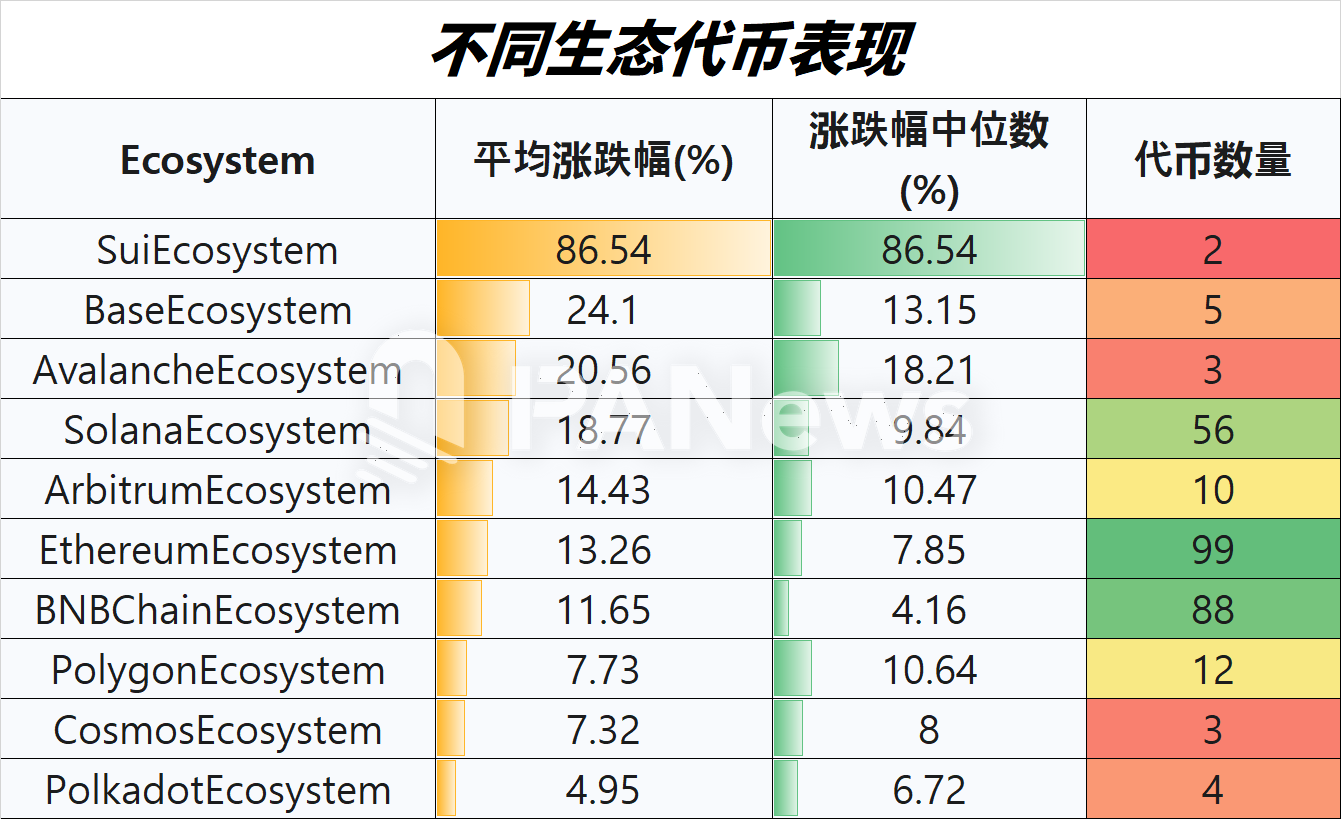
不同的区块链生态中,Sui生态的涨幅最大,虽然币安上线的Sui生态代币数量较少,不过结合整体市场的数据来看,Sui确实也是这一轮反弹当中表现最好的生态。其次是Base生态、Avalanche生态和Solana生态在4月份展现出相对更强的平均涨幅数据,不过这里由于Base和Avalanche的数据较少,结合实际的整体数据来看,Base生态确实迎来了较大的反弹,而Avalanche的真实表现可能远低于这个数据。Arbitrum生态紧随其后。而Ethereum和BNBChain这两大生态系统,虽然拥有最多的代币数量,但整体表现与市场平均水平接近或略低。Polygon、Cosmos和Polkadot生态在本月表现相对靠后。不过,这部分的数据因为只是上线币安的代币,与各个生态代币的整体数据还是有较大的差距。

中大市值代币平均表现更好
市值

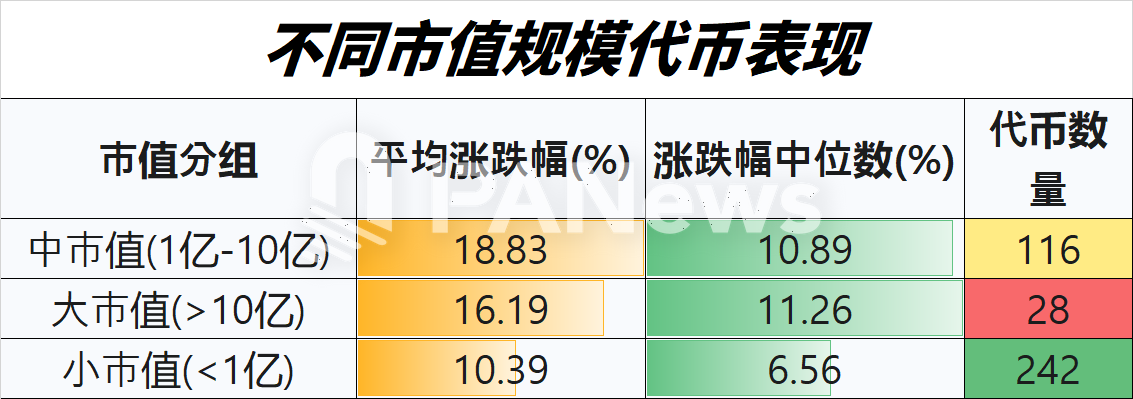
在这次分析中,PANews还加入了一个维度,就是不同市值规模的代币在这一轮上涨中的表现。有趣的是,与通常认为的小市值弹性更大的印象不同,在4月份的数据中,中市值(1亿-10亿)和大市值(>10亿)代币的平均涨幅反而略高于小市值(<1亿)代币。这可能暗示在本轮反弹中,资金更倾向于流向已有一定基础和共识的资产,而非纯粹追求高风险高弹性的小币种。而从数量上来看,目前币安上占比最多的还是市值1亿以下的小市值代币居多达到242个,占比达到6成。中市值的代币次之,为116个。市值超过10亿美元的代币仅为28个。从这点来看,整体代币市场的规模还是较为分散。

总的来看,在4月份的这一轮反弹当中,至少在整体的涨幅和高涨幅的代币数量上来看,可能并没有迎来人们希望中的大反转。而另外一些有趣的现象就是,新的代币似乎更能获得市场青睐,而上一轮牛市上线的代币反而不太有市场。再就是中大市值的代币涨幅整体更大一些,但小市值的代币似乎更容易制造高倍涨幅(在涨幅前20的代币中,有12个代币的市值低于1亿)。对于投资者而言,当前市场可能更适合精选个币和赛道,而非期待全面的“山寨季”普涨。

(本文内容基于历史数据分析,不构成任何投资建议。加密市场波动剧烈,投资需谨慎。)

Trending Cryptos

Related Reads

Claude Science Completes Two Years' Work in a Few Weeks, Is 10x Research Acceleration Really Here?

Claude Science, a new AI workbench from Anthropic, is being tested by scientists, reportedly accelerating specific research workflows by up to 10x. A neuro-scientist at the Allen Institute completed a lengthy literature review in weeks instead of nearly two years using the tool, which automates tasks like citation verification. The platform is an integrated environment for macOS and Linux, connecting to local or remote computing resources. It streamlines the fragmented research process—literature analysis, computation, visualization, and drafting—into a single, auditable workflow. A key feature is its emphasis on reproducibility: every chart generated includes the exact code, environment, and history used to create it. Claude Science uses a multi-agent system. A coordinator manages over 60 pre-configured skills for life sciences (genomics, proteomics, etc.) and can spawn specialized agents. A dedicated reviewer agent checks citations and calculations for accuracy, creating a form of internal AI peer review. The system operates with a human-in-the-loop, requiring user approval for major steps. Initial applications are in life sciences. Examples include target identification for biotech company Manifold Bio and germline variant analysis for glioma research at UCSF, completing analyses in roughly one-tenth the previous time. The approach contrasts with competitors: Google focuses on proprietary models like AlphaFold, while OpenAI is advancing models' scientific reasoning with benchmarks like GeneBench-Pro. Claude Science differentiates by automating and integrating the practical research pipeline, not just the model's intelligence, aiming to make AI-aided science more reproducible and integrated into daily lab work.

marsbit2m ago

Claude Science Completes Two Years' Work in a Few Weeks, Is 10x Research Acceleration Really Here?

marsbit2m ago

The Invisible Force in Bitcoin's Bear Market: Accelerating On-Chain Payments and Institutional Adoption

Amidst ongoing Bitcoin price volatility, the quiet acceleration of on-chain payments and tokenized trading holds significant importance for investors and policymakers, especially with legislation like the CLARITY Act on the horizon. Major traditional financial institutions adopting these technologies are driving crucial discussions on compliance, security, and transparency, which are vital for broader market adoption. Key developments are shaping this evolution. First, blockchain traceability is moving beyond a simple "public vs. private" debate. New frameworks aim to standardize how financial data from immutable ledgers is analyzed and interpreted, making it as crucial as standardized financial reporting for building institutional trust. Second, while traditional finance supports clear digital asset regulation, they emphasize that an asset's economic function should dictate its regulatory treatment, advocating for robust consumer protections over broad exemptions. Furthermore, the growth of on-chain deposits at regulated institutions signals a shift. Major banks are leveraging blockchain not to replace but to upgrade existing services—like deposits and cross-border settlements—with benefits like 24/7 operations and programmable treasury management. This trend focuses more on modernizing financial infrastructure than creating speculative assets. Despite market turbulence, these underlying advancements in on-chain infrastructure point toward a more robust foundation for the industry's future.

Foresight News50m ago

The Invisible Force in Bitcoin's Bear Market: Accelerating On-Chain Payments and Institutional Adoption

Foresight News50m ago

Trading

Spot

Hot Articles

What is $BITCOIN

DIGITAL GOLD ($BITCOIN): A Comprehensive Analysis Introduction to DIGITAL GOLD ($BITCOIN) DIGITAL GOLD ($BITCOIN) is a blockchain-based project operating on the Solana network, which aims to combine the characteristics of traditional precious metals with the innovation of decentralized technologies. While it shares a name with Bitcoin, often referred to as “digital gold” due to its perception as a store of value, DIGITAL GOLD is a separate token designed to create a unique ecosystem within the Web3 landscape. Its goal is to position itself as a viable alternative digital asset, although specifics regarding its applications and functionalities are still developing. What is DIGITAL GOLD ($BITCOIN)? DIGITAL GOLD ($BITCOIN) is a cryptocurrency token explicitly designed for use on the Solana blockchain. In contrast to Bitcoin, which provides a widely recognized value storage role, this token appears to focus on broader applications and characteristics. Notable aspects include: Blockchain Infrastructure: The token is built on the Solana blockchain, known for its capacity to handle high-speed and low-cost transactions. Supply Dynamics: DIGITAL GOLD has a maximum supply capped at 100 quadrillion tokens (100P $BITCOIN), although details regarding its circulating supply are currently undisclosed. Utility: While precise functionalities are not explicitly outlined, there are indications that the token could be utilized for various applications, potentially involving decentralized applications (dApps) or asset tokenization strategies. Who is the Creator of DIGITAL GOLD ($BITCOIN)? At present, the identity of the creators and development team behind DIGITAL GOLD ($BITCOIN) remains unknown. This situation is typical among many innovative projects within the blockchain space, particularly those aligning with decentralized finance and meme coin phenomena. While such anonymity may foster a community-driven culture, it intensifies concerns about governance and accountability. Who are the Investors of DIGITAL GOLD ($BITCOIN)? The available information indicates that DIGITAL GOLD ($BITCOIN) does not have any known institutional backers or prominent venture capital investments. The project seems to operate on a peer-to-peer model focused on community support and adoption rather than traditional funding routes. Its activity and liquidity are primarily situated on decentralized exchanges (DEXs), such as PumpSwap, rather than established centralized trading platforms, further highlighting its grassroots approach. How DIGITAL GOLD ($BITCOIN) Works The operational mechanics of DIGITAL GOLD ($BITCOIN) can be elaborated on based on its blockchain design and network attributes: Consensus Mechanism: By leveraging Solana’s unique proof-of-history (PoH) combined with a proof-of-stake (PoS) model, the project ensures efficient transaction validation contributing to the network's high performance. Tokenomics: While specific deflationary mechanisms have not been extensively detailed, the vast maximum token supply implies that it may cater to microtransactions or niche use cases that are still to be defined. Interoperability: There exists the potential for integration with Solana’s broader ecosystem, including various decentralized finance (DeFi) platforms. However, the details regarding specific integrations remain unspecified. Timeline of Key Events Here is a timeline that highlights significant milestones concerning DIGITAL GOLD ($BITCOIN): 2023: The initial deployment of the token occurs on the Solana blockchain, marked by its contract address. 2024: DIGITAL GOLD gains visibility as it becomes available for trading on decentralized exchanges like PumpSwap, allowing users to trade it against SOL. 2025: The project witnesses sporadic trading activity and potential interest in community-led engagements, although no noteworthy partnerships or technical advancements have been documented as of yet. Critical Analysis Strengths Scalability: The underlying Solana infrastructure supports high transaction volumes, which could enhance the utility of $BITCOIN in various transaction scenarios. Accessibility: The potential low trading price per token could attract retail investors, facilitating wider participation due to fractional ownership opportunities. Risks Lack of Transparency: The absence of publicly known backers, developers, or an audit process may yield skepticism regarding the project's sustainability and trustworthiness. Market Volatility: The trading activity is heavily reliant on speculative behavior, which can result in significant price volatility and uncertainty for investors. Conclusion DIGITAL GOLD ($BITCOIN) emerges as an intriguing yet ambiguous project within the rapidly evolving Solana ecosystem. While it attempts to leverage the “digital gold” narrative, its departure from Bitcoin's established role as a store of value underscores the need for a clearer differentiation of its intended utility and governance structure. Future acceptance and adoption will likely depend on addressing the current opacity and defining its operational and economic strategies more explicitly. Note: This report encompasses synthesised information available as of October 2023, and developments may have transpired beyond the research period.

538 Total ViewsPublished 2025.05.13Updated 2025.05.13

What is $BITCOIN

Discussions

Welcome to the HTX Community. Here, you can stay informed about the latest platform developments and gain access to professional market insights. Users' opinions on the price of BTC (BTC) are presented below.

活动图片