Ethereum Foundation разделяет совет директоров и руководство

cryptonews.ruPublished on 2024-04-29Last updated on 2025-04-29

Ethereum Foundation, который поддерживает разработку блокчейна Ethereum, пересмотрел свою структуру руководства, чтобы разделить обязанности своей управленческой команды и совета директоров.

Совет директоров будет действовать как «совет безопасности, чтобы защитить сердце и душу» фонда и определить видение Ethereum, в то время как новое руководство будет сосредоточено на стратегическом и оперативном исполнении этих видений, сообщил Фонд в сообщении в блоге от 28 апреля.

В сообщении X от 28 апреля было добавлено, что Сяо-Вэй Ван и Томаш К. Станчак были назначены соисполнительными директорами 2 марта для реализации этих видений, которые сосредоточены вокруг поддержки сопротивления цензуре, инноваций с открытым исходным кодом, конфиденциальности и безопасности

Роль Вана и Станчака вступила в силу 28 апреля, когда фонд установил двухлетний срок для Станчака, чтобы решить некоторые из самых больших проблем Ethereum. Новая роль Станчака будет сбалансирована с его работой в качестве основателя инфраструктурной компании Ethereum Nethermind и венчурной компании, ориентированной на Ethereum, о которой вскоре будет объявлено.
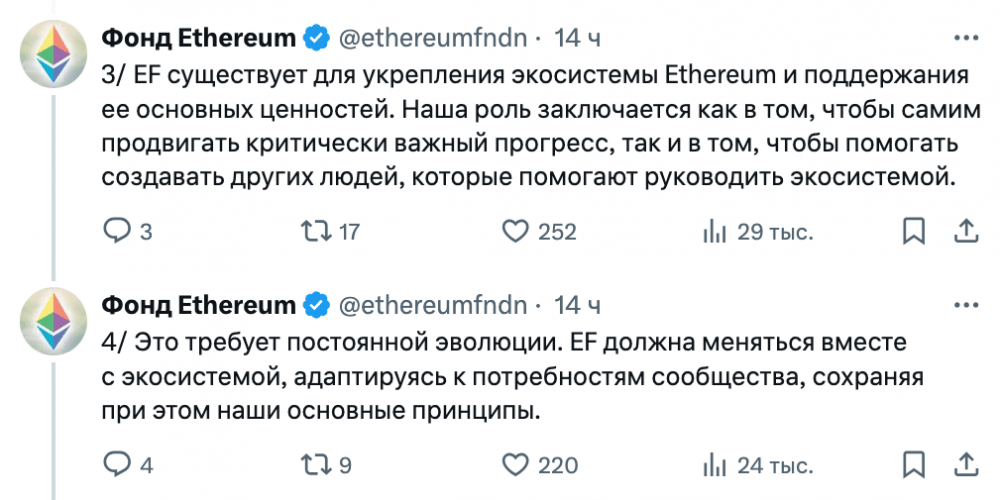

Источник: Ethereum Foundation.

Бастиан Ауэ и Джош Старк также входят в состав управленческой команды, при этом Ауэ сосредоточится на организационной стратегии, найме и обучении, а Старк будет в первую очередь заниматься реализацией проектов, коммуникациями и маркетингом.

В совет директоров входят соучредитель Ethereum Виталик Бутерин, президент Ethereum Foundation Ая Миягучи, швейцарский юрист Патрик Сторхенеггер и Ван, который будет связующим звеном между советом директоров и управленческой командой.

Бутерин продолжит предоставлять техническое и интеллектуальное руководство экосистемой Ethereum, Миягучи будет курировать видение фонда, управляя внешними связями, а Сторхенеггер продолжит заниматься юридическими вопросами и вопросами соответствия нормативным требованиям.

Совет директоров отвечал за выбор Вана и Станчака в качестве исполнительных директоров — решение, которое они признали нетрадиционным — и у них также есть полномочия увольнять с этих должностей.

В последние месяцы Ethereum Foundation занял более активную роль в экосистеме Ethereum после критики со стороны основателя Synthetix (SNX) Кейна Уорвика о том, что фонд «не заботится» об инновациях в области децентрализованных финансов.

Другие участники сообщества Ethereum ранее связывали отсутствие вовлеченности и лидерства фонда с низкой ценовой эффективностью Ethereum по сравнению с Bitcoin и Solana.

Основное внимание Ethereum Foundation сосредоточено на масштабировании

Фонд заявил, что его три основных направления в течение следующих 12 месяцев будут включать масштабирование первого уровня Ethereum, масштабирование BLOB-объектов на Layer 2 и улучшение пользовательского опыта.

Исследователь Ethereum Foundation Данкрад Фейст и глава отдела поддержки протокола София Голд уже представили предложения по решению проблем масштабирования Ethereum на базовом уровне в рамках предложений по улучшению Ethereum EIP-9678 и EIP-9698.

Оба EIP направлены на повышение лимита газа, что теоретически должно повысить пропускную способность транзакций Ethereum на ту же величину.

Trending Cryptos

Related Reads

The Impact of OUSD on Circle, Tether, and Paxos: Not a Simple Negative, but a More Complex Competitive Landscape

OUSD's Impact on Circle, Tether, and Paxos: A Nuanced Competitive Reshuffle The launch of OUSD, a new stablecoin initiative, has complex implications for the stablecoin market. For Circle (CRCL), the initial 15-20% stock drop reflects legitimate competitive concerns but is not a "death sentence." Circle retains deep liquidity, existing integrations, and first-mover advantages. A potential restructuring or termination of its Coinbase partnership could even double its net revenue in the short term, providing more competitive freedom. However, OUSD, backed by Stripe's engineering and product strengths, could become the default stablecoin within the Stripe ecosystem for new adopters, challenging USDC's position. OUSD does not solve the core barrier for corporate adoption: it remains a credit exposure to its issuer (likely a Bridge-related entity), which, like Circle, is not an investment-grade entity. Large banks and asset managers could still capture the most lucrative enterprise use cases. Circle must accelerate its payment/fintech product development and consider defensive M&A. For Tether, OUSD targets a different market segment. Tether will continue focusing on distribution channels not prioritized by Stripe or Circle. Its market share may decline over time, but within a significantly growing total market. Paxos faces the greatest pressure. OUSD undermines the key selling points of its USDG stablecoin, and Paxos's regulatory advantages may diminish as frameworks mature. This poses a more existential challenge, explaining Paxos's recent shift back to its brokerage-as-a-service business.

marsbit2h ago

The Impact of OUSD on Circle, Tether, and Paxos: Not a Simple Negative, but a More Complex Competitive Landscape

marsbit2h ago

OUSD's Impact on Circle, Tether, and Paxos: Not a Simple Negative, but a More Complex Competitive Reshuffle

This article analyzes the impact of the newly announced stablecoin OUSD, backed by a consortium including Stripe, on major incumbents like Circle (USDC), Tether (USDT), and Paxos (USDG). For Circle, the announcement is not a simple negative. While the initial market reaction was rational, it's not a "death sentence." Circle retains deep liquidity, existing integrations, and first-mover advantage. A potential restructuring or termination of its exclusive revenue-sharing deal with Coinbase could even near-double its net income in the short term, providing more competitive flexibility. However, within the Stripe ecosystem, OUSD, with its strong engineering and product focus, could become the default choice, displacing USDC for new integrations. Circle must accelerate its own fintech product development and consider defensive M&A. OUSD does not directly threaten Tether's core markets, which focus on different distribution channels. Tether's market share may decline over time but within a significantly growing overall market. Paxos faces the greatest pressure. OUSD undermines the primary value proposition of its USDG stablecoin, and Paxos's regulatory advantages may erode as frameworks mature, posing a more existential challenge. This explains Paxos's recent strategic pivot towards brokerage-as-a-service. A fundamental unresolved issue for enterprise adoption remains: if issued by a Bridge-related entity, OUSD, like USDC, still represents a credit exposure to a non-investment-grade issuer, unless a parent company guarantee is provided. Large banks and asset managers entering the space later could still compete for the most lucrative enterprise use cases.

链捕手2h ago

OUSD's Impact on Circle, Tether, and Paxos: Not a Simple Negative, but a More Complex Competitive Reshuffle

链捕手2h ago

Trading

Spot

Hot Articles

Discussions

Welcome to the HTX Community. Here, you can stay informed about the latest platform developments and gain access to professional market insights. Users' opinions on the price of ETH (ETH) are presented below.

活动图片