BTC重回9万4,但VC却高兴不起来

coinvoicePublished on 2025-04-24Last updated on 2025-04-24

4 月 23 日,随着特朗普宣布降低对中国的关税,这一消息又重燃了市场情绪。

投资者对风险资产的信心迅速回升,BTC 在悄无声息中上涨 7%,价格重回 94,000 美元。

一切,一晚上好像又都回来了。

BTC 距离年初突破 10 万美元的历史高点又近了一步,推特上充斥着对新一轮牛市的期待,二级市场的交易者们忙着追涨杀跌,市场仿佛又回到了 2021 年的狂热春光。

然而,这场情绪的回归却并非属于所有人。

热闹的是他们,一级投资者们或许面对牛回迹象,沉默不语。

牛回死于锁仓

BTC 重回 94000 美元的喜讯让二级市场投资者欢呼雀跃,但对于一级市场的投资者来说,这场狂欢却像是一场遥远的幻梦。

他们的代币大多处于锁仓状态,无法自由交易,而过去一年的市场表现更是让他们损失惨重。

一张来自 STIX (@stix_co)的图表揭示了这一残酷现实。
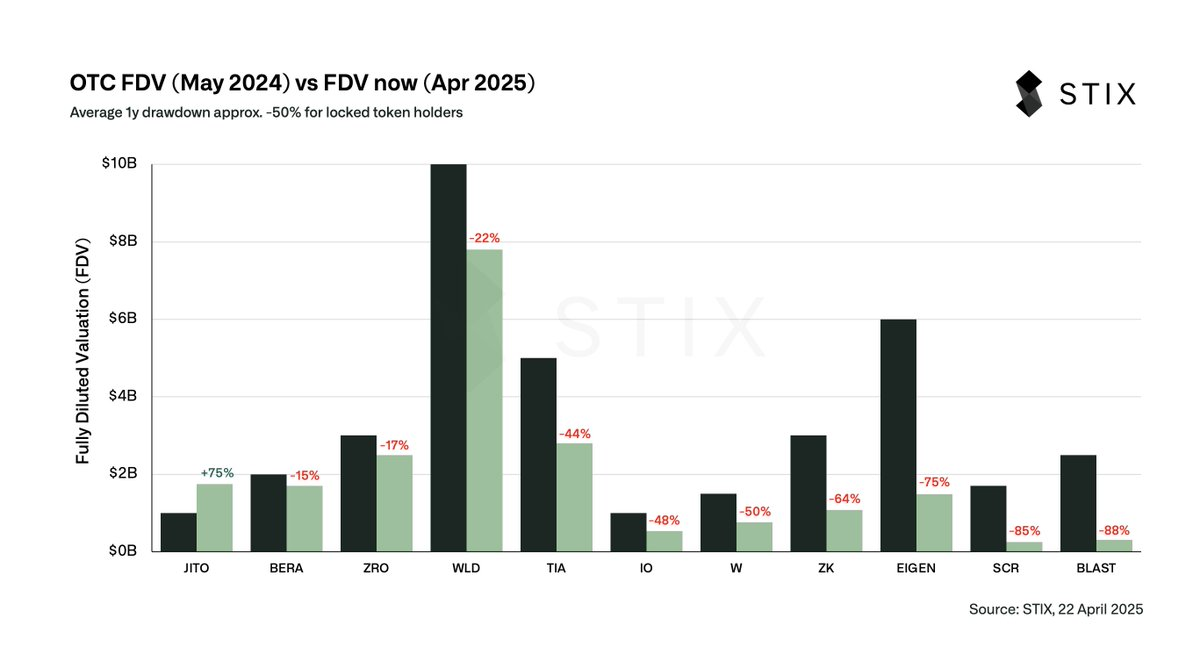
BTC重回9万4,但VC却高兴不起来

@stix_co 是一家专注于加密货币 OTC(场外交易)交易的平台,为锁仓代币提供流动性支持。

上图对比了多个代币在 2024 年 5 月和 2025 年 4 月的估值变化:2024 年 5 月是这些代币在场外交易时的估值(也就是锁仓时一级投资者能卖出的价格),而 2025 年 4 月是这些代币在公开市场上的实际估值(即现在的市场价格)。

结果显示,平均来看这些代币的估值在一年内跌了 50%。

我们来看几个具体的例子。

BLAST 去年的场外估值是 2.5 亿美元,现在的市场估值只剩 0.3 亿美元,跌了 88%;EIGEN 从 6 亿美元跌到 1.5 亿美元,跌了 75%;SCR 更惨,从 1.7 亿美元跌到 0.255 亿美元,跌幅高达 85%。

几乎所有的代币都大幅下跌,只有 JTO 是个例外,从 1 亿美元涨到了 1.75 亿美元,涨了 75%。

但这只是个特例,掩盖不了整体的惨淡局面。

简单来说,这些一级投资者手里的代币,如果去年没有通过 OTC 场外交易卖掉的话,那么持币的平均价值直接砍了一半,有些甚至只剩一两成。

插个背景知识,场外交易是指在代币解锁前,一级投资者可以通过私下交易提前卖出,通常会打点折扣。

Taran 在上图的 帖子 中提到,去年这些代币在场外交易时,价格大概是估值的八九折。

也就是说,如果他们去年卖掉,可能只亏 10%-20%,甚至可能不亏。但也有投资者选择了持有一年,等待解锁,结果却是代币价值平均跌了 50%,有些甚至跌了七八成,财富大幅缩水。

你可能会说,他们的投资成本价低,即使跌了这么多,还有得赚。

但问题在于,经济学中还有个叫机会成本的东西。作为一个投资人,比少赚(说不定还亏了)更难受的,是理论上机会成本的损失。

理论最优的情况下,过去 12 个月,比特币(BTC)涨了 45%。

如果一级投资者去年把代币卖掉,换成 BTC,他们的钱现在可能已经涨到原来的 1.45 倍。

但现在,他们的代币价值只剩 0.5 倍,甚至在未来解锁后可能还得再打五折才能卖出去,最终可能只值 0.25 倍。

换句话说,相比 BTC 的涨幅,他们的实际损失高达 82.8%;就算按美元算,也亏了 75%。

这就像眼睁睁看着别人赚了大钱,而自己手里的资产却越缩越小。

“牛回”,对他们来说可能已经死于锁仓。

锁仓一年,亏损一半,这件事最气的地方在于:

研究、比较、识别和投项目,付出心力之后,还不如直接拿着 BTC 更实惠。

在经典投资书籍《漫步华尔街》中,有一个著名的“猩猩扔飞镖理论”。

作者伯顿·马尔基尔提出,如果让一只猩猩蒙着眼睛随便扔飞镖,选中股票组合,其长期收益可能并不比专业投资者的精心挑选差。

这个理论原本是用来讽刺股票市场中过度分析的无效性,但如今放在加密货币市场中,却让人感到格外讽刺。

一级投资者们花费大量时间和精力,研究白皮书、分析项目前景,甚至不惜锁仓一年以博取高收益,但结果却可能是:还不如随便把飞镖扔到比特币上。

BTC 过去一年涨了 45%,而他们的锁仓代币平均跌了 50%,甚至更多。

整个山寨币的估值和投资逻辑,或许亟待重塑。

春天不回来

下一波加密山寨币的玩法,还是这样锁仓吗?

VC 以低价格进场,锁仓机制原本是为了保护项目初期,防止早期投资者大量抛售导致价格崩盘。但从过去一年的数据来看,这种机制却让一级投资者也承担了巨大的风险。

上文的图表原贴中也提到,未来将有超过 400 亿美元的锁仓代币陆续解锁,这意味着市场可能会面临更大的抛售压力。如果新代币继续以高估值锁仓,投资者可能再次陷入“锁仓一年,亏损一半”的恶性循环。

显然,锁仓这种玩法已经不再适合当下的市场环境。

加密市场的一级投资还会火热吗?一级投资的春天还能回来吗?从目前的情况看,答案可能并不乐观。

过去几年,山寨币的高估值往往建立在市场狂热和流动性溢价的基础上,但随着市场逐渐成熟,投资者开始更加注重项目的实际价值和流动性。

锁仓代币的高风险让一级投资者望而却步,越来越多的人可能会选择更透明、更流动的项目。

一些新兴趋势已经显现:比如更短的锁仓周期、更低的估值倍数,甚至直接通过直接发 Meme 来减少一级投资的泡沫;

当然也有可能还是新瓶装旧酒,在 Meme 币更加公平的外表下,一级逻辑依然存在,组局造盘子,让你看不出有一级的存在罢了。

对于整个加密市场而言,更透明的机制也变得尤为重要。锁仓机制也需要找到更好的平衡点,既能保护项目初期,又不至于让投资者承担过高的风险。

不过问题来了,一级不亏,二级不亏,韭菜不亏,那谁会亏呢?

加密代币们并不生产价值,而是转移价值;有人赚,就一定有人亏。

一波人的春天,必然是另一波人的寒冬。


声明:本内容为作者独立观点,不代表 CoinVoice 立场,且不构成投资建议,请谨慎对待,如需报道或加入交流群,请联系微信:VOICE-V。

来源:深潮TechFlow

Trending Cryptos

Related Reads

The Most Hidden AI Winners

"The Most Under-the-Radar AI Winners" While core AI giants and their direct suppliers have dominated headlines, a group of seemingly unrelated, decades-old manufacturing companies have emerged as major beneficiaries. A key example is Japan's TOTO, famous for bathroom fixtures. Its stock soared 145% in a year, driven not by its mainstay toilet business but by its nearly 40-year-old semiconductor ceramic component unit. Specifically, TOTO manufactures electrostatic chucks—critical, hard-to-replace parts for advanced chip manufacturing processes like etching and EUV lithography. This segment, though only 9% of revenue, contributed over 54% of operating profit in FY2025 with a 43% margin. High barriers to entry, including deep know-how in high-purity ceramic sintering and long supplier certification cycles (5+ years), secure its position. This pattern repeats across industries. Nitto Boseki, a 128-year-old glass fiber maker, saw its stock rise 325% due to near-monopoly supply of T-glass, an essential low-expansion material for AI chip substrates. Similarly, Ajinomoto, the global MSG leader, commands 80-95% of the market for ABF film, a vital insulating layer in chip packaging. These "hidden" segments, often born from deep materials science expertise, are now bottleneck supplies in the AI hardware chain, enjoying pricing power and high margins. In China's A-share market, the theme combines this AI-driven demand with domestic substitution. Companies like Zhongci Electronic (advancing in electrostatic chucks) and Honghe Technology & Feilihua (in high-end electronic glass fabrics) are gaining traction. The investment thesis hinges on whether these domestic players can rapidly scale qualified capacity to capture the supply gap within the critical time window. Ultimately, these cases show that in the AI supply chain, high-profit concentrations exist not only at the cutting-edge tech frontier but also in indispensable, difficult-to-replicate materials and components. Market recognition often lags behind fundamental profit shifts, creating potential for significant re-ratings as traditional industrial firms are re-evaluated as key enablers of advanced semiconductor manufacturing.

marsbit7m ago

The Most Hidden AI Winners

marsbit7m ago

The Most Secretive Winners of the AI Boom

"The Most Hidden AI Winners" An unlikely group of companies are emerging as major beneficiaries of the AI boom, not from designing chips, but from supplying critical materials and components essential for advanced semiconductor manufacturing. These 'hidden winners' are traditional manufacturers whose deep expertise in materials science has become indispensable. Japanese companies are leading this trend. Toto, globally known for bathroom fixtures, has seen its stock surge 145% over the past year, driven by its 40-year-old semiconductor ceramics business, which now contributes over half of its operating profit. Its electrostatic chucks are vital for advanced chip production and require years of expertise to manufacture. Similarly, Nittobo, a 128-year-old textile firm, controls 90% of the market for T-glass, a low-expansion glass fiber essential for AI chip substrates. Ajinomoto, the world's largest MSG producer, dominates the market (80-95% share) for ABF insulating film used in chip packaging. The core insight is that chasing "advanced" chips paradoxically increases reliance on traditional, high-precision material science where supply cannot be quickly replicated. These materials are now critical bottlenecks in the AI supply chain. This trend is mirrored in China's A股 market, framed by the theme of 'import substitution'. Companies like Zhongci Dianzi (electrostatic chucks) and Honghe Technology (ultra-thin electronic cloth) are making progress, but face the test of scaling production and matching Japanese rivals' quality. The key tension lies in the slow change of market perception. While profit structures rapidly shift towards high-margin tech components, these firms retain their traditional industry classifications, creating a valuation gap that is gradually closing as their roles in the AI ecosystem become undeniable.

链捕手14m ago

The Most Secretive Winners of the AI Boom

链捕手14m ago

DeFi Enters a Moment of Value Reassessment: Risks and Opportunities Behind the $70 Billion TVL

DeFi Enters a Moment of Value Reassessment: Peril and Opportunity Behind $70 Billion TVL On July 1st, the total value locked (TVL) across all DeFi protocols fell below $70 billion to approximately $69.358 billion, hitting its lowest point since February 2024. This decline signals a significant contraction in DeFi liquidity and marks a new adjustment phase for the industry, far from its 2021 peak of over $180 billion. The primary drivers of this TVL drop are a general decrease in crypto market risk appetite, which leads capital to exit volatile sectors like DeFi first, and the fading effectiveness of the high-yield liquidity incentive models that fueled the initial DeFi boom. Many protocols' high TVL figures were built on temporary subsidy-driven capital rather than genuine demand. Furthermore, capital is migrating to newer narratives like AI, RWA, and modular infrastructure. This cooldown exposes DeFi's growth bottlenecks: innovation has slowed with rampant protocol copycats, real yields have normalized to single digits, and poor user experience continues to hinder mass adoption beyond crypto-natives. However, the TVL decline does not spell the end for DeFi. The metric itself is limited, as it fluctuates with underlying asset prices. The industry is shifting from capital accumulation to efficiency competition, leveraging Layer 2 solutions and modular architecture to do more with less locked value. Crucially, DeFi is expanding into real-world financial use cases like the tokenization of real-world assets (RWA) and the growth of the stablecoin ecosystem, moving its value proposition from speculative token subsidies to real cash flows. In conclusion, while short-term pressures from liquidity contraction and user growth stagnation persist, the sector is undergoing a necessary value reassessment. DeFi is transitioning from a subsidy-driven, hype-based era toward a more mature, rational, and efficiency-focused phase, with long-term growth hinging on meeting real-world financial needs through RWA, stablecoins, and robust infrastructure.

marsbit34m ago

DeFi Enters a Moment of Value Reassessment: Risks and Opportunities Behind the $70 Billion TVL

marsbit34m ago

Trading

Spot

Hot Articles

What is $BITCOIN

DIGITAL GOLD ($BITCOIN): A Comprehensive Analysis Introduction to DIGITAL GOLD ($BITCOIN) DIGITAL GOLD ($BITCOIN) is a blockchain-based project operating on the Solana network, which aims to combine the characteristics of traditional precious metals with the innovation of decentralized technologies. While it shares a name with Bitcoin, often referred to as “digital gold” due to its perception as a store of value, DIGITAL GOLD is a separate token designed to create a unique ecosystem within the Web3 landscape. Its goal is to position itself as a viable alternative digital asset, although specifics regarding its applications and functionalities are still developing. What is DIGITAL GOLD ($BITCOIN)? DIGITAL GOLD ($BITCOIN) is a cryptocurrency token explicitly designed for use on the Solana blockchain. In contrast to Bitcoin, which provides a widely recognized value storage role, this token appears to focus on broader applications and characteristics. Notable aspects include: Blockchain Infrastructure: The token is built on the Solana blockchain, known for its capacity to handle high-speed and low-cost transactions. Supply Dynamics: DIGITAL GOLD has a maximum supply capped at 100 quadrillion tokens (100P $BITCOIN), although details regarding its circulating supply are currently undisclosed. Utility: While precise functionalities are not explicitly outlined, there are indications that the token could be utilized for various applications, potentially involving decentralized applications (dApps) or asset tokenization strategies. Who is the Creator of DIGITAL GOLD ($BITCOIN)? At present, the identity of the creators and development team behind DIGITAL GOLD ($BITCOIN) remains unknown. This situation is typical among many innovative projects within the blockchain space, particularly those aligning with decentralized finance and meme coin phenomena. While such anonymity may foster a community-driven culture, it intensifies concerns about governance and accountability. Who are the Investors of DIGITAL GOLD ($BITCOIN)? The available information indicates that DIGITAL GOLD ($BITCOIN) does not have any known institutional backers or prominent venture capital investments. The project seems to operate on a peer-to-peer model focused on community support and adoption rather than traditional funding routes. Its activity and liquidity are primarily situated on decentralized exchanges (DEXs), such as PumpSwap, rather than established centralized trading platforms, further highlighting its grassroots approach. How DIGITAL GOLD ($BITCOIN) Works The operational mechanics of DIGITAL GOLD ($BITCOIN) can be elaborated on based on its blockchain design and network attributes: Consensus Mechanism: By leveraging Solana’s unique proof-of-history (PoH) combined with a proof-of-stake (PoS) model, the project ensures efficient transaction validation contributing to the network's high performance. Tokenomics: While specific deflationary mechanisms have not been extensively detailed, the vast maximum token supply implies that it may cater to microtransactions or niche use cases that are still to be defined. Interoperability: There exists the potential for integration with Solana’s broader ecosystem, including various decentralized finance (DeFi) platforms. However, the details regarding specific integrations remain unspecified. Timeline of Key Events Here is a timeline that highlights significant milestones concerning DIGITAL GOLD ($BITCOIN): 2023: The initial deployment of the token occurs on the Solana blockchain, marked by its contract address. 2024: DIGITAL GOLD gains visibility as it becomes available for trading on decentralized exchanges like PumpSwap, allowing users to trade it against SOL. 2025: The project witnesses sporadic trading activity and potential interest in community-led engagements, although no noteworthy partnerships or technical advancements have been documented as of yet. Critical Analysis Strengths Scalability: The underlying Solana infrastructure supports high transaction volumes, which could enhance the utility of $BITCOIN in various transaction scenarios. Accessibility: The potential low trading price per token could attract retail investors, facilitating wider participation due to fractional ownership opportunities. Risks Lack of Transparency: The absence of publicly known backers, developers, or an audit process may yield skepticism regarding the project's sustainability and trustworthiness. Market Volatility: The trading activity is heavily reliant on speculative behavior, which can result in significant price volatility and uncertainty for investors. Conclusion DIGITAL GOLD ($BITCOIN) emerges as an intriguing yet ambiguous project within the rapidly evolving Solana ecosystem. While it attempts to leverage the “digital gold” narrative, its departure from Bitcoin's established role as a store of value underscores the need for a clearer differentiation of its intended utility and governance structure. Future acceptance and adoption will likely depend on addressing the current opacity and defining its operational and economic strategies more explicitly. Note: This report encompasses synthesised information available as of October 2023, and developments may have transpired beyond the research period.

552 Total ViewsPublished 2025.05.13Updated 2025.05.13

What is $BITCOIN

Discussions

Welcome to the HTX Community. Here, you can stay informed about the latest platform developments and gain access to professional market insights. Users' opinions on the price of BTC (BTC) are presented below.

活动图片