比特币与美股脱钩,“数字黄金”属性回归?

金十数据Published on 2025-04-23Last updated on 2025-04-23

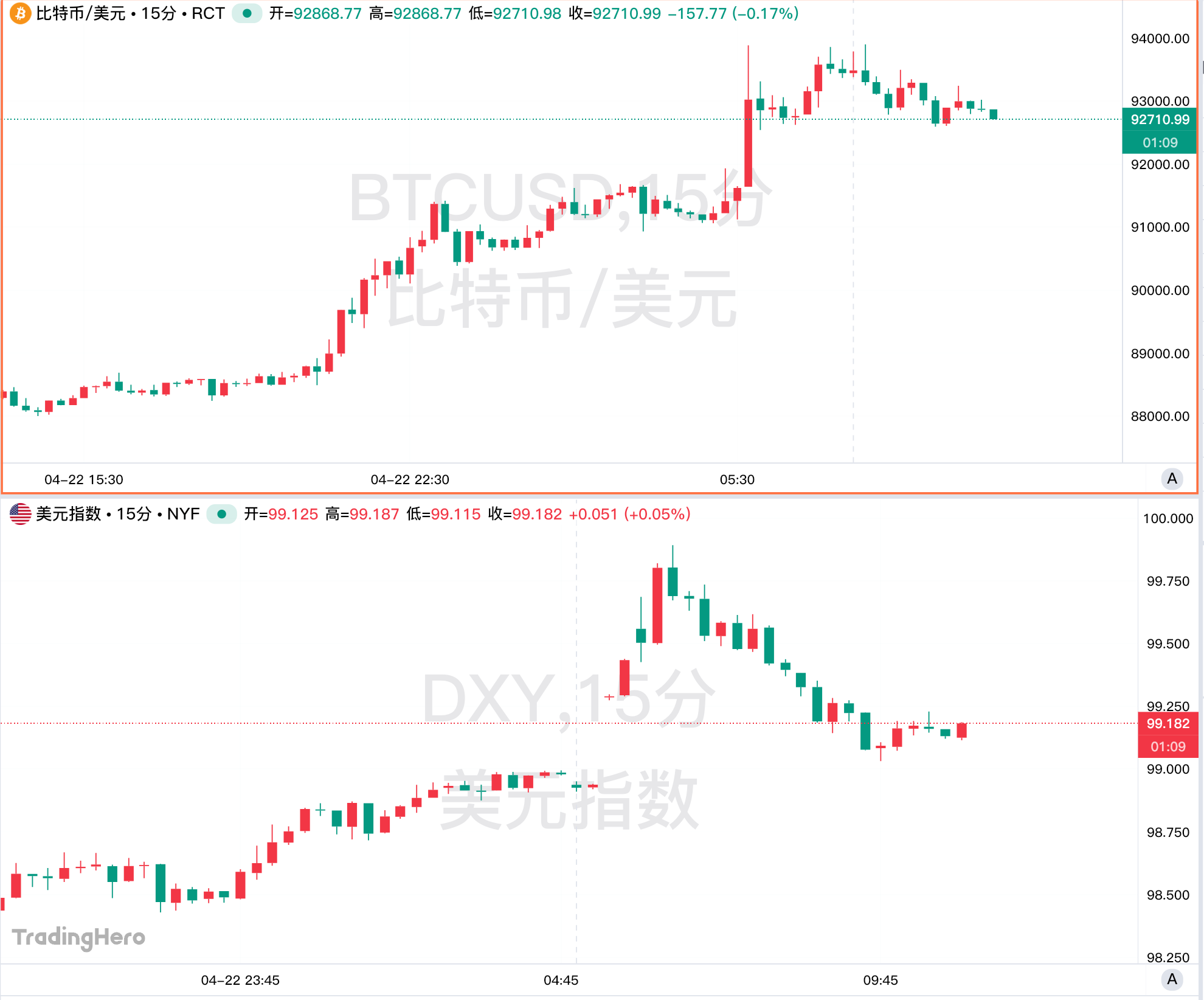
比特币自3月初以来首次突破9万美元关口,激发了市场对其终于摆脱与美国科技股同涨同跌长期关联的乐观预期。周二,比特币累计上涨6.77%,周三亚盘初延续涨势,最高触及93883美元/枚。美元指数则在周一跌至三年最低点后略有反弹。纳斯达克100指数尽管在周一暴跌后大幅反弹,但仍远低于2月底至3月初的高位。

此前,比特币曾短暂受特朗普关税引发的风险资产抛售潮所拖累,但此后从4月7日低点反弹超过20%。这一过程中,比特币的交易表现开始更像黄金这一在关税不确定性动荡下表现突出的资产。

此次与美国风险资产的“脱钩”,在很大程度上得益于美元走弱,也为加密货币多头带来了一丝慰藉。毕竟,特朗普上台三个月以来,并未带来市场期待的加密行情。即便4月涨幅可观,比特币当前价格仍较1月特朗普重返白宫当天创下的历史高点(一度接近11万美元)低约16%。加密交易平台SignalPlus合伙人范奥古斯丁(Augustine Fan)表示:

“美国市场的脱钩可能重新激活比特币作为价值储藏手段的长期多头逻辑……过去一年,我们一直在批评比特币只是加杠杆的纳指‘代理’,现在它终于出现了一些脱钩迹象。”

过去一周,特朗普对美联储主席鲍威尔猛烈抨击,指责其降息过慢,加剧了投资者的不安,也强化了“美国例外论”终结的说法。与此同时,市场对“战略比特币储备”计划未来几周有更多细节披露的期待,也是加密资产反弹的重要催化剂之一。特朗普在3月初签署行政令,提出建立国家级比特币储备及其他代币的战略储备,并要求财政部长在60天内就该计划的法律和投资可行性提交评估报告。

加密货币交易平台K33的研究主管Vetle Lunde指出:“特朗普行政令设定的60天截止期限已不足两周,任何有关质疑美联储独立性的言论都对比特币产生了正面外溢效应。”

还有一则利好消息在美国时间周二晚间传出。有媒体报道称,Cantor Fitzgerald、Tether Holdings和软银集团正洽谈设立一只30亿美元的特殊目的收购公司(SPAC),用于吸纳大量加密资产。这一消息进一步提振了市场情绪。

比特币的期货和期权市场也出现了多头需求回暖的迹象。一个明显的信号是,芝商所(CME)的比特币基差——即现货价与期货价的差值——攀升至三个月高点,同时未平仓合约数温和增长。根据Coinglass的数据,过去24小时内,加密货币空头头寸的清算规模显著增加。Lunde表示:

“市场再次增持多头仓位的早期迹象健康而明显。”

与此同时,比特币期权市场中,用于对冲大幅下跌风险的重仓逐渐被解除。加密货币主经纪商FalconX市场联席主管Ravi Doshi指出,“我们的衍生品交易台注意到,随着现货突破9万美元,市场情绪从下行对冲转向买入看涨期权,交易量出现增长。

不过,离岸永续合约市场却释放出不同信号。所谓“perps”(永续合约)是美国以外投资者押注加密资产的主要工具,其无到期日,并通过资金费率实现持仓成本的转移。若资金费率为负,代表市场整体偏空。

Lunde指出:“过去几天永续合约的未平仓量大幅增加。在过去36小时中,名义未平仓量飙升8.4%,资金费率持续处于负值区间,显示出市场略偏空的情绪。

市场的谨慎情绪仍在。加密衍生品平台Deribit的数据显示,行权价约在7万美元的看跌期权未平仓量在短期期限内依然维持在较高水平。

值得注意的是,这波比特币上涨,恰好与黄金同步。黄金价格周二一度首次触及3,500美元/盎司,随后有所回落。悉尼加密对冲基金DACM联合创始人Richard Galvin表示:

“如果比特币继续像黄金那样交易而非类科技股,那‘脱钩’的逻辑将更具说服力。”

另一种情绪转变的迹象是:美国上市的比特币ETF在周一共吸引了3.81亿美元资金流入,为1月30日以来最大单日流入。Delta Exchange研究分析师Riya Sehgal指出,如果比特币价格持续稳定在88,800美元以上,可能进一步推动其上涨至92,000至94,000美元区间。

不过,这轮涨势可能即将面临修正。加密托管公司Bitgo亚洲区场外交易负责人Stefan von Haenisch警告称:“市场过去几天涨势过猛,现在感觉有些超买。”他表示,比特币回调至至少88,000美元“并不意外”。

Trending Cryptos

Related Reads

Bitwise CIO: STRC Plunge is a Bottom Signal, Bull Market to Begin in Autumn

Matt Hougan, Chief Investment Officer at Bitwise, explains the recent Bitcoin price drop below $60,000 and its connection to the steep decline in MicroStrategy's STRC (Strategy's Perpetual Preferred Stock). STRC, designed as a high-yield, stable-price instrument, fell from its $100 target to $75 due to market fears over MicroStrategy's ability to sustain its dividend amid Bitcoin's price weakness. Hougan clarifies that while MicroStrategy's overall financial position remains strong, with significant Bitcoin holdings and cash, the core market anxiety centered on the optional nature of the dividend payments. In response, MicroStrategy announced a new operational framework: it will sell some Bitcoin as needed to fund dividends, will no longer actively defend the $100 share price through dividend hikes, and may repurchase STRC on the open market. This shift marks a change in MicroStrategy's role from a consistent, one-way buyer of Bitcoin to a more dynamic participant that may both buy and sell. According to Hougan, the STRC volatility is a classic late-cycle event, signaling the painful but necessary process of flushing out excessive leverage from the market. He draws parallels to the unwinding of the GBTC premium in the previous cycle. He identifies key potential bottoming signals: MSTR trading at a discount to its net asset value (NAV), extreme readings on the Crypto Fear & Greed Index, and persistently negative Bitcoin funding rates. Hougan concludes that while the exact timing of the market bottom is unpredictable, the current deleveraging phase suggests it is near. He expresses confidence that a new bull market will begin in the fall of this year, with the next major wave of buying expected to come from institutional investors like banks, asset managers, and pension funds.

Foresight News15m ago

Bitwise CIO: STRC Plunge is a Bottom Signal, Bull Market to Begin in Autumn

Foresight News15m ago

ENS Founder Seeks to 'Seize Power' from DAO

On June 29th, the ENS community entered the on-chain voting phase for a proposal to renew the ENS DAO Security Council's veto power for two more years. Shortly after voting began, ENS founder Nick Johnson used his substantial ENS holdings to cast over 3.55 million votes against the proposal, swinging the outcome despite initial strong support. The Security Council was established in July 2024 with a 4/8 multisig veto power to protect the DAO's treasury (valued over $350 million) from malicious proposals during a period of low voter participation. Its powers were limited to vetoing only harmful proposals, not normal ones. Nick Johnson's opposition stems from broader concerns about ENS DAO's governance. In late 2025, he and others expressed frustration that the DAO had become mired in political gamesmanship, with capable contributors leaving and leadership falling to less experienced or misaligned parties. This context set the stage for a major restructuring proposal by ENS COO Katherine Wu on June 19th, titled "Next Era of ENS DAO: Empowering the ENS Foundation." The controversial proposal aims to transfer daily operations, treasury management, and long-term strategy to a restructured ENS Foundation with a professional board, while the DAO would retain core protocol governance powers. Critics, including original ENS constitution author Brantly Millegan, argue this effectively transfers treasury control from token holders to ENS Labs (the core development team), undermining the DAO's original decentralized design. Nick's massive "no" vote on the Security Council renewal is seen as the first move in this power struggle. He explained his vote was due to concerns about insufficient checks on the Council's power and the potential for its veto to be used politically. In response, Katherine Wu submitted a revised proposal with higher execution thresholds (5/8 instead of 4/8) and stricter limits. The push for change comes as ENS's annual revenue has declined significantly, from over $10 million in 2023 to under $2 million in 2025, increasing pressure to manage the treasury more effectively. Nick Johnson now faces the challenge of proving that a more structured foundation can steer ENS better than the current DAO model.

Foresight News45m ago

ENS Founder Seeks to 'Seize Power' from DAO

Foresight News45m ago

Predicting World Cup Knockout Matches: Why Are Different AI Models So Far Apart?

AI performance in predicting the 2026 FIFA World Cup knockout matches varied significantly, according to an analysis of models including ChatGPT, Grok, DeepSeek, Gemini, and Claude. The standout predictions came from DeepSeek and Gemini for the Netherlands vs. Morocco match. Gemini precisely forecasted a 1-1 draw and a penalty shootout win for Morocco, while DeepSeek correctly identified the high probability of a draw and Morocco's potential to advance via a defensive and counter-attacking strategy. Grok and Tongyi Qianwen (千问) demonstrated strength in predicting accurate scores for matches with clearer favorites. They correctly called the narrow 1-0 win for Canada over South Africa and Brazil's 2-1 victory over Japan, as well as Norway's 2-1 win over Ivory Coast. ChatGPT and Claude excelled more in match process analysis than in predicting exact scores or upsets. They frequently identified potential challenges for favorites, such as Japan's pressing against Brazil or DR Congo's defensive tactics against England, even when predicting the favorite's ultimate victory. A notable failure was the unanimous misjudgment of Germany vs. Paraguay. All models incorrectly favored Germany, underestimating Paraguay's ability to force a penalty shootout and cause an upset. In summary, Gemini and DeepSeek showed the most insight for high-stakes, unpredictable matches. Grok and Qianwen were reliable "score predictors" for less volatile games. ChatGPT and Claude were strong "analytical models," adept at outlining match dynamics but often hesitant to predict upsets.

Odaily星球日报1h ago

Predicting World Cup Knockout Matches: Why Are Different AI Models So Far Apart?

Odaily星球日报1h ago

Trading

Spot

Hot Articles

What is $BITCOIN

DIGITAL GOLD ($BITCOIN): A Comprehensive Analysis Introduction to DIGITAL GOLD ($BITCOIN) DIGITAL GOLD ($BITCOIN) is a blockchain-based project operating on the Solana network, which aims to combine the characteristics of traditional precious metals with the innovation of decentralized technologies. While it shares a name with Bitcoin, often referred to as “digital gold” due to its perception as a store of value, DIGITAL GOLD is a separate token designed to create a unique ecosystem within the Web3 landscape. Its goal is to position itself as a viable alternative digital asset, although specifics regarding its applications and functionalities are still developing. What is DIGITAL GOLD ($BITCOIN)? DIGITAL GOLD ($BITCOIN) is a cryptocurrency token explicitly designed for use on the Solana blockchain. In contrast to Bitcoin, which provides a widely recognized value storage role, this token appears to focus on broader applications and characteristics. Notable aspects include: Blockchain Infrastructure: The token is built on the Solana blockchain, known for its capacity to handle high-speed and low-cost transactions. Supply Dynamics: DIGITAL GOLD has a maximum supply capped at 100 quadrillion tokens (100P $BITCOIN), although details regarding its circulating supply are currently undisclosed. Utility: While precise functionalities are not explicitly outlined, there are indications that the token could be utilized for various applications, potentially involving decentralized applications (dApps) or asset tokenization strategies. Who is the Creator of DIGITAL GOLD ($BITCOIN)? At present, the identity of the creators and development team behind DIGITAL GOLD ($BITCOIN) remains unknown. This situation is typical among many innovative projects within the blockchain space, particularly those aligning with decentralized finance and meme coin phenomena. While such anonymity may foster a community-driven culture, it intensifies concerns about governance and accountability. Who are the Investors of DIGITAL GOLD ($BITCOIN)? The available information indicates that DIGITAL GOLD ($BITCOIN) does not have any known institutional backers or prominent venture capital investments. The project seems to operate on a peer-to-peer model focused on community support and adoption rather than traditional funding routes. Its activity and liquidity are primarily situated on decentralized exchanges (DEXs), such as PumpSwap, rather than established centralized trading platforms, further highlighting its grassroots approach. How DIGITAL GOLD ($BITCOIN) Works The operational mechanics of DIGITAL GOLD ($BITCOIN) can be elaborated on based on its blockchain design and network attributes: Consensus Mechanism: By leveraging Solana’s unique proof-of-history (PoH) combined with a proof-of-stake (PoS) model, the project ensures efficient transaction validation contributing to the network's high performance. Tokenomics: While specific deflationary mechanisms have not been extensively detailed, the vast maximum token supply implies that it may cater to microtransactions or niche use cases that are still to be defined. Interoperability: There exists the potential for integration with Solana’s broader ecosystem, including various decentralized finance (DeFi) platforms. However, the details regarding specific integrations remain unspecified. Timeline of Key Events Here is a timeline that highlights significant milestones concerning DIGITAL GOLD ($BITCOIN): 2023: The initial deployment of the token occurs on the Solana blockchain, marked by its contract address. 2024: DIGITAL GOLD gains visibility as it becomes available for trading on decentralized exchanges like PumpSwap, allowing users to trade it against SOL. 2025: The project witnesses sporadic trading activity and potential interest in community-led engagements, although no noteworthy partnerships or technical advancements have been documented as of yet. Critical Analysis Strengths Scalability: The underlying Solana infrastructure supports high transaction volumes, which could enhance the utility of $BITCOIN in various transaction scenarios. Accessibility: The potential low trading price per token could attract retail investors, facilitating wider participation due to fractional ownership opportunities. Risks Lack of Transparency: The absence of publicly known backers, developers, or an audit process may yield skepticism regarding the project's sustainability and trustworthiness. Market Volatility: The trading activity is heavily reliant on speculative behavior, which can result in significant price volatility and uncertainty for investors. Conclusion DIGITAL GOLD ($BITCOIN) emerges as an intriguing yet ambiguous project within the rapidly evolving Solana ecosystem. While it attempts to leverage the “digital gold” narrative, its departure from Bitcoin's established role as a store of value underscores the need for a clearer differentiation of its intended utility and governance structure. Future acceptance and adoption will likely depend on addressing the current opacity and defining its operational and economic strategies more explicitly. Note: This report encompasses synthesised information available as of October 2023, and developments may have transpired beyond the research period.

552 Total ViewsPublished 2025.05.13Updated 2025.05.13
What is $BITCOIN

Discussions

Welcome to the HTX Community. Here, you can stay informed about the latest platform developments and gain access to professional market insights. Users' opinions on the price of BTC (BTC) are presented below.

活动图片