Топ-3 прогноза цен на биткоин, эфириум, XRP: BTC, ETH и XRP готовятся к волатильности на фоне «Дня освобождения» Трампа

cryptonews.ruPublished on 2024-09-02Last updated on 2025-04-02

  • Цена биткоина в среду столкнулась с небольшим откатом от критического уровня после восстановления на 3,16% днем ​​ранее.
  • Цена Ethereum пробила дневное сопротивление на уровне $1861, что указывает на возможность восстановления.
  • Цена XRP падает ниже 100-дневной EMA, что указывает на приближающуюся коррекцию.

Цена биткоина (BTC) столкнулась с небольшим отклонением около своего уровня сопротивления $85 000 в среду после восстановления на 3,16% в предыдущий день.

XRP следует за BTC, поскольку он падает ниже своего критического уровня, указывая на слабость и коррекцию на горизонте. Однако цена Ethereum (ETH) пробила свой ключевой уровень сопротивления, нацеливаясь на восстановление.

Трейдерам следует следить за «Днем освобождения» президента США Дональда Трампа в среду с существенными объявлениями о тарифах, которые могут спровоцировать повышенную волатильность на рынке криптовалют из-за потенциального влияния взаимных тарифов.

Биткоин восстанавливается и приближается к ключевому уровню сопротивления

Цена биткоина стабилизировалась около $82 500 в начале недели в понедельник и восстановилась на 3,16% на следующий день. На момент написания статьи в среду он столкнулся с небольшим отклонением от своего дневного уровня сопротивления $85 000. Этот дневной уровень совпадает с 200-дневной EMA и нисходящей линией тренда, что делает его ключевой зоной сопротивления.

Индикатор индекса относительной силы (RSI) на дневном графике показывает 47 и указывает вниз после того, как столкнулся с отклонением от своего нейтрального уровня 50, что указывает на медвежий импульс. Если RSI продолжит скользить вниз, медвежий импульс усилится, что приведет к резкому падению цены BTC.

Линии схождения-расхождения скользящих средних (MACD) закручиваются друг напротив друга, указывая на нерешительность трейдеров.

Если BTC продолжит сталкиваться с отталкиванием от своего дневного сопротивления на уровне $85 000, он может продолжить падение и повторно протестировать свой следующий уровень поддержки на уровне $78 258.
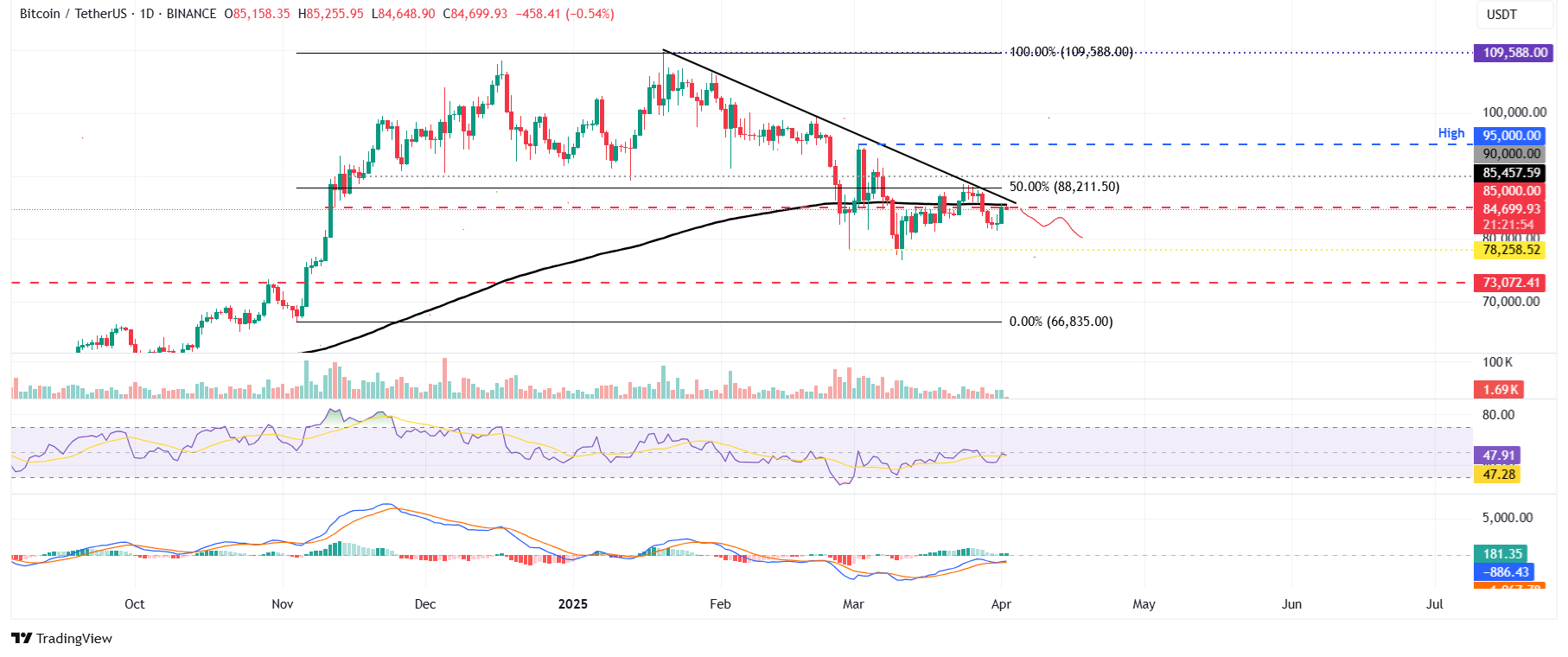
Дневной график BTC/USDT

Дневной график BTC/USDT

Однако если BTC восстановится и закроется выше своего дневного сопротивления на уровне $85 000, он может продлить восстановительный рост до ключевого психологического уровня в $90 000.

Ethereum может продолжить падение, если поддержка $1861 снова не удержится

Цена Ethereum закрылась ниже своего дневного уровня поддержки $1861 на прошлой неделе и снизилась на 9,88%. Однако в начале этой недели ETH восстановился на 4,05%, закрывшись выше уровня $1861 до вторника. На момент написания статьи он торгуется немного ниже, приближаясь к своему дневному уровню сопротивления $1861.

Если ETH не найдет поддержки около $1861 и продолжит нисходящую тенденцию, он может продолжить падение и повторно протестировать важный психологический уровень $1700.

RSI на дневном графике составляет 40, что ниже нейтрального уровня 50, и направлен вниз, что указывает на медвежий тренд.
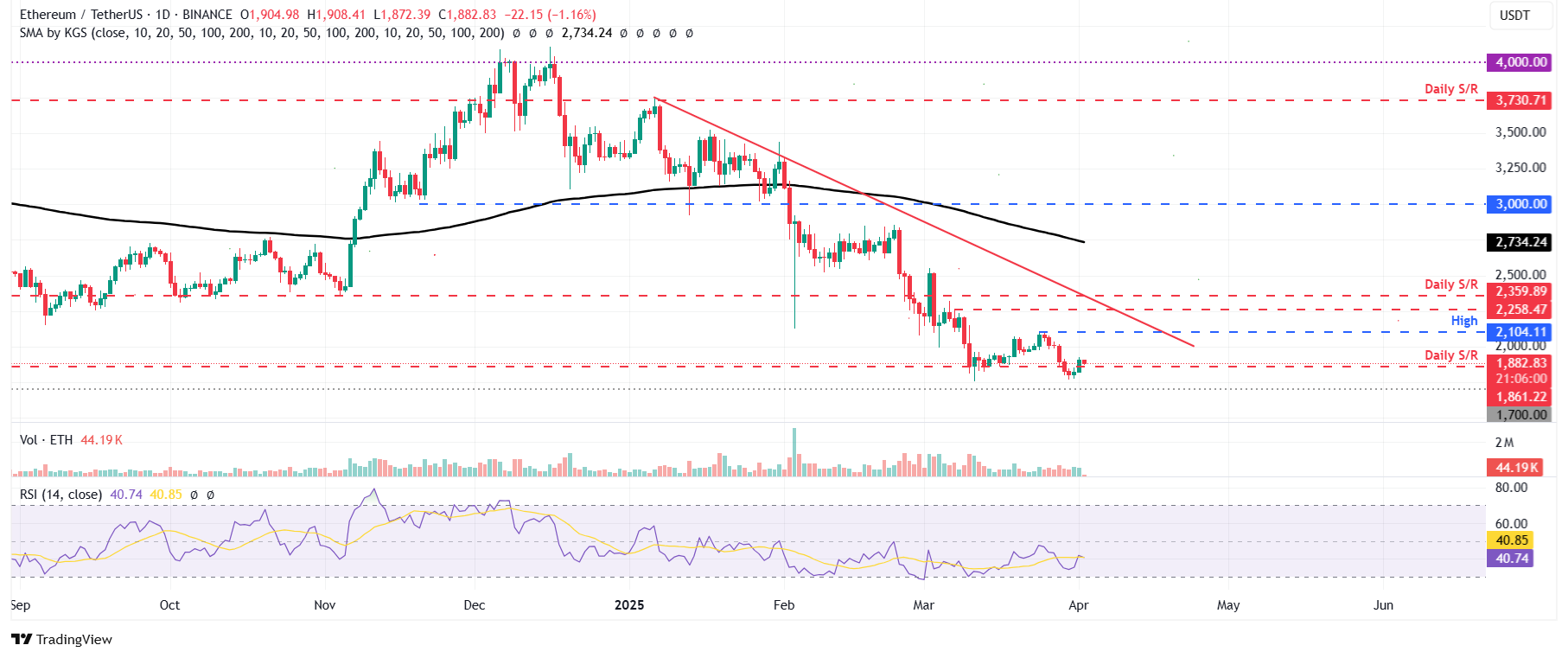
Дневной график ETH/USDT

Дневной график ETH/USDT

И наоборот, если ETH найдет поддержку около уровня $1861 и продолжит восстановление, он может продлить восстановление до своего максимума 24 марта в $2104.

XRP демонстрирует слабость, закрываясь ниже своей 100-дневной EMA

Цена XRP закрылась ниже своей 100-дневной EMA на уровне $2,30 на прошлой неделе и снизилась на 12,40%. В последние два дня этой недели она стабилизировалась около уровня $2,14. На момент написания статьи в среду она торгуется немного ниже уровня $2,09.

Если XRP продолжит коррекцию, он может отказаться протестировать следующий уровень поддержки на отметке $1,96.

RSI на дневном графике составляет 39, что ниже нейтрального уровня 50, как у Bitcoin и Ethereum, что указывает на медвежий тренд.
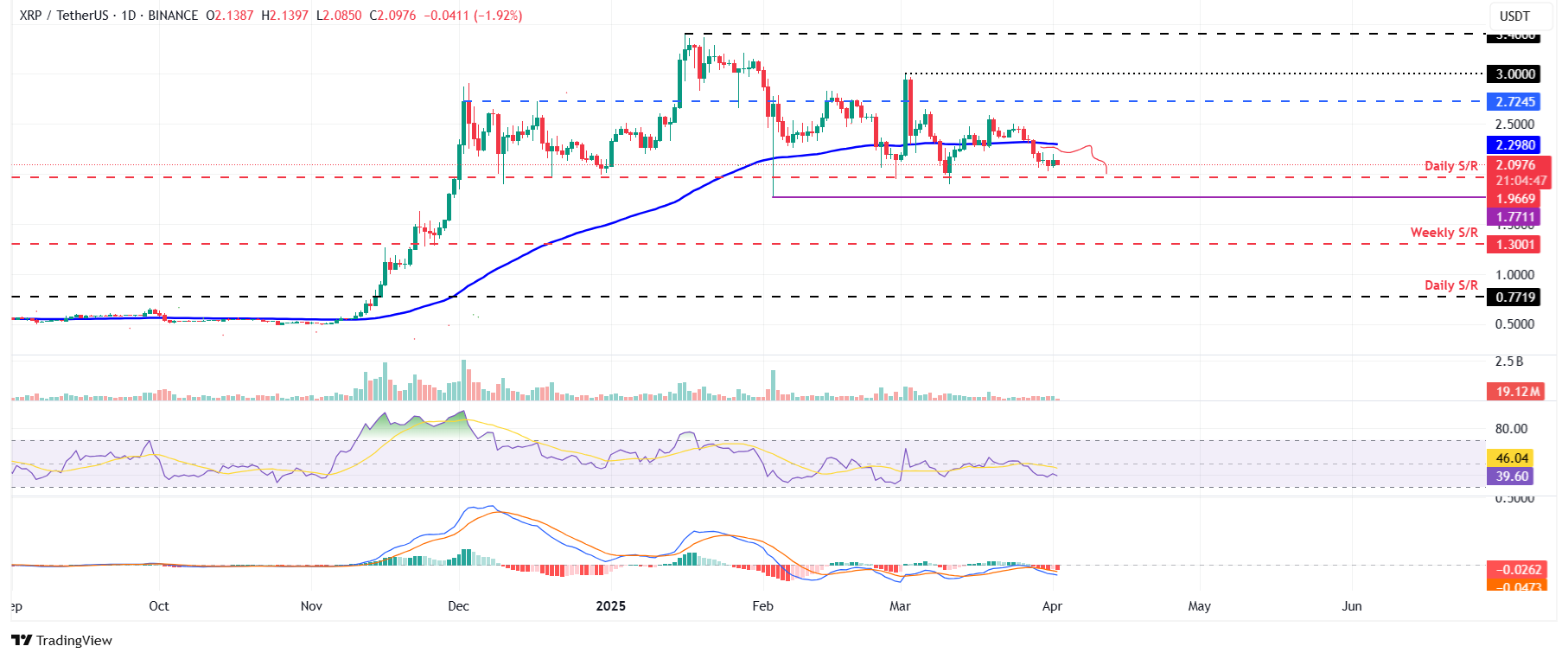
Дневной график XRP/USDT


Дневной график XRP/USDT

Trending Cryptos

Related Reads

Top 8 DEXs of July 2026

This article presents the top 8 decentralized exchanges (DEXs) for July 2026, highlighting their key features and evolution within the DeFi space. DEXs, which enable peer-to-peer cryptocurrency trading via smart contracts without intermediaries, are praised for offering users greater control, privacy, transparency, and global access compared to centralized platforms. The listed DEXs are: 1. **Shadow Exchange**: A Sonic-native DEX specializing in concentrated liquidity for efficient trading and reduced slippage. 2. **Uniswap**: A leading protocol using an Automated Market Maker (AMM) model across multiple blockchains. 3. **SushiSwap**: An evolved platform offering token swaps, yield farming, and governance via its SUSHI token across 40+ networks. 4. **Orca**: A user-friendly AMM on Solana featuring capital-efficient "Whirlpools" for concentrated liquidity. 5. **Meteora**: A Solana-based DEX focusing on dynamic liquidity infrastructure and vaults for advanced strategies. 6. **Raydium**: A hybrid exchange on Solana combining AMM pools with a central limit order book for deep liquidity. 7. **Hyperliquid**: A Layer 1 blockchain hosting a non-custodial perpetual futures exchange using an on-chain order book. 8. **PancakeSwap**: A multi-chain AMM hub originating on BNB Chain, now supporting thousands of trading pairs across several networks. The article concludes by noting the significant role of DEXs in crypto, their expansion beyond simple swaps into areas like derivatives and cross-chain interoperability, and advises users to conduct their own research before engaging with any platform.

ambcrypto1h ago

Top 8 DEXs of July 2026

ambcrypto1h ago

USDT Market Cap Approaches Ethereum's: What Signal Does This Convey?

The market capitalization of USDT has nearly reached that of Ethereum, making it the second-largest cryptocurrency after Bitcoin. This prompts an examination of what this signifies and what it does not. Firstly, this does not relate to economic security. Unlike some Web3 systems where a governance token's value must underpin the security of its applications (e.g., oracles), USDT's stability is not backed by the value of the underlying blockchains it operates on. Tether, the issuer, controls the assets, and can freeze, reissue, or abandon tokens on a compromised chain. While stablecoins require functional blockchains, a chain's native token market cap does not provide direct security for the stablecoin. Secondly, USDT's growth does not inherently reflect poorly on Ethereum. USDT is a dollar-pegged store of value, while ETH represents a claim on future Ethereum network revenue. Their valuations are driven by different factors. USDT's rising market cap simply indicates strong demand for stablecoin utility, independent of Ethereum's technological merits or competitive position. The core insight is the overwhelming market demand for permissionless dollar transfers. This is the most established and essential use case in crypto. It requires minimal technological sophistication—essentially just a trusted issuer's promise of redemption on a functional chain. This explains why stablecoin supply has grown exponentially while the combined market cap of major non-stablecoin cryptocurrencies like Bitcoin, Ethereum, and others has stagnated for years. Users primarily seek accessible dollar-denominated assets. They largely disregard the issuer's credibility (as seen with Tether's dominance over more credible alternatives like USDC or BlackRock's BUIDL) and are indifferent to the governance or decentralization of the underlying blockchain. As long as a stablecoin is widely accepted and easy to transfer, users will adopt it across any chain. The trend suggests that the market for permissionless stablecoins could continue to expand far beyond the total value of the smart contract platforms that host them, driven by this singular, powerful use case.

Foresight News1h ago

USDT Market Cap Approaches Ethereum's: What Signal Does This Convey?

Foresight News1h ago

Trading

Spot

Hot Articles

What is $BITCOIN

DIGITAL GOLD ($BITCOIN): A Comprehensive Analysis Introduction to DIGITAL GOLD ($BITCOIN) DIGITAL GOLD ($BITCOIN) is a blockchain-based project operating on the Solana network, which aims to combine the characteristics of traditional precious metals with the innovation of decentralized technologies. While it shares a name with Bitcoin, often referred to as “digital gold” due to its perception as a store of value, DIGITAL GOLD is a separate token designed to create a unique ecosystem within the Web3 landscape. Its goal is to position itself as a viable alternative digital asset, although specifics regarding its applications and functionalities are still developing. What is DIGITAL GOLD ($BITCOIN)? DIGITAL GOLD ($BITCOIN) is a cryptocurrency token explicitly designed for use on the Solana blockchain. In contrast to Bitcoin, which provides a widely recognized value storage role, this token appears to focus on broader applications and characteristics. Notable aspects include: Blockchain Infrastructure: The token is built on the Solana blockchain, known for its capacity to handle high-speed and low-cost transactions. Supply Dynamics: DIGITAL GOLD has a maximum supply capped at 100 quadrillion tokens (100P $BITCOIN), although details regarding its circulating supply are currently undisclosed. Utility: While precise functionalities are not explicitly outlined, there are indications that the token could be utilized for various applications, potentially involving decentralized applications (dApps) or asset tokenization strategies. Who is the Creator of DIGITAL GOLD ($BITCOIN)? At present, the identity of the creators and development team behind DIGITAL GOLD ($BITCOIN) remains unknown. This situation is typical among many innovative projects within the blockchain space, particularly those aligning with decentralized finance and meme coin phenomena. While such anonymity may foster a community-driven culture, it intensifies concerns about governance and accountability. Who are the Investors of DIGITAL GOLD ($BITCOIN)? The available information indicates that DIGITAL GOLD ($BITCOIN) does not have any known institutional backers or prominent venture capital investments. The project seems to operate on a peer-to-peer model focused on community support and adoption rather than traditional funding routes. Its activity and liquidity are primarily situated on decentralized exchanges (DEXs), such as PumpSwap, rather than established centralized trading platforms, further highlighting its grassroots approach. How DIGITAL GOLD ($BITCOIN) Works The operational mechanics of DIGITAL GOLD ($BITCOIN) can be elaborated on based on its blockchain design and network attributes: Consensus Mechanism: By leveraging Solana’s unique proof-of-history (PoH) combined with a proof-of-stake (PoS) model, the project ensures efficient transaction validation contributing to the network's high performance. Tokenomics: While specific deflationary mechanisms have not been extensively detailed, the vast maximum token supply implies that it may cater to microtransactions or niche use cases that are still to be defined. Interoperability: There exists the potential for integration with Solana’s broader ecosystem, including various decentralized finance (DeFi) platforms. However, the details regarding specific integrations remain unspecified. Timeline of Key Events Here is a timeline that highlights significant milestones concerning DIGITAL GOLD ($BITCOIN): 2023: The initial deployment of the token occurs on the Solana blockchain, marked by its contract address. 2024: DIGITAL GOLD gains visibility as it becomes available for trading on decentralized exchanges like PumpSwap, allowing users to trade it against SOL. 2025: The project witnesses sporadic trading activity and potential interest in community-led engagements, although no noteworthy partnerships or technical advancements have been documented as of yet. Critical Analysis Strengths Scalability: The underlying Solana infrastructure supports high transaction volumes, which could enhance the utility of $BITCOIN in various transaction scenarios. Accessibility: The potential low trading price per token could attract retail investors, facilitating wider participation due to fractional ownership opportunities. Risks Lack of Transparency: The absence of publicly known backers, developers, or an audit process may yield skepticism regarding the project's sustainability and trustworthiness. Market Volatility: The trading activity is heavily reliant on speculative behavior, which can result in significant price volatility and uncertainty for investors. Conclusion DIGITAL GOLD ($BITCOIN) emerges as an intriguing yet ambiguous project within the rapidly evolving Solana ecosystem. While it attempts to leverage the “digital gold” narrative, its departure from Bitcoin's established role as a store of value underscores the need for a clearer differentiation of its intended utility and governance structure. Future acceptance and adoption will likely depend on addressing the current opacity and defining its operational and economic strategies more explicitly. Note: This report encompasses synthesised information available as of October 2023, and developments may have transpired beyond the research period.

702 Total ViewsPublished 2025.05.13Updated 2025.05.13

What is $BITCOIN

Discussions

Welcome to the HTX Community. Here, you can stay informed about the latest platform developments and gain access to professional market insights. Users' opinions on the price of BTC (BTC) are presented below.

活动图片