Dogecoin (DOGE) at a Critical Turning Point as Key Levels Dictate Its Next Move

mediumPublished on 2025-03-20Last updated on 2025-03-20

Abstract

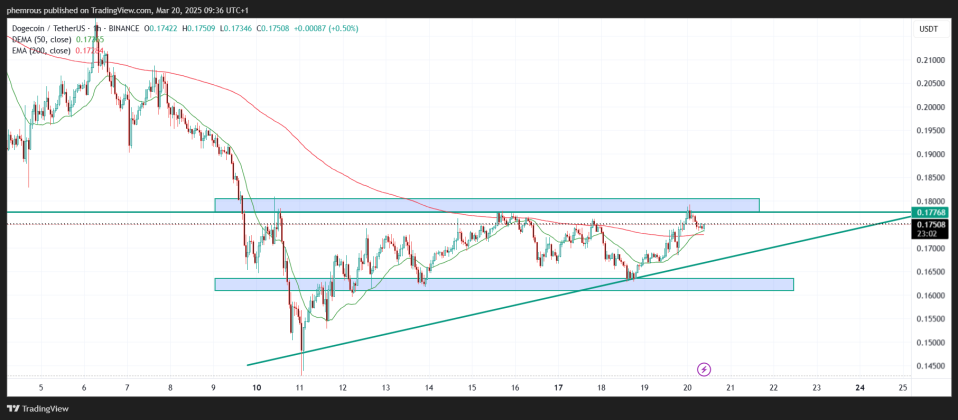
Dogecoin (DOGE) is currently trading at $0.17508, following a pullback from the $0.17919 resistance zone.

Dogecoin (DOGE) is currently trading at $0.17508, following a pullback from the $0.17919 resistance zone. This level has proven difficult to break, leading to a fake breakout above the ascending triangle on the 1-hour chart. As selling pressure mounts, DOGE is edging toward $0.17019, a key support level that will determine its next move.

Key Levels to Watch

Resistance Levels:

$0.17750 – A key short-term resistance; a breakout could trigger renewed bullish momentum.

$0.17919 – A major resistance zone that previously rejected the price. A decisive move above this level could confirm a long-term uptrend.

Support Levels:

$0.17019 – Immediate support where buyers may attempt to regain control.

Ascending Triangle Lower Line – A crucial trend line. If broken, DOGE could face further downside pressure.

Bearish Scenario

If $0.17456 support fails, selling pressure could drive DOGE toward the ascending triangle’s lower trend line. A breakdown below this structure would signal a strong bearish move, increasing the likelihood of a deeper downtrend toward lower support zones. This could lead to extended losses and shake investor confidence.

Bullish Outlook

Conversely, if $0.17456 or the trend line holds, buyers may regain strength and push DOGE toward the $0.17750 resistance zone. A successful breakout past $0.17919 could trigger a sustained rally, reinforcing bullish sentiment. Breaking above this zone could pave the way for a long-term uptrend, benefiting traders and investors.

DOGE is at a pivotal moment. A bounce from support could fuel a bullish breakout, while failure to hold key levels may result in further declines. Traders should monitor these levels closely to anticipate DOGE’s next significant move.

Disclaimer: This content is meant to inform and should not be considered financial advice. The views expressed in this article may include the author’s personal opinions and do not represent Times Tabloid’s opinion. Readers are urged to do in-depth research before making any investment decisions. Any action taken by the reader is strictly at their own risk. Times Tabloid is not responsible for any financial losses.

Related Reads

Why Sam Altman's 'Water and Electricity Theory' Sparks Copyright Controversy

OpenAI CEO Sam Altman's recent statement that "intelligence will become a utility like electricity or water" has sparked significant controversy, primarily around copyright issues and the nature of AI development. While positioning AI as a utility serves as a compelling narrative for infrastructure investors, critics argue the analogy is flawed in three key areas. First, there's a fundamental "property gap." Traditional utilities like water and power create new, physical infrastructure from scratch. In contrast, major AI models are trained by reorganizing vast amounts of existing human-created content—books, articles, code, etc.—often scraped from the web without explicit permission or compensation to creators. This "free acquisition, paid resale" model is seen by many as ethically problematic. Second, there's a "pricing gap." True public utilities are typically regulated to ensure universal service with non-discriminatory, cost-plus pricing. AI's token-based pricing, however, involves significant price discrimination (e.g., output tokens costing much more than input tokens) and is designed for revenue maximization, not equitable access. Third, a "governance gap" exists. Utilities operate under public oversight, while AI pricing and development are currently controlled by a few private companies. Furthermore, the industry's own shift toward buying licensed training data (e.g., deals with Reddit or news publishers) undermines its previous legal reliance on "fair use" for freely scraped data. In conclusion, while AI is indeed becoming a foundational technology, calling it a public utility remains contentious. The title requires not just scale and a pay-per-use model, but also credible solutions for data provenance, equitable pricing, and public governance.

marsbit12m ago

Why Sam Altman's 'Water and Electricity Theory' Sparks Copyright Controversy

marsbit12m ago

From ZEC's Surge to Vitalik's Support: Will the Privacy Narrative Resurface?

From ZEC's surge to Vitalik's endorsement, is privacy making a comeback? The recent rally in ZEC has refocused attention on the crypto privacy sector. This resurgence stems from a growing market realization: while blockchain transparency builds trust, full exposure of user balances, trading strategies, and risk positions can become a vulnerability, especially for large traders and institutions on platforms like Hyperliquid. The privacy landscape has evolved beyond classic anonymity coins like ZEC, XMR, and DASH. It now encompasses privacy infrastructure projects such as Railgun (bringing privacy to DeFi) and Aztec (a privacy-focused L2), as well as newer entrants like Genius Terminal, SilentSwap, and 0xBow that emphasize transaction privacy while attempting to balance compliance. Industry trends confirm privacy is becoming integrated, not a niche feature. Perp DEX Aster has introduced a "Shield Mode," and Vitalik has discussed the need for native privacy at the Ethereum protocol level, including proposals like EIP-8182 for standardized private transfers. In conclusion, this revival is more than a simple sector rotation. It reflects a critical reassessment of transparency's limits. As on-chain finance matures, the challenge is finding a sustainable balance between necessary transparency for trust and essential privacy for protecting assets and strategies, making privacy a potential cornerstone of next-generation infrastructure.

marsbit22m ago

From ZEC's Surge to Vitalik's Support: Will the Privacy Narrative Resurface?

marsbit22m ago

Trump, the "Stock Market Manipulator" in U.S. Stocks, Lifts Up the Entire Quantum Computing Sector

"Trump, the 'U.S. Stock Market Mastermind,' Boosts the Entire Quantum Computing Sector" This article details how former U.S. President Donald Trump's policies and public statements have significantly influenced the stock market, particularly in the quantum computing sector. A key example is the U.S. government's direct investment in Intel stock in August 2025, which yielded over $45 billion in gains within seven months. Trump publicly credited himself for this profit. Recently, the Trump administration announced a new $2 billion initiative. Through the Department of Commerce, funding from the CHIPS and Science Act will be provided to nine quantum computing companies in exchange for minority, non-controlling equity stakes. The recipients include IBM ($1B for its subsidiary Anderon), GlobalFoundries ($375M), and listed companies like D-Wave, Infleqtion, and Rigetti ($100M each). Private firms such as Atom Computing and PsiQuantum also received $100M. This "investment-for-equity" strategy marks a shift from pure subsidies to an "active investor" model under the CHIPS Act. The announcement immediately boosted quantum computing stocks. The article frames this as part of Trump's "America First" industrial policy, aimed at securing U.S. technological leadership, similar to past investments in semiconductors, rare earths, and lithium. The author suggests this pattern of government-backed market intervention, alongside Trump's personal stock endorsements, is a hallmark of his approach to driving market gains and may continue in sectors like defense and advanced energy.

marsbit1h ago

Trump, the "Stock Market Manipulator" in U.S. Stocks, Lifts Up the Entire Quantum Computing Sector

marsbit1h ago

Trading

Spot
Futures

Hot Articles

What is DOGE M

Doge Matrix ($doge m): The New Breed of Community-Driven Cryptocurrency Introduction In the ever-evolving landscape of cryptocurrency, new projects constantly emerge, each aiming to capture the interest of investors and enthusiasts alike. One of the latest entrants to this domain is Doge Matrix, represented by the ticker symbol $doge m. This project has attracted attention thanks to its roots in the popular meme culture surrounding Dogecoin, establishing its place within the web3 space. This article aims to provide a comprehensive analysis of Doge Matrix, covering its overview, creator, investors, functionality, timeline, and notable aspects. What is Doge Matrix ($doge m)? Doge Matrix is a community-driven cryptocurrency project that seemingly builds upon the widespread appeal of Dogecoin, a digital currency known for its Shiba Inu mascot and its meme origins. While the overarching objectives of Doge Matrix are not extensively defined, it is characterized by a commitment to harnessing community involvement and support. Unlike traditional cryptocurrencies that often emphasize utility or intrinsic value through underlying technologies, Doge Matrix positions itself within a space that embraces the cultural phenomenon of cryptocurrencies, particularly appealing to those who resonate with the ethos of meme-based assets. Drawing on the strengths of the Dogecoin community, Doge Matrix operates as part of a broader ecosystem, inviting participation and engagement from users who share an interest in cryptocurrency and the digital landscape. Who is the Creator of Doge Matrix ($doge m)? The identity of the creator of Doge Matrix remains unknown. This lack of transparency is not an uncommon occurrence in the cryptocurrency space, where some projects are launched without revealing the identities of their founders. The absence of information regarding the founding team can raise questions among potential investors about the project’s accountability and direction. Who are the Investors of Doge Matrix ($doge m)? As it stands, there is no publicly available information detailing the investors or investment foundations that back Doge Matrix. The project appears to rely primarily on community support rather than institutional investment. This model aligns with the community-driven nature of the initiative, fostering an environment where the direction of the project is shaped by its participants rather than being dictated by a select few financial backers. How Does Doge Matrix ($doge m) Work? The specifics regarding the operational mechanisms of Doge Matrix are somewhat vague, reflecting a broader trend of projects in the meme coin space where innovative functionalities are not always clearly articulated. Nonetheless, Doge Matrix seems designed to tap into the existing cryptocurrency ecosystem by encouraging user participation while tapping into the familiar cultural references associated with Dogecoin. Its potentially unique characteristics derive from community interactions rather than technological advancements, emphasizing shared experiences and collaboration among token holders. While the exact innovations have not been explicitly outlined, the project appears to create a space where community members can engage, share ideas, and propel the project's potential forward. Timeline of Doge Matrix ($doge m) Reflecting on the project’s timeline reveals notable events that have defined its journey thus far: November 25, 2024: Doge Matrix reached its all-time high value, marking a significant milestone in its early history. January 1, 2025: Conversely, Doge Matrix hit its all-time low value, illustrating the volatility often associated with cryptocurrencies, especially in the early stages of a project's lifecycle. Ongoing: The project continues to be actively traded and supported by its community, although specific future milestones or objectives have yet to be disclosed. Key Points About Doge Matrix ($doge m) Community Focus At the heart of Doge Matrix is a commitment to community engagement. The project thrives on the premise of collaboration and shared objectives among its members, emphasizing the importance of collective effort. Unlike centralized projects that often have a defined leadership structure, Doge Matrix at present showcases a more fluid approach to governance, where every community member's voice matters. Volatility The cryptocurrency market is notorious for its volatility, and Doge Matrix is no exception. Its price history reflects significant fluctuations between high and low values, which is typical of many new cryptocurrencies but underscores the risks associated with investment in emerging tokens. Lack of Detailed Information One of the most striking features about Doge Matrix is the scarcity of detailed information regarding its technological underpinnings and operational mechanisms. This ambiguity necessitates that potential investors conduct thorough due diligence before engaging with the project. Conclusion In summary, Doge Matrix ($doge m) illustrates a new wave of cryptocurrency projects that lean heavily on community engagement and cultural relevance. While lacking in certain specifics—such as clear leadership, defined objectives, and detailed functionality—the project has managed to generate interest within the crypto community, leveraging the established appeal of meme culture. As with any investment in the cryptocurrency space, understanding the inherent risks and conducting comprehensive research is essential for potential participants. Doge Matrix stands as a reminder of the dynamic, sometimes unpredictable nature of the crypto industry, marked by constant evolution and enthusiasm for community-driven initiatives.

3.6k Total ViewsPublished 2025.02.03Updated 2025.02.03
What is DOGE M

Discussions

Welcome to the HTX Community. Here, you can stay informed about the latest platform developments and gain access to professional market insights. Users' opinions on the price of DOGE (DOGE) are presented below.

活动图片