Solana SIMD 228 提案没通过,对SOL价格影响大吗

深潮TechFlowPublished on 2025-03-14Last updated on 2025-03-14

Abstract

SIMD 228 提出了一种静态曲线,根据质押参与率减少 SOL 的发行量。

作者:Carlos

编译:深潮TechFlow

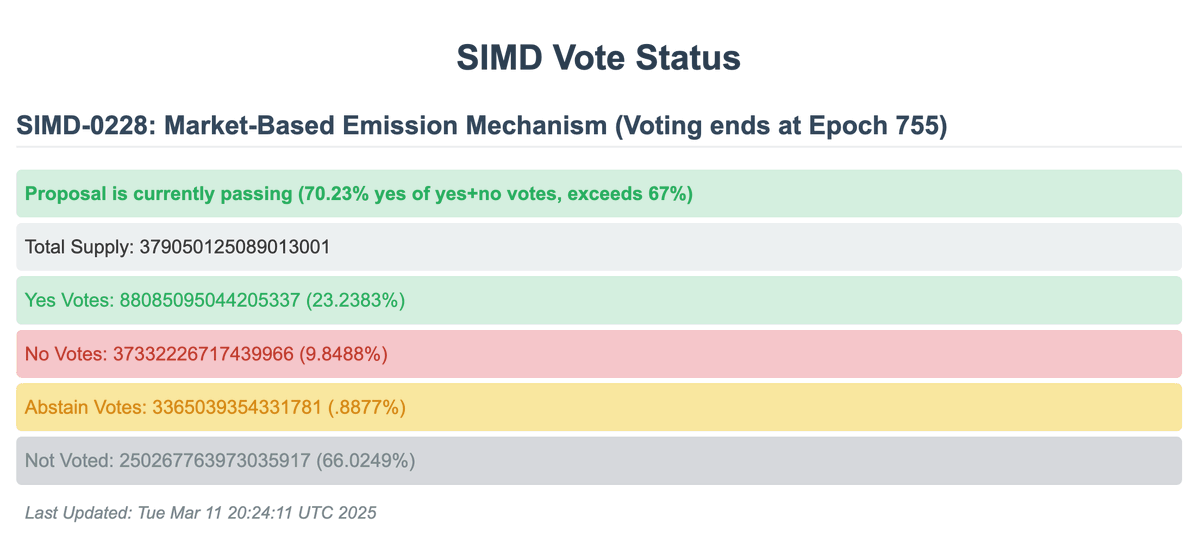
@solana SIMD 228 提案已达到法定人数,70%的人投票支持。投票将在第 755 个纪元结束,大约 52 小时之后。

什么是 SIMD 228?

支持的理由是什么?

反对的理由是什么?

让我们一起来深入看看吧。
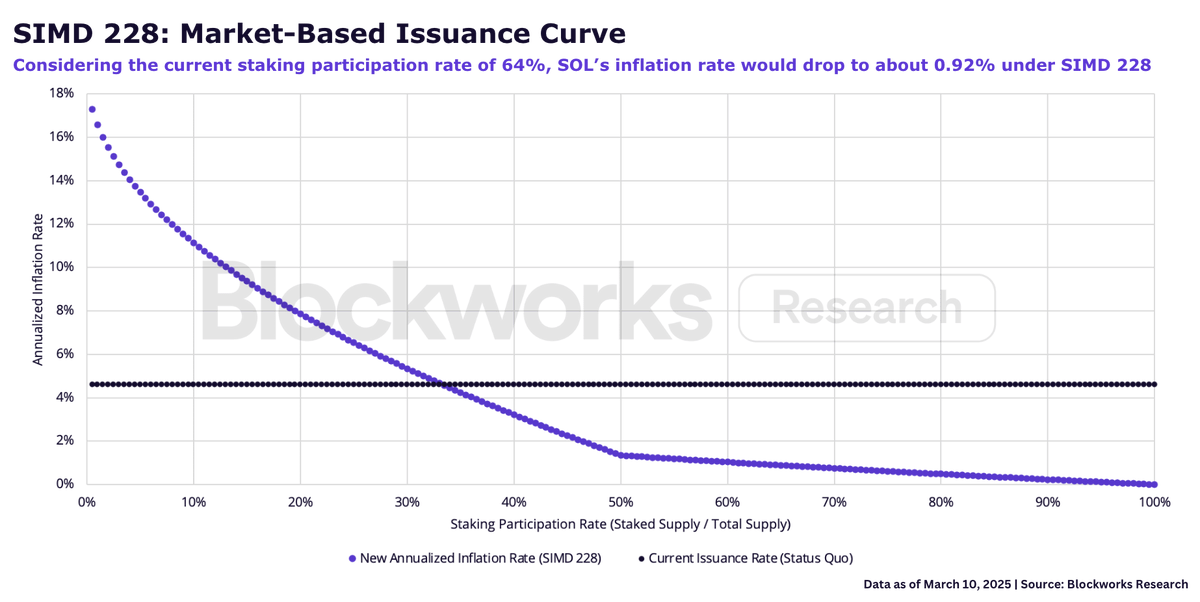
SIMD 228 提出了一种静态曲线,根据质押参与率减少 SOL 的发行量。在当前的质押率为 64% 的情况下,SIMD 228 实施后,经过一段平滑期,SOL 的通胀率将降至约 0.92%。值得注意的是,当质押率低于 50% 时,曲线会变得更加激进,使得新的发行率在当前固定发行计划之上,这一点在质押参与率等于 1/3(约 33.3%)时尤为明显。
支持的理由

支持理由 1:Solana 目前为安全性支付了过高的成本。

最有效的代币发行率是确保网络安全所需的最低水平。提案的原作者(@TusharJain_, @kankanivishal)指出,固定发行计划在 Solana 还是一个没有实际经济价值(REV)的新兴生态系统时是合理的。当时,依赖代币发行来吸引质押并确保安全是必要的。

然而,考虑到当前网络的经济活动和费用(REV)水平,固定发行计划已变得不那么合理,因为它发行的 SOL 超过了当前确保网络安全所需的量。这就是所谓的“漏桶问题”,@MaxResnick1将其定义为由于税收或具有市场权力的中间人(如 Coinbase 或 Binance 等高佣金验证者)导致的损失转移。

支持理由 2:名义收益率与实际收益率。

正如 @y2kappa所指出的,SOL 发行是一种会计技巧,它只会稀释未质押的 SOL 持有者,并导致人为的高收益率,这在没有区分名义(基于发行)和实际(基于 REV)收益率的情况下激励了不分青红皂白的质押。随着 Solana 的成熟,网络应变得经济可持续,并完全依靠费用运行,这反映了在网络上交易的真正经济需求。

支持理由 3:市场是确定价格的最佳机制,Solana 的发行不应例外。

上述论点的结论是,即使 SIMD 228 并不完美,基于市场的方法也比当前的固定发行计划有显著改进,后者是任意且低效的,会导致抛压上升。

反对的理由

反对理由 1:SOL 通胀补贴了机构分配。

虽然代币持有者只应关心实际收益率,但托管人和 ETP 发行者则相反。他们被激励追求尽可能高的名义收益率,因为他们收取佣金率且不暴露于底层资产(感谢@smyyguy的框架)。

以质押 SOL ETP 为例,ETP 发行者收取质押奖励的一部分,但不暴露于基础资产(即 SOL)。因此,高名义收益率激励这些玩家向客户销售 SOL 产品以增加自己的收入。从这个角度来看,Resnick 所称的“漏桶问题”实际上是一种分配支出(@calilyliu)。在我看来,这是反对 SIMD 228 的最有力的论据。

反对理由 2:机构吸引力。

这与上述观点相关。根据 @calilyliu 的说法,在机构兴趣达到顶峰且 Solana ETF 上线之前(可能在今年)改变固定发行计划是一个战略错误。Liu 的核心论点是,基于市场的方法会使通胀变得不可预测和不稳定,降低了 SOL 作为资产的吸引力。

对此的反驳是,SOL 是一种波动性过大的资产,其 7-8% 的收益率并不是购买的理由,那些因为名义收益率下降而停止购买 SOL 的人一开始就没有理解其投资逻辑。

反对理由 3:对验证者盈利能力的影响 / 验证者数量减少。

以 SOL 计价的投票费用是验证者当前的最大支出。有人(@David_Grid)担心SIMD 228 可能对小验证者的盈利能力产生影响,特别是在网络活动和 REV 从当前水平下降的情况下。换句话说,SIMD-228 的通胀曲线可能会导致验证者群体的缩水,尽管一些估计认为这种影响有限(在 70% 质押率情景下,根据 @0xIchigo和@__lostin__的估计,盈利验证者数量将预计下降 3.4%)。

还有一些次要的关于 SIMD 228 可能造成影响的担忧,包括对 Solana DeFi 利率的潜在影响、通胀是否会增加 SOL 抛售压力、提案讨论不足等。

无论验证者如何投票,理解双方观点以做出明智决策都至关重要。

如果通过,SIMD 228 将在几个月后实施,之后将有一个 50 个纪元(约 100 天)的过渡期,以平滑旧利率和新利率之间的曲线。

注:截止发稿前,本次提案 SIMD-0228 已结束投票暂时未获通过。提案获得了 61.39% 的支持率(仅计算赞成票与反对票),低于所需的 66.67% 通过门槛。

Trending Cryptos

Related Reads

Doubao and Qwen Will Discontinue Agent Functionality on July 15

On July 4th, Doubao and Tongyi Qianwen announced the impending shutdown of their user-created "AI Agent" features. Doubao confirmed its agent feature will be taken offline on July 15, directing users to ByteDance's CatBox app for similar needs. On the same day, Tongyi Qianwen notified users, specifying that personalized interactive agents and user-built agent functions will cease on July 10, with all agent features and services completely deactivated by July 15. After this date, access to agent configurations and historical chat records will be lost. This adjustment impacts core user scenarios like role-playing, personal assistants, and vertical tool agents. The shutdown date coincides with the official implementation of China's "Interim Measures for the Administration of Artificial Intelligence Human-like Interactive Services" on July 15. The new regulations impose strict rules on "human-like emotional interaction services," requiring platforms to implement measures like anti-addiction systems, minor verification, and content moderation. This move is widely seen as a proactive step by the platforms to align with regulatory timelines and mitigate compliance risks. Additionally, commercial challenges are a key driver. Analysis suggests that casual, human-like chat agents generate high-frequency, low-value interactions, leading to high computational costs with poor monetization. As the AI application market shifts from user growth to proving value, sustaining such "high-cost, low-efficiency" user-generated content becomes difficult. Both platforms have outlined transition plans. Doubao will allow data viewing and self-backup for a period after shutdown, with data scheduled for permanent deletion by October 15. Tongyi Qianwen similarly advised users to save important content via copying or screenshots before the deadline. This strategic retreat from C-end agent features signals a broader market shift. Compliance capability and sustainable business models are replacing user scale and feature richness as the new core competitive dimensions. Tongyi Qianwen's recent move to fully open its Agent and Skill platforms to third-party enterprises and developers further underscores a strategic pivot from low-value C-end services to high-value B-end enterprise scenarios.

marsbit3h ago

Doubao and Qwen Will Discontinue Agent Functionality on July 15

marsbit3h ago

Why Did Codex and ChatGPT Merge? What's Next for Codex? OpenAI Core Leader Answers Everything

In 2026, OpenAI's Codex saw explosive growth, with weekly active users surging over 5x to 5 million since January, driven largely by the February launch of its desktop app. Codex desktop lead Andrew Ambrosino explains key shifts behind its evolution. A core change is the inversion of development costs: implementation is now cheap, while curation and taste—judging which of many AI-generated prototypes is valuable—have become the new scarcities. Ambrosino defines taste as a blend of aesthetics, systems thinking, direction, and semantic coherence in interaction. He notes AI still struggles with design because evaluating it requires human cultural context and abstract reasoning about how components relate—capabilities beyond current models. Timing is critical: the same Codex app would have failed months earlier; success hinges on the model's capabilities at launch. Roles are blurring within his team, with engineers, designers, and PMs overlapping significantly. However, Ambrosino cautions against eliminating specialized roles entirely, as each field retains deep expertise. On AI-assisted development, the focus has shifted from measuring code written by AI to distinguishing between supervised and unsupervised generation. A current challenge is teaching models to simplify code, not just add complexity. The merger of Codex and ChatGPT stems from observed user behavior: non-developers adopted Codex for general knowledge work despite its developer-centric interface. This revealed a collapsing boundary between specialized tools and universal assistants. The vision is a "home base" that orchestrates tasks across external professional tools (like Excel or Premiere Pro) via connectors, rather than rebuilding everything internally. An internal example showed Codex helping edit video by interacting with Premiere Pro's files and even writing a plugin for it. The future direction is a unified, extensible platform that serves as a central hub for automating and managing work across any specialized tool the user employs.

marsbit3h ago

Why Did Codex and ChatGPT Merge? What's Next for Codex? OpenAI Core Leader Answers Everything

marsbit3h ago

Trading

Spot

Hot Articles

Discussions

Welcome to the HTX Community. Here, you can stay informed about the latest platform developments and gain access to professional market insights. Users' opinions on the price of SOL (SOL) are presented below.

活动图片