Bitcoin Traders Undecided On Direction As Sentiment Turns Exactly Neutral

bitcoinistPublished on 2025-02-14Last updated on 2025-02-14

Abstract

Data shows the Bitcoin trader sentiment has hit a net neutral level as the consolidation in the cryptocurrency's price has...

Data shows the Bitcoin trader sentiment has hit a net neutral level as the consolidation in the cryptocurrency’s price has continued.

Bitcoin Fear & Greed Index Is Currently Exactly In The Balance

The “Fear & Greed Index” refers to an indicator created by Alternative that keeps track of the average sentiment present among the traders in the Bitcoin and wider cryptocurrency markets.

This index uses a numeric scale that runs from zero to hundred for representing the market mentality. All values below the 47 mark imply the investors are sharing a sentiment of fear, while those above 53 suggest the presence of greed in the market. The region in-between the two cutoffs corresponds to a neutral sentiment.

Besides these three main sentiments, the metric also has two special territories known as the extreme fear and extreme greed. The former occurs when the index grows below 25, while the latter above 75.

Here is how the current Bitcoin market sentiment is like according to the Fear & Greed Index:

Bitcoin Neutral Sentiment

Looks like the index has a value of 50 at the moment | Source: Alternative

As is visible above, the indicator has a value of 50, which means the investors as a whole share an exactly neutral sentiment right now. The index has arrived at this balance following a period of fluctuations.

Below is a chart that shows how the Bitcoin Fear & Greed Index has changed recently.
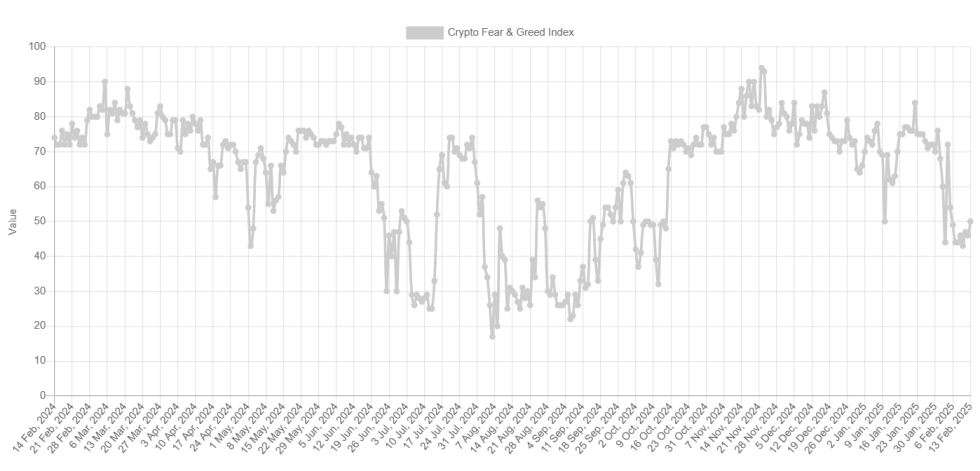
Bitcoin Fear & Greed Index

The value of the metric appears to have registered a sharp plunge over the past couple of weeks | Source: Alternative

The indicator ended January inside the extreme greed zone, but February kicked off with a rapid deterioration in sentiment as the index plunged all the way into the fear region.

But it would appear that the investors are now neither bullish nor bearish on the cryptocurrency, considering that the metric is back inside the neutral territory. The uncertainty among the investors is likely a product of the long consolidation that the asset has been witnessing recently.

Historically, Bitcoin has often tended to move in the direction that’s the opposite of what the crowd is expecting. Major tops and bottoms have generally occurred during the extreme sentiments, as these regions are where the investors are the most sure of the cryptocurrency’s trajectory.

With the trader mentality being perfectly in the balance right now, though, BTC theoretically has equal potential to run in either direction. In such a market, it’s possible that the consolidation of the asset will only lengthen until some sort of news arrives that swings opinion one way or the other.

BTC Price

At the time of writing, Bitcoin is trading around $95,700, down around 2% over the last seven days.

Bitcoin Price Chart

Looks like the price of the coin has been moving sideways in recent days | Source: BTCUSDT on TradingView
Featured image from Dall-E, Alternative.me, chart from TradingView.com
Keshav Verma

Keshav Verma

Keshav is a Physics graduate who has been employed as a writer with Bitcoinist since June 2021. He is passionate about writing and through the years, he has gained experience working in a variety of niches. Keshav holds an active interest in the cryptocurrency market, with on-chain analysis being an area he particularly likes to research and write about.

Related Reads

After $HYPE Hits a New High, Is It Worth Considering the Stock of "HYPE Version MicroStrategy" $PURR?

**HYPE Hits New Highs: Is $PURR, the "HYPE Version of MicroStrategy," Worth Considering?** The stock of Hyperliquid Strategies (NASDAQ: $PURR), a publicly-traded company that exclusively buys and holds the cryptocurrency HYPE, has gained over 100% year-to-date, mirroring HYPE's own 150% surge to new all-time highs. This has sparked discussions about PURR being a more "capital-efficient" play than MicroStrategy's bitcoin strategy, given its reported ~$1 billion unrealized gain on a ~$220 million investment. The article clarifies that PURR is essentially a pure-play wrapper for HYPE, with no other business. It resulted from a 2025 SPAC merger led by firms like Paradigm and Atlas Merchant Capital, bringing traditional finance veterans to its board. Its value is entirely derived from the price of HYPE. While PURR offers a crucial compliance bridge for US-based institutional and retirement accounts unable to access HYPE directly, the analysis questions the "capital efficiency" narrative. The outsized gains are attributed to HYPE's exceptional performance, not superior corporate strategy. For investors who can buy HYPE directly, holding PURR introduces unnecessary risks: potential shareholder dilution from future stock offerings, incomplete passthrough of staking rewards, market hour mismatches, and counterparty risk via its single custodian. A key metric is its mNAV (modified net asset value). Current calculations show PURR trades at a discount to its HYPE holdings, but this could flip to a premium depending on the execution of registered share issuances. The article concludes that PURR is primarily a "conduit product." The investment thesis hinges entirely on one's bullishness on HYPE itself, not on the PURR wrapper, which adds friction and risk for those with direct crypto access.

marsbit26m ago

After $HYPE Hits a New High, Is It Worth Considering the Stock of "HYPE Version MicroStrategy" $PURR?

marsbit26m ago

The Real Progress and Investment Opportunities of Decentralized AI Computing Power Networks in 2026

In 2026, the AI compute market is marked by centralized GPU consolidation and a significant GPU shortage for smaller players. In this context, Decentralized Physical Infrastructure Networks (DePIN), valued at $9.4B+, have emerged as a viable, revenue-generating alternative. Leading protocols like Aethir ($150M ARR), io.net (130k+ GPUs), Akash, Bittensor, and Render are carving out distinct niches, moving beyond hype to deliver verifiable income primarily from non-crypto-native clients. The key advantage of decentralized GPU networks lies in serving latency-tolerant, cost-sensitive workloads like AI inference, fine-tuning, data preprocessing, and agent operations, offering substantial cost savings (45-80%) compared to major cloud providers. However, reliability variance, lack of robust SLAs, and fragmented tech stacks remain significant adoption hurdles. The sector is maturing with critical 2026 shifts: 1) Evolution of tokenomics towards demand-driven, revenue-linked models (e.g., Render's BME, io.net's IDE), and 2) Clearer enterprise adoption pathways, with traditional firms integrating decentralized compute. For new entrants, opportunities are now concentrated in specialized tooling layers (orchestration, verification, SLA management), vertical applications (e.g., bio-med, content generation), and innovative token designs tied to real usage, rather than generic GPU aggregation. The convergence with the emerging AI Agent economy presents a significant future growth vector.

marsbit27m ago

The Real Progress and Investment Opportunities of Decentralized AI Computing Power Networks in 2026

marsbit27m ago

We Captured Thousands of Job Postings and Discovered ByteDance is Reviving Smartphone R&D

This article analyzes ByteDance's recent hiring activities, revealing a potential restart of smartphone hardware development. By scraping and analyzing thousands of ByteDance job postings, the authors identify three key categories: roles for the "Doubao Phone Assistant" (an AI agent), for a "Mobile OS" (system-level development), and for hardware/engineering positions in Shenzhen (a manufacturing hub). The piece traces the context to the 2025 launch of the "Doubao Phone," a concept device that integrated an AI agent directly into a smartphone, allowing it to see the screen, operate apps, and perform tasks like shopping or booking tickets. While innovative as an early AI Agent prototype, it faced operational restrictions from major platforms like WeChat and Alipay. The new hiring signals a deeper commitment. "Doubao Phone Assistant" roles focus on core Agent capabilities (task execution, memory, cross-app operation). "Mobile OS" positions involve deep system work (kernel, chip adaptation, power/thermal management) necessary for a responsive, always-on AI. Shenzhen-based hardware roles (structure design, testing, production) suggest preparation for physical device manufacturing. The article concludes that in the AI era, where phones may become an Agent's "body," controlling the operating system and hardware is critical. For a company like ByteDance, being merely an app within others' ecosystems is no longer sustainable if it aims to own the next-generation user interface. Therefore, while a consumer phone brand isn't confirmed, ByteDance is decisively moving beyond app development into the complex domain of system-level and hardware-integrated AI.

marsbit57m ago

We Captured Thousands of Job Postings and Discovered ByteDance is Reviving Smartphone R&D

marsbit57m ago

AI Impact on SaaS Software Stocks: Deconstructing the Bottom-Fishing Logic of Salesforce, ServiceNow, and Snowflake

"AI Nightmare for SaaS Stocks: Unpacking the Bottom-Fishing Logic for Salesforce, ServiceNow, and Snowflake" A deep dive analysis argues that the recent collapse in SaaS software stocks, dubbed the "SaaS Doom," presents a contrarian buying opportunity. The market panic, triggered by fears that AI will disrupt traditional per-user subscription models through "seat compression" and AI agents bypassing software UIs, has led to extreme selling in the software sector. The analysis evaluates three major players under a unified framework: 1. **Salesforce (CRM):** Positioned as a "margin of safety" play. Trading at historically low valuations (13-14x forward P/E), with strong cash flow and a massive buyback, it offers value. Its key challenge is transitioning from a "seat economy" to an AI-driven "task economy" with its Agentforce platform. 2. **ServiceNow (NOW):** The "clearest AI narrative" play. Its "AI Control Tower" strategy aims to become the governance and orchestration layer for enterprise AI agents, benefiting from AI proliferation. Backed by Nvidia's CEO, it trades at a relatively low valuation post-correction. 3. **Snowflake (SNOW):** The "high-risk, high-reward" bet. Its consumption-based model aligns with rising AI workloads, and its RPO growth is strong. However, it faces intense competition (e.g., Databricks), is not yet GAAP profitable, and carries the highest valuation. The conclusion counters the simplified "AI kills software" narrative. AI is eliminating software that sells only functional interfaces but rewarding platforms that provide essential infrastructure, data, and governance. The current sell-off may have created a buying opportunity for resilient software leaders positioned as future AI infrastructure platforms.

marsbit1h ago

AI Impact on SaaS Software Stocks: Deconstructing the Bottom-Fishing Logic of Salesforce, ServiceNow, and Snowflake

marsbit1h ago

Trading

Spot
Futures

Hot Articles

What is $BITCOIN

DIGITAL GOLD ($BITCOIN): A Comprehensive Analysis Introduction to DIGITAL GOLD ($BITCOIN) DIGITAL GOLD ($BITCOIN) is a blockchain-based project operating on the Solana network, which aims to combine the characteristics of traditional precious metals with the innovation of decentralized technologies. While it shares a name with Bitcoin, often referred to as “digital gold” due to its perception as a store of value, DIGITAL GOLD is a separate token designed to create a unique ecosystem within the Web3 landscape. Its goal is to position itself as a viable alternative digital asset, although specifics regarding its applications and functionalities are still developing. What is DIGITAL GOLD ($BITCOIN)? DIGITAL GOLD ($BITCOIN) is a cryptocurrency token explicitly designed for use on the Solana blockchain. In contrast to Bitcoin, which provides a widely recognized value storage role, this token appears to focus on broader applications and characteristics. Notable aspects include: Blockchain Infrastructure: The token is built on the Solana blockchain, known for its capacity to handle high-speed and low-cost transactions. Supply Dynamics: DIGITAL GOLD has a maximum supply capped at 100 quadrillion tokens (100P $BITCOIN), although details regarding its circulating supply are currently undisclosed. Utility: While precise functionalities are not explicitly outlined, there are indications that the token could be utilized for various applications, potentially involving decentralized applications (dApps) or asset tokenization strategies. Who is the Creator of DIGITAL GOLD ($BITCOIN)? At present, the identity of the creators and development team behind DIGITAL GOLD ($BITCOIN) remains unknown. This situation is typical among many innovative projects within the blockchain space, particularly those aligning with decentralized finance and meme coin phenomena. While such anonymity may foster a community-driven culture, it intensifies concerns about governance and accountability. Who are the Investors of DIGITAL GOLD ($BITCOIN)? The available information indicates that DIGITAL GOLD ($BITCOIN) does not have any known institutional backers or prominent venture capital investments. The project seems to operate on a peer-to-peer model focused on community support and adoption rather than traditional funding routes. Its activity and liquidity are primarily situated on decentralized exchanges (DEXs), such as PumpSwap, rather than established centralized trading platforms, further highlighting its grassroots approach. How DIGITAL GOLD ($BITCOIN) Works The operational mechanics of DIGITAL GOLD ($BITCOIN) can be elaborated on based on its blockchain design and network attributes: Consensus Mechanism: By leveraging Solana’s unique proof-of-history (PoH) combined with a proof-of-stake (PoS) model, the project ensures efficient transaction validation contributing to the network's high performance. Tokenomics: While specific deflationary mechanisms have not been extensively detailed, the vast maximum token supply implies that it may cater to microtransactions or niche use cases that are still to be defined. Interoperability: There exists the potential for integration with Solana’s broader ecosystem, including various decentralized finance (DeFi) platforms. However, the details regarding specific integrations remain unspecified. Timeline of Key Events Here is a timeline that highlights significant milestones concerning DIGITAL GOLD ($BITCOIN): 2023: The initial deployment of the token occurs on the Solana blockchain, marked by its contract address. 2024: DIGITAL GOLD gains visibility as it becomes available for trading on decentralized exchanges like PumpSwap, allowing users to trade it against SOL. 2025: The project witnesses sporadic trading activity and potential interest in community-led engagements, although no noteworthy partnerships or technical advancements have been documented as of yet. Critical Analysis Strengths Scalability: The underlying Solana infrastructure supports high transaction volumes, which could enhance the utility of $BITCOIN in various transaction scenarios. Accessibility: The potential low trading price per token could attract retail investors, facilitating wider participation due to fractional ownership opportunities. Risks Lack of Transparency: The absence of publicly known backers, developers, or an audit process may yield skepticism regarding the project's sustainability and trustworthiness. Market Volatility: The trading activity is heavily reliant on speculative behavior, which can result in significant price volatility and uncertainty for investors. Conclusion DIGITAL GOLD ($BITCOIN) emerges as an intriguing yet ambiguous project within the rapidly evolving Solana ecosystem. While it attempts to leverage the “digital gold” narrative, its departure from Bitcoin's established role as a store of value underscores the need for a clearer differentiation of its intended utility and governance structure. Future acceptance and adoption will likely depend on addressing the current opacity and defining its operational and economic strategies more explicitly. Note: This report encompasses synthesised information available as of October 2023, and developments may have transpired beyond the research period.

363 Total ViewsPublished 2025.05.13Updated 2025.05.13

What is $BITCOIN

Discussions

Welcome to the HTX Community. Here, you can stay informed about the latest platform developments and gain access to professional market insights. Users' opinions on the price of BTC (BTC) are presented below.

活动图片