Bittensor (TAO) остается лидером среди AI-монет: «золотой крест» на графике

cryptonews.ruPublished on 2024-04-30Last updated on 2025-01-30

TAO выделяется на фоне падающего рынка

Bittensor (TAO) продолжает удерживать статус крупнейшей AI-криптовалюты по капитализации. В последние сутки его цена выросла менее чем на 1%, но на фоне снижения других AI-токенов, таких как RENDER, FET и INJ, TAO остается в плюсе.

Технические индикаторы указывают на нарастающий бычий тренд. BBTrend поднялся до максимального уровня за три недели, а на графике EMA формируется «золотой крест» — сигнал потенциального роста.

Вопрос остается открытым: сможет ли TAO вернуться к $500 в феврале или рынок столкнется с коррекцией? Ответ зависит от поведения цены на ключевых уровнях поддержки и сопротивления.

Облако Ишимоку подтверждает бычий настрой
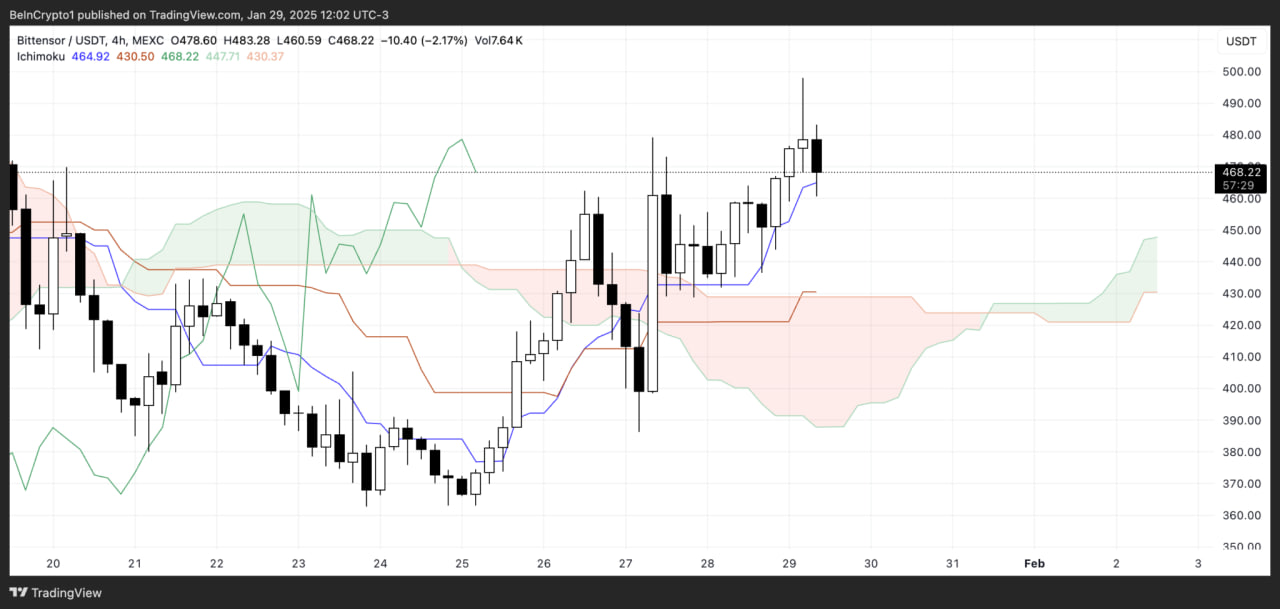
Индикатор Ichimoku Cloud показывает, что TAO торгуется выше облака, что указывает на сильный восходящий тренд. Зеленое облако впереди говорит о формировании поддержки, что может помочь продолжить рост.

Цена также остается выше линии Tenkan-sen, что подтверждает преобладание покупателей. Однако последнее снижение говорит о наличии сопротивления. Если TAO удержится над облаком, вероятность роста увеличится.

В случае падения ниже линий Tenkan-sen и Kijun-sen возможно движение в сторону облака. Если цена уйдет под него, это может стать сигналом к консолидации или даже смене тренда. Пока TAO держится выше ключевых уровней, общий взгляд остается позитивным.

BBTrend достигает 3-недельного максимума
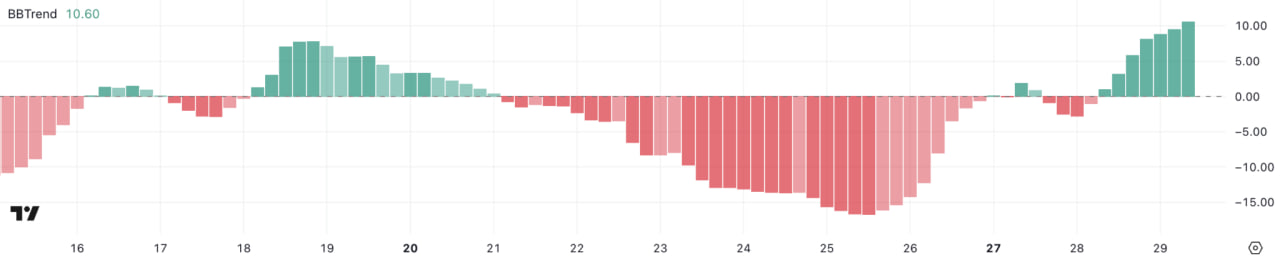
TAO демонстрирует сильное восстановление. Индикатор BBTrend вырос до 10,6 после вчерашнего падения до -2,7, что говорит о значительном изменении настроений.

Это самый высокий уровень с 7 января, что указывает на усиление бычьего тренда. Среди пяти крупнейших AI-монет TAO остается единственным активом, показывающим рост.

BBTrend (Bollinger Band Trend) измеряет силу импульса на основе положения цены внутри Боллинджер-Бэндов. Положительные значения указывают на доминирование покупателей, отрицательные — на медвежий рынок.

Если BBTrend продолжит расти, TAO может обновить локальные максимумы. Однако снижение этого показателя может спровоцировать краткосрочную коррекцию.

Прогноз цены: вернется ли TAO к $500?
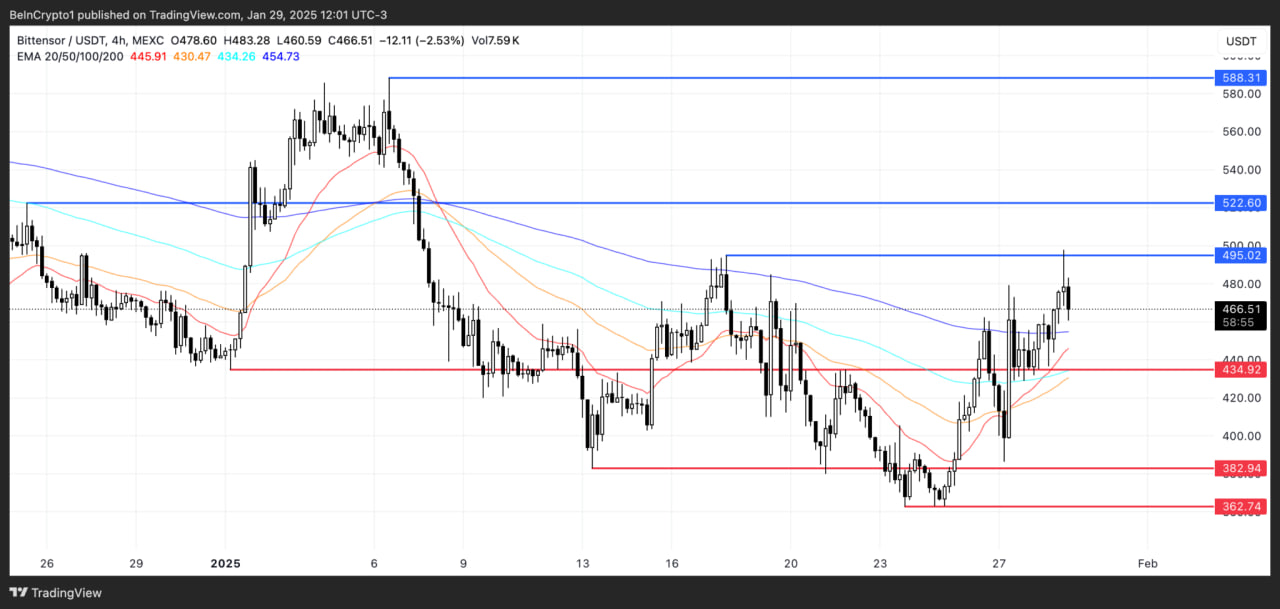
EMA-линии указывают на скорое формирование «золотого креста» — сигнала о потенциальном восходящем тренде. Если это подтвердится, TAO может пробить сопротивление в $495. Закрепление выше этой отметки откроет путь к $522, а в случае усиления импульса — к $588, что эквивалентно росту на 26%.

Однако если быки не смогут удержать тренд, TAO может протестировать поддержку на $434. Потеря этого уровня усилит давление продавцов и приведет к снижению до $382 или даже $362.

Ранее: Скандал вокруг DeepSeek: США и OpenAI обвиняют китайский стартап в краже технологий

Что дальше?

Bittensor удерживает лидерство среди AI-криптовалют, но ему предстоит доказать свою силу. Если тренд сохранится, TAO может показать сильное восстановление и вернуться выше $500.

Однако в случае коррекции падение ниже $400 поставит под угрозу его статус крупнейшей AI-монеты по капитализации. В ближайшие дни рынок определит, какой из сценариев реализуется.


Trending Cryptos

Related Reads

Why Did Codex and ChatGPT Merge? What's Next for Codex? OpenAI Core Leader Answers Everything

In 2026, OpenAI's Codex saw explosive growth, with weekly active users surging over 5x to 5 million since January, driven largely by the February launch of its desktop app. Codex desktop lead Andrew Ambrosino explains key shifts behind its evolution. A core change is the inversion of development costs: implementation is now cheap, while curation and taste—judging which of many AI-generated prototypes is valuable—have become the new scarcities. Ambrosino defines taste as a blend of aesthetics, systems thinking, direction, and semantic coherence in interaction. He notes AI still struggles with design because evaluating it requires human cultural context and abstract reasoning about how components relate—capabilities beyond current models. Timing is critical: the same Codex app would have failed months earlier; success hinges on the model's capabilities at launch. Roles are blurring within his team, with engineers, designers, and PMs overlapping significantly. However, Ambrosino cautions against eliminating specialized roles entirely, as each field retains deep expertise. On AI-assisted development, the focus has shifted from measuring code written by AI to distinguishing between supervised and unsupervised generation. A current challenge is teaching models to simplify code, not just add complexity. The merger of Codex and ChatGPT stems from observed user behavior: non-developers adopted Codex for general knowledge work despite its developer-centric interface. This revealed a collapsing boundary between specialized tools and universal assistants. The vision is a "home base" that orchestrates tasks across external professional tools (like Excel or Premiere Pro) via connectors, rather than rebuilding everything internally. An internal example showed Codex helping edit video by interacting with Premiere Pro's files and even writing a plugin for it. The future direction is a unified, extensible platform that serves as a central hub for automating and managing work across any specialized tool the user employs.

marsbit11m ago

Why Did Codex and ChatGPT Merge? What's Next for Codex? OpenAI Core Leader Answers Everything

marsbit11m ago

The Impact of OUSD on Circle, Tether, and Paxos: Not a Simple Negative, but a More Complex Competitive Landscape

OUSD's Impact on Circle, Tether, and Paxos: A Nuanced Competitive Reshuffle The launch of OUSD, a new stablecoin initiative, has complex implications for the stablecoin market. For Circle (CRCL), the initial 15-20% stock drop reflects legitimate competitive concerns but is not a "death sentence." Circle retains deep liquidity, existing integrations, and first-mover advantages. A potential restructuring or termination of its Coinbase partnership could even double its net revenue in the short term, providing more competitive freedom. However, OUSD, backed by Stripe's engineering and product strengths, could become the default stablecoin within the Stripe ecosystem for new adopters, challenging USDC's position. OUSD does not solve the core barrier for corporate adoption: it remains a credit exposure to its issuer (likely a Bridge-related entity), which, like Circle, is not an investment-grade entity. Large banks and asset managers could still capture the most lucrative enterprise use cases. Circle must accelerate its payment/fintech product development and consider defensive M&A. For Tether, OUSD targets a different market segment. Tether will continue focusing on distribution channels not prioritized by Stripe or Circle. Its market share may decline over time, but within a significantly growing total market. Paxos faces the greatest pressure. OUSD undermines the key selling points of its USDG stablecoin, and Paxos's regulatory advantages may diminish as frameworks mature. This poses a more existential challenge, explaining Paxos's recent shift back to its brokerage-as-a-service business.

marsbit3h ago

The Impact of OUSD on Circle, Tether, and Paxos: Not a Simple Negative, but a More Complex Competitive Landscape

marsbit3h ago

Trading

Spot

Hot Articles

Discussions

Welcome to the HTX Community. Here, you can stay informed about the latest platform developments and gain access to professional market insights. Users' opinions on the price of AI (AI) are presented below.

活动图片