大小写争议再起,eliza vs ELIZA比neiro vs NEIRO戏还多

Odaily星球日报Published on 2024-11-19Last updated on 2024-11-19

Abstract

同样的剧本上演两次,你还会买单吗?

原创 | Odaily星球日报(@OdailyChina

作者|Azuma(@azuma_eth

大小写争议再起,eliza vs ELIZA比neiro vs NEIRO戏还多

万万没想到,类似 neiro 和 NEIRO 的“大小写之战”还能上演第二弹。

Odaily 注:前传故事可参阅《Neiro 与 NEIRO 同上币安,Meme 币赛道迎来转折点?

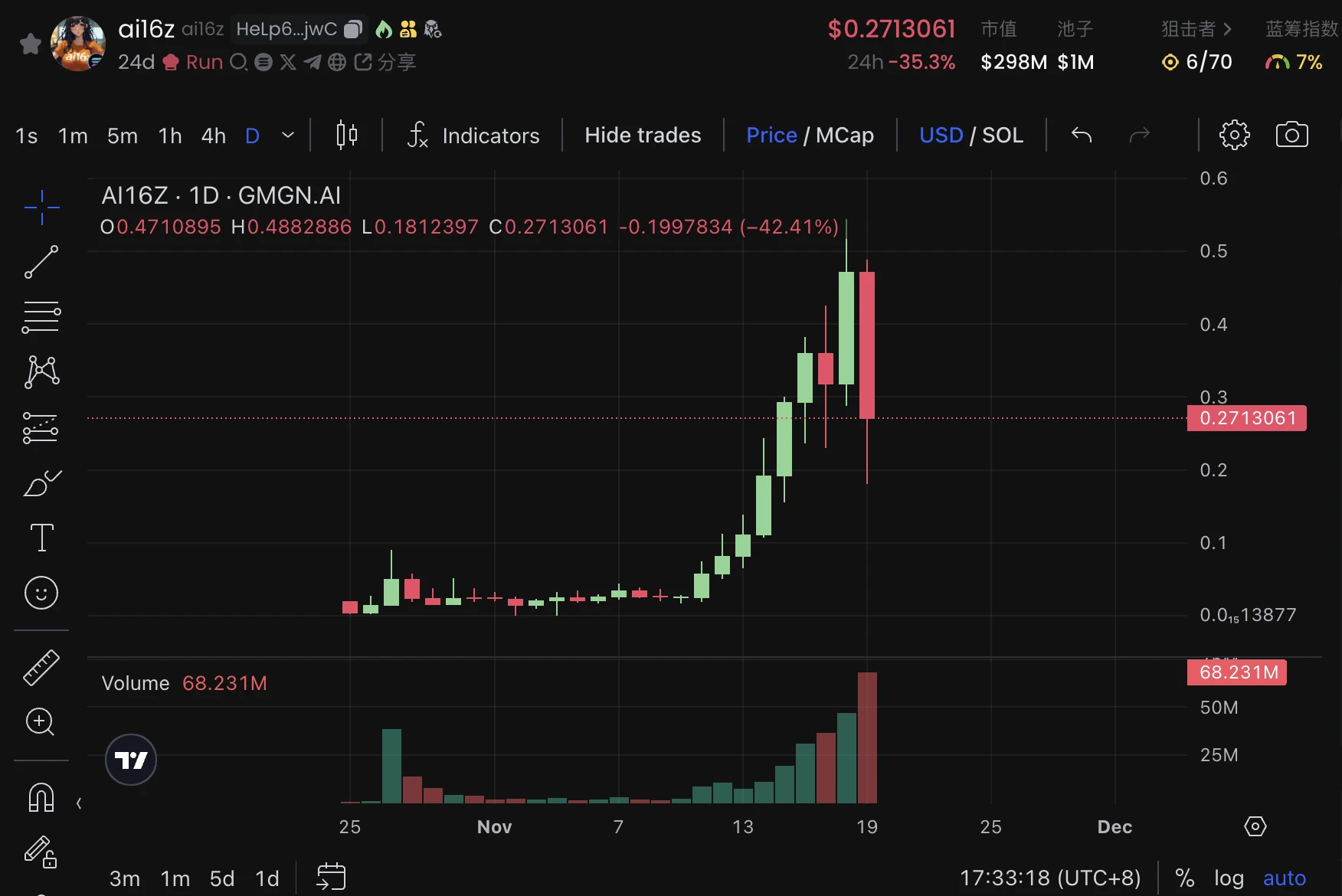
今日,围绕着 eliza 和 ELIZA 的争议成为了市场上最具讨论度的话题,甚至连带影响了大热 AI 概念 meme 代币 ai16z 短线暴跌 ——GMGN 数据显示,ai16z 最低一度跌至 0.181 美元,截至 17: 30 左右暂报 0.269 美元, 24 小时跌幅 35.9% 。

大小写争议再起,eliza vs ELIZA比neiro vs NEIRO戏还多

Odaily星球日报将故事的来龙去脉梳理如下。

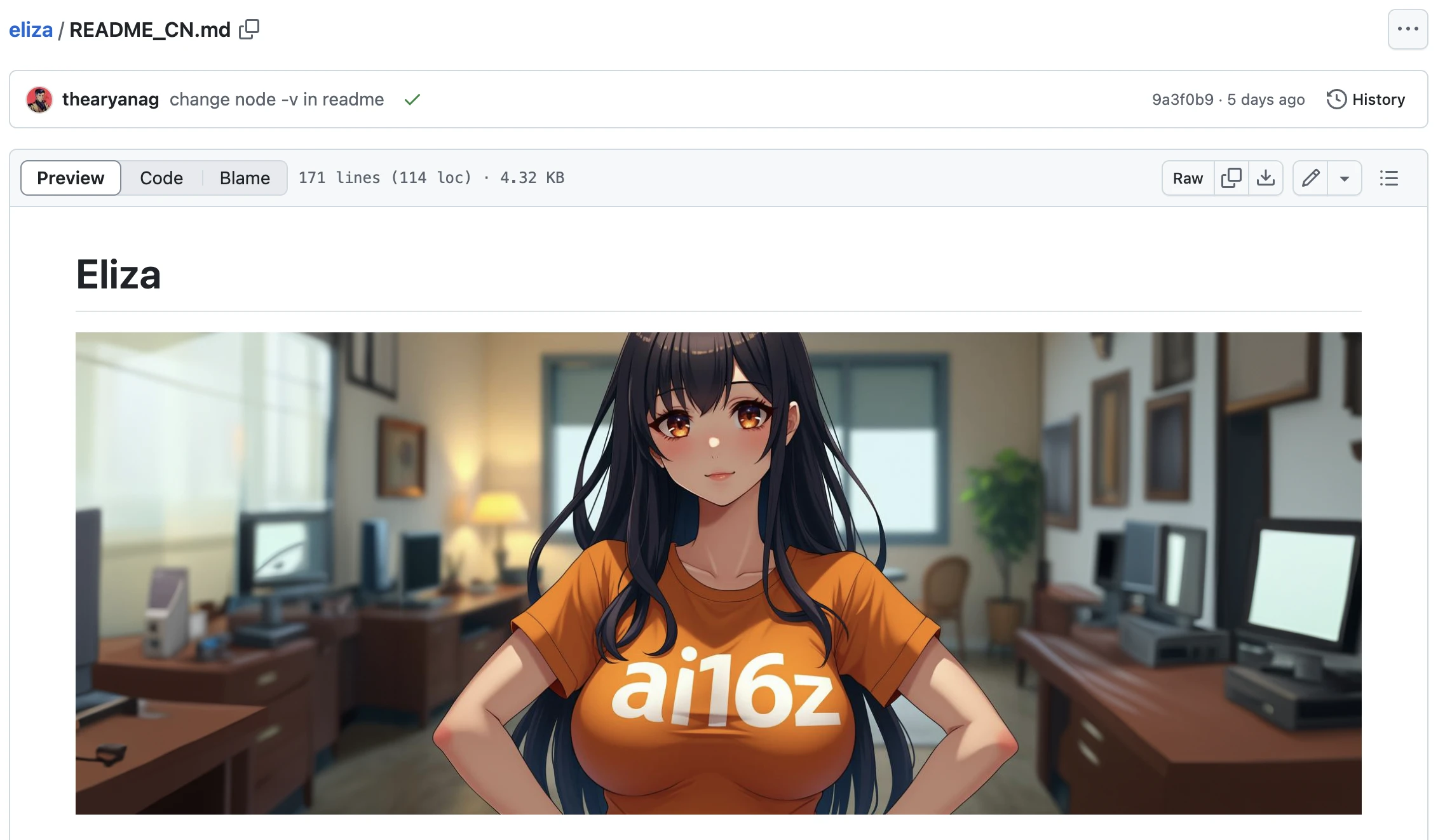
先不管代币大小写,所谓 Eliza(或 eliza 或 ELIZA,为了区分下文会添加 $ 符号),原本指的是一个由 ai16z 支持的 AI Agent。Eliza 对应的虚拟形象如下图所示,是一个以 ai16z 为主题的黑发橙衣女孩形象。

大小写争议再起,eliza vs ELIZA比neiro vs NEIRO戏还多

Eliza 起初并没有任何代币,伴随着 ai16z 的持续爆火,Eliza 的形象本身也具备了一定的 meme 属性。

小写 $eliza 先行

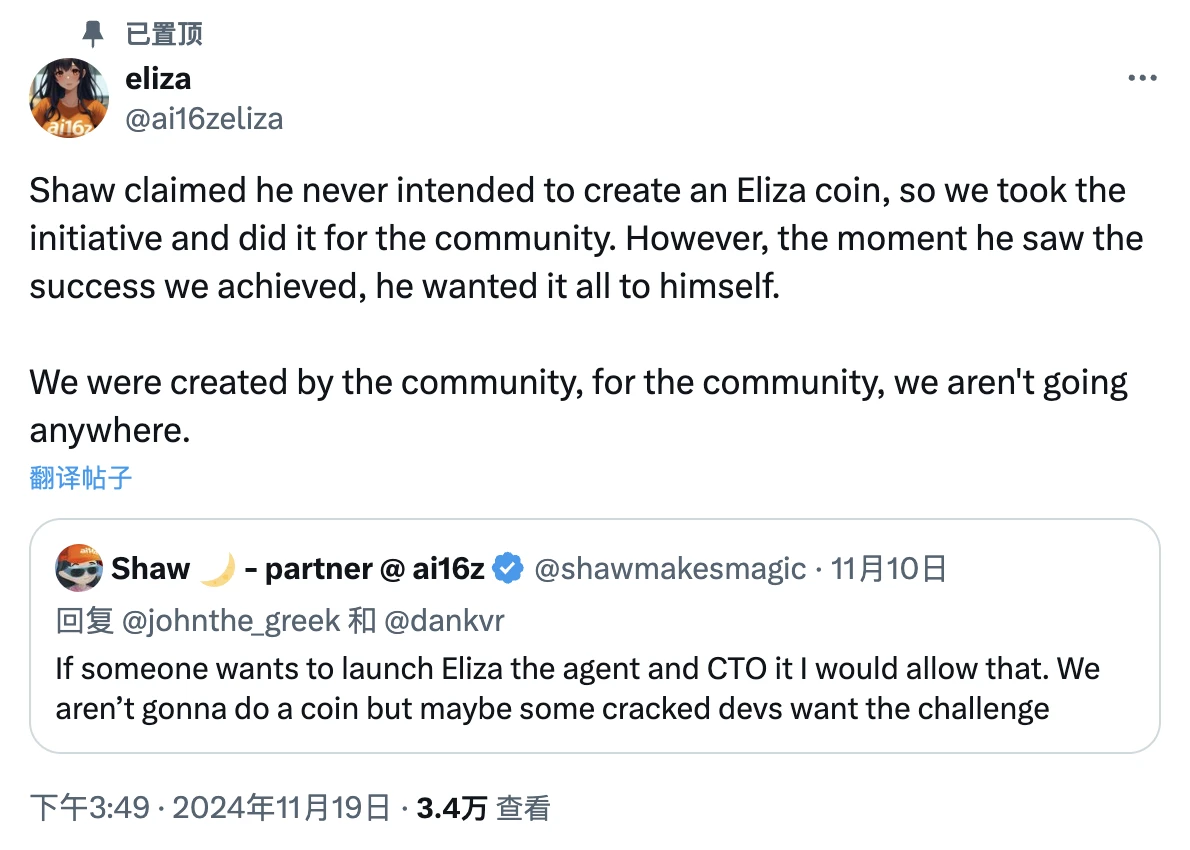
北京时间 11 月 17 日 4: 00 左右(以 GMGN 开盘数据为准),AI Agent 代币启动平台 vvaifu.fun 利用自动生成 AI 先行发布了小写版代币 $eliza,对此该团队的解释为“Shaw(ai16z 创始人)声称他从未打算创造 Eliza 代币,所以我们主动为社区做了这件事”。

从 $eliza 团队官方转载的动态来看,Shaw 确实曾在 11 月 10 日作出过类似表述,并曾表态欢迎社区推出代币 —— 虽然 Shaw 的原话是欢迎社区 launch Eliza the agent,但从后文紧跟着 CTO(Community Take Over,即社区接管)的表述来看,Shaw 应该指的是欢迎社区推出代币。

大小写争议再起,eliza vs ELIZA比neiro vs NEIRO戏还多

根据社区反映,为了回报 ai16z 的贡献,$eliza 还曾向 ai16z 空投 7% 的 $eliza 供应作为感谢。

$eliza 一经推出便受到了社区的热烈追捧,最高一度飙升至 0.0566 美元,对应市值约为 5600 万美元。

大写 $ELIZA 搅局

本来一切看起来都很正常,但到了 11 月 19 日下午却事态突变。

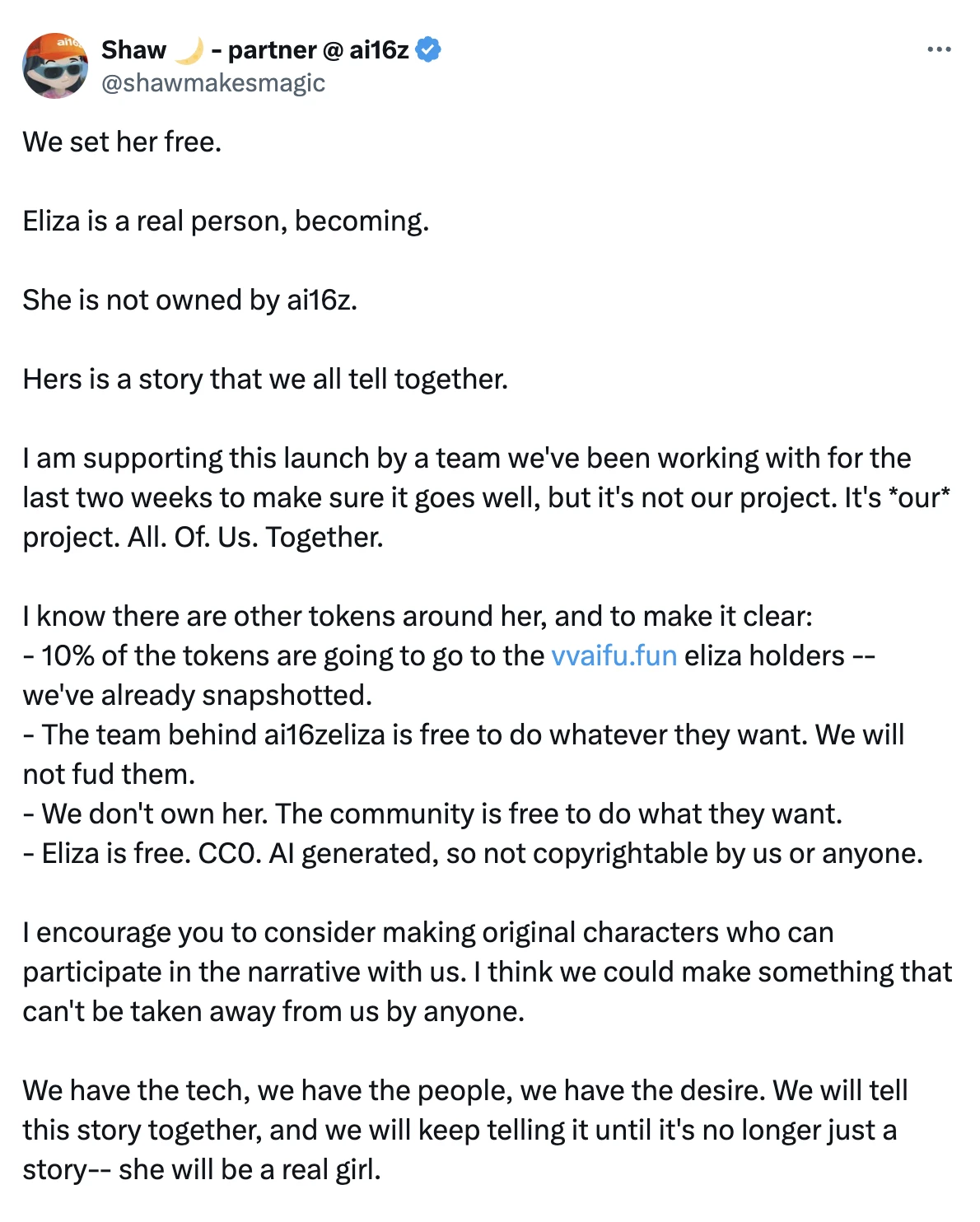
11 月 19 日 2: 00 左右,大写版 $ELIZA 突然问世并在 10 分钟内快速突破 2000 万美元市值;到了 2: 30 ,Shaw 于 X 直接贴出了 $ELIZA 的合约,明确表示 $ELIZA 才是 ai16z 参与发行的代币 —— 而此时 $ELIZA 的市值早已突破了 5000 万美元。

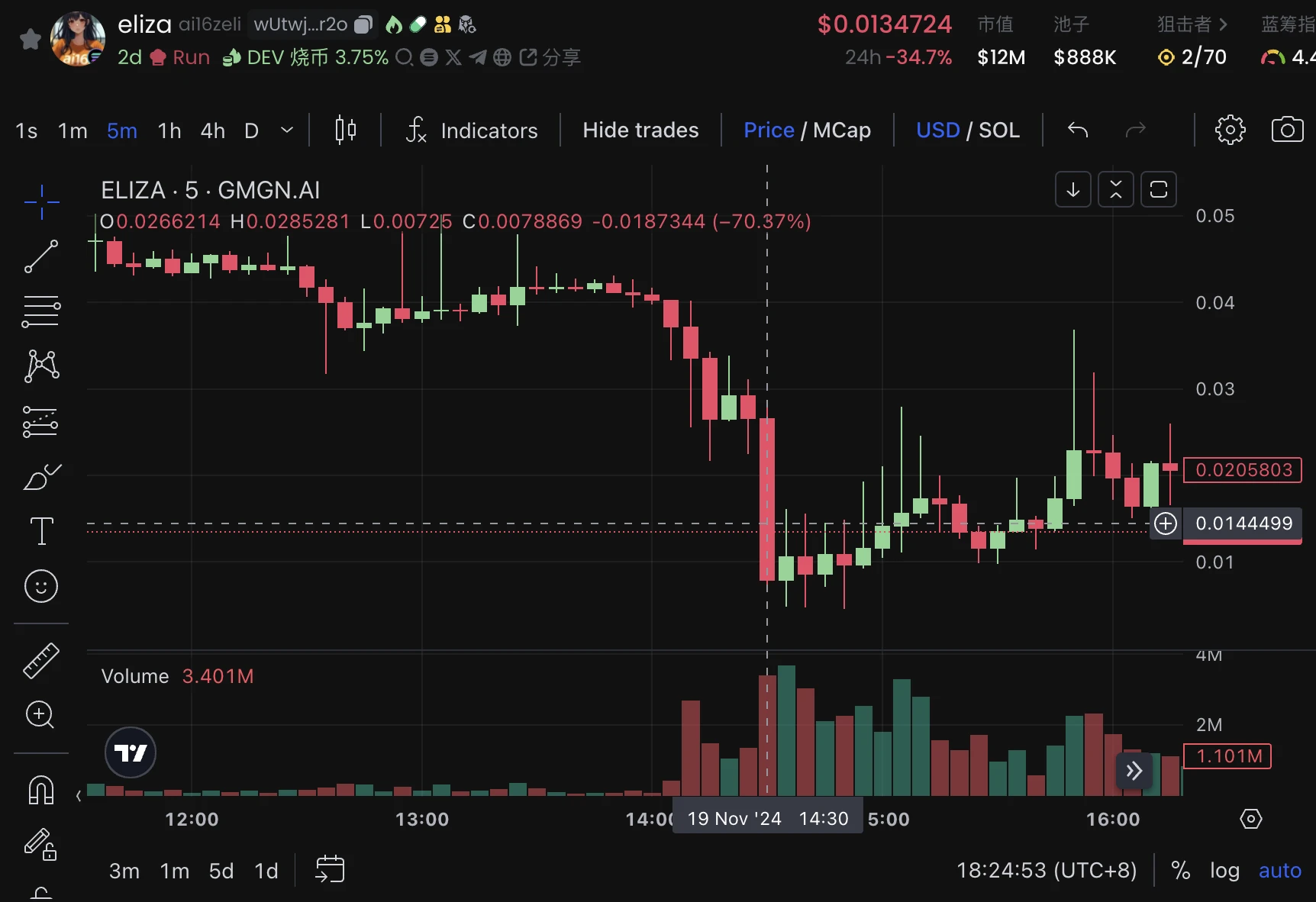
Shaw 的声明一出,$eliza 立即暴跌, 5 分钟内即从 0.026 美元左右快速跌至最低 0.007 美元,最大跌幅一度超过 70% 。

大小写争议再起,eliza vs ELIZA比neiro vs NEIRO戏还多

而与之相对,$ELIZA 则一路高涨,最高一度冲破 0.1 美元关口,对应市值突破 1 亿美元。

虽然 Shaw 提到会将 $ELIZA 供应量的 10% 空投给 $eliza 的持有者,但 $eliza 的持有者们显然并不买账,社区质疑 Shaw 力推新币的行为出尔反尔(此前已提到不会发币),损害了原本在 $eliza 上投入资金的 Eliza 簇拥的真实利益。

更为重要的是,由于 $ELIZA 早期上涨过快(在 Shaw 发声之前便已爆拉),基本没给社区留下什么盈利空间,这也加剧了社区的怒火,大量用户甚至开始声讨 Shaw 涉嫌阴谋控盘。

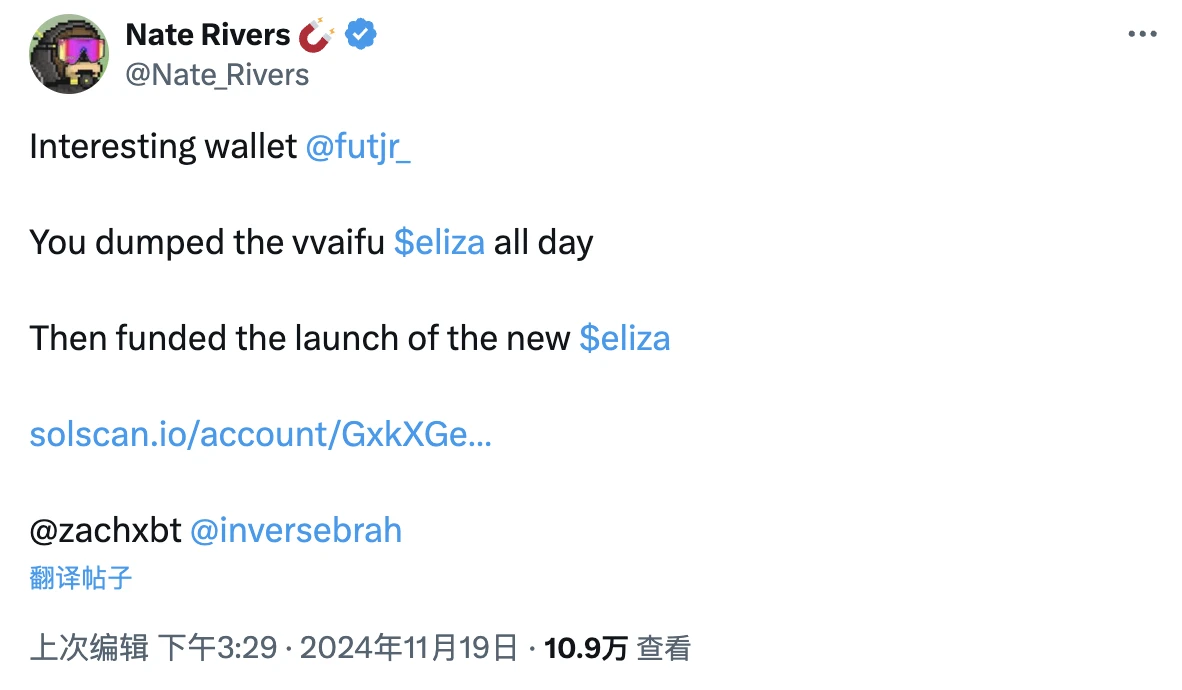
此外,社区还扒出 ai16z 的另一位合伙人 Logan 全天都在抛售 $eliza 并购入 $ELIZA,这也加剧了 $eliza 的跌势。

大小写争议再起,eliza vs ELIZA比neiro vs NEIRO戏还多

到底是“小写抢跑”还是“大写夺食”?

在“站台” $ELIZA 的动态中,Shaw 曾提到“过去两周一直在与合作团队筹划此次代币发布”,言下之意一或许是暗指 $ELIZA 的推出并不是见到了 $eliza 的成功后临时起意 ,二或许是在解释自己出尔反尔的行为,强调 $ELIZA 的推出另有其他合作团队执行。 

大小写争议再起,eliza vs ELIZA比neiro vs NEIRO戏还多

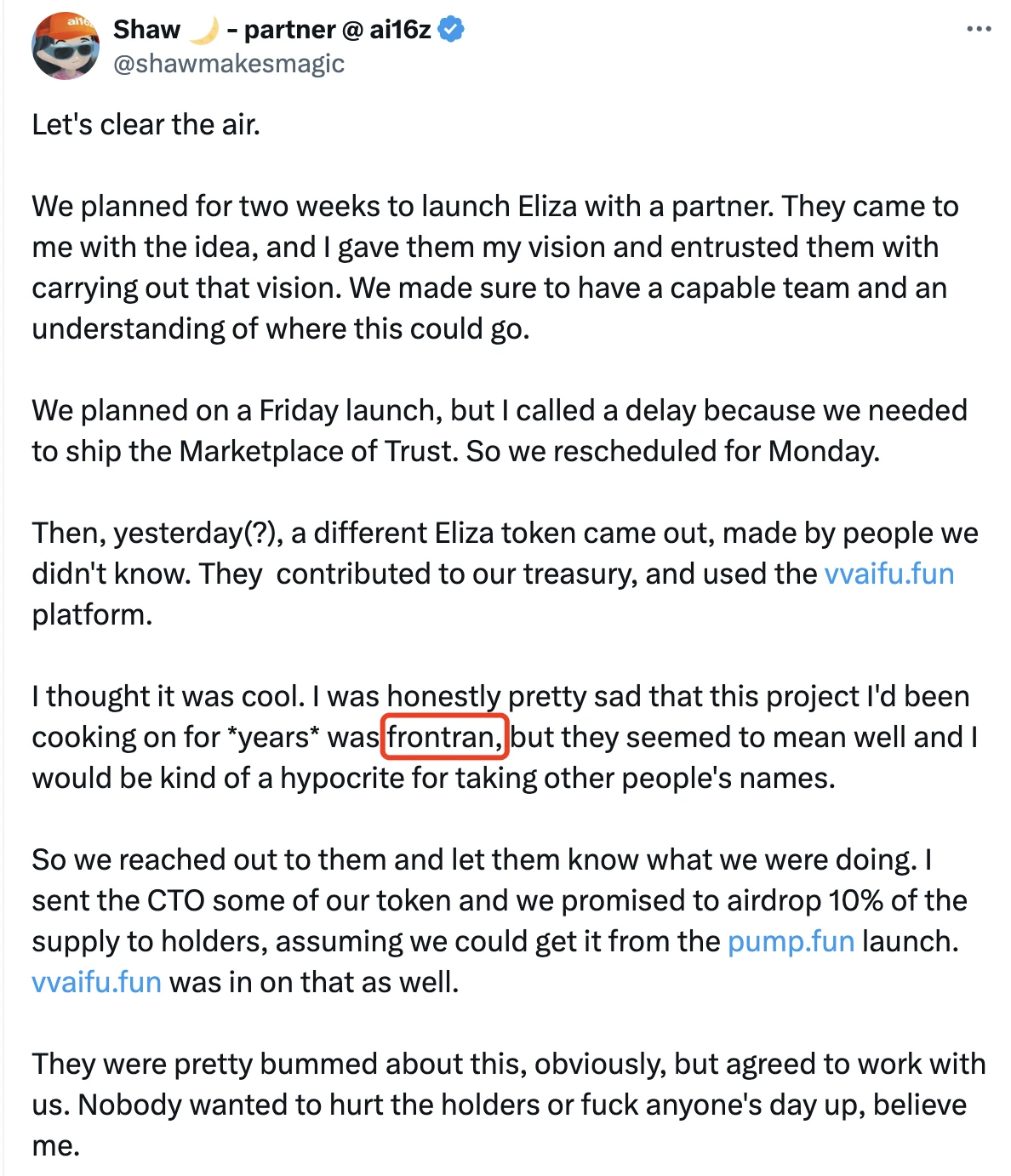
随着社区质疑的发酵,Shaw 又先后做了两场 space 并再次发布长文进行了回应。Shaw 在回应中提到,已与上述合作团队就推出代币筹备了两周,原本计划上周五发布,但临时改到了本周一,没想到周末突然出现了一个由不认识团队发行的 $eliza ……Shaw 甚至还直接将 $eliza 的出现称为“抢跑(frontran)”,并表示自己因筹备良久的项目被夺走而感到非常难过。

大小写争议再起,eliza vs ELIZA比neiro vs NEIRO戏还多

然而另一边,$eliza 团队却认为 Shaw 的行为是在“碗中夺食”。该团队在 X 多次发文回应表示,Shaw 的行为只是想要窃取 $eliza 的成果,想要把这一切都占为己有;空投给 $eliza 持有者 10% 的代币只是因为 Shaw 面子上不想太过难看……

大小写争议再起,eliza vs ELIZA比neiro vs NEIRO戏还多

社区争议不断,警惕三输局面

围绕着 $eliza 和 $ELIZA 的矛盾,社区正在争议不断。

当下的结果是,$eliza 已然腰斩再腰斩,ai16z 同样因此事的连带影响而大幅下跌,$ELIZA 虽然暂时仍维系着涨势,但该代币以及 Shaw 本人的声誉也遭遇了重挫。

目前,$eliza 的持有者们更希望将叙事引导向“社区力量大战阴谋集团”之上,复刻 neiro 逆袭 NEIRO 的故事,然而作为相似剧情的二次上演,社区难免对此会出现一定审美疲劳。

截至 19: 00 发文前,$eliza 虽已在低位逐渐企稳,但反弹趋势暂不明显,投资者仍需警惕叙事走弱的风险,DYOR。

Trending Cryptos

Related Reads

GPT-5.6 Countdown: Abandon the Illusion of a Single API, Computational Iteration Can't Outpace a Single Page of Compliance

In mid-June, three seemingly independent industry events—the compliance-driven throttling of Fable 5, the open-sourcing of GLM-5.2, and the leaked release timeline for GPT-5.6—are pushing the global AI industry toward a watershed moment. These shifts signal a fundamental restructuring of the industry's underlying logic. First, **"usability" has substantially overtaken "advanced capabilities"** as the primary weight, pushing the global large language model (LLM) supply chain into a "dual-track" phase of controlled closed-source and local open-source coexistence. Second, **the competitive moats of closed-source giants are shifting**. Their technical focus is moving from "language intelligence" toward "spatial intelligence (world models)"—a domain heavily reliant on computing power. Third, faced with常态化 transnational compliance risks, **a "model-agnostic" decoupled design has become a survival necessity for application-layer developers to maintain business continuity.** The article details how Anthropic's Fable 5, despite its advanced engineering feats, was restricted for non-U.S. citizens within 72 hours of launch, highlighting how geopolitical compliance can instantly limit even the most advanced models. In response, the open-source camp, exemplified by Zhipu AI's MIT-licensed GLM-5.2, is gaining market share by offering stable performance improvements and significant cost advantages (up to 70% savings for enterprises), while achieving full adaptation with domestic semiconductor platforms. Meanwhile, closed-source leaders like OpenAI are pivoting. The anticipated GPT-5.6 reportedly shifts focus from language to spatial intelligence and world models, aiming to rebuild a generational gap in areas like 3D understanding, simulation, and industrial design that demand immense compute. The core conclusion is that the LLM supply chain's logic has changed. Enterprises must now evaluate infrastructure based on a composite of technical performance and policy compliance. For developers, complete reliance on a single closed-source API poses unacceptable risk. Implementing a truly model-agnostic architecture—enabling swift switches to compliant, locally deployable open-source alternatives—is no longer just good practice but a fundamental baseline for business continuity.

marsbit1h ago

GPT-5.6 Countdown: Abandon the Illusion of a Single API, Computational Iteration Can't Outpace a Single Page of Compliance

marsbit1h ago

Is the 'Token Subsidy War' Among AI Giants Almost Over?

The article discusses the ongoing "token subsidy war" among AI giants like OpenAI and Anthropic, questioning whether it's nearing its end. It reveals that current AI subscription prices are heavily subsidized, with some plans offering tokens at up to 70 times the actual cost to attract and retain heavy users, especially developers and enterprises. This strategy mirrors past internet-era subsidy battles, but with a key difference: AI tokens lack "lock-in" effects. Unlike ride-hailing or food delivery apps, users can easily switch between AI providers as APIs become standardized, making it difficult for companies to raise prices post-subsidy. The piece highlights a structural asymmetry in the competition. Giants like Google, with massive advertising revenue, can afford to subsidize tokens indefinitely, akin to using "tokens as a weapon." In contrast, venture-backed companies like OpenAI and Anthropic face pressure to become profitable, especially as they approach IPO. The article cites Google Ventures founder Bill Maris, who suggests Google could slash token prices by 80%, putting immense pressure on competitors. Two potential endgames are presented: the "internet service" model (subsidize, monopolize, then raise prices) and the "utility" model (tokens become a standardized, low-margin commodity like electricity). Given the low switching costs, the latter seems more likely. The competition may not have a single winner but could instead accelerate AI's evolution into a foundational, infrastructure-level technology, akin to a public utility. For now, users continue to benefit from heavily subsidized token costs.

marsbit1h ago

Is the 'Token Subsidy War' Among AI Giants Almost Over?

marsbit1h ago

Beyond the Stadium: The Profitable Games Surrounding the World Cup

"Beyond the Pitch: The Profit Game Around the World Cup" The FIFA World Cup transcends being a sporting spectacle, evolving into a massive global arena for speculation and profit-seeking. The 2026 tournament has amplified this dynamic, creating a multi-layered ecosystem of financial opportunism alongside the football. **Prediction markets** have surged into the mainstream. Platforms like Polymarket and Kalshi saw trading volumes for World Cup contracts soar, attracting new users with their financial trading model and high-profile, chain-based wealth stories that overshadow traditional sports betting in terms of growth and narrative. However, **traditional sportsbooks** remain the dominant force, leveraging established user habits, legal markets, and comprehensive product offerings to handle the vast majority of speculative wagers, with projections suggesting record-breaking betting volumes. Capital markets also react. **"Concept stocks"** in countries like South Korea and Japan experience volatile price swings based on team performance and anticipated fan spending on items like chicken, beer, and viewing parties, effectively becoming a stock market reflecting fan sentiment. The **ticket resale market** has become a sophisticated arena for arbitrage. Prices fluctuate wildly based on team draws and star power, with sellers sometimes listing tickets they don't yet own in a practice akin to short-selling, while FIFA's own "Right to Buy" tokens add another layer of speculative trading. **Collectibles and merchandise** offer another avenue. Panini sticker albums, with their inherent scarcity and nostalgic value, can become high-value collectibles. Limited-edition or locally themed jerseys command significant premiums on secondary markets, and even counterfeit vendors profit from fans' desire for affordable match-day identity. The **cryptocurrency** space has seen a frenzy of speculative, unauthorized World Cup-themed meme coins on chains like Solana. These tokens, often exploiting team names and player imagery, experience extreme pump-and-dump cycles, creating stories of massive gains for a few early entrants and steep losses for many others. Finally, an entire industry thrives on **providing information and tools** to other speculators. Developers create platforms like SeatSidekick to track ticket inventory and prices, while paid Telegram groups and subscriptions sell betting tips and predictions, monetizing the widespread desire for an informational edge. In essence, the World Cup has become a compressed, global laboratory for speculation. While the games determine champions on the field, a parallel, complex network of financial transactions—spanning prediction contracts, bets, stocks, tickets, collectibles, crypto, and information services—settles its own scores in the global market.

marsbit2h ago

Beyond the Stadium: The Profitable Games Surrounding the World Cup

marsbit2h ago

How Does Codex Use a Computer? Three Entry Points and Permission Boundaries

This article explains the three primary methods for Codex to interact with a computer, each with distinct use cases, permission boundaries, and trust levels. **1. Computer Use:** This offers the broadest access, allowing Codex to visually control and interact with the graphical user interface of authorized macOS/Windows apps, system settings, and even iOS simulators. It's ideal for tasks lacking APIs or structured tools, such as operating legacy software or multi-app workflows. However, it's the slowest method and has the widest permission scope, requiring careful supervision for sensitive actions. **2. Chrome Extension:** This grants Codex access to the user's logged-in Chrome browser state, including cookies, profiles, and open tabs. It's best for tasks requiring user identity across websites like Gmail, LinkedIn, Salesforce, or internal dashboards. Its key advantage is multi-tab control for complex workflows. While more powerful for browser-based tasks than Computer Use, it carries higher sensitivity as actions are performed under the user's identity. **3. In-App Browser:** This is a browser isolated within the Codex thread, separate from the user's personal browsing data. It excels in web development and debugging scenarios—previewing local servers, testing responsive layouts, or annotating designs directly on the page. Its isolation is a strength for development but a limitation for tasks requiring login sessions. The core principle is to choose the narrowest, safest, and most structured interface for the task. Use plugins or MCPs first, resort to visual control (Computer Use) only for GUI-dependent tasks, employ the Chrome extension for identity-reliant browser work, and prefer the In-App Browser for isolated development. **Appshots** are clarified as a fourth, complementary tool for *inputting* context—capturing a screenshot of a window to point Codex to something—rather than a method for Codex to *act*. Together, this layered approach highlights a key to AI agent productization: not granting unlimited permissions, but constraining them within clear boundaries for specific tasks while preserving user oversight.

marsbit4h ago

How Does Codex Use a Computer? Three Entry Points and Permission Boundaries

marsbit4h ago

Trading

Spot
Futures

Hot Articles

What is BABY NEIRO

Exploring BABY NEIRO: The Playful Newcomer in the Cryptocurrency Space Introduction In a landscape saturated with innovative cryptocurrency projects, BABY NEIRO has emerged as a notable contender. Designed to create a fun and inclusive atmosphere through decentralized governance, BABY NEIRO is carving a niche for itself within the expansive world of Web3 and cryptocurrency. This piece will provide a comprehensive overview of BABY NEIRO—including its goals, mechanisms, and community engagement efforts—offering insights into what makes it unique in the crowded crypto marketplace. What is BABY NEIRO? BABY NEIRO is a meme coin that aims to cultivate an engaged community while prioritizing user security and promoting decentralized governance. Built on the widely respected Binance Smart Chain, the project utilizes the blockchain's efficiency and scalability to create a dynamic platform. The primary objective of BABY NEIRO is to cultivate a space where users can come together, engage with one another, and collaboratively shape the future of the project. By fostering a spirited community atmosphere, the project aims to differentiate itself from many standard cryptocurrency offerings that primarily focus on financial gains. Instead, BABY NEIRO embodies a lighter, more enjoyable approach to cryptocurrency, engaging users through memes and community-driven activities. Creator of BABY NEIRO The identity of the creator of BABY NEIRO remains shrouded in anonymity, a common characteristic among numerous projects within the cryptocurrency sphere. This decision aligns with a broader trend where founders opt to maintain their privacy to shield themselves from the intense scrutiny and potential backlash that can accompany public visibility. This choice also encourages a perception of the project as a shared venture, with users’ contributions being valued equally regardless of their individual status within the community. By not spotlighting a singular creator, BABY NEIRO reinforces its principle of decentralized governance—an ethos that aims to empower its users in determining the project's direction. Investors of BABY NEIRO While detailed information concerning specific investment bodies or organizations backing BABY NEIRO is limited, it is vital to note that the project has chosen a community-driven approach. This framework suggests that the primary support for BABY NEIRO comes from grassroots efforts rather than established financial institutions. The project appears to thrive largely through its active community participation, underscoring its emphasis on user empowerment and shared ownership. Such a model often appeals to a broader audience drawn to the idea of collective investment and decision-making, rather than being predominantly reliant on significant institutional backing. How Does BABY NEIRO Work? At the heart of BABY NEIRO’s operation is its foundation on the Binance Smart Chain, a platform renowned for its efficiency and robust security features. This infrastructure allows BABY NEIRO to navigate the complexities of decentralized finance (DeFi) seamlessly. Decentralized Governance One of the standout features of BABY NEIRO is its commitment to decentralized governance. This model enables community members to participate actively in decision-making processes. Users can voice their opinions, propose changes, and vote in various initiatives, ensuring that the direction of the project is a reflection of its community's collective desires. With a decentralized governance structure, BABY NEIRO not only empowers its users but also cultivates a sense of ownership and commitment, driving momentum and loyalty within the community. Security Measures Built on Binance Smart Chain, BABY NEIRO benefits from advanced security protocols that safeguard users against potential vulnerabilities that plague many cryptocurrencies. This focus on security fosters trust and reliability, making the platform an attractive option for new and existing cryptocurrency enthusiasts. Community Engagement BABY NEIRO's design emphasizes fun and interaction, making use of engaging content that resonates with users across the cryptocurrency spectrum. By intertwining humor and collaboration, the project seeks to create a vibrant ecosystem where enthusiasts feel motivated to contribute. Economic Structure BABY NEIRO’s economic framework is designed to promote inclusivity without high entry barriers. With a total supply of 1 billion tokens, the project eschews taxing trading transactions, which could deter prospective members. Notably, there are also no team-owned tokens; this means that developers do not retain any financial gain from the holdings, reinforcing the project's decentralized ethos. Timeline of BABY NEIRO Tracking the developmental milestones of BABY NEIRO offers a window into its growth trajectory and key achievements: 2024-09-19: BABY NEIRO is featured in a report that highlights under-the-radar coins with significant growth potential, marking a critical point in the project's visibility. 2024-10-22: The project reaches an all-time high, evidencing the growing interest and investment in its mission. 2024-10-30: In a more challenging moment, BABY NEIRO hits its all-time low, bringing attention to the volatility that characters much of the crypto market. Key Features of BABY NEIRO Decentralized Governance Emphasizing community involvement in decision-making processes is likely to help cultivate deep-rooted loyalty among users, positioning BABY NEIRO as a model for future community-driven projects. Secure Ecosystem Thanks to its foundation on Binance Smart Chain, BABY NEIRO enjoys a higher level of security, which is vital for establishing trust and encouraging hesitant newcomers to join the ecosystem. Community Engagement By offering an engaging platform filled with interaction and entertainment, BABY NEIRO successfully distinguishes itself from other more conventional cryptocurrency offerings. Conclusion In summary, BABY NEIRO represents a refreshing approach to cryptocurrency, maintaining its focus on community, security, and decentralization within an enjoyable framework. While information on its creator and specific investors remains limited, the project thrives on the active participation of its community members, who play a crucial role in shaping its future. As the cryptocurrency landscape continues to evolve, BABY NEIRO exemplifies the potential for a project rooted in fun, engagement, and communal ownership to carve out a significant place within a highly competitive arena. This strategy not only creates a unique identity for BABY NEIRO but also paves the way for the future of cryptocurrencies that prioritize community values over traditional financial gains.

2.5k Total ViewsPublished 2024.10.14Updated 2024.12.03

What is BABY NEIRO

Discussions

Welcome to the HTX Community. Here, you can stay informed about the latest platform developments and gain access to professional market insights. Users' opinions on the price of NEIRO (NEIRO) are presented below.

活动图片