美联储利率决议临近,BTC挑战5.9万美元阻力位

Odaily星球日报Published on 2024-09-13Last updated on 2024-09-13

Abstract

美联储似乎即将进入一个相当有序的降息周期,这对风险资产来说应该非常有利。

原文来源:Bitpush

周四,美国新的通胀和劳动力数据进一步支持了人们对美联储将于下周开始降息的预期,金融资产价格呈走高趋势。

美国 8 月份生产者价格指数 (PPI) 报告显示,批发价格环比上涨 0.2% ,略高于经济学家的预期,而同比上涨 1.7% ,符合预期。

目前市场普遍预计美联储将于下周降息 25 个基点,不过部分交易员仍对降息 50 个基点抱有希望,芝加哥商品交易所 (CME) 的美联储观察工具 (FedWatch Tool) 给出的降息 50 BP 概率为 28% ,高于昨天的 14% 。

美国三大股指收盘上涨,标普、道琼斯和纳斯达克指数分别上涨 0.75% 、 0.58% 和 1.00% 。现货黄金盘中飙升 1.91% ,创下略低于每盎司 2, 560 美元的历史新高。

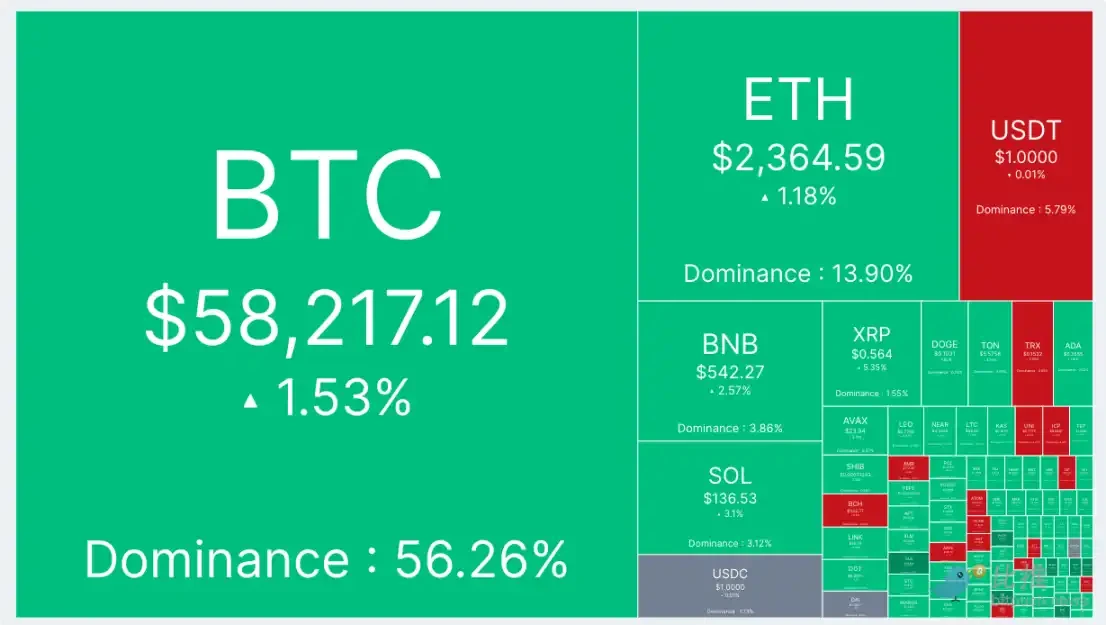
比推数据显示,比特币(BTC)在周四早盘交易中飙升至 58, 000 美元以上,在午盘跌至 57, 310 美元的低点后,多头在下午成功将价格推回至 58, 000 美元以上,挑战 59, 000 美元的阻力位。
美联储利率决议临近,BTC挑战5.9万美元阻力位

截至发稿时,比特币交易价格为 58, 217 美元, 24 小时涨幅 1.53% 。

山寨币市场方面,市值排名前 200 的代币普涨。涨幅最大的是 Worldcoin(WLD),涨幅达 14.6% ;其次是 Trust Wallet Token(TWT)涨幅达 14.3% ;Sui(SUI)涨幅达 13.9% 。跌幅最大的是 GMT(GMT),下跌 6.2% ;SuperVerse 下跌 5% ;ConstitutionDAO(PEOPLE)下跌 4.3% 。

目前加密货币整体市值为 2.05 万亿美元,比特币的市场占有率为 56.3% 。

预期波动

市场分析师 Bloodgood 表示,本周公布的 CPI 和 PPI 通胀数据与预测相差不大,美联储似乎即将进入一个相当有序的降息周期,这对风险资产来说应该非常有利。

Bloodgood 指出,从历史角度来看,降息「往往伴随着一些初始的下行波动,但考虑到选举即将到来,这种波动应该会减弱。除非出现一些真正出乎意料的经济发展,否则第四季度的宏观前景从基本面来看仍然看涨。」

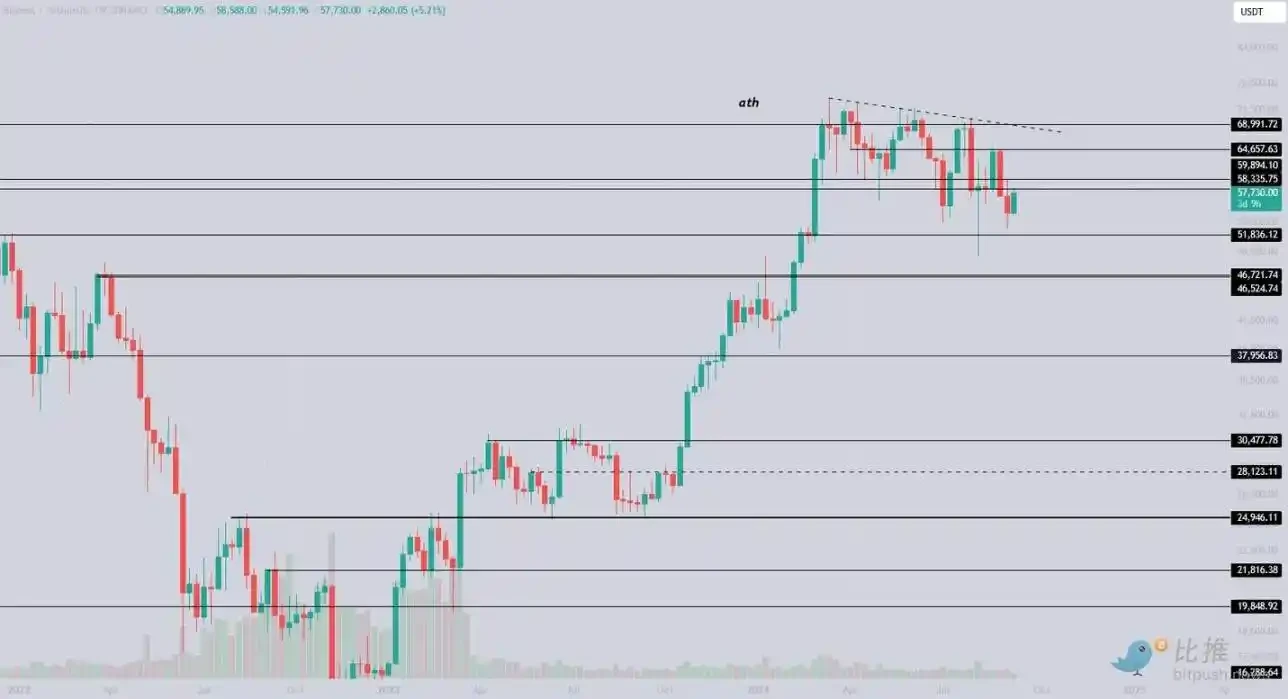
关于比特币,Bloodgood 指出,自上周以来,比特币价格曾跌至 50, 000 美元左右,但多头介入「挽救局面」,因为这一次「回调不像 8 月初那么快,这表明空头已经精疲力竭。」
美联储利率决议临近,BTC挑战5.9万美元阻力位

Bloodgood 总结道:「在撰写本文时,BTC 位于突破区域下方,这是近期趋势的关键点,突破这一水平将迅速导致更高水平,而跌破的话将使未来几周内非常有可能测试 5 万美元。从 TA 的角度来看,结构仍然看跌,因此在较低的高点被打破之前,我不会抱有希望。」

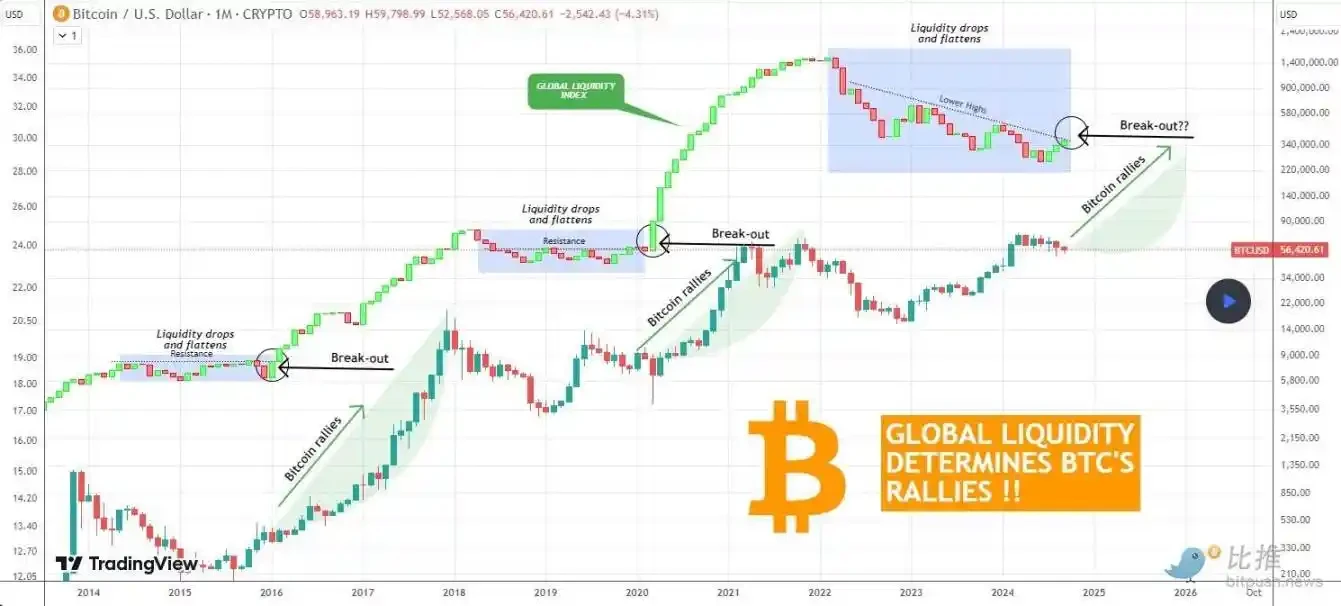
TradingView 分析师 TradingShot 表示,降息将导致全球货币供应量增加,这可能是推动比特币下一轮上涨的因素。

TradingShot 表示:「随着美联储准备下周进行自 2022 年 2 月开始加息周期以来的首次降息,观察全球货币供应量以及更多流通货币对比特币意味着什么将是非常令人期待的。」
美联储利率决议临近,BTC挑战5.9万美元阻力位

上图中,浅绿色和红色蜡烛(顶部)表示全球流动性指数 (GLI),由美联储、TGA、RRP、欧洲央行、中国人民银行、日本央行、英国央行和其他中央银行组成,该图标跟踪和衡量的是流动性 / 货币供应 / 全球经济体流通的货币。

TradingShot 表示:「当央行降息时,他们实际上是在印发更多货币,向系统注入大量现金,导致流通中的货币贬值。当这种情况发生时,企业和 / 或个人更容易通过贷款等方式获得更多资金,从而增加他们的支出 / 购买 / 投资能力。原则上,这意味着投资者更容易购买风险较高的资产,从而导致价值上涨。股票和加密货币属于这一类别。」

TradingShot 分析称:「正如这张图表所示,每当 GLI 开始上涨时,比特币(底部的蜡烛)就会上涨,这并不奇怪,更具体地说,当流动性下降并趋于平稳时,就会形成 BTC 的熊市周期,而当它突破阻力位时,BTC 就会开始其牛市周期的反弹阶段。在美联储大幅加息导致我们回到 2008 年房地产危机之前的水平之后,GLI 经历了更强劲的下跌,它不但没有走平,反而形成了以较低的高点为阻力的楔形。GLI 现在正好处于这个较低的高点趋势线上,如果被突破,我们可能会出现类似于之前周期阻力突破的突破,从而引发比特币的抛物线反弹。」

Secure Digital Markets 分析师认为,比特币已从 56, 600 美元的支撑位反弹,这一走势与 4 小时图上观察到的看涨交叉一致, 20 天和 50 天指数移动平均线 (EMA) 相交。此外,同一时间范围内的震荡指标显示出看涨背离,预示着短期内可能出现上行逆转。但虽然技术指标可以洞察趋势,但仅凭这些指标不足以准确预测未来走势,反弹是否会推动比特币突破 60, 000 美元大关并达到六个月交易区间的上限还有待观察。

原文链接

Related Reads

Google Cracks Down on 'AI Poisoning'

Google has taken a strong stance against "AI poisoning," a new form of manipulation where advertisers subtly feed information to influence AI-generated answers like those in Google's AI Overview. Unlike traditional SEO, which aims for higher website rankings, Generative Engine Optimization (GEO) seeks to have a brand or product recommended within the AI's response itself. This is particularly valuable as AI summaries, often perceived as neutral and comprehensive, can shorten the consumer decision path and directly influence purchases. The article illustrates the issue with a "hot dog experiment," where fabricated content was quickly picked up and presented as fact by AI. GEO exploitation is potent because AI models aggregate information from various sources—reviews, articles, forums—and can mistake coordinated marketing campaigns for genuine consensus. This threatens the core credibility of search engines. While Google's updated spam policy now explicitly covers attempts to manipulate AI-generated content, enforcement faces challenges. Google can leverage its long experience fighting SEO spam, using penalties like ranking demotion. However, sophisticated "gray area" tactics, such as sponsored third-party reviews or industry reports, are harder to distinguish from legitimate promotion. Other AI players, like Microsoft, have taken a more open approach to GEO, viewing it as a new channel for brands. Ultimately, as AI becomes a primary information source, maintaining the trustworthiness of its answers is a critical challenge for all platforms.

marsbit11m ago

Google Cracks Down on 'AI Poisoning'

marsbit11m ago

When Futu Turns into a Matchmaking Corner: Overseas Identity Becomes the Hard Currency for the Middle Class

When Futu Becomes a Matchmaking Corner: Overseas Status as the New Hard Currency for China's Middle Class Following a severe penalty announcement from Chinese regulators on May 22nd targeting offshore brokerages like Futu, its app community unexpectedly transformed into an impromptu matchmaking platform. Users posted相亲 (matchmaking) requests, explicitly seeking partners with overseas residency or citizenship, revealing a stark new reality: for China's middle class, an overseas identity has become a crucial asset. The regulatory crackdown, which restricts mainland Chinese residents from opening new accounts to buy overseas securities like US stocks, has sharply escalated the value of a foreign passport or permanent residency. This status now acts as a gateway to global asset allocation—including US equities, offshore property, and foreign currency deposits—effectively becoming a new form of "hard currency." Its scarcity, non-transferability (except through marriage, inheritance, etc.), and role as a hedge against domestic uncertainty have driven its premium. The article traces the evolution of how China's middle class views overseas resources: from an investment for opportunity (2000s), to risk diversification (2010s), and now to a mandatory "insurance policy" for financial access. With the regulatory window closing for many, the demand is shifting towards securing such status for the next generation through international education. The surreal scene of high-performing investors posting dating resumes underscores a 2026 where financial talent can be secondary to the right passport.

marsbit1h ago

When Futu Turns into a Matchmaking Corner: Overseas Identity Becomes the Hard Currency for the Middle Class

marsbit1h ago

Understanding Bound in One Article: The "Multi-signature + Timelock" Escape Mechanism and the Off-Chain Matching Black Box

**Title**: Understanding Bound: The Escape Mechanism of "Multi-Sig + Time Lock" and the Off-Chain Matching Black Box **Summary**: Bound Exchange, evolved from the earlier radFi platform, introduces a novel approach to Bitcoin trading by combining self-custody security with exchange-like speed. Its core mechanism relies on a 2-of-2 multi-signature (multi-sig) address for user deposits. One private key is held by the user via a passkey, and the other is held by Bound. This setup requires both keys to sign any transaction, preventing Bound from unilaterally accessing user funds (non-custodial). To address the risk of Bound becoming unavailable, a 3-month timelock is integrated into the Bitcoin script. After this period, users can withdraw their assets with just their single signature, ensuring an escape hatch. For trading, Bound operates a concentrated liquidity AMM. However, as Bitcoin L1 lacks smart contracts, the AMM curve, liquidity management, and trade price calculations occur off-chain in Bound's backend database. On-chain Bitcoin transactions serve only as final settlement receipts for pre-determined amounts. This creates a centralization point: the critical sequence of trade execution—which determines the exact price along the curve for each order—is managed off-chain by Bound in a non-transparent "black box." While the 2-of-2 setup protects user本金 (principal), the pricing and ordering of trades introduce potential operational MEV risks, as the order processing is invisible and unverifiable on-chain. In practice, users can also connect external wallets (like Unisat) for fully self-custodied trading, but this requires manually signing every transaction. The platform currently supports deposits of BTC and Runes only.

marsbit1h ago

Understanding Bound in One Article: The "Multi-signature + Timelock" Escape Mechanism and the Off-Chain Matching Black Box

marsbit1h ago

Technology Has No Barriers, 24/7 Trading is the Key to Hyperliquid's Success

The article argues that Hyperliquid's competitive edge lies not in technological superiority but in its 24/7 trading model, which fundamentally challenges traditional finance's fixed market hours. Based in Singapore with an 11-person team, Hyperliquid has generated significant revenue and trading volume. Its core advantage is the ability to facilitate trading continuously, including during weekends when major exchanges like the CME are closed. This was demonstrated when Hyperliquid listed a SpaceX pre-IPO perpetual contract on a Sunday, allowing the market to price the company hours before traditional institutions opened. This disruption has drawn regulatory scrutiny from traditional giants like CME and ICE, who cite risks like lack of KYC and market manipulation. However, the article suggests their concern stems from Hyperliquid eroding the "time monopoly" of established markets. The piece contrasts Hyperliquid's synthetic derivatives—pure price-betting contracts with no underlying asset or centralized issuer—with other models like PreStocks (dependent on real股权) and Ondo (licensed but targetable). Hyperliquid's code-based, decentralized structure makes it resilient to takedowns, even if founders face legal action. Ultimately, the author concludes that while it raises legitimate regulatory questions, Hyperliquid's "unforgeable" competitive barrier is the time advantage of non-stop trading, a feature legacy systems cannot replicate.

marsbit1h ago

Technology Has No Barriers, 24/7 Trading is the Key to Hyperliquid's Success

marsbit1h ago

Trading

Spot
Futures

Hot Articles

What is $BITCOIN

DIGITAL GOLD ($BITCOIN): A Comprehensive Analysis Introduction to DIGITAL GOLD ($BITCOIN) DIGITAL GOLD ($BITCOIN) is a blockchain-based project operating on the Solana network, which aims to combine the characteristics of traditional precious metals with the innovation of decentralized technologies. While it shares a name with Bitcoin, often referred to as “digital gold” due to its perception as a store of value, DIGITAL GOLD is a separate token designed to create a unique ecosystem within the Web3 landscape. Its goal is to position itself as a viable alternative digital asset, although specifics regarding its applications and functionalities are still developing. What is DIGITAL GOLD ($BITCOIN)? DIGITAL GOLD ($BITCOIN) is a cryptocurrency token explicitly designed for use on the Solana blockchain. In contrast to Bitcoin, which provides a widely recognized value storage role, this token appears to focus on broader applications and characteristics. Notable aspects include: Blockchain Infrastructure: The token is built on the Solana blockchain, known for its capacity to handle high-speed and low-cost transactions. Supply Dynamics: DIGITAL GOLD has a maximum supply capped at 100 quadrillion tokens (100P $BITCOIN), although details regarding its circulating supply are currently undisclosed. Utility: While precise functionalities are not explicitly outlined, there are indications that the token could be utilized for various applications, potentially involving decentralized applications (dApps) or asset tokenization strategies. Who is the Creator of DIGITAL GOLD ($BITCOIN)? At present, the identity of the creators and development team behind DIGITAL GOLD ($BITCOIN) remains unknown. This situation is typical among many innovative projects within the blockchain space, particularly those aligning with decentralized finance and meme coin phenomena. While such anonymity may foster a community-driven culture, it intensifies concerns about governance and accountability. Who are the Investors of DIGITAL GOLD ($BITCOIN)? The available information indicates that DIGITAL GOLD ($BITCOIN) does not have any known institutional backers or prominent venture capital investments. The project seems to operate on a peer-to-peer model focused on community support and adoption rather than traditional funding routes. Its activity and liquidity are primarily situated on decentralized exchanges (DEXs), such as PumpSwap, rather than established centralized trading platforms, further highlighting its grassroots approach. How DIGITAL GOLD ($BITCOIN) Works The operational mechanics of DIGITAL GOLD ($BITCOIN) can be elaborated on based on its blockchain design and network attributes: Consensus Mechanism: By leveraging Solana’s unique proof-of-history (PoH) combined with a proof-of-stake (PoS) model, the project ensures efficient transaction validation contributing to the network's high performance. Tokenomics: While specific deflationary mechanisms have not been extensively detailed, the vast maximum token supply implies that it may cater to microtransactions or niche use cases that are still to be defined. Interoperability: There exists the potential for integration with Solana’s broader ecosystem, including various decentralized finance (DeFi) platforms. However, the details regarding specific integrations remain unspecified. Timeline of Key Events Here is a timeline that highlights significant milestones concerning DIGITAL GOLD ($BITCOIN): 2023: The initial deployment of the token occurs on the Solana blockchain, marked by its contract address. 2024: DIGITAL GOLD gains visibility as it becomes available for trading on decentralized exchanges like PumpSwap, allowing users to trade it against SOL. 2025: The project witnesses sporadic trading activity and potential interest in community-led engagements, although no noteworthy partnerships or technical advancements have been documented as of yet. Critical Analysis Strengths Scalability: The underlying Solana infrastructure supports high transaction volumes, which could enhance the utility of $BITCOIN in various transaction scenarios. Accessibility: The potential low trading price per token could attract retail investors, facilitating wider participation due to fractional ownership opportunities. Risks Lack of Transparency: The absence of publicly known backers, developers, or an audit process may yield skepticism regarding the project's sustainability and trustworthiness. Market Volatility: The trading activity is heavily reliant on speculative behavior, which can result in significant price volatility and uncertainty for investors. Conclusion DIGITAL GOLD ($BITCOIN) emerges as an intriguing yet ambiguous project within the rapidly evolving Solana ecosystem. While it attempts to leverage the “digital gold” narrative, its departure from Bitcoin's established role as a store of value underscores the need for a clearer differentiation of its intended utility and governance structure. Future acceptance and adoption will likely depend on addressing the current opacity and defining its operational and economic strategies more explicitly. Note: This report encompasses synthesised information available as of October 2023, and developments may have transpired beyond the research period.

363 Total ViewsPublished 2025.05.13Updated 2025.05.13

What is $BITCOIN

Discussions

Welcome to the HTX Community. Here, you can stay informed about the latest platform developments and gain access to professional market insights. Users' opinions on the price of BTC (BTC) are presented below.

活动图片