Bitcoin Difficulty Jumps 3% As Hashrate Slowly Recovers

bitcoinistPublished on 2024-08-30Last updated on 2024-08-30

Abstract

On-chain data shows the Bitcoin mining difficulty has seen an increase in the latest adjustment, a consequence of the hashrate's...

On-chain data shows the Bitcoin mining difficulty has seen an increase in the latest adjustment, a consequence of the hashrate’s recovery.

Bitcoin Mining Difficulty Has Seen A Positive 3% Adjustment Recently

The “mining difficulty” refers to a feature built into the Bitcoin blockchain that controls how hard the miners would find it to mine on the Bitcoin network right now. The difficulty goes through periodic adjustments about every two weeks, which are entirely controlled by code and thus, are completely automatic.

When the network makes a positive difficulty adjustment, it means miners would find it harder to mine on the blockchain than in the past two weeks and as such, would have their pace slowed down.

On the other hand, BTC going through a negative adjustment implies miners would be able to mine through blocks on the network at a faster speed than in the last couple of weeks.

Now, here is a chart that shows how the last few adjustments changed Bitcoin’s difficulty:
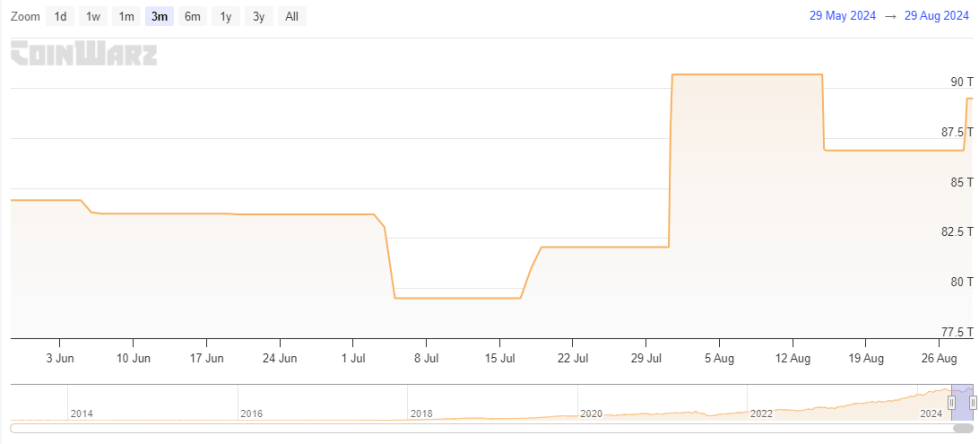
Bitcoin Difficulty

Looks like the value of the metric has spiked recently | Source: CoinWarz

As is visible in the above graph, the latest Bitcoin network adjustment has led to an increase in difficulty for the miners. More specifically, the metric has risen by 3% compared to the value at the end of the last adjustment.

To understand the reason behind this change (or any previous adjustment, for that matter), the goal behind the mining difficulty’s existence must be understood first.

A feature of the Bitcoin blockchain is that the cryptocurrency’s supply goes up whenever miners go through blocks and receive block subsidy as compensation for them.

Miners use computing power to solve puzzles that grant them the opportunity to add the next block to the chain, so when they increase their computing power, they become faster at their task, and hence, can produce blocks at a faster rate.

But as the production rate of the asset itself is tied to this task of the miners, leaving miners’ growth unchecked can lead to an explosion in the asset’s supply, which would adversely affect its price, due to how supply-demand dynamics tend to work out.

As a measure of keeping miners’ block production rate at a constant value, Satoshi, Bitcoin’s creator, decided to program in the concept of difficulty. Because of this feature, whenever miners increase their power, the network hits back at them with an increase of difficulty in the next adjustment.

The total computing power of the miners is called the “hashrate.” Below is a chart that shows the trend in the 7-day average of this metric over the past year.
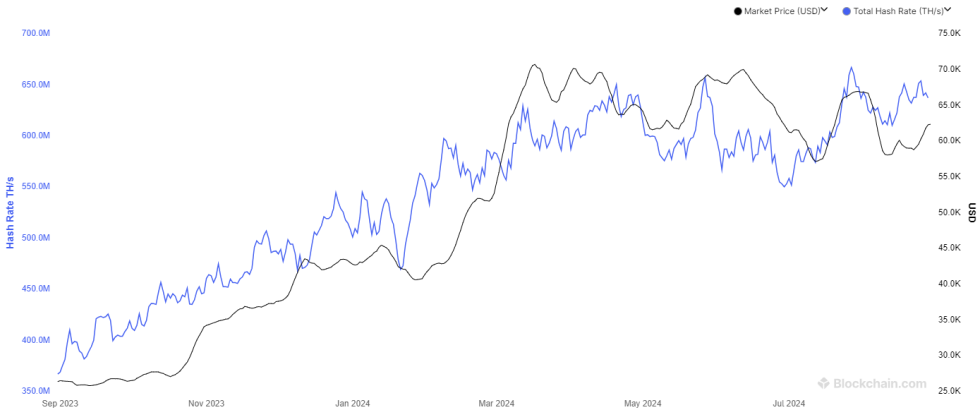
Bitcoin Mining Hashrate

The value of the indicator has been on the rise in recent days | Source: Blockchain.com

As would be expected given the difficulty’s positive adjustment, the Bitcoin mining hashrate has been rising recently. Miners had earlier downsized their facilities, which had led to the metric plunging, but it appears that they have gradually started adding back mining rigs to their farms.

BTC Price

Bitcoin had plunged under the $60,000 mark yesterday, but the coin appears to have made recovery back above the level today.

Bitcoin Price Chart

The price of the asset seems to have plunged over the last few days | Source: BTCUSD on TradingView
Featured image from Dall-E, Blockchain.com, CoinWarz.com, chart from TradingView.com
Keshav Verma

Keshav Verma

Keshav is a Physics graduate who has been employed as a writer with Bitcoinist since June 2021. He is passionate about writing and through the years, he has gained experience working in a variety of niches. Keshav holds an active interest in the cryptocurrency market, with on-chain analysis being an area he particularly likes to research and write about.

Trending Cryptos

Related Reads

Just now, DeepSeek V4 updates with DSpark, improving inference speed by 80%

DeepSeek has updated its DeepSeek V4 model with the DSpark speculative decoding framework, achieving a significant 60-85% speedup in generation for Flash models and 57-78% for Pro models while maintaining the same overall throughput. This engineering-focused update, rather than a core architectural change, introduces DSpark to address latency and throughput bottlenecks in high-concurrency production environments. DSpark combines high-throughput parallel generation with adaptive load-aware verification. Its key innovations include a semi-autoregressive generation architecture to model dependencies within token blocks and a hardware-aware confidence-scheduled verification system. This system uses a confidence head to predict token acceptance probabilities, allowing it to dynamically optimize verification length per request and allocate compute only to tokens with the highest expected payoff. The asynchronous scheduler is designed for real-world deployment, ensuring zero-overhead scheduling and continuous CUDA graph replay while preserving the target model's output distribution. In tests across mathematical reasoning, code generation, and daily dialogue, DSpark outperformed state-of-the-art models like Eagle3 and DFlash, increasing average acceptance length by 26.7%-30.9% and 16.3%-18.4% respectively on Qwen3 target models. DeepSeek also open-sourced DeepSpec, a full-stack codebase for training and evaluating speculative decoding draft models, providing a standardized toolkit that includes data preparation tools, model implementations, training code, and evaluation scripts.

marsbit8h ago

Just now, DeepSeek V4 updates with DSpark, improving inference speed by 80%

marsbit8h ago

Trading

Spot

Hot Articles

What is $BITCOIN

DIGITAL GOLD ($BITCOIN): A Comprehensive Analysis Introduction to DIGITAL GOLD ($BITCOIN) DIGITAL GOLD ($BITCOIN) is a blockchain-based project operating on the Solana network, which aims to combine the characteristics of traditional precious metals with the innovation of decentralized technologies. While it shares a name with Bitcoin, often referred to as “digital gold” due to its perception as a store of value, DIGITAL GOLD is a separate token designed to create a unique ecosystem within the Web3 landscape. Its goal is to position itself as a viable alternative digital asset, although specifics regarding its applications and functionalities are still developing. What is DIGITAL GOLD ($BITCOIN)? DIGITAL GOLD ($BITCOIN) is a cryptocurrency token explicitly designed for use on the Solana blockchain. In contrast to Bitcoin, which provides a widely recognized value storage role, this token appears to focus on broader applications and characteristics. Notable aspects include: Blockchain Infrastructure: The token is built on the Solana blockchain, known for its capacity to handle high-speed and low-cost transactions. Supply Dynamics: DIGITAL GOLD has a maximum supply capped at 100 quadrillion tokens (100P $BITCOIN), although details regarding its circulating supply are currently undisclosed. Utility: While precise functionalities are not explicitly outlined, there are indications that the token could be utilized for various applications, potentially involving decentralized applications (dApps) or asset tokenization strategies. Who is the Creator of DIGITAL GOLD ($BITCOIN)? At present, the identity of the creators and development team behind DIGITAL GOLD ($BITCOIN) remains unknown. This situation is typical among many innovative projects within the blockchain space, particularly those aligning with decentralized finance and meme coin phenomena. While such anonymity may foster a community-driven culture, it intensifies concerns about governance and accountability. Who are the Investors of DIGITAL GOLD ($BITCOIN)? The available information indicates that DIGITAL GOLD ($BITCOIN) does not have any known institutional backers or prominent venture capital investments. The project seems to operate on a peer-to-peer model focused on community support and adoption rather than traditional funding routes. Its activity and liquidity are primarily situated on decentralized exchanges (DEXs), such as PumpSwap, rather than established centralized trading platforms, further highlighting its grassroots approach. How DIGITAL GOLD ($BITCOIN) Works The operational mechanics of DIGITAL GOLD ($BITCOIN) can be elaborated on based on its blockchain design and network attributes: Consensus Mechanism: By leveraging Solana’s unique proof-of-history (PoH) combined with a proof-of-stake (PoS) model, the project ensures efficient transaction validation contributing to the network's high performance. Tokenomics: While specific deflationary mechanisms have not been extensively detailed, the vast maximum token supply implies that it may cater to microtransactions or niche use cases that are still to be defined. Interoperability: There exists the potential for integration with Solana’s broader ecosystem, including various decentralized finance (DeFi) platforms. However, the details regarding specific integrations remain unspecified. Timeline of Key Events Here is a timeline that highlights significant milestones concerning DIGITAL GOLD ($BITCOIN): 2023: The initial deployment of the token occurs on the Solana blockchain, marked by its contract address. 2024: DIGITAL GOLD gains visibility as it becomes available for trading on decentralized exchanges like PumpSwap, allowing users to trade it against SOL. 2025: The project witnesses sporadic trading activity and potential interest in community-led engagements, although no noteworthy partnerships or technical advancements have been documented as of yet. Critical Analysis Strengths Scalability: The underlying Solana infrastructure supports high transaction volumes, which could enhance the utility of $BITCOIN in various transaction scenarios. Accessibility: The potential low trading price per token could attract retail investors, facilitating wider participation due to fractional ownership opportunities. Risks Lack of Transparency: The absence of publicly known backers, developers, or an audit process may yield skepticism regarding the project's sustainability and trustworthiness. Market Volatility: The trading activity is heavily reliant on speculative behavior, which can result in significant price volatility and uncertainty for investors. Conclusion DIGITAL GOLD ($BITCOIN) emerges as an intriguing yet ambiguous project within the rapidly evolving Solana ecosystem. While it attempts to leverage the “digital gold” narrative, its departure from Bitcoin's established role as a store of value underscores the need for a clearer differentiation of its intended utility and governance structure. Future acceptance and adoption will likely depend on addressing the current opacity and defining its operational and economic strategies more explicitly. Note: This report encompasses synthesised information available as of October 2023, and developments may have transpired beyond the research period.

473 Total ViewsPublished 2025.05.13Updated 2025.05.13

What is $BITCOIN

Discussions

Welcome to the HTX Community. Here, you can stay informed about the latest platform developments and gain access to professional market insights. Users' opinions on the price of BTC (BTC) are presented below.

活动图片