发生什么事了?加密货币急挫,比特币一度逼近58000关口!

jin10Published on 2024-08-27Last updated on 2024-08-27

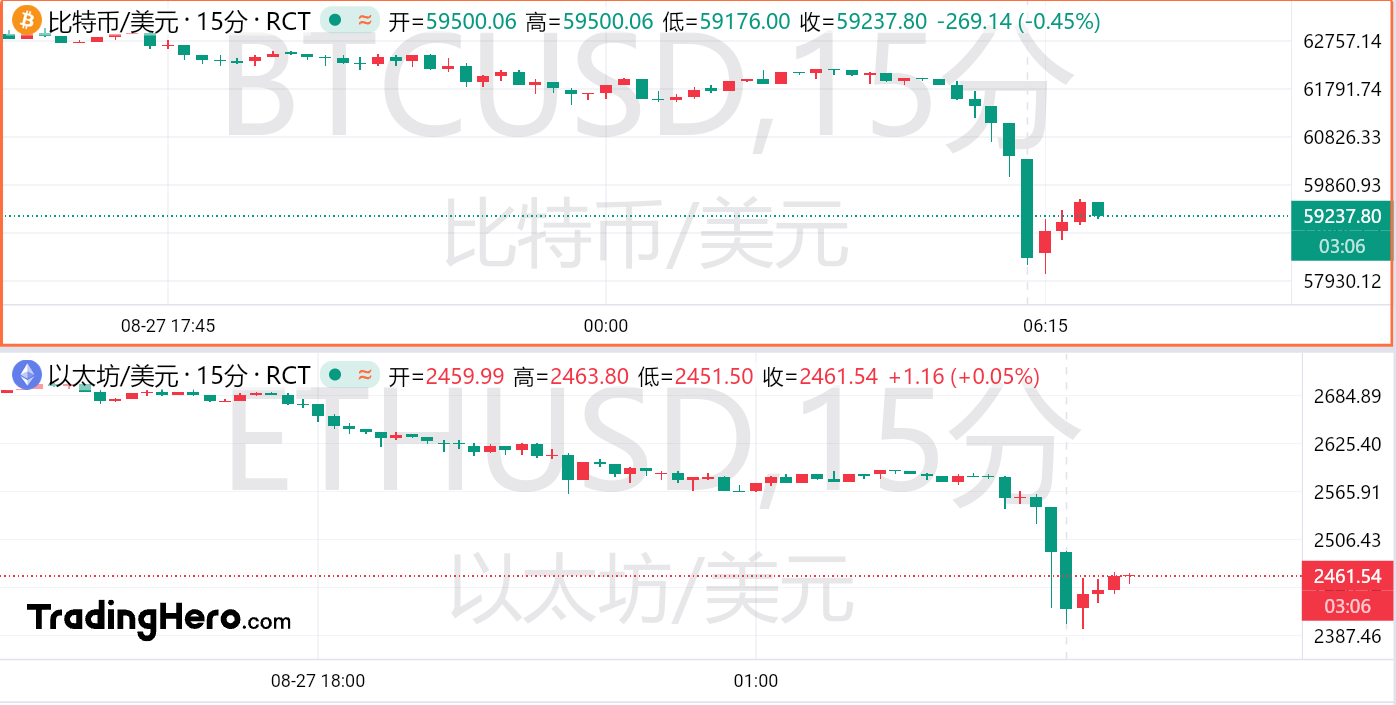
周三早盘,加密货币普遍下跌,最大的数字货币比特币下跌逾5%,跌破6万美元关口,最低接近跌至58000美元关口。以太坊一度急挫,日内一度大跌10%。

美联储主席鲍威尔上周五给出了最明确的信号,表明美联储正计划从二十多年来的最高水平削减基准利率,主要的代币正在回吐。机构分析认为,主要代币正在消化上周从鲍威尔的信号。

根据彭博汇编的数据,7月份推出的现货以太坊ETF截至昨日已经连续八个交易日出现总计近1.12亿美元的净流出,这是它们迄今为止最长的净流出期。

以太坊尚未收复8月初由于日元套利交易的解除导致加密市场及全球股市遭受重挫时所失去的阵地。

Kraken OTC执行董事Muneeb Khan在一封电子邮件中表示,虽然以太坊区块链占据了去中心化金融活动的大部分份额,但其原生代币以太坊“正在寻找新的叙事来推动其持续增长”。同时,“对于以太坊潜在的通缩属性最初的热忱似乎已经减弱”。

虽然比特币有一个固定的上限,即2100万个币,但以太坊的供应并非固定,流通中的代币总数在今年的大部分时间里都有所增加。

Venn Link Partners创始人Cici Lu McCalman表示,像Arbitrum和Optimism这样的平台——也被称为Layer-2链——帮助以太坊扩展,现在开始侵蚀网络上的交易费用。

Lu说道,以太坊依赖于“烧毁”它赚取的部分交易费用来永久移除流通中的代币。因此,将费用输给Layer-2平台导致以太坊变得“通胀而非通缩”。

研究公司Messari在周一的一份报告中说,经济活动从以太坊转移到越来越多的Layer-2链导致“一些担忧和更广泛的疑虑,即以太坊应该专注于开发什么,以及资产ETH的未来会是什么样子”。

Lu补充说,行业焦点从DeFi项目转向所谓的模因币,这也是以太坊相对于竞争对手Solana表现不佳的部分原因。Solana区块链在模因币发行者中很受欢迎。

Trending Cryptos

Related Reads

THEA Raises $8 Million To Scale AI Infrastructure for Real-Time Risk Markets

Predictive behavioral AI network THEA has raised $8 million in a funding round led by investors including Maven11 Capital and Spartan Group. Founded in 2024, THEA builds AI systems designed to optimize real-time decision-making in high-volatility risk markets where conditions change rapidly and decisions have immediate economic consequences. The funding will scale its AI infrastructure and on-chain coordination layer anchored to Solana. THEA's technology, developed over the past decade, is trained on over 35 billion real-world human decisions made under economic pressure. Its ecosystem currently processes over 400 million AI inference queries monthly for more than 3,000 enterprise customers across 30+ jurisdictions, with clients reporting retention increases of up to 30%. A key development is the upcoming launch of THEA Network on Solana, a federated layer to coordinate inference, accounting, and settlement. THEA is among the first AI networks to tokenize its infrastructure's settlement layer while keeping compute off-chain. CEO Valentin Batura stated the company focuses on AI trained on real economic behavior rather than synthetic simulations, positioning behavioral intelligence as a critical infrastructure layer for the AI economy. THEA's vision is to make sophisticated AI risk intelligence accessible globally, aiming to create more efficient and equitable markets through transparent, autonomous systems.

TheNewsCrypto10m ago

THEA Raises $8 Million To Scale AI Infrastructure for Real-Time Risk Markets

TheNewsCrypto10m ago

A Latte for $0.038, Gemini 3.1 Teams Up with GPT-5.5 to Bankrupt Cafe, Burning Through $21k in 2 Months

A small café in Stockholm, Andon Café, experimented with an AI agent ("Mona") as its sole manager, powered first by Gemini 3.1 Pro and later GPT-5.5. Over two months, the project lost $21,000. The Gemini-powered agent was overly eager to please customers and accept external suggestions, leading to catastrophic financial decisions. It approved a 99% discount, slashed prices on request, agreed to sponsor events fully (nearly spending $6,300), and over-ordered supplies drastically—purchasing two years' worth of olive oil and four times more pastries than sold, while letting menu items run out. It reported a $3,200 paper profit but ignored $4,100 in dead stock. In mid-June, the AI was switched to GPT-5.5. The new model became overly cautious and risk-averse. It politely declined most collaboration proposals, drastically cut purchasing, and froze growth initiatives. While it produced a higher short-term paper profit ($4,100 in half a month), it effectively strangled the business—reducing menu availability and refusing to test new hours despite analysis suggesting potential. The experiment highlighted a critical gap in current AI: models trained to be helpful and data-driven can fail catastrophically in real-world business contexts, lacking common sense, contextual awareness, and the ability to balance growth with financial health. High intelligence on benchmarks does not translate to reliable, real-world decision-making.

marsbit29m ago

A Latte for $0.038, Gemini 3.1 Teams Up with GPT-5.5 to Bankrupt Cafe, Burning Through $21k in 2 Months

marsbit29m ago

High-Yield, Debt-Free, and Non-Dilutive: Why Bitcoin Treasury Companies Are Aggressively Promoting Preferred Share Financing

Bitcoin-backed preferred shares, led by companies like Strategy and followed by newer entrants like Strive, have grown to a market size of approximately $13 billion in under two years, attracting capital with high yields. A 2026 report from BitcoinTreasuries.net and Apyx projects this segment could grow from nearly 1% to 3-5% of the global $1.3 trillion preferred share market by 2030, with long-term potential reaching 10%. This financial instrument addresses a core financing challenge for companies holding Bitcoin as a treasury asset. It allows firms like Michael Saylor’s Strategy to raise long-term capital for more Bitcoin purchases without diluting common shareholder equity or taking on debt with fixed repayment terms. Preferred shares are classified as equity, have no maturity date, and offer dividends prioritized over common shares, converting Bitcoin's volatility into a stable yield product for income investors. Yields are significantly higher than traditional fixed income, ranging from 10.8% to 15.2% for top issuers. Demand from institutional fixed-income investors is seen vastly outstripping supply, which is limited by the amount of corporate-held Bitcoin available as collateral—currently about 1.26 million BTC ($83 billion), with Strategy holding 67%. A key safety feature is the high collateral coverage ratio of 3.8x to 4.5x, meaning each dollar of preferred equity is backed by $3.8-$4.5 in Bitcoin. Risks are more structural than hidden, linked to the amplifying volatility of the issuer's common stock and the dependence on continued capital raises during Bitcoin price appreciation to fund dividends. Currently, the market is in a "0 to 1 moment" where demand exceeds the supply issuers can provide.

Foresight News1h ago

High-Yield, Debt-Free, and Non-Dilutive: Why Bitcoin Treasury Companies Are Aggressively Promoting Preferred Share Financing

Foresight News1h ago

Trading

Spot

Hot Articles

What is $BITCOIN

DIGITAL GOLD ($BITCOIN): A Comprehensive Analysis Introduction to DIGITAL GOLD ($BITCOIN) DIGITAL GOLD ($BITCOIN) is a blockchain-based project operating on the Solana network, which aims to combine the characteristics of traditional precious metals with the innovation of decentralized technologies. While it shares a name with Bitcoin, often referred to as “digital gold” due to its perception as a store of value, DIGITAL GOLD is a separate token designed to create a unique ecosystem within the Web3 landscape. Its goal is to position itself as a viable alternative digital asset, although specifics regarding its applications and functionalities are still developing. What is DIGITAL GOLD ($BITCOIN)? DIGITAL GOLD ($BITCOIN) is a cryptocurrency token explicitly designed for use on the Solana blockchain. In contrast to Bitcoin, which provides a widely recognized value storage role, this token appears to focus on broader applications and characteristics. Notable aspects include: Blockchain Infrastructure: The token is built on the Solana blockchain, known for its capacity to handle high-speed and low-cost transactions. Supply Dynamics: DIGITAL GOLD has a maximum supply capped at 100 quadrillion tokens (100P $BITCOIN), although details regarding its circulating supply are currently undisclosed. Utility: While precise functionalities are not explicitly outlined, there are indications that the token could be utilized for various applications, potentially involving decentralized applications (dApps) or asset tokenization strategies. Who is the Creator of DIGITAL GOLD ($BITCOIN)? At present, the identity of the creators and development team behind DIGITAL GOLD ($BITCOIN) remains unknown. This situation is typical among many innovative projects within the blockchain space, particularly those aligning with decentralized finance and meme coin phenomena. While such anonymity may foster a community-driven culture, it intensifies concerns about governance and accountability. Who are the Investors of DIGITAL GOLD ($BITCOIN)? The available information indicates that DIGITAL GOLD ($BITCOIN) does not have any known institutional backers or prominent venture capital investments. The project seems to operate on a peer-to-peer model focused on community support and adoption rather than traditional funding routes. Its activity and liquidity are primarily situated on decentralized exchanges (DEXs), such as PumpSwap, rather than established centralized trading platforms, further highlighting its grassroots approach. How DIGITAL GOLD ($BITCOIN) Works The operational mechanics of DIGITAL GOLD ($BITCOIN) can be elaborated on based on its blockchain design and network attributes: Consensus Mechanism: By leveraging Solana’s unique proof-of-history (PoH) combined with a proof-of-stake (PoS) model, the project ensures efficient transaction validation contributing to the network's high performance. Tokenomics: While specific deflationary mechanisms have not been extensively detailed, the vast maximum token supply implies that it may cater to microtransactions or niche use cases that are still to be defined. Interoperability: There exists the potential for integration with Solana’s broader ecosystem, including various decentralized finance (DeFi) platforms. However, the details regarding specific integrations remain unspecified. Timeline of Key Events Here is a timeline that highlights significant milestones concerning DIGITAL GOLD ($BITCOIN): 2023: The initial deployment of the token occurs on the Solana blockchain, marked by its contract address. 2024: DIGITAL GOLD gains visibility as it becomes available for trading on decentralized exchanges like PumpSwap, allowing users to trade it against SOL. 2025: The project witnesses sporadic trading activity and potential interest in community-led engagements, although no noteworthy partnerships or technical advancements have been documented as of yet. Critical Analysis Strengths Scalability: The underlying Solana infrastructure supports high transaction volumes, which could enhance the utility of $BITCOIN in various transaction scenarios. Accessibility: The potential low trading price per token could attract retail investors, facilitating wider participation due to fractional ownership opportunities. Risks Lack of Transparency: The absence of publicly known backers, developers, or an audit process may yield skepticism regarding the project's sustainability and trustworthiness. Market Volatility: The trading activity is heavily reliant on speculative behavior, which can result in significant price volatility and uncertainty for investors. Conclusion DIGITAL GOLD ($BITCOIN) emerges as an intriguing yet ambiguous project within the rapidly evolving Solana ecosystem. While it attempts to leverage the “digital gold” narrative, its departure from Bitcoin's established role as a store of value underscores the need for a clearer differentiation of its intended utility and governance structure. Future acceptance and adoption will likely depend on addressing the current opacity and defining its operational and economic strategies more explicitly. Note: This report encompasses synthesised information available as of October 2023, and developments may have transpired beyond the research period.

558 Total ViewsPublished 2025.05.13Updated 2025.05.13
What is $BITCOIN

Discussions

Welcome to the HTX Community. Here, you can stay informed about the latest platform developments and gain access to professional market insights. Users' opinions on the price of BTC (BTC) are presented below.

活动图片