比特币生态的下一个爆点来了

深潮Published on 2024-08-23Last updated on 2024-08-23

目前比特币生态最火的项目,会是今年最后的翻身机会吗?

撰文:Biteye 核心贡献者 Viee

编辑:Biteye 核心贡献者 Crush

在比特币生态中,新的创新浪潮正在悄然兴起,Fractal Bitcoin(分形比特币)作为这一浪潮的先锋,正为比特币网络带来前所未有的扩展能力!通过引入分形层,不仅提升了交易速度,还可以保持与比特币主链的兼容性。

分形比特币如何在激烈的市场竞争中脱颖而出,成为比特币生态的下一个爆点呢?本文将介绍分形比特币的核心概念、技术优势及其未来潜力,帮助你快速了解这一可能改变游戏规则的项目!

01 Fractal Bitcoin 介绍:什么是分形层?和 L2 有何区别?

Fractal Bitcoin,又叫作分形比特币,是一个基于比特币的扩展解决方案。由 Unisat 团队、BSF、Uniworlds 和 Asset Bridge 等知名机构联合推出。

什么是分形?

是指通过在比特币主链上添加分形层,逐步扩展比特币区块链,转变为一个可扩展的计算系统,同时保持与比特币主链的完全一致性。我们可以将这个概念比喻为一个不断生长的树。

一棵树的主干是比特币主链,而树枝和树叶则代表分形层。Fractal Bitcoin 通过在比特币主链上添加这些「树枝」,它们可以独立处理交易,但又与主干保持紧密联系,使得整个系统能够扩展得更快、更高效。

与传统 Layer 2 有什么区别?

关键区别在于,Fractal Bitcoin 通过在比特币主链上添加分形层来扩展网络,分形层允许比特币网络在不改动原有代码的前提下,处理更多的交易,保持与主链的兼容性和安全性。

相比之下,传统的 Layer 2 是在比特币主链上建立的独立网络,像是一个附加的通道。虽然也能加快交易,但使用起来通常更复杂,并可能需要跨链。

也就是说,Fractal Bitcoin 并不会与比特币主网争夺流动性。

02 Fractal Bitcoin 技术优势:为什么要添加分形层?

主要是为了在保持与比特币主链的完全一致性,提升交易速度和处理能力,这就得谈到 Fractal Bitcoin 的技术优势了。👇

  • 完全兼容比特币主链:Fractal Bitcoin 是唯一一个即时兼容比特币的原生扩展方案,无需对比特币主链进行任何修改,也就是说可以直接使用原有的钱包、工具等

  • 高效的共识机制:采用与比特币相同的工作量证明机制,矿工可以利用现有的 ASIC、GPU 等设备进行挖矿

  • 递归扩展结构:Fractal Bitcoin 通过递归创建无限扩展层,形成树状结构,使每一层能够进一步扩展,显著提升交易处理能力和速度,交易确认时间仅需 30 秒,是比特币主链的 20 倍。

  • 动态调整能力:Fractal Bitcoin 能够根据网络负载情况动态调整扩展层数量,确保高效运行,而不影响主链的稳定性。

  • 支持 BRC-20 代币标准:可以在 Fractal Bitcoin 上发行和交易代币。

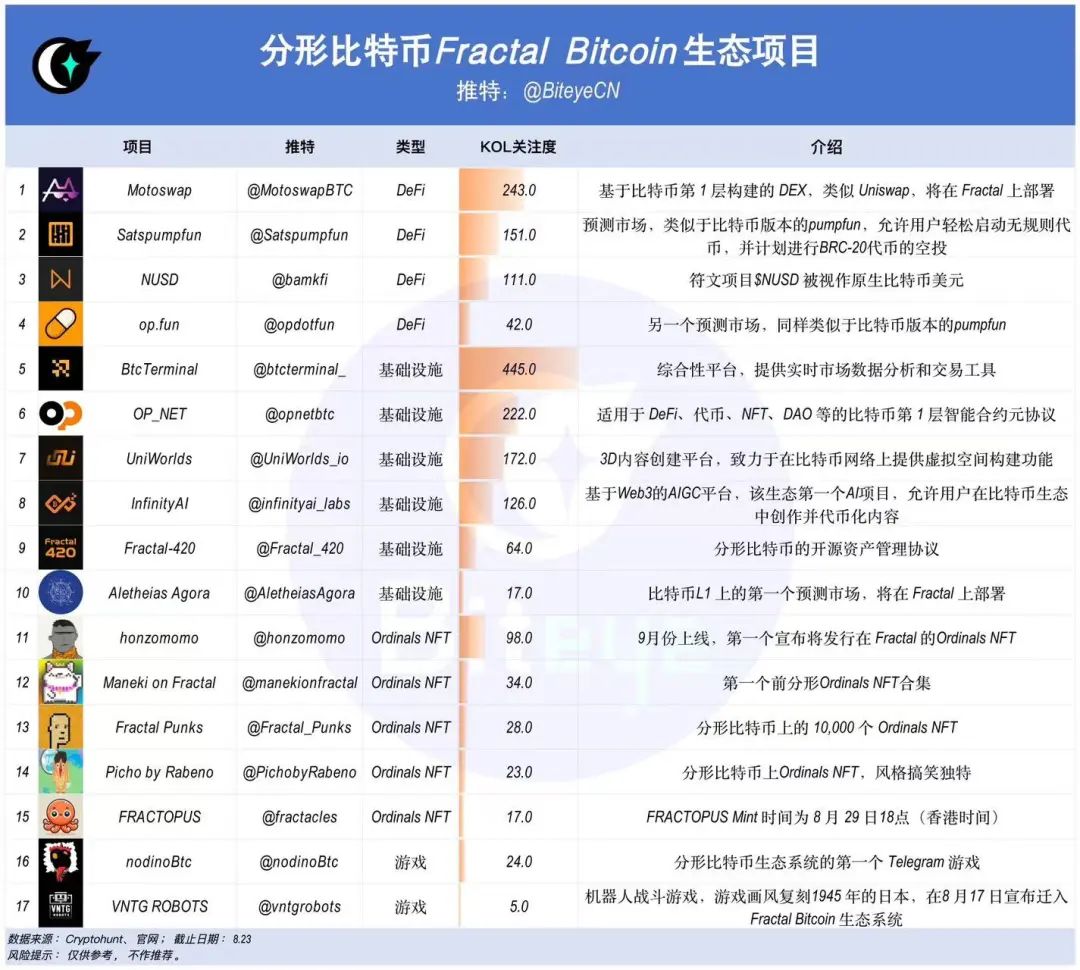
03 Fractal Bitcoin 生态项目大盘点

DeFi

  • Motoswap @MotoswapBTC:基于比特币第 1 层构建的 DEX,类似 Uniswap。

  • Satspumpfun @Satspumpfun:预测市场,类似于比特币版本 pumpfun,允许用户轻松启动无规则代币,并计划进行 BRC-20 代币的空投。

  • op.fun @opdotfun:另一个预测市场,同样类似于比特币版本的 pumpfun。

  • NUSD @bamkfi:符文项目 $NUSD 被视作原生比特币美元。

基础设施

  • OP_NET @opnetbtc:适用于 DeFi、代币、NFT、DAO 等的比特币第 1 层智能合约元协议。

  • Fractal-420 @Fractal_420:分形比特币的开源资产管理协议。

  • InfinityAI @infinityai_labs:基于 Web3 的 AIGC 平台,该生态第一个 AI 项目,允许用户在比特币生态中创作并代币化内容。

  • UniWorlds @UniWorlds_io:3D 内容创建平台,致力于在比特币网络上提供虚拟空间构建功能。

  • BtcTerminal @btcterminal:综合性平台,提供实时市场数据分析和交易工具。

  • Aletheias Agora @AletheiasAgora:比特币 L1 上的第一个预测市场。

Ordinals NFT

  • honzomomo @honzomomo:9 月份上线,分形网络上的第一个 Ordinals NFT。

  • FRACTOPUS @fractacles

  • Fractal Punks @Fractal_Punks

  • Maneki on Fractal @manekionfractal

  • Picho by Rabeno @PichobyRabeno

游戏

  • nodinoBtc @nodinoBtc

  • VNTG ROBOTS @vntgrobots

04 目前阶段与前景

Fractal Bitcoin 的测试网已于 2023 年 7 月上线,预计将于 9 月 1 日正式推出主网。

Fractal Bitcoin 有知名机构背书。其在技术上完全兼容比特币主链的特点,使得现有的 BTC 用户可以无缝切换到 Fractal Bitcoin 上,大大提升了用户的使用体验。同时,高交易处理能力和低交易费用,也为大规模应用提供了基础。

未来,随着更多优质项目的加入,Fractal Bitcoin 的应用场景必将更加丰富,用户群体也将不断扩大。目前还处在非常早期,可以先学习 + 埋伏机会,搏一搏早期空投等红利。

Trending Cryptos

Related Reads

From 'Address Clustering' to 'Evidence Standards': Why is Chainalysis Redefining Blockchain Tracing?

**Summary:** In June 2026, Chainalysis introduced the **Blockchain Tracing Ontology (BTO)**, a proposed data framework aiming to establish standardized, transparent, and verifiable models for blockchain analysis. This initiative addresses a core industry issue: despite public blockchain data, different firms often produce inconsistent results (e.g., differing entity labels for the same address) due to non-uniform methodologies, particularly in **address clustering**. This lack of standardization poses challenges for judicial investigations, AML, and enforcement. The BTO is not a new clustering algorithm but a **common "language" or conceptual framework**. It moves beyond the simplistic "cluster" model by introducing a hierarchical structure: **Entity → Wallet → Wallet Segment → Address**, which better reflects complex organizational wallet management. A key shift is from presenting mere results to ensuring **process trust and explainability**. The framework emphasizes documenting the **Evidence** and **Confidence** behind each analytical claim—specifying the on-chain/off-chain data, rules applied, and certainty levels—enabling third-party verification. This focus is partly informed by legal precedents like the **Bitcoin Fog** case, where Chainalysis's methods underwent rigorous judicial scrutiny (Daubert hearing), highlighting the need for reproducible, scientifically sound analysis. The proposal clarifies that on-chain analysis identifies address relationships and flow patterns, not real-world identities, which still require off-chain evidence (e.g., KYC data). Ultimately, Chainalysis envisions steering the industry from an "experience-driven" to a **"standards-driven"** future, where competition centers on **data quality, analytical transparency, and judicial admissibility** rather than just label coverage. Widespread adoption could facilitate cross-agency collaboration, reduce disputes, and provide a more reliable foundation for global compliance and enforcement.

marsbit19m ago

From 'Address Clustering' to 'Evidence Standards': Why is Chainalysis Redefining Blockchain Tracing?

marsbit19m ago

The 'Conference Circuit' for the Second Half of the Year Begins! A Complete Overview of the 2026 Web3 Global Summit Schedule

"Web3 Global Summit Calendar for the Second Half of 2026" provides a comprehensive list of major Web3 and blockchain conferences worldwide, focusing on events from July to December 2026. The schedule starts in July with IVS in Kyoto, WebX in Tokyo, Canada Crypto Week in Toronto, and Malaysia Blockchain Week in Kuala Lumpur. August features Conviction in Ho Chi Minh City, Coinfest Asia in Bali, and Bitcoin Hong Kong. September is the most intense month, with notable events like NFT NYC in New York, ETHRome in Rome, Money20/20 in Saudi Arabia, European Blockchain Convention in Barcelona, and Korea Blockchain Week in Seoul. The fourth quarter begins with the significant TOKEN2049 Singapore in October, which will be the sole TOKEN2049 event of the year following the cancellation of the Dubai edition. November includes Devcon 8 and Bitcoin Amsterdam in Amsterdam, Digital Asset Summit and Solana Breakpoint in London. The year concludes in December with Blockchain Life in Dubai and Bitcoin MENA in Abu Dhabi. The article also lists key events from the first half of the year (January to June, marked as concluded) for reference, including Consensus Hong Kong, ETHDenver, and Paris Blockchain Week. The guide serves as a resource for planning attendance at these industry gatherings across Asia, Europe, North America, and the Middle East.

Foresight News29m ago

The 'Conference Circuit' for the Second Half of the Year Begins! A Complete Overview of the 2026 Web3 Global Summit Schedule

Foresight News29m ago

Video Edition Nano Banana Arrives: Built-in Gemini World Knowledge, Original Banana Generates Images in Just 4 Seconds

Google has unveiled two new multimodal AI models: Gemini Omni Flash and Nano Banana 2 Lite. Gemini Omni Flash is a video generation and editing model that leverages Gemini's world knowledge. It allows for conversational video editing using natural language prompts, maintains scene consistency, and integrates text/graphics with video actions. Priced at $0.10 per second of output, its current limitations include a 10-second video cap. Nano Banana 2 Lite (gemini-3.1-flash-lite-image) is an optimized image generation model focused on speed and cost. It produces a 1K resolution image in about 4 seconds at a cost of roughly $0.034, making it significantly faster and cheaper than its predecessor. It retains strong text rendering capabilities. A key highlight is the combined workflow: users can rapidly generate images with Nano Banana 2 Lite and then seamlessly feed them into Gemini Omni Flash to create videos. Google demonstrated this with three application demos: "Anywhere" for creating travel videos from photos, "Space Lift" for generating interior design walkthroughs, and "Omni Product Studio" for automating e-commerce ad creation from product photos. The release underscores Google's strategic focus on advancing multimodal AI for practical, commercial applications in areas like marketing, design, and content creation, despite competitive pressures in other AI domains.

marsbit37m ago

Video Edition Nano Banana Arrives: Built-in Gemini World Knowledge, Original Banana Generates Images in Just 4 Seconds

marsbit37m ago

Trading

Spot

Hot Articles

What is $BITCOIN

DIGITAL GOLD ($BITCOIN): A Comprehensive Analysis Introduction to DIGITAL GOLD ($BITCOIN) DIGITAL GOLD ($BITCOIN) is a blockchain-based project operating on the Solana network, which aims to combine the characteristics of traditional precious metals with the innovation of decentralized technologies. While it shares a name with Bitcoin, often referred to as “digital gold” due to its perception as a store of value, DIGITAL GOLD is a separate token designed to create a unique ecosystem within the Web3 landscape. Its goal is to position itself as a viable alternative digital asset, although specifics regarding its applications and functionalities are still developing. What is DIGITAL GOLD ($BITCOIN)? DIGITAL GOLD ($BITCOIN) is a cryptocurrency token explicitly designed for use on the Solana blockchain. In contrast to Bitcoin, which provides a widely recognized value storage role, this token appears to focus on broader applications and characteristics. Notable aspects include: Blockchain Infrastructure: The token is built on the Solana blockchain, known for its capacity to handle high-speed and low-cost transactions. Supply Dynamics: DIGITAL GOLD has a maximum supply capped at 100 quadrillion tokens (100P $BITCOIN), although details regarding its circulating supply are currently undisclosed. Utility: While precise functionalities are not explicitly outlined, there are indications that the token could be utilized for various applications, potentially involving decentralized applications (dApps) or asset tokenization strategies. Who is the Creator of DIGITAL GOLD ($BITCOIN)? At present, the identity of the creators and development team behind DIGITAL GOLD ($BITCOIN) remains unknown. This situation is typical among many innovative projects within the blockchain space, particularly those aligning with decentralized finance and meme coin phenomena. While such anonymity may foster a community-driven culture, it intensifies concerns about governance and accountability. Who are the Investors of DIGITAL GOLD ($BITCOIN)? The available information indicates that DIGITAL GOLD ($BITCOIN) does not have any known institutional backers or prominent venture capital investments. The project seems to operate on a peer-to-peer model focused on community support and adoption rather than traditional funding routes. Its activity and liquidity are primarily situated on decentralized exchanges (DEXs), such as PumpSwap, rather than established centralized trading platforms, further highlighting its grassroots approach. How DIGITAL GOLD ($BITCOIN) Works The operational mechanics of DIGITAL GOLD ($BITCOIN) can be elaborated on based on its blockchain design and network attributes: Consensus Mechanism: By leveraging Solana’s unique proof-of-history (PoH) combined with a proof-of-stake (PoS) model, the project ensures efficient transaction validation contributing to the network's high performance. Tokenomics: While specific deflationary mechanisms have not been extensively detailed, the vast maximum token supply implies that it may cater to microtransactions or niche use cases that are still to be defined. Interoperability: There exists the potential for integration with Solana’s broader ecosystem, including various decentralized finance (DeFi) platforms. However, the details regarding specific integrations remain unspecified. Timeline of Key Events Here is a timeline that highlights significant milestones concerning DIGITAL GOLD ($BITCOIN): 2023: The initial deployment of the token occurs on the Solana blockchain, marked by its contract address. 2024: DIGITAL GOLD gains visibility as it becomes available for trading on decentralized exchanges like PumpSwap, allowing users to trade it against SOL. 2025: The project witnesses sporadic trading activity and potential interest in community-led engagements, although no noteworthy partnerships or technical advancements have been documented as of yet. Critical Analysis Strengths Scalability: The underlying Solana infrastructure supports high transaction volumes, which could enhance the utility of $BITCOIN in various transaction scenarios. Accessibility: The potential low trading price per token could attract retail investors, facilitating wider participation due to fractional ownership opportunities. Risks Lack of Transparency: The absence of publicly known backers, developers, or an audit process may yield skepticism regarding the project's sustainability and trustworthiness. Market Volatility: The trading activity is heavily reliant on speculative behavior, which can result in significant price volatility and uncertainty for investors. Conclusion DIGITAL GOLD ($BITCOIN) emerges as an intriguing yet ambiguous project within the rapidly evolving Solana ecosystem. While it attempts to leverage the “digital gold” narrative, its departure from Bitcoin's established role as a store of value underscores the need for a clearer differentiation of its intended utility and governance structure. Future acceptance and adoption will likely depend on addressing the current opacity and defining its operational and economic strategies more explicitly. Note: This report encompasses synthesised information available as of October 2023, and developments may have transpired beyond the research period.

535 Total ViewsPublished 2025.05.13Updated 2025.05.13
What is $BITCOIN

Discussions

Welcome to the HTX Community. Here, you can stay informed about the latest platform developments and gain access to professional market insights. Users' opinions on the price of BTC (BTC) are presented below.

活动图片