Эксперт: текущая просадка биткоина соответствует началу «бычьего» цикла в 2016 году

cryptonews.ruPublished on 2022-06-06Last updated on 2024-08-06

  • Аналитик Питер Брандт прокомментировал спад на крипторынке.
  • Он привел в качестве примера цикл 2015-2017 годов.
  • По мнению эксперта, он похож с текущим.

Известный трейдер и аналитик Питер Брандт сравнил текущую фазу биткоин-рынка с циклом в период с 2015 по 2017 год. По его мнению, просадка от 4-5 августа соответствует аналогичной тенденции перед началом «бычьего» роста.

Please note that $BTC decline since halving is now similar to that of the 2015-2017 Halving Bull market cycle pic.twitter.com/cIm3WKzBog

— Peter Brandt (@PeterLBrandt) August 5, 2024

Брандт подкрепил свой прогноз рыночными данными. Эксперт проанализировал ряд показателей, включая следующие:

  • уровень, на котором закрылись торги через неделю после халвинга;
  • локальные минимумы в разные циклы;
  • процент просадки после халвинга;
  • уровни поддержки перед началом роста;
  • время до максимума в следующем цикле.

Второй халвинг в сети биткоина произошел в июле 2016 года. Непосредственно перед ним, в июне, курс актива был на уровне $770, согласно CoinMarketCap. Через неделю после халвинга цена упала до $650, а промежуточный минимум составил $474.

Просадка достигла 27%. После этого курс восстановился до барьера в $790 к концу 2016 года. Затем начался «бычий» цикл, который продлился год. К тому моменту стоимость актива превысила $16 000.

Брандт видит определенные параллели между этой фазой и текущей. Напомним, четвертый халвинг прошел 20 апреля 2024 года. Подробнее о нем:

Через неделю после него стоимость биткоина составила $64 962. В ходе глобального спада на крипторынке 4-5 августа курс актива достиг отметки в $49 050. Просадка составила 26%. Уровень барьера, в свою очередь, — $73 804.

В цикле 2015-2017 годов биткоину потребовалось 24 недели, чтобы пробить его и обновить максимум. В этом цикле прошло уже 16 недель по состоянию на 5 августа 2024 года.

На момент написания биткоин торгуется по $58 888. Как видно, актив частично восстановился после падения.
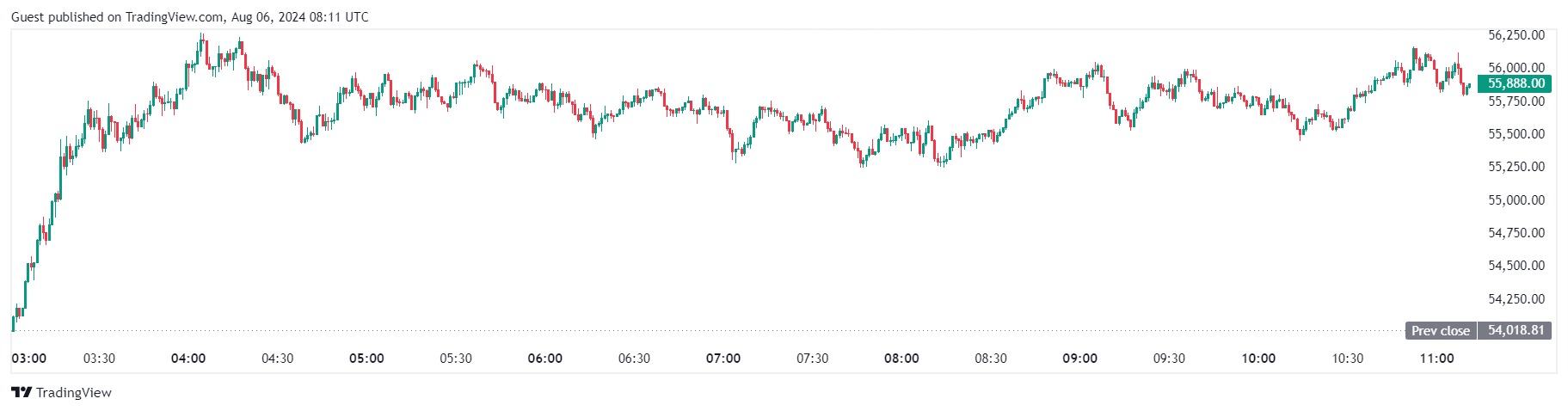
Курс BTC/USDT на бирже Binance. Источник: TradingView.

Подробнее о том, почему это произошло, читайте в нашем материале с мнениями экспертов:

Related Reads

Coin Stock Barometer丨BitMine's Total Assets and Investment Reach $10.7 Billion, Exceeding ~$9.3 Billion Floating Loss; Strategy Buys Only 520 BTC, Strive Adds Positions Against the Trend (June 23)

This article provides a weekly market update on "coin-equity" trends, focusing on listed companies holding major cryptocurrencies. Key highlights include: **General Market Trends:** Global equities, particularly in the US, Japan, and South Korea, faced significant sell-offs, led by large tech and AI-related stocks. Analysts cite profit-taking and a shift from hype-driven to performance-driven valuation for AI companies. Market focus is on upcoming Micron Technology's earnings. **Cryptocurrency Treasury Updates:** * **Bitcoin (BTC):** Net weekly BTC purchases by listed companies (excluding miners) totaled approximately $86 million, down 13.97% from the prior week. Strategy (formerly MicroStrategy) purchased only 520 BTC for ~$34.9 million, while Strive Asset Management increased its holdings by 759 BTC for ~$50 million. Other notable actions include Mara Holdings adding 1,000 BTC and Capital B shareholders approving a massive financing plan (up to ~$1.2 trillion) to potentially expand its Bitcoin reserves. * **Ethereum (ETH):** BitMine emerged as the largest corporate ETH treasury, holding 5.67 million ETH (4.7% of supply). It purchased an additional 52,203 ETH ($92 million) in the past week. Sharplink completed a $75 million private placement to fund further ETH accumulation and stock buybacks. * **Solana (SOL):** The top five listed companies hold over 15.7 million SOL combined. However, Solmate Infrastructure, a SOL treasury firm, faces a lawsuit from its largest external shareholder alleging board misconduct and self-dealing. * **Other:** Updates include Canton Strategic's $50 million stock buyback plan and Lite Strategy's $1 million strategic investment in LitVM, a Layer-2 network for Litecoin. The article notes that while crypto treasury firms continue fundraising and accumulation, their stocks may struggle to rise against the broader market downturn until Q4.

marsbit12m ago

Coin Stock Barometer丨BitMine's Total Assets and Investment Reach $10.7 Billion, Exceeding ~$9.3 Billion Floating Loss; Strategy Buys Only 520 BTC, Strive Adds Positions Against the Trend (June 23)

marsbit12m ago

OpenAI Partners with PE Firms, Investing $4 Billion. Let's Talk About Silicon Valley's Hottest New Role: FDE.

The hottest new role in Silicon Valley is the Forward Deployment Engineer (FDE), a hybrid of engineer and business consultant whose core mission is to transform AI demos into native, practical workflows within client organizations. The recent surge in demand is driven by a strategic shift from leading AI companies. OpenAI, partnering with 19 private equity firms in a $4 billion investment, formed a Deployment Company and acquired Tomoro along with its 150 FDEs. Anthropic also announced a $1.5 billion joint venture with financial institutions like Blackstone. The article, based on interviews with industry experts Jove (FDE lead at Cresta) and Oliver (VP at Invisible Technologies, ex-McKinsey), explores the FDE role and the rise of deployment-focused companies. Key insights include: **The FDE Role:** Jove describes an FDE as a "Forward Deployed CTO"—a technically strong engineer who works intimately with clients to implement AI solutions, learn from the process, and feed those insights back to improve the core product. They require expertise in AI agents, client-facing experience, resilience, and the ability to handle complex, imperfect systems. While AI tools enhance their efficiency, the role's complexity makes full automation a distant prospect. **Industry Shift:** Model companies are moving beyond selling tools to ensuring real-world adoption. This blurs the line between model and application companies. Collaborations with private equity (PE) firms are key, providing access to large portfolios of traditional businesses needing AI transformation. For PE firms, these partnerships offer signal value to LPs, create tangible value in portfolio companies, and provide exposure to high-growth AI assets. **Consulting & Transformation:** AI deployment involves deep, customized workflow redesign, moving beyond simple tool augmentation. Companies like Invisible Technologies build modular platforms to create bespoke, AI-native workflows for clients. While traditional consulting will see growth in helping businesses rethink their models for AI, the real value is captured by firms that leave behind transformed, operational systems. Critical success factors include building robust data foundations and strategically deciding which workflow steps should be deterministic versus AI-driven. The ultimate goal shifts from pure cost-cutting to unlocking new revenue opportunities previously impossible without AI-scale capabilities.

marsbit25m ago

OpenAI Partners with PE Firms, Investing $4 Billion. Let's Talk About Silicon Valley's Hottest New Role: FDE.

marsbit25m ago

Trading

Spot
Futures
活动图片