ICO泡沫下的众生相:有的成为比特币巨富,有的市值仅剩7万

Odaily星球日报Published on 2024-07-11Last updated on 2024-07-11

Abstract

走过7年的时间,当年宣称要打造下一个比特币和以太坊的项目则又换了一批选手。

原文作者:Frank,PANews

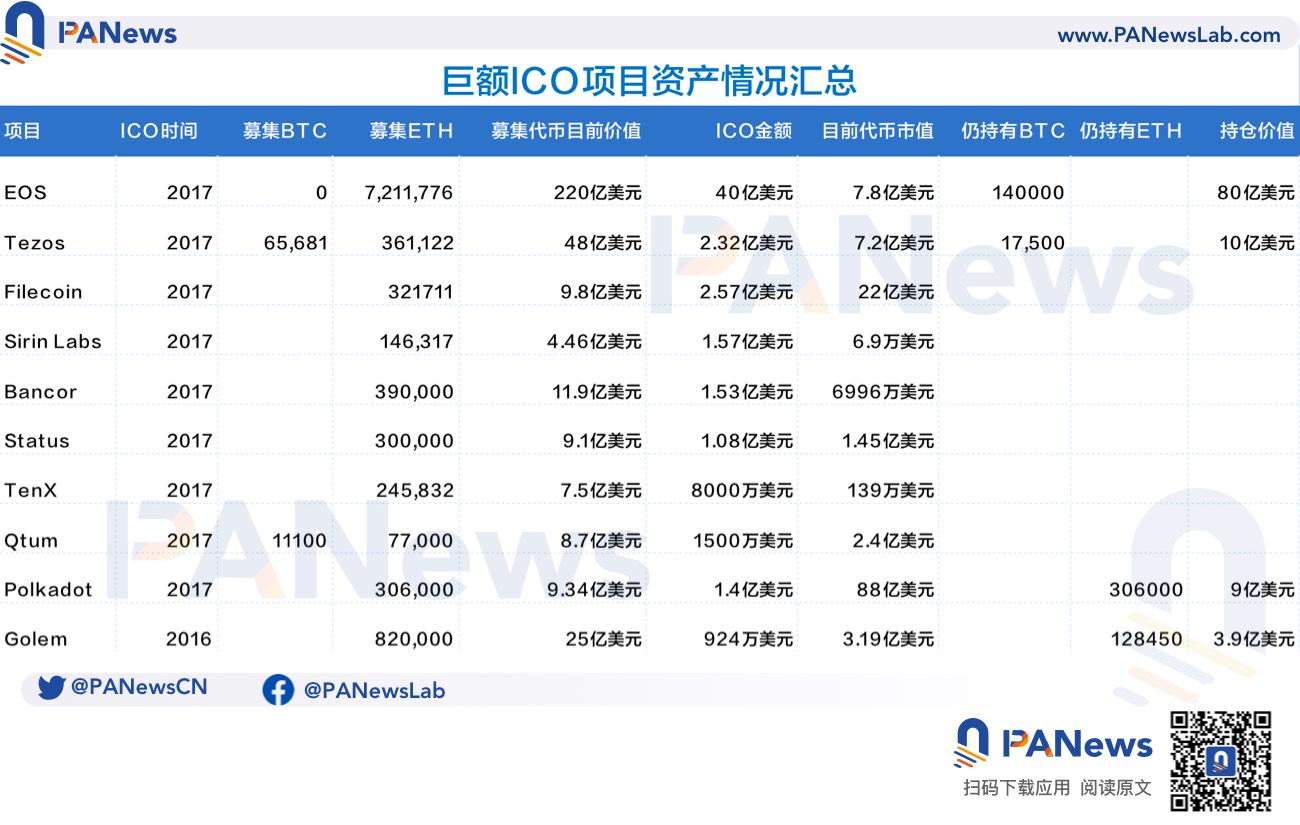
2016 年 ICO 募集了 82 万枚 ETH 的项目 Golem Network 最近频繁出售 ETH 备受关注,截至 7 月 8 日,近期累计出售了 3.6 万枚 ETH,价值约 1.145 亿美元。结合此前创造行业内最大的 ICO 案例的 EOS 创始公司至今仍持有 14 万枚比特币,价值约 80 亿美元。

投资者忽然发现,当年自己争先恐后投资的那些项目,团队有些都已销声匿迹, 持币不动的项目反而赚的盆满钵满。PANews 就 2016 ~ 2017 年 ICO 最火的 10 个项目的资产状况做了一个盘点,发现所有的项目投资回报均不及持币 BTC 和以太坊。

ICO泡沫下的众生相:有的成为比特币巨富,有的市值仅剩7万

Sirin Labs:融资 1.57 亿,代币市值仅 7 万美元

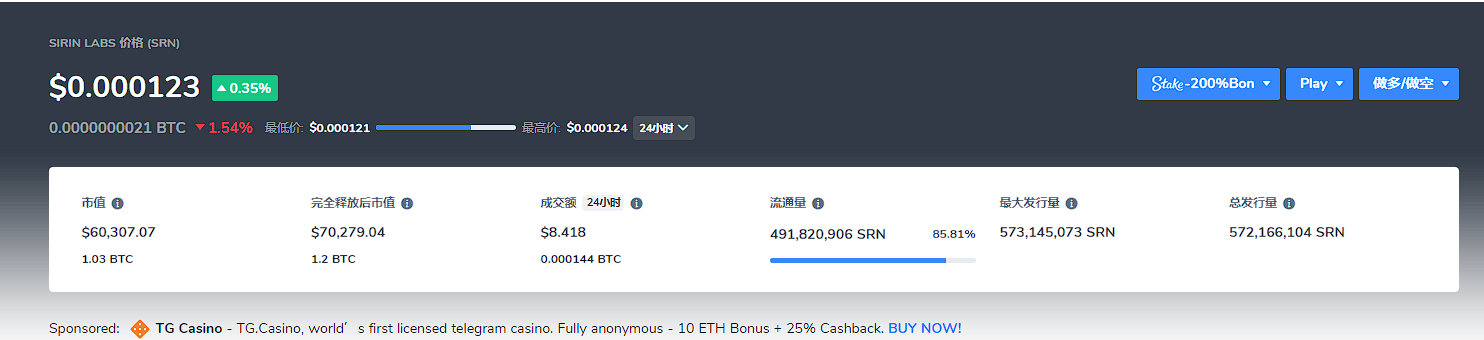
融资额与发展现状反差最大的莫过于 Sirin Labs,该项目于 2017 年通过 ICO 的形式融资约 1.58 亿美元。成为当年 ICO 最大金额的明星项目之一,其所发现的代币为 SRN,目前的市值仅剩 7 万美元, 24 小时成交额仅为 8 美元。

ICO泡沫下的众生相:有的成为比特币巨富,有的市值仅剩7万

Sirin Labs 是最早瞄准Web3手机产品的公司,早在 2017 年就以区块链智能手机 Finney 为噱头在 ICO 市场狂揽 1.58 亿美元融资, 2018 年足球运动员梅西还为这款加密手机进行了代言。好景不长, 2019 年 Sirin Labs 被曝出因手机销售不佳,裁员 25% 还有拖欠工厂工钱的消息。2021 年,Sirin Labs 的投资人被起诉利用 ICO 欺诈,挪用超过 2.5 亿美元。

如今,Sirin Labs 的社交媒体账号已经超过 3 年未更新了,评论区里仅留下“骗子”的骂声。

EOS:史上最高的 ICO 创造最富有的 Block.one

EOS 创造了一个 ICO 的募资高峰,这个记录至今仍未能被打破。2017 年,凭借 BM 的明星光环和李笑来的背书。EOS 以以太坊杀手、第三代公链之名获得超过 40 亿美元的融资,成为迄今为止加密领域 ICO 金额最高的项目。

而 EOS 背后的公司 Block.one 随后将募集的 ETH 均换成了 BTC,持有量一度超过 16.4 万枚,超过比特币持有大户微策略公司。据最新数据,Block.one 公司仍持有超过 14 万枚比特币,总价值超过 80 亿美元。

2022 年,EOS 基金会曾多次尝试通过法律手段让 Block.one 归还 41 亿美元,并将 EOS 转型为 DAO 组织。今年 4 月份,EOS 基金会尝试推出新的代币经济学,但市场似乎已经彻底抛弃了这个曾经的公链新星,价格自 4 月份又下跌了近 40% 。如今,EOS 代币的市值仅为 7.8 亿美元,不及 Block.one 持有的比特币价值十分之一。

Tezos: 代币市值不如基金会资产多

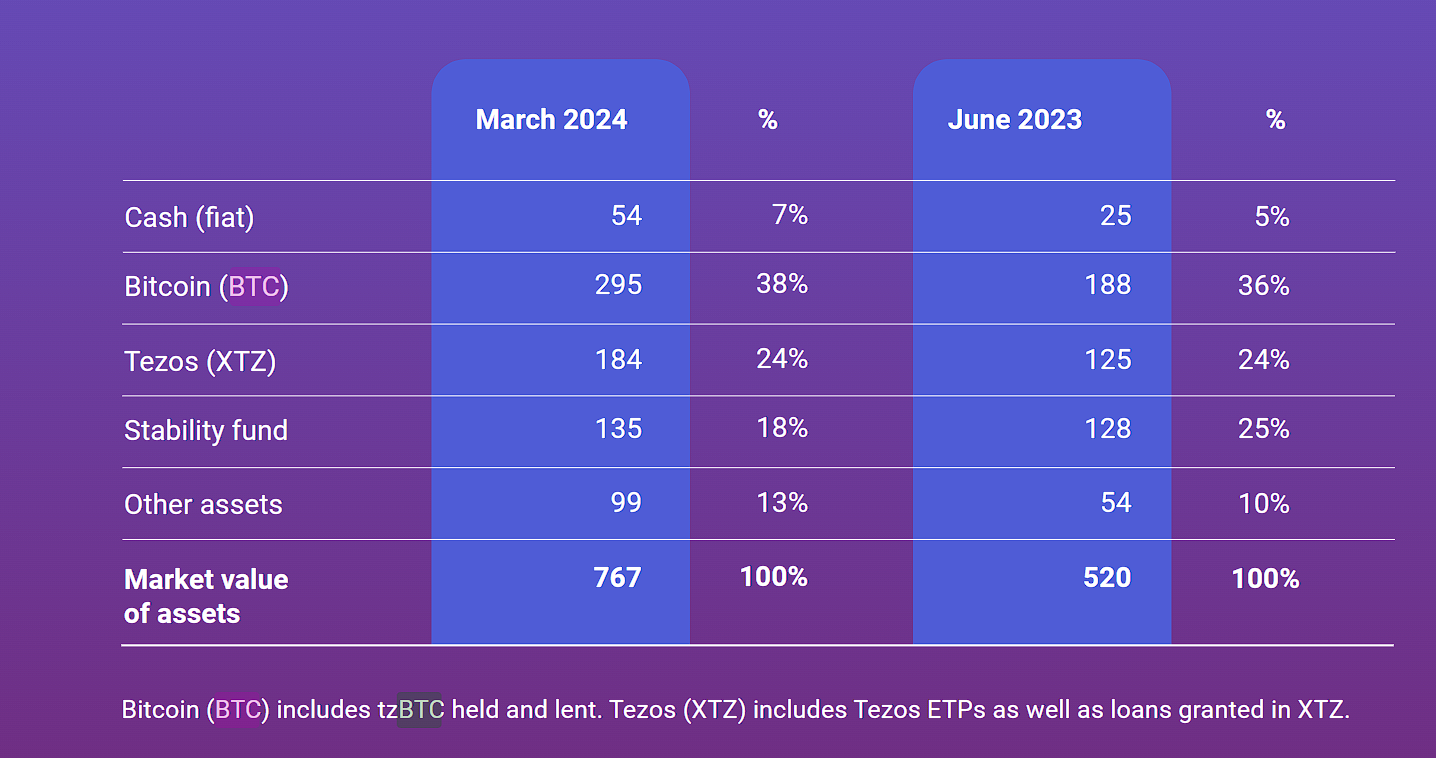
公链 Tezos 在 2017 年通过 ICO 获得了 2.32 亿美元的投资,虽然网传 Tezos 基金会持有 1.75 万枚比特币,但 PANews 据 Tezos 基金会 2024 年 3 月的报告显示,该组织目前仍持有价值 2.95 亿美元的 BTC,以当时的 BTC 价格计算,数量约为 5000 枚左右。不过,Tezos 当时在 ICO 时共募集了 65, 681 枚比特币、 36.1 万枚以太坊。这些代币如今的价值约合 48 亿美元,而 Tezos 代币 TXZ 目前的总市值约为 7.4 亿美元,也仅为筹款金额的 3 倍,甚至不如 Tezos 基金会的 7.6 亿资产。ICO泡沫下的众生相:有的成为比特币巨富,有的市值仅剩7万

Polkadot:仍持有 30 万枚以太坊未售出

最近,公链 Polkadot 因上半年财报引发热议, 8700 万美元的推广费支出和 110 万美元的收入引发了社区的担忧。似乎, 8700 万的推广费用不及一份财报引发的话题更高。作为 2017 年的明星项目,Polkadot 在当年的融资额就已达到 1.4 亿美元,募集超过 42.9 万个以太坊。据链上数据显示,目前 ICO 的智能合约地址中仍持有 30.6 万枚以太坊,价值约 9.3 亿美元。因此,外界对 Polkadot 金库的担忧似乎是多余的。这部分的以太坊代币从最初至今仍未有售出。

Bancor:从无人不知到无人问津

去中心化交易协议 Bancor 在 2017 年通过 ICO 募集了约 39 万枚以太坊,价值超 1.5 亿美元,超过了 The DAO 的募资金额。这些代币目前的价值约为 11 亿美元,而 Bancor 的代币 BNT 的市值则仅剩约 7000 万美元,对于当时投资的用户来说,这个结果显然是难以接受的。

Golem:精打细算,资产越卖越多

Golem Network 是非常早期的一个 ICO 项目,早在 2016 年 Golem Network 就提出去中心化算力市场这一概念,到了 2024 年,Golem Network 出名的并非具有前瞻性的市场部署,而是擅长理财的持币策略。2016 年 Golem Network 曾通过 ICO 募集了 82 万枚以太坊,是除了 EOS 之外募集以太坊最多的项目。Golem 的项目进展虽然一直不温不火,但项目方并未像其他团队一样快速将 ETH 变卖,而是在多年内少量多次的出手。从最早的 ICO 价值 900 万美元,到 2019 年 6 月,虽然持币数量降至 36.9 万枚,但价值却超过 1 亿美元。再到目前持币数量降至 12.5 万枚,总价值还有 3.9 亿美元。坐上以太坊价格增长的红利,Golem 的资产可谓是越卖越多。而当时用 11 美元的 ETH 投资 Golem 的人不知作何感想。

TenX:项目方一波变现,市值仅剩 164 万美元

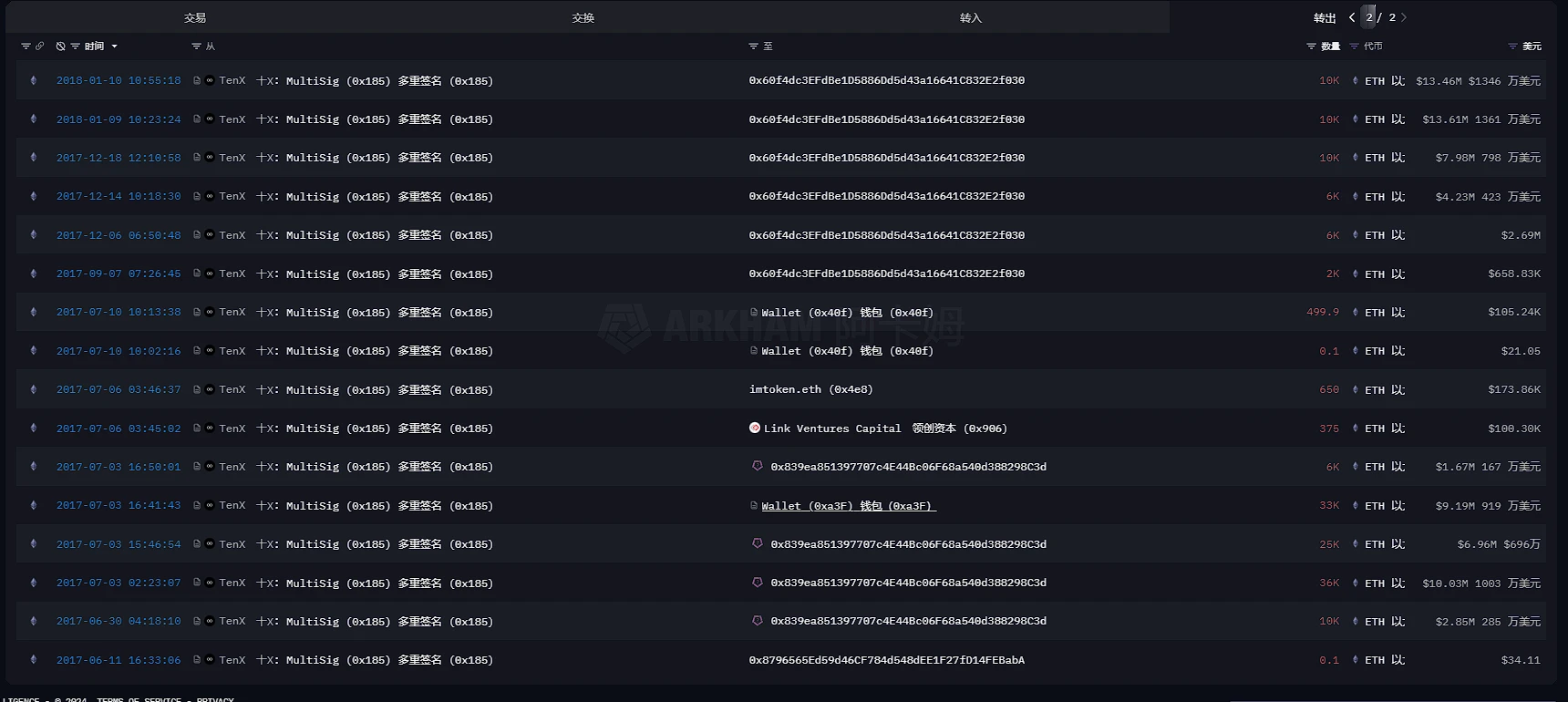
支付项目 TenX 在 2017 年募资了超过 8000 万美元,共 245832 个以太坊。不过项目方似乎对加密市场没有太大的信心,在 ICO 后一个月就开始陆续操作将大部分的代币通过交易所出售。目前该项目的代币 PAY 市值仅剩 164 万美元。

ICO泡沫下的众生相:有的成为比特币巨富,有的市值仅剩7万

Filecoin:去中心化存储的明星仍有余热

Filecoin 作为去中心化存储的热门项目,也是 2017 年融资金额最高的项目之一。Filecoin 通过 ICO 募集了 2.53 亿美元。时至今日仍有不少加密投资人通过矿机挖取 FIL 代币。从结果来看,FIL 代币当前的市值约为 22 亿美元,在 2017 年的明星项目中仅次于 Polkadot。

Qtum:一盘录音带跌下神坛

Qtum 是 2017 年红极一时又饱受争议的有一个项目。从 ICO 的金额来看,Qtum 1560 万美元的金额并不算多,而 2018 年量子链的价格飙升使得该项目成为知名的区块链项目。但随着李笑来的录音曝光,Qtum 创始人的形象也被拉下神坛,从此 Qtum 一蹶不振。Qtum 筹集了 11000 枚 BTC 和 75000 枚 ETH,如今的价值超过 8.7 亿美元。远超 QTUM 代币市值的 2.4 亿美元。

Status:当年一币难求,如今万幸未投

Status 于 2017 年完成了 1.05 亿美元的 ICO 融资,共计筹款 30 万枚 ETH。自 2017 年以来,项目陆续将手中所持有的代币卖出,目前仍持有 1.7 万枚以太坊,价值约 5400 万美元。其代币 SNT 的市值约为 1.5 亿美元。Status 在 2017 年火爆的程度也是非比寻常,据官方透露,ICO 退回的 ETH 高达 34.7 万枚,比筹集的数量还多。不知这些没有成功上车的投资人现在是否庆幸自己没能用手中的 ETH 换了 SNT。

总结

除了上述列举的项目,在 2016 ~ 2017 年火热的 ICO 时代还有大量的项目,不少已经彻底停运,在市场中沉寂。回顾历史总是有意义的,从盘点的 10 个项目来看,这些项目无疑是那个时代最耀眼的明星,顶着名人光环,轻而易举的获取巨额投资。时间走过 7 年的时间,当年宣称要打造下一个比特币和以太坊的项目则又换了一批选手。这也不禁引发我们的思考,再过 7 年今天的明星项目还有多少能存在于大众视野,又有谁能兑现承诺或是靠着融资苟活。

原文链接

Trending Cryptos

Related Reads

Hackers Steal Nearly $17 Million in 40 Days as 'Zombie Contracts' Become Their ATMs

According to an analysis published by ZeroDrift on June 22, 2026, attackers have stolen approximately $16.9 million over 40 days from five deprecated but still operational smart contracts across various blockchains. The primary issue is not a specific vulnerability but the incomplete decommissioning of legacy contracts. These "zombie contracts" often retain economic value, operational permissions, and callable functions, making them prime targets long after teams cease active development. The most significant loss occurred at DxSale, where an old locker contract lost about $7.3 million due to a forgotten control path becoming accessible again. Other affected projects include TrustedVolumes (~$5.87M), Raydium's legacy AMM pool (~$1.34M), Aztec Connect (~$2.28M), and Huma Finance V1 pool (~$101k). These incidents involved diverse systems—RFQ settlement, credit pools, liquidity lockers, AMMs—demonstrating the widespread nature of the risk. The analysis highlights that automated tools are lowering the cost for attackers to systematically scan for these long-tail targets, which have public code and weaker monitoring. In contrast, defensive practices for contract retirement remain underdeveloped. While the DeFi industry has mature audit processes for new deployments, it lacks strict protocols for securely sunsetting old contracts, which only become truly "retired" after all funds, permissions, authorizations, and trust assumptions are removed.

marsbit7m ago

Hackers Steal Nearly $17 Million in 40 Days as 'Zombie Contracts' Become Their ATMs

marsbit7m ago

Valuation Rout of Old Titans: The Demise of a Generation's Asset Valuation Framework

"The Old Titans' Valuation Collapse: The Death of an Era's Valuation Framework" Between Alibaba's 2014 NYSE debut at $93.89 and its 2026 price of ~$95, twelve years have passed with zero price appreciation. This stagnation symbolizes a wholesale valuation reset for an entire generation of Chinese internet assets. Companies like Tencent, Pinduoduo, Meituan, Bilibili, and Kuaishou have seen catastrophic declines of 80-98% from their peaks. The core question arises: what framework now prices these companies, or has the framework itself expired? The valuation logic for Chinese internet stocks followed a clear "anchor-setting and anchor-removing" process. From 2014-2017, the dominant narrative was "US comparable discounting" – applying a growth premium and governance discount to US peers' multiples. This anchor loosened with the 2018 US-China trade war and the VIE structure risk, then was violently uprooted by the 2020-2021 regulatory crackdowns (Ant Group, Didi, anti-monopoly fines). The 2022 delisting panic and subsequent 2025-2026 geopolitical shocks (US military lists, AI espionage accusations) completed the demolition. The old "US对标打折" model is dead. However, this is not solely a China story. A structural mirror exists in US "old titan" stocks ("老登股"). In 2026, even Microsoft – with robust fundamentals – saw its PE compress from a 34x median to 22x, its worst performer status among the "Magnificent Seven" driven by a $190 billion annual AI capex crushing free cash flow. The core dilemma is universal: legacy platform giants, whether Alibaba or Microsoft, are spending colossal sums to chase an AI paradigm that may颠覆 their own high-margin, user/subscription-based business models. They have shifted from "companies defining the future" to "companies needing to prove they won't be淘汰ed by the future." This phenomenon of a dying valuation坐标系 has a historical precedent: post-1989 Japan. After its bubble burst, the "Japan premium" narrative ("most efficient manufacturing + perpetual growth") collapsed. A 25-year valuation vacuum ensued until Warren Buffett provided a new language in the 2010s: "low valuation + high dividend + governance reform." China's internet sector is now in a similar vacuum six years into its reset. While different from Japan's deflationary context, the parallel is clear: the old macro assumption of "deep integration with global capital" is falsified, but a new pricing framework is absent. Potential "new languages" for Chinese internet valuations are contradictory. AI transformation requires gutting profitable core businesses (e.g., Alibaba's ad-driven e-commerce) for an unproven consumption-based model, risking a Microsoft-like cash flow crunch. Alternatively, shareholder returns (buybacks/dividends) could build a floor, following Buffett's Japanese playbook, but current scales are insufficient to form a standalone anchor. The current state mirrors mid-1990s Japan: the old framework is dead, the new one unborn. The market waits in a vacuum for a重新定义ing force – a person, event, or proven business model shift – to answer "why buy." This may only be the middle phase of a prolonged re-rating.

marsbit14m ago

Valuation Rout of Old Titans: The Demise of a Generation's Asset Valuation Framework

marsbit14m ago

STRC Trading at Significant Discount, mNAV Falls Below Break-Even, Strategy's Valuation Logic Has Been Rewritten

Title: STRC Deeply Discounted, mNAV Falls Below Break-even, Strategy's Valuation Logic Redefined The recent volatility in MSTR and STRC highlights the need to reassess the core business model of Bitcoin reserve companies. These entities function more like leveraged, single-asset banks rather than software/tech firms. Consequently, they should be valued using banking metrics, not based on their total Bitcoin holdings. The key valuation metric is mNAV (market net asset value), akin to a price-to-book ratio. It compares the company's market capitalization to the equity value of its Bitcoin holdings after deducting all senior debt and preferred equity (like STRC). As of June 24, Strategy's mNAV was 1.10x. The focus should be on "net Bitcoin per share" (the Bitcoin claim per share after senior claims) and its growth rate, equivalent to a bank's book value and return on assets. Given STRC's 19% discount to its $100 par value (yielding 14.2%), issuing new MSTR equity at the current price to buy more Bitcoin is inefficient. It slightly dilutes the widely watched "total Bitcoin per share" metric while providing minimal improvement to the more critical "net Bitcoin per share." The article analyzes four potential uses for $1 billion in new equity: 1. **Buy Bitcoin:** Least effective. Improves net Bitcoin per share only marginally while diluting total Bitcoin per share. 2. **Repurchase STRC:** Most effective for balance sheet repair. The discount creates immediate value, increasing net Bitcoin per share by 1.0%, reducing debt burden, and lowering future dividend obligations. 3. **Boost Cash Reserves:** Dramatically improves the "cash coverage ratio" for STRC dividends from 9.8 months to 16.8 months, a crucial liquidity metric in a tightening funding environment. 4. **50/50 Split (STRC buyback & cash):** A balanced approach improving all key metrics. Strategy's own Q1 report indicates its internal break-even mNAV for profitable equity issuance to buy Bitcoin is 1.22x. With the current mNAV at 1.10x, such a move would be value-destructive. The core assumptions of its previous expansion model—issuing STRC at par and maintaining ample dividend coverage—have broken down. The recommended path is to use new capital to optimize core financial health: repurchasing discounted STRC and/or bolstering cash reserves. This would repair the balance sheet, signal liquidity strength, support STRC's price, lower its yield, and potentially reopen the par-value issuance channel. The current STRC discount represents a low-cost capital opportunity to restart this positive cycle. Bitcoin reserve companies must be evaluated as banks, focusing on book value, leverage, and liquidity resilience.

Foresight News15m ago

STRC Trading at Significant Discount, mNAV Falls Below Break-Even, Strategy's Valuation Logic Has Been Rewritten

Foresight News15m ago

Trading

Spot

Hot Articles

What is $BITCOIN

DIGITAL GOLD ($BITCOIN): A Comprehensive Analysis Introduction to DIGITAL GOLD ($BITCOIN) DIGITAL GOLD ($BITCOIN) is a blockchain-based project operating on the Solana network, which aims to combine the characteristics of traditional precious metals with the innovation of decentralized technologies. While it shares a name with Bitcoin, often referred to as “digital gold” due to its perception as a store of value, DIGITAL GOLD is a separate token designed to create a unique ecosystem within the Web3 landscape. Its goal is to position itself as a viable alternative digital asset, although specifics regarding its applications and functionalities are still developing. What is DIGITAL GOLD ($BITCOIN)? DIGITAL GOLD ($BITCOIN) is a cryptocurrency token explicitly designed for use on the Solana blockchain. In contrast to Bitcoin, which provides a widely recognized value storage role, this token appears to focus on broader applications and characteristics. Notable aspects include: Blockchain Infrastructure: The token is built on the Solana blockchain, known for its capacity to handle high-speed and low-cost transactions. Supply Dynamics: DIGITAL GOLD has a maximum supply capped at 100 quadrillion tokens (100P $BITCOIN), although details regarding its circulating supply are currently undisclosed. Utility: While precise functionalities are not explicitly outlined, there are indications that the token could be utilized for various applications, potentially involving decentralized applications (dApps) or asset tokenization strategies. Who is the Creator of DIGITAL GOLD ($BITCOIN)? At present, the identity of the creators and development team behind DIGITAL GOLD ($BITCOIN) remains unknown. This situation is typical among many innovative projects within the blockchain space, particularly those aligning with decentralized finance and meme coin phenomena. While such anonymity may foster a community-driven culture, it intensifies concerns about governance and accountability. Who are the Investors of DIGITAL GOLD ($BITCOIN)? The available information indicates that DIGITAL GOLD ($BITCOIN) does not have any known institutional backers or prominent venture capital investments. The project seems to operate on a peer-to-peer model focused on community support and adoption rather than traditional funding routes. Its activity and liquidity are primarily situated on decentralized exchanges (DEXs), such as PumpSwap, rather than established centralized trading platforms, further highlighting its grassroots approach. How DIGITAL GOLD ($BITCOIN) Works The operational mechanics of DIGITAL GOLD ($BITCOIN) can be elaborated on based on its blockchain design and network attributes: Consensus Mechanism: By leveraging Solana’s unique proof-of-history (PoH) combined with a proof-of-stake (PoS) model, the project ensures efficient transaction validation contributing to the network's high performance. Tokenomics: While specific deflationary mechanisms have not been extensively detailed, the vast maximum token supply implies that it may cater to microtransactions or niche use cases that are still to be defined. Interoperability: There exists the potential for integration with Solana’s broader ecosystem, including various decentralized finance (DeFi) platforms. However, the details regarding specific integrations remain unspecified. Timeline of Key Events Here is a timeline that highlights significant milestones concerning DIGITAL GOLD ($BITCOIN): 2023: The initial deployment of the token occurs on the Solana blockchain, marked by its contract address. 2024: DIGITAL GOLD gains visibility as it becomes available for trading on decentralized exchanges like PumpSwap, allowing users to trade it against SOL. 2025: The project witnesses sporadic trading activity and potential interest in community-led engagements, although no noteworthy partnerships or technical advancements have been documented as of yet. Critical Analysis Strengths Scalability: The underlying Solana infrastructure supports high transaction volumes, which could enhance the utility of $BITCOIN in various transaction scenarios. Accessibility: The potential low trading price per token could attract retail investors, facilitating wider participation due to fractional ownership opportunities. Risks Lack of Transparency: The absence of publicly known backers, developers, or an audit process may yield skepticism regarding the project's sustainability and trustworthiness. Market Volatility: The trading activity is heavily reliant on speculative behavior, which can result in significant price volatility and uncertainty for investors. Conclusion DIGITAL GOLD ($BITCOIN) emerges as an intriguing yet ambiguous project within the rapidly evolving Solana ecosystem. While it attempts to leverage the “digital gold” narrative, its departure from Bitcoin's established role as a store of value underscores the need for a clearer differentiation of its intended utility and governance structure. Future acceptance and adoption will likely depend on addressing the current opacity and defining its operational and economic strategies more explicitly. Note: This report encompasses synthesised information available as of October 2023, and developments may have transpired beyond the research period.

463 Total ViewsPublished 2025.05.13Updated 2025.05.13

What is $BITCOIN

Discussions

Welcome to the HTX Community. Here, you can stay informed about the latest platform developments and gain access to professional market insights. Users' opinions on the price of BTC (BTC) are presented below.

活动图片