Dawn Song, The First Lady of Computer Security, Joins Meta

marsbitPublished on 2026-06-26Last updated on 2026-06-26

Abstract

Computer security and AI safety pioneer Dawn Song has joined Meta's Superintelligence Labs as Vice President of AI Research, reporting to MSL head Nat Friedman. Song, a professor at UC Berkeley's EECS department and a MacArthur Fellow, is renowned for her foundational work in dynamic taint analysis and her leadership in adversarial machine learning and AI agent security. Her lab is considered a top training ground in computer security. Song is also a founder of Oasis Labs and Virtue AI, a company focused on enterprise AI safety infrastructure. Virtue AI co-founders Bo Li and Sanmi Koyejo, along with other team members, are also joining Meta, a move seen as strengthening Meta's safety measures for AI agents amid growing industry concerns. Separately, Denny Zhou, founder of Google's Gemini Reasoning Team and a key figure in advancing large language model reasoning techniques like Chain-of-Thought, reportedly joined Meta several months ago. These high-profile hires come as Meta seeks to deploy AI across its products while assuring regulators and the public of its models' robustness against misuse.

This Thursday, UC Berkeley computer science professor Dawn Song announced that she is joining Meta's Superintelligence Labs (MSL) as Vice President of AI Research.
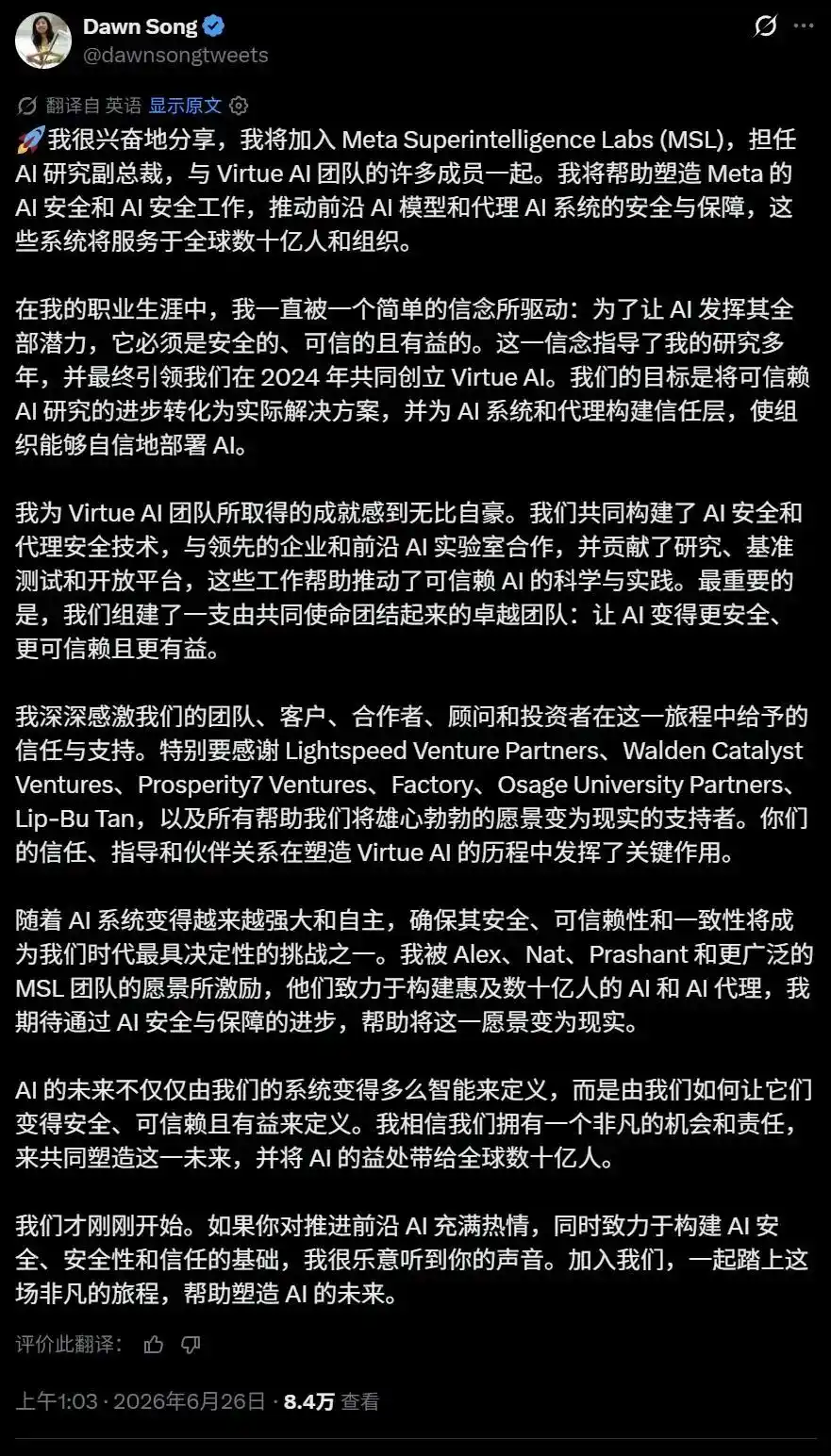
Song will report directly to MSL head Nat Friedman.

Dawn Song enjoys a high reputation in both academia and industry. She is one of the most influential scholars globally in the fields of computer security and AI safety, and is currently a professor in the Department of Electrical Engineering and Computer Sciences (EECS) at the University of California, Berkeley (UC Berkeley).

Song earned her undergraduate degree from the Department of Physics at Tsinghua University. She received her Master's degree from Carnegie Mellon University's Computer Science Department in 1999 and her Ph.D. from UC Berkeley in 2002. During her tenure at Berkeley, she also served as Co-Director of the Center for Decentralized Intelligence (Berkeley RDI). She is a recipient of the MacArthur Fellowship ("Genius Grant") and is also an ACM Fellow, IEEE Fellow, and a member of the American Academy of Arts and Sciences (AAAS), having won numerous top honors in computer science.

Her 2005 paper proposing "Dynamic Taint Analysis" is a classic in the field of computer security.
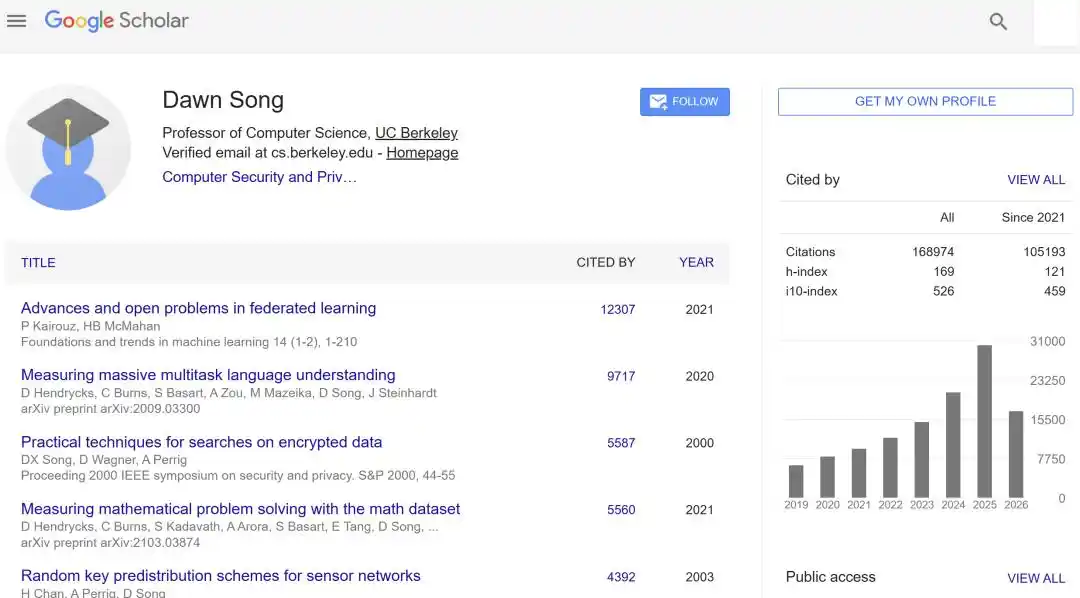
Song's research not only covers traditional software and network security but also pioneers in adversarial machine learning and agent safety. She has been deeply involved in establishing safety benchmarks for the generative AI era.

In AMiner's rankings, she is the most cited scholar globally in computer security. Her lab at Berkeley is hailed as the "West Point" of computer security.

Two weeks ago, we reported on her team's development of ALE (Agents' Last Exam), designed to measure whether AI agents can truly perform economically valuable work across a wide range of real-world domains.

In ALE, the Berkeley team evaluated Fable 5, GPT-5.5, Composer 2.5, and other cutting-edge agent systems, with impressive results.

Dawn Song is also the founder of Oasis Labs and Virtue AI. Virtue AI focuses on enterprise-level AI security infrastructure, particularly automated red-teaming and runtime guardrails for AI agents.

According to foreign media reports, in this move, along with Song, the other two founders of Virtue AI, Bo Li and Sanmi Koyejo, as well as more team members, have also joined Meta. Since the release and subsequent restriction of Anthropic's new safety-focused large model, Mythos, AI safety issues have drawn widespread attention in the tech industry, and Meta is seeking to strengthen its safety measures for agents.

As frontier models face growing security challenges, top AI labs worldwide are under unprecedented pressure. Meta's goal is to deploy AI across its social product matrix used by billions, while continuing its open-source strategy. To achieve this, it must demonstrate to regulators and the public that its models possess robust capabilities to resist malicious abuse. The addition of the Virtue AI team is expected to provide significant assistance.

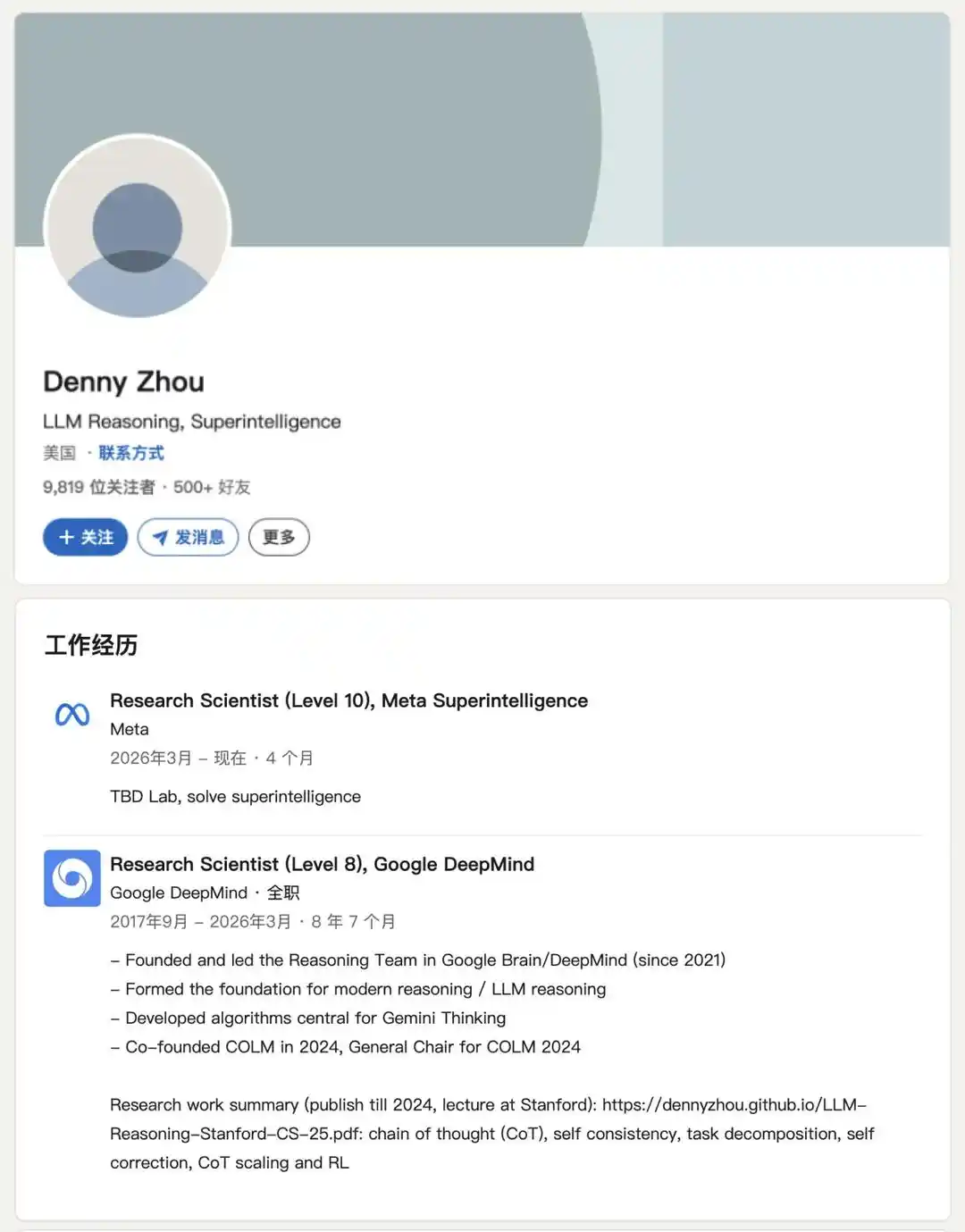
Meanwhile, Denny Zhou, founder of the Gemini Reasoning Team, is rumored to have left Google months ago to join Meta's TBD Lab (his LinkedIn already shows he joined Meta several months ago with a Level 10 position).
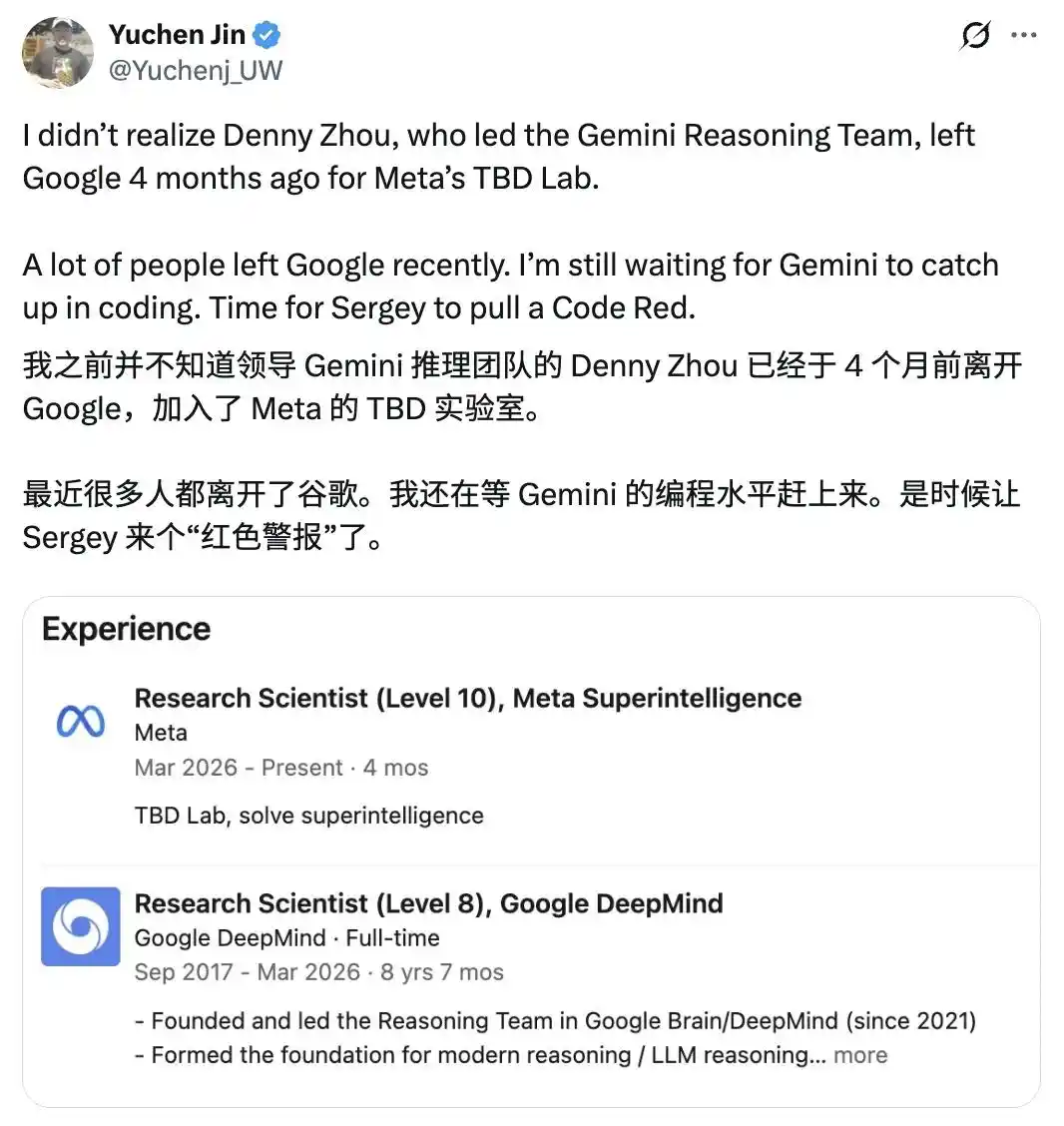
Denny Zhou is an absolute top expert in the field of AI reasoning, credited as a key figure in "teaching LLMs how to reason."

Over the past few years, Denny Zhou has been instrumental in advancing key methods such as Chain-of-Thought, Self-Consistency, and Least-to-Most Prompting, transforming large model reasoning from "prompt engineering tricks" into a researchable, scalable, and engineerable technical roadmap. In a sense, Gemini's ongoing advancements in complex math, coding, and long-range reasoning tasks are built upon this foundational research lineage established early by the Reasoning Team.
References:

https://x.com/dawnsongtweets/status/2070191051873345910

https://www.axios.com/2026/06/25/meta-hires-virtue-ai-founders-security

This article is from the WeChat public account "Almost Human" (ID: almosthuman2014), edited by Zenan.


Trending Cryptos

Related Questions

QWho is Dawn Song and what is her new role at Meta?

ADawn Song (Song Xiaodong) is a renowned UC Berkeley professor in computer security and AI safety. She has joined Meta's Superintelligence Labs as the Vice President of AI Research.

QWhat is Dawn Song's most influential contribution to computer security?

AHer 2005 paper proposing 'Dynamic Taint Analysis' is considered a classic foundational work in the field of computer security.

QWhat is the ALE benchmark developed by Dawn Song's team, and what does it measure?

AALE (Agents' Last Exam) is a benchmark developed by her team at UC Berkeley to measure whether AI agents can perform economically valuable work across a wide range of real-world domains.

QWhich company's founders, besides Dawn Song, joined Meta as part of this move?

AThe other founders of Virtue AI, Bo Li and Sanmi Koyejo, along with more team members, also joined Meta.

QWho is Denny Zhou, mentioned later in the article, and why is his move to Meta significant?

ADenny Zhou is a top expert in AI reasoning, known for key methods like Chain-of-Thought. He left Google to join Meta months earlier, and his expertise is crucial for advancing complex reasoning in AI models.

Related Reads

Bitcoin Withstood 10 Bearish Blows in 2026, Yet Experienced Its Mildest Bear Market

Bitcoin, the leading cryptocurrency by market cap, peaked above $126,000 in early October before entering a prolonged decline. By August, it was mainly trading between $63,000 and $65,400, inflicting losses on late buyers but resulting in what is, historically for Bitcoin, an unusually shallow bear market—down about 49% from its peak, compared to typical 75-80% plunges. Throughout 2026, Bitcoin faced multiple headwinds yet demonstrated notable resilience. Geopolitical tensions in the Middle East and volatile oil prices revived inflation concerns but failed to trigger the panic-driven sell-offs seen in prior cycles. A significant psychological blow came from corporate seller MicroStrategy, a longtime accumulator, which began strategic sales to bolster its cash position, reducing its holdings. U.S. spot Bitcoin ETFs also faced sustained outflows, though a late-week inflow hinted at potential relief. Pressure also came from within the ecosystem. A contentious blockchain proposal, BIP-110, failed after a minority chain stalled. Miners, facing tighter economics, sold reserves and pivoted infrastructure toward AI. A major security breach involving Coldcard hardware wallets saw an estimated 2,000 BTC stolen, shaking confidence in self-custody. Long-term threats like quantum computing resurfaced in discussions. Despite this confluence of corporate selling, ETF outflows, miner capitulation, geopolitical shocks, internal conflict, and security issues—any one of which could historically cause sharp declines—Bitcoin stubbornly held above a key $60,000 support level. Deeper market liquidity, regulated products, and long-term holders appear to be absorbing selling pressure that once would have caused deeper crashes. This resilience suggests a maturing market structure, though risks remain. Another shock could still push Bitcoin toward $50,000. For now, its 49% decline, severe for most assets, is relatively moderate by Bitcoin's own volatile standards. The remaining months of 2026 will test whether $60,000 is a durable floor or merely the next major line of defense.

cryptonews.ru53m ago

Bitcoin Withstood 10 Bearish Blows in 2026, Yet Experienced Its Mildest Bear Market

cryptonews.ru53m ago

Korean Financial Supervisory Service to Revise Compensation System for Phishing Losses Involving Crypto Transfer

The South Korean Financial Supervisory Service (FSS) is overhauling its system for reimbursing victims of voice phishing scams. Starting in October, the new system will be able to calculate and compensate losses held in cryptocurrency, not just in Korean won. Previously, the reimbursement system assumed stolen funds were in won, failing to fully compensate victims whose money was converted into digital assets. The upgraded software will apply a recovery ratio to determine the specific type and quantity of tokens owed to each victim, based on the token's value at the time the payment was frozen. It will also better track cases where fraud proceeds are split across multiple accounts and later consolidated. These changes follow March 31st amendments to the Act on Reimbursement of Losses from Telecommunications Fraud, which now classify virtual assets as both damaged and recoverable property. Major Korean crypto exchanges like Upbit and Bithumb must now comply with the same anti-phishing obligations as banks, including verifying transaction purposes and tracking suspicious funds. The revised law takes effect October 1st, with the FSS allocating a three-month period and a budget of 118.53 million won for system implementation and troubleshooting. The update addresses schemes where stolen money is intentionally laundered through cryptocurrency for overseas transfer. Notably, telecom fraud losses in South Korea rose 14.1% to 433.8 billion won in 2025, a five-year high.

cryptonews.ru1h ago

Korean Financial Supervisory Service to Revise Compensation System for Phishing Losses Involving Crypto Transfer

cryptonews.ru1h ago

Trading

Spot

Hot Articles

Discussions

Welcome to the HTX Community. Here, you can stay informed about the latest platform developments and gain access to professional market insights. Users' opinions on the price of S (S) are presented below.

活动图片