SEC起诉Metamask 这次连Lido和Rocket Pool也难逃一劫 LDO暴跌近18%

金色财经Published on 2024-07-08Last updated on 2024-07-09

Abstract

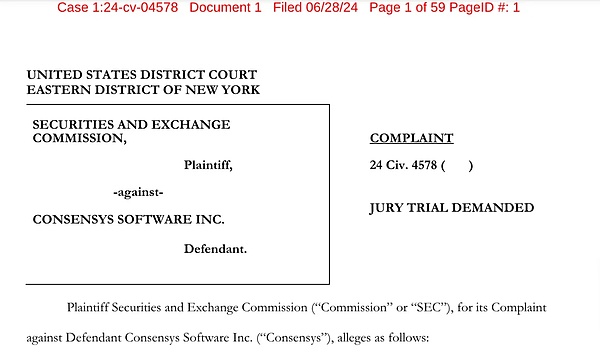
币圈用户广泛使用的小狐狸钱包 MetaMask,其母公司 Consensys 于昨日(28 日)正式被美国证券交易委员会(SEC)起诉。SEC 指控 MetaMask 的 Swap 和质押产品涉嫌违反联邦证券法,并指出 Consensys 自 2020 年以来一直以未注册经纪商的身份运营,通过 MetaMask 从事未注册证券的发行和销售。

币圈用户广泛使用的小狐狸钱包 MetaMask,其母公司 Consensys 于昨日(28 日)正式被美国证券交易委员会(SEC)起诉。SEC 指控 MetaMask 的 Swap 和质押产品涉嫌违反联邦证券法,并指出 Consensys 自 2020 年以来一直以未注册经纪商的身份运营,通过 MetaMask 从事未注册证券的发行和销售。
据 Coindesk 和 Cointelegraph 报道,SEC 在起诉书中提到,MetaMask 允许用户通过其 “Swap” 服务直接在应用程序内买卖数字资产。Consensys 对这项服务收取手续费,并在过去四年内促成了超过 3600 万笔加密货币交易。SEC 声称,其中至少有 500 万笔交易涉及 “加密资产证券”。
这些加密资产证券包括 Polygon (MATIC)、Mana (MANA)、Chiliz (CHZ)、Sandbox (SAND) 和 Luna (LUNA) 等在 SEC 先前诉讼中被归类为证券的代币。SEC 还暗示,其他一些数字资产也有可能被视为证券。
图片


SEC 追击质押服务!Lido 和 Rocket Pool 被点名
起诉书还指出,Consensys在未注册的情况下,通过加密资产经纪交易和质押服务收取了超过2.5亿美元的手续费,从而剥夺了投资者的重要保护。SEC针对此次Consensys涉嫌违反联邦证券法的行为,谋求永久禁令、民事处罚以及其他公平救济。
此次执法行动证实了业界长久以来的忧虑。尽管上个月以太坊现货ETF的关键文件意外获得批准,降低了ETH被归类为证券的可能性,但SEC仍试图将以太坊衍生的流动性质押代币视作证券,包括Lido的stETH和Rocket Pool的rETH。
LDO 重挫近18%,RPL 下跌6%
图片


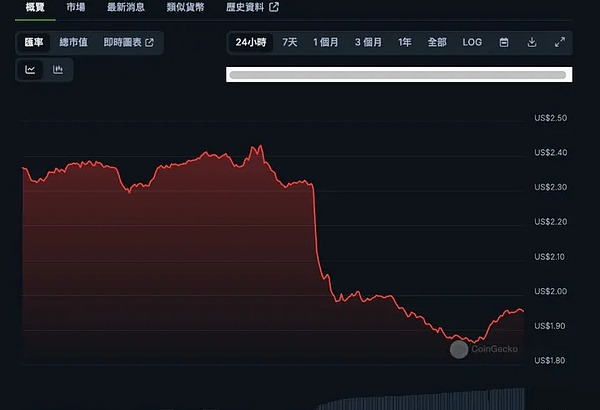
受到 SEC 指控的影响,Lido(LDO)昨晚从 2.43 美元暴跌超过 23%,今晨最低触及 1.86 美元,截至截稿前报价为 1.95 美元,近 24 小时大幅下跌 17.6%;Rocket Pool(RPL)24 小时跌幅相对较小,约为 6%,在撰稿时报价为 19.23 美元。被列为主要被告的 MetaMask 则尚未发行代币。


Related Reads

Uncovering the Truth About Agent Commerce, Payments, and Infrastructure

Decoding Agent Commerce, Payments, and Infrastructure: The Reality Over the past year, I've been building infrastructure for the Agent economy, engaging with major players like Stripe, Visa, Coinbase, Google, and dozens of startups. A clear conclusion emerges: true, large-scale demand does not yet exist. Startups face structural challenges. Data points illustrate this gap. Stripe's Agent commerce platform has over 1,000 merchants but only single-digit transacting agents. Visa's Agent payment token requires 9-month KYC and a $250M revenue threshold, accessible only to giants like Amazon. On-chain analysis reveals actual daily Agent transaction volume is around $17k, half of which are test transactions. The article analyzes four potential markets: **1. Agent-to-Merchant (A2M):** Current AI shopping UX is often inferior to traditional e-commerce for visual, comparison-heavy purchases (clothing, electronics). Chat interfaces are a step back. Real merchant interest is defensive "Agent Engine Optimization," fearing future obsolescence, not current demand. Potential exists in high-frequency, low-decision purchases (e.g., food delivery) or simplifying terrible UX (complex checkouts, non-native shoppers), but these require massive consumer distribution channels dominated by giants like DoorDash and Amazon. **2. Agent-to-API (A2A):** Developers already have subscriptions and billing for core APIs (compute, data). The argument for micro-payments via crypto for sub-dollar API calls is addressed by pre-paid balances today. The deeper issue is supplier resistance; major SaaS firms rely on enterprise contracts, not fractional cent pricing. Opportunity lies in the long tail of niche services, but this is a smaller market catering to developers, a historically low-paying group. **3. Agent-to-Agent (A2A):** This remains a theoretical long-term vision with near-zero current transaction volume. It involves unique challenges: discovery, trust, negotiation, dispute resolution. When it materializes, it will require a fundamentally new settlement infrastructure for high-speed, variable-value, multi-party transactions. It's a real long-term bet, but not the current market. **4. Agent-to-Finance (A2F):** This is the only category with existing, paying demand. Integrating AI into financial workflows (trading, portfolio management) is a natural evolution and enables new capabilities like autonomous rebalancing. However, competition favors incumbents with regulatory licenses, compliance infrastructure, and existing client relationships. **The Real Issue:** Why is infrastructure still being built? Incumbents can afford long-term bets, and payment companies see every problem as a nail for their payment hammer. However, payment is just one piece. The core challenge is *coordination*—orchestrating work between Agents and humans, verifying outcomes, and settling results. Payment is part of settlement, which is part of coordination. Companies that solve the coordination problem will subsume payments, not the other way around. Startups lack the infinite runway of giants and must find today's real market, which, after a year of exploration, lies outside these four categories—in an area with real, growing, and underserved activity.

marsbit1h ago

Uncovering the Truth About Agent Commerce, Payments, and Infrastructure

marsbit1h ago

Kalshi, MTS, and a16z's Ambition

The article "Kalshi, MTS, and a16z's Ambition" explores prediction markets as a focal point of excitement in 2025 for investors, crypto enthusiasts, and media. It traces their intellectual lineage from Friedrich Hayek's ideas on dispersed knowledge and market coordination to Robin Hanson's Logarithmic Market Scoring Rule (LMSR), which incentivizes truthful information sharing. The piece argues that a16z's significant investment in prediction market platform Kalshi (valued at $220B) transcends mere financial speculation. a16z frames prediction markets as a new form of "media" that provides "presence"—a way for individuals to actively engage with and influence world events through financial stakes, countering postmodern detachment. By wagering on outcomes, users become "super observers," and the market's aggregated probabilities gain authoritative power to define event truth and importance. The article uses media company MTS ("Monitoring The Situation") as a case study of a16z's "new media" strategy: rapidly producing high-intensity, multi-format content to "take over the timeline." However, prediction markets like Kalshi are presented as the ultimate piece in this media empire. Their real-money, crowd-sourced probabilities possess a unique "reality distortion field" and perceived objectivity, potentially swaying public opinion and granting a private company unprecedented interpretive power over reality. Ultimately, Kalshi's immense valuation is attributed not just to its exchange model, but to its role as a foundational component in a16z's envisioned new media landscape, where prediction markets define narrative and truth.

链捕手1h ago

Kalshi, MTS, and a16z's Ambition

链捕手1h ago

Trading

Spot
Futures

Hot Articles

How to Buy LDO

Welcome to HTX.com! We've made purchasing Lido (LDO) simple and convenient. Follow our step-by-step guide to embark on your crypto journey.Step 1: Create Your HTX AccountUse your email or phone number to sign up for a free account on HTX. Experience a hassle-free registration journey and unlock all features.Get My AccountStep 2: Go to Buy Crypto and Choose Your Payment MethodCredit/Debit Card: Use your Visa or Mastercard to buy Lido (LDO) instantly.Balance: Use funds from your HTX account balance to trade seamlessly.Third Parties: We've added popular payment methods such as Google Pay and Apple Pay to enhance convenience.P2P: Trade directly with other users on HTX.Over-the-Counter (OTC): We offer tailor-made services and competitive exchange rates for traders.Step 3: Store Your Lido (LDO)After purchasing your Lido (LDO), store it in your HTX account. Alternatively, you can send it elsewhere via blockchain transfer or use it to trade other cryptocurrencies.Step 4: Trade Lido (LDO)Easily trade Lido (LDO) on HTX's spot market. Simply access your account, select your trading pair, execute your trades, and monitor in real-time. We offer a user-friendly experience for both beginners and seasoned traders.

4.4k Total ViewsPublished 2024.03.29Updated 2026.06.02

How to Buy LDO

Discussions

Welcome to the HTX Community. Here, you can stay informed about the latest platform developments and gain access to professional market insights. Users' opinions on the price of LDO (LDO) are presented below.

活动图片












