Table of Contents
- Quick Navigation
- What is Liquid Restaking?
- What is BounceBit?
- What Problems Does BounceBit Solve?
- Understanding BounceBit’s Infrastructure
- Dual-Token PoS Structure
- Sustainable Validator Economics
- EVM Compatibility
- BounceClub: For Owners and Members
- BTC Bridge
- The Liquid Staking Tokens
- BounceBit Economy: Everything You Need to Know About BB Tokenomics
- The Binance Megadrop: Step by Step Guide
The concept of liquid restaking, a topic that has gained significant popularity in recent quarters, offers users the exciting possibility to extract additional value from their staked tokens.
Predominantly, however, this has been applied throughout a variety of Ethereum-based applications.
BounceBit, on the other hand, is delivering a BTC restaking infrastructure designed to provide a foundational layer for various restaking products.
In the following guide, we take a closer look at how BounceBit works, the tokenomics behind its native cryptocurrency, and more. Let’s dive in.
Quick Navigation
- What is Liquid Restaking?
- What is BounceBit?
- What Problems Does BounceBit Solve?
- Understanding BounceBit’s Infrastructure
- Dual-Token PoS Structure
- Sustainable Validator Economics
- EVM Compatibility
- BounceClub: For Owners and Members
- BTC Bridge
- The Liquid Staking Tokens
- BounceBit Economy: Everything You Need to Know About BB Tokenomics
- The Binance Megadrop: Step by Step Guide
What is Liquid Restaking?
Before we explain what BounceBit does, it’s important to understand the concept of liquid restaking that we mentioned above.
You might be familiar with liquid staking protocols and their liquid staking tokens (LSTs). It’s a mechanism that came to prominence with protocols like Lido. Users are able to stake their ETH into Lido (or other protocols) and receive a synthetic representation of this ETH. This is a new token that’s supposed to be pegged to the value of ETH 1:1. They could then use this synthetic ETH to carry out various operations with other protocols that support it.
Liquid restaking, on the other hand, is a process aimed at increasing the economic security of external systems. In essence, you can take your synthetic ETH (your LST) and restake it, receiving another token called a liquid restaking token.
As mentioned above, most of the LRT protocols are increasingly focused on Ethereum because of its Proof of Stake architecture.
BounceBit, on the other hand, is building a BTC restaking infrastructure that’s designed to provide a layer for restaking products on the Bitcoin network.
How do they do it? Well, let’s find out.

What is BounceBit?
In a bid to reimagine Bitcoin’s value, BounceBit proposes an infrastructure designed based on the conviction that Bitcoin should be predominantly asset-driven at the infrastructure level.
BounceBit differentiates itself as a Proof of Stake layer one ecosystem where validators are required to stake BTC and the native BounceBit token. This establishes a dual-token security system that’s aimed at strengthening the network itself but also at improving the intrinsic value of Bitcoin by providing its holders with an active role in validating the BounceBit network.
The goal is to provide a symbiotic relationship between BounceBit’s native token and BTC in an attempt to create a versatile and resilient network.
BounceBit also leverages interoperability with other networks that are EVM-compatible, incorporating staked assets such as BTCB on the “Build ‘N’ Build” (BNB) Chain and Wrapped Bitcoin (WBTC).
Now, it’s worth noting that when t comes to generating yield on BTC – there is a very unique challenge that’s inherently different from yield-generation protocols associated with Ethereum. The Bitcoin protocols can’t yield returns when the BTC is held within multi-signature wallets. This is what BounceBit confronts by integrating a centralized finance (CeFi) approach, taking advantage of Mainnet Digital’s custody services, as well as Ceffu’s MirrorX technology stack.
This essentially allows Bitcoin to maintain its presence on-chain, while also engaging in trading activities on centralized exchanges.
What Problems Does BounceBit Solve?
- Tackling Lack of Transparency
Those who were around in 2022 remember the transparency issues that plagued the industry through the likes of Celsius and others.
BounceBit incorporates on-chain proof-of-reserve (PoR), while also maintaining transparent activities in a bid to restore the trust and deliver a secure platform that allows BTC holders to earn interest.
- Underutilized BTC Assets
Undoutedbly, BTC holders face the challenge of their assets being underutilized. BounceBit seeks to tackle this challenge by providing them with a means of actively engaging their assets in the thriving sectors of decentralized finance and NFTs.
- Improving Bitcoin Utility by Enabling Additional Use Cases
By extension of the above, BounceBit also commits to expanding the overall utility of BTC and Bitcon’s network as a whole. The goal is to broaden the scope of opportunities for BTC holders and leverage the cryptocurrency as a major asset.
- Unifying BTC Across Chains
BounceBit identifies the absence of a smart contract platform within Bitcoin’s ecosystem as limiting the overall development of dApps and works to provide one.
Understanding BounceBit’s Infrastructure
BounceBit is building a network that leverages the well-known Proof-of-Stake (PoS) consensus algorithm to rethink conventional staking models that focus on a single token. They call this approach Dual-Token Proof of Stake (PoS).
- Dual-Token PoS Structure
In light of the above, it’s worth explaining that the protocol’s architecture incorporates a number of node operators. These can be selected as validators. These are parties that have to stake BB (the native token of BounceBit) and/or BBTC (staked BTC on the BounceBit chain). Their job is to record and verify the transactions on the network and as a reward – they receive transaction fees. As it’s a hybrid model, validators can choose to accept BBTC and/or BB tokens.
The purpose of accepting BTC, albeit staked, in the consensus mechanism, is to bootstrap the protocol with the deep liquidity that Bitcoin’s network has to offer, while also taking advantage of its relatively lower volatility.
- Sustainable Validator Economics
In a bid to balance the requirements for operating the network, BounceBit empowers its validators to charge a commission on the staking rewards. This is an approach that attempts to ensure that validators are compensated appropriately for the important role that they play in maintaining the robustness and functionality of the network.
- EVM Compatibility
BounceBit’s chain is fully compatible with both the Ethereum Virtual Machine and with Solidity. The latter is the programming language that’s predominantly used to create smart contracts for Ethereum. This ensures that the migration for developers would be seamless while also leveraging the proven security and abundant ecosystem of Ethereum.
- BounceClub: For Owners and Members
The BounceClub takes inspiration from Apple Inc.’s strive for innovation. It is an on-chain Web3 world where users are empowered to customize, launch, and engage with various dApps.
For BounceClub Owners -> If you meet the criteria to own a BounceClub, you will be able to select desired protocols from the BounceBit App Store and customize the space seamlessly and in a very user-friendly way. There’s a complete guide on it that you can find here.
For BounceClub Members -> Say you’re not interested in operating a BounceClub, you can still browse the various clubs that are created by other users and engage in different Web3 activities. You would only need to get your wallet connected.
- BTC Bridge
The main purpose of the BTC bridge within BounceBit’s ecosystem is to provide a secure way of transferring BTC between Bitcoin’s network and other EVM Chains, including BounceBit.
It is a critical component of the functionality and the completion of BounceBit’s vision and purpose.
It’s important to note that network validators are responsible for maintaining the security of the bridge. Each validator also operates a bridge node. They contribute to the signing of cross-chain messages, taking the multi-signature approach multiple steps further. You can find out more about the BounceBit BTC bridge here.
The Liquid Staking Tokens
BounceBit has a native liquid staking smart contract. If users opt-in to stake their BB or BTC, they will receive an LST (liquid staking token). These are:
- stBB – derived from staking BB
- stBBTC – derived from staking BBTC (BTC staked on BounceBit)
These can be later restaked to Shared Security Clients with the aims of aggregating security and unlocking liquidity of staked assets. LSTs can be redeemed here by simply unstaking. Following the redemption request, users have to wait for 24 hours before they can claim.
BounceBit Economy: Everything You Need to Know About BB Tokenomics
First things first, BounceBit’s economy is primarily composed of three types of actors, all of which are relatively self-explanatory:
- Users
- BB Holders
- Node operators
BB is the native token that powers the BounceBit platform. The total supply is capped at 2.1 billion (paying homage to the number of 21 million – Bitcoin’s capped supply.)
BB tokens can be used in multiple ways, so we will list a few of them:
- Use BB to take part in the on-chain governance process
- Stake BB to participate in the PoS Dual-token mechanism (read above)
- BB is paid out as a reward for validators who secure the network
- It’s the denomination of gas fees on the network
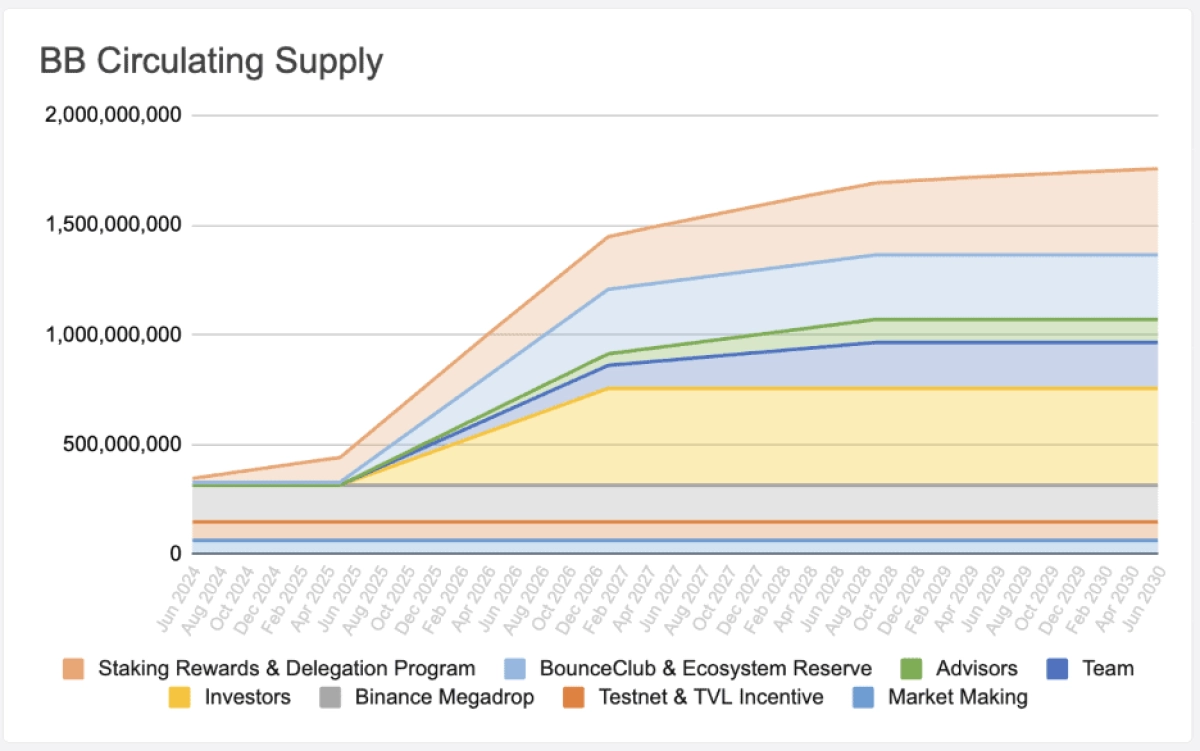
Here’s what the token release schedule looks like:
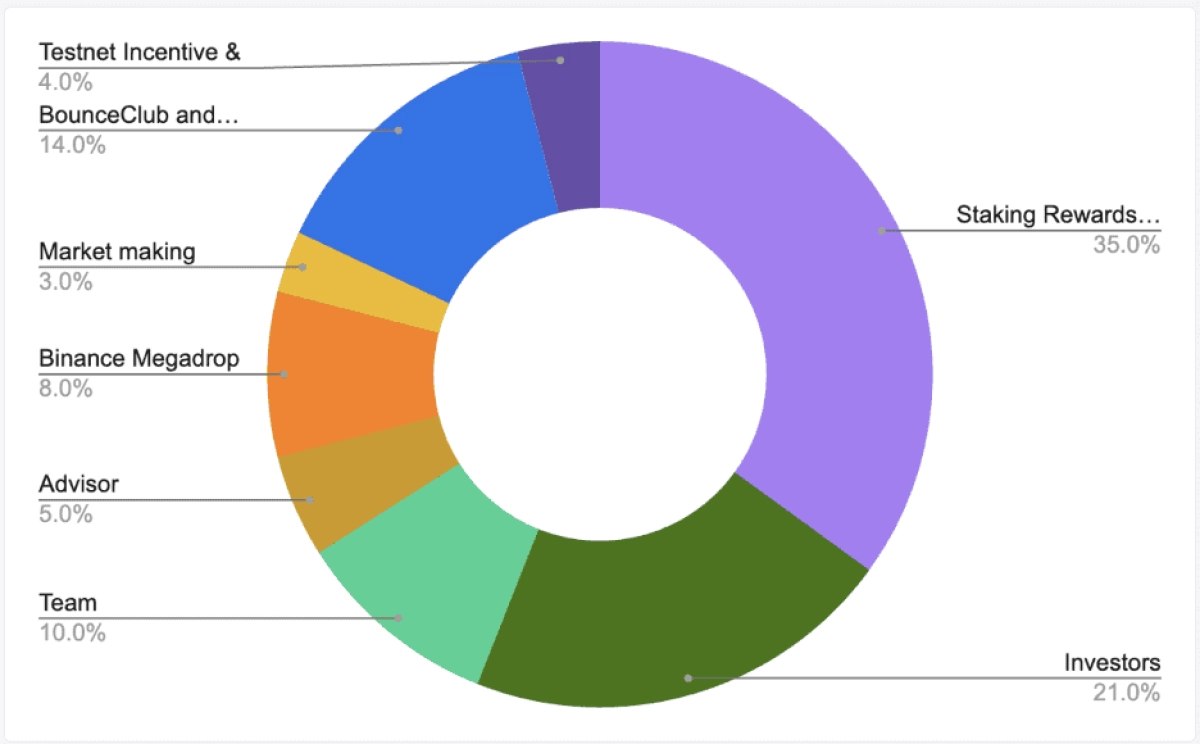
This is the BB token distribution:
Testnet & TVL Incentive: 4%
Investors: 21%
Team: 10%
Advisors: 5%
Binance Megadrop: 8%
Market Making: 3%
BounceClub & Ecosystem Reserve: 14%
Staking Reward & Delegation Program: 35%
The Binance Megadrop: Step by Step Guide
As you can see, the Binance Megadrop has 8% of the total supply reserved for it. It is a new token launch platform that’s designed to integrate Binance’s Simple Earn and the Web3 Wallet of the company.
It aims to provide users with early access to certain Web3 projects well before they are listed on the exchange.
The following is a step-by-step guide on how to participate in the Binance Megadrop for BounceBit.
There are two ways to participate, and both require a Binance account.
You can register one using this link and also earn a $600 welcome bonus as an exclusive deal for CryptoPotato readers!
Now that your account is ready, the first thing you can do is navigate to the Megadrop section and lock your BNB to earn scores. From there, you can subscribe to your BNB and lock it for a certain period of time, thus earning a score.
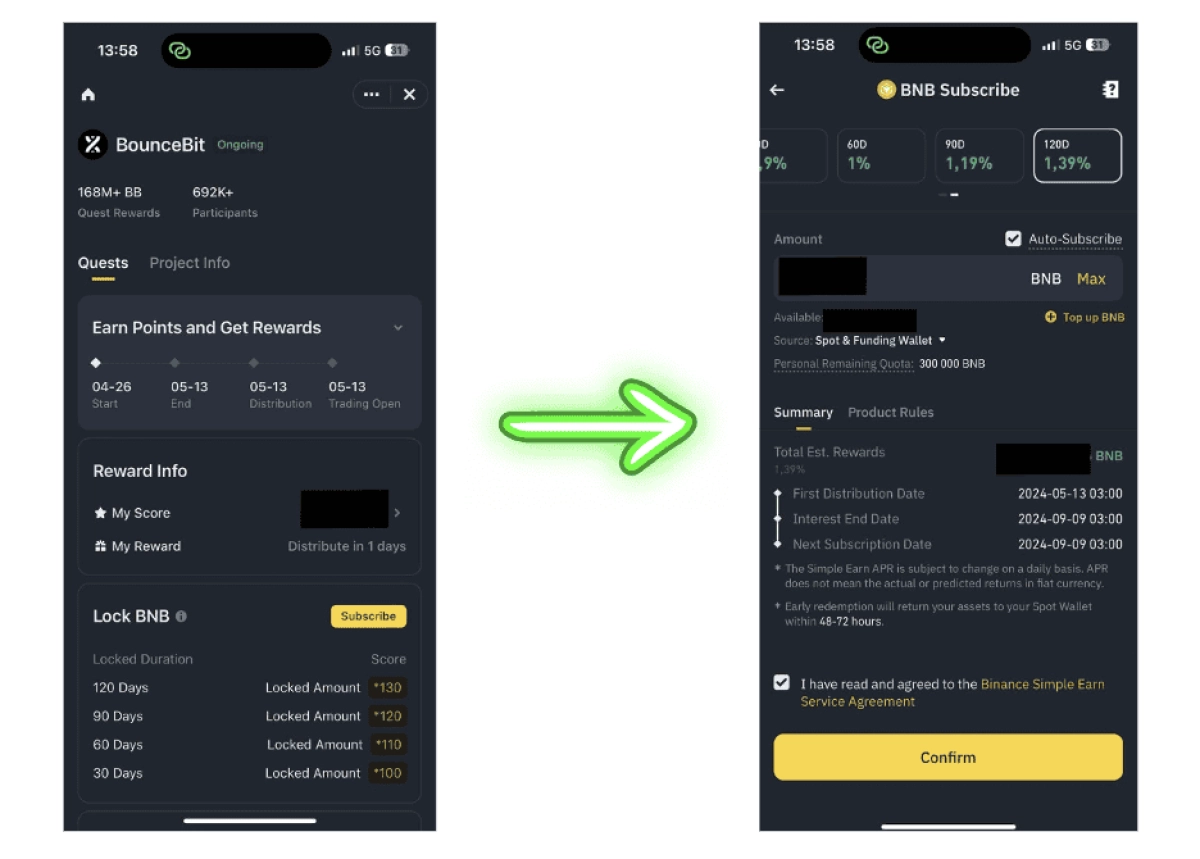
As you can see, the longer the subscription period, the higher the multiplier is.
The next thing you can do is complete Web3 quests. To do so, you will need the Binance Web3 Wallet. You can create one from your Binance mobile application. Navigate to your “wallets” tab at the bottom and then tap on the “Web3” at the top.
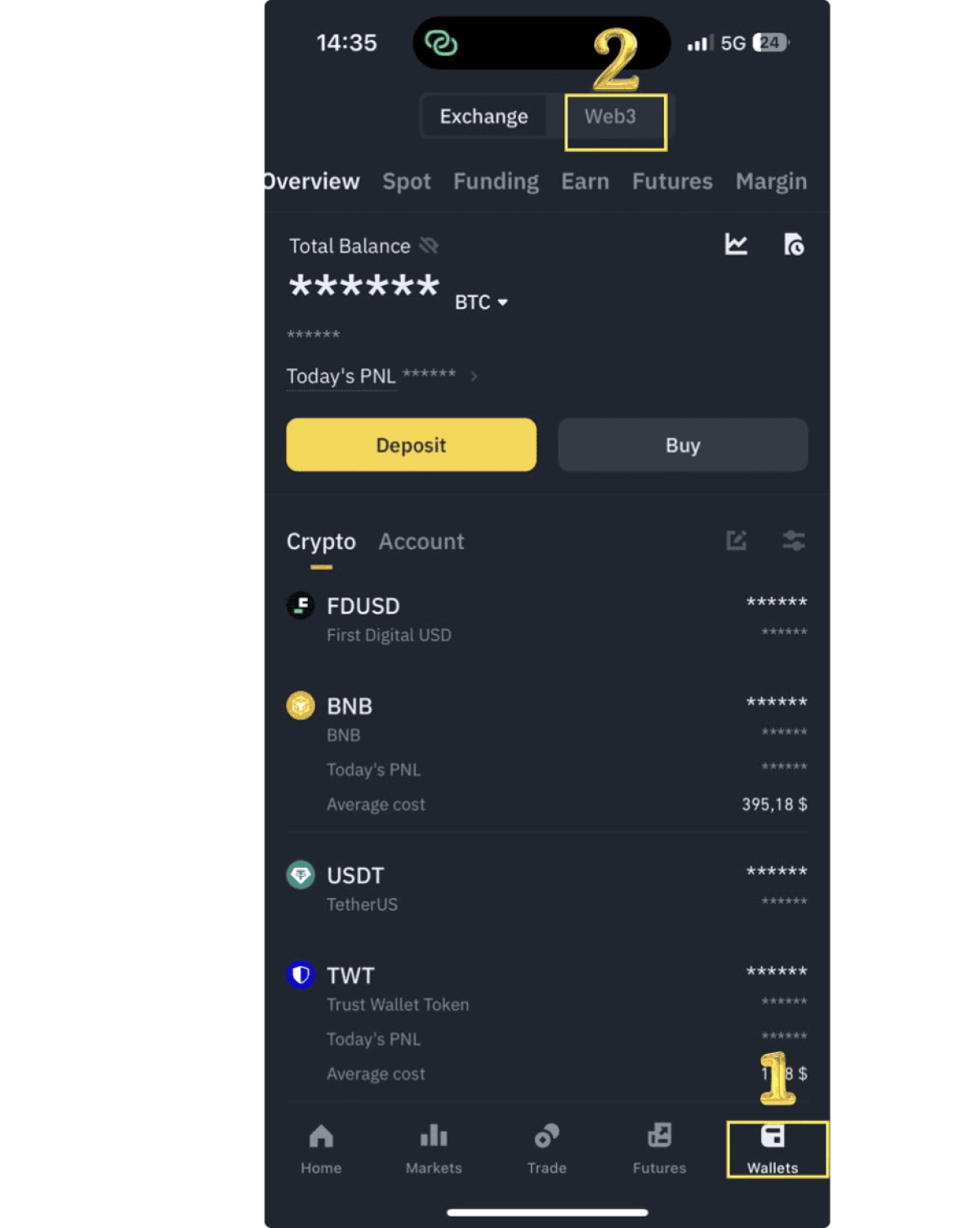
From here, simply follow the instructions, and your Web3 wallet will be generated. Now that your wallet is complete, navigate back to the Megadrop section and hit the “Start Quest” at the bottom – you will have to stake with BounceBit.
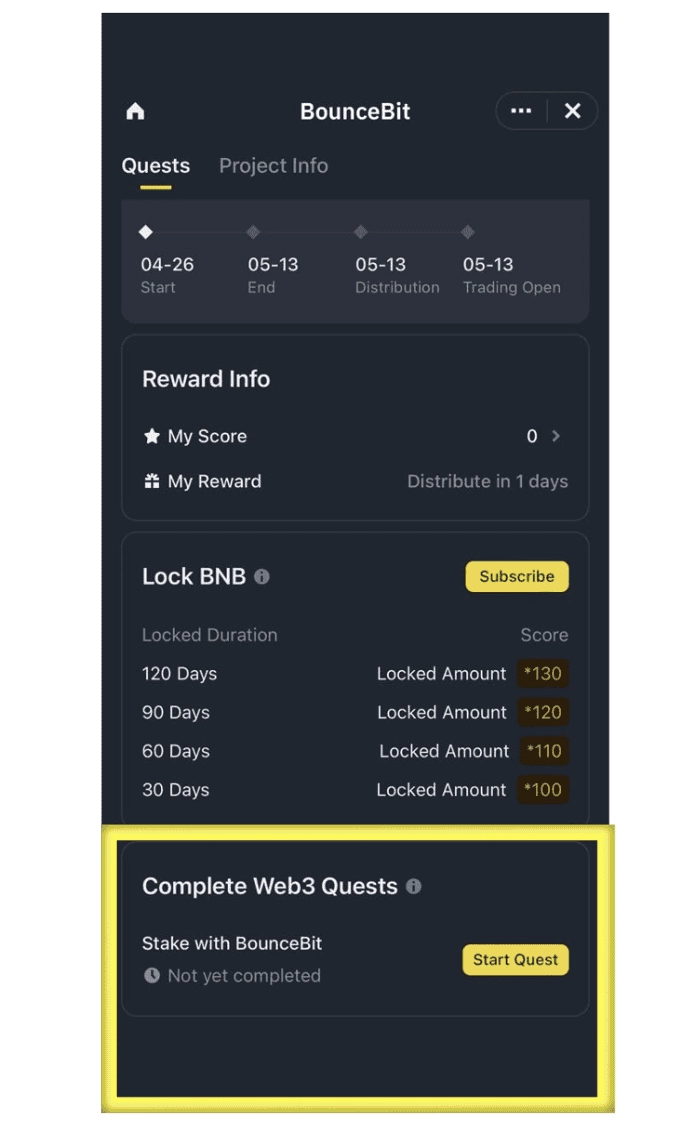
From there on, you can follow the instructions, which will guide you toward quest completion.
The total score you receive will be a combination of your Locked BNB score, your Web3 quest multiplier, and will also add your Web3 quest bonus. So the formula looks like this:
Total Score = (Locked BNB Score * Web3 Quest Multiplier) + Web3 Quest Bonus.
If you fail to finish all the quests, you will receive a multiplier of just 1.
This post has been powered by BounceBit.
The post What is BounceBit: Liquid Restaking on Bitcoin appeared first on CryptoPotato.
Disclaimer: This article is provided for informational purposes only. It is not offered or intended to be used as legal, tax, investment, financial, or other advice.
Read on CryptoPotato Investment Disclaimer