Written by: Maciej Zerelik
Compiled by: AididiaoJP, Foresight News
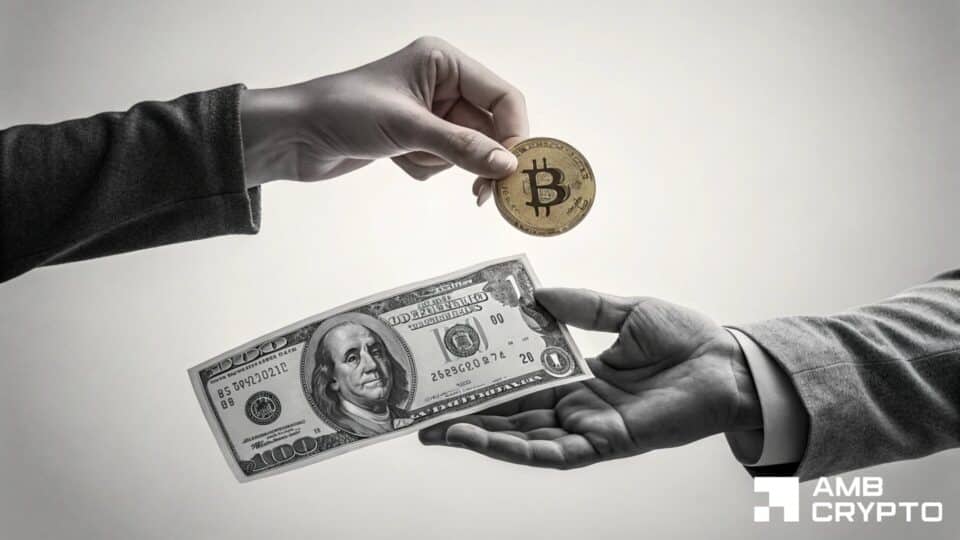
The altcoin season kicks off when alternative cryptocurrencies start outperforming Bitcoin. However, accurately pinpointing its exact start is not easy. This guide will provide a detailed explanation of the cyclical patterns of altcoin seasons, the impact of the ETF Wall, narrative-driven sector rotations, and potential cross-chain strategies for 2026.
Understanding Altcoin Season
Definition of Altcoin Season
Many newcomers wonder, what exactly is an altcoin season, and why does it attract so much attention from crypto investors.
Altcoin season refers to a phase where at least 75% of the top 50 cryptocurrencies outperform Bitcoin over a rolling 90-day period. Analysts use this benchmark to gauge whether capital is flowing from BTC into other digital assets.
This concept became widely known during the 2017-2018 bull market. At that time, countless investors shifted Bitcoin profits into Ethereum and other smaller tokens, resulting in many altcoins delivering returns far exceeding BTC within months.
Historically, a complete altcoin season typically lasts 2 to 6 months, though the rhythm varies each cycle.
"Outperform" means that an altcoin has a higher return than Bitcoin over the same period. For example, if Bitcoin rises 25% over 90 days, and Solana rises 80%, then Solana has significantly outperformed BTC. When most leading cryptocurrencies exhibit similar performance, the market is usually considered to be in an altcoin season.
Bitcoin vs. Altcoin Dynamics: The ETF Wall
Bitcoin Dominance represents Bitcoin's share of the total cryptocurrency market capitalization. When this indicator begins to decline, investors often interpret it as a signal that capital is flowing into altcoins.
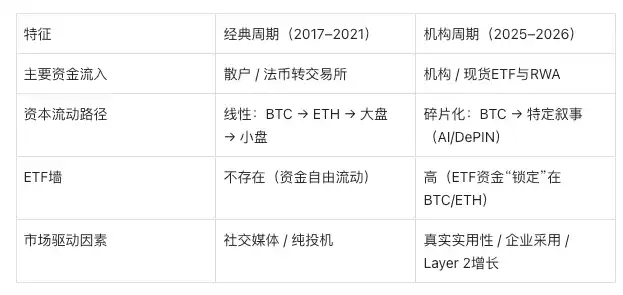
However, this market cycle is different from previous ones due to the existence of the so-called "ETF Wall."
Spot Bitcoin ETFs launched by asset managers like BlackRock and Fidelity have attracted tens of billions of dollars from institutional investors. These investors typically only gain Bitcoin exposure through regulated financial products, effectively locking this portion of capital within the BTC ecosystem.
In the 2017 bull market, retail capital could flow more freely into thousands of altcoins. In 2026, for a broad altcoin season to occur, it may require Bitcoin profit-taking alongside a new wave of retail and on-chain liquidity injection before capital can diffuse into the broader market.
Comparison between classic cycles (2017–2021) and institutional cycles (2025–2026):
How to Identify Altcoin Season
Identifying an altcoin season early can make a huge difference, as entering after the biggest gains often carries higher risks and less upside potential.
Altcoin Season Index and New 2026 Indicators
The Altcoin Season Index is one of the most popular tools for tracking market rotation. Developed by Blockchaincenter, it measures the performance of major cryptocurrencies against Bitcoin over the past 90 days on a scale of 0-100.
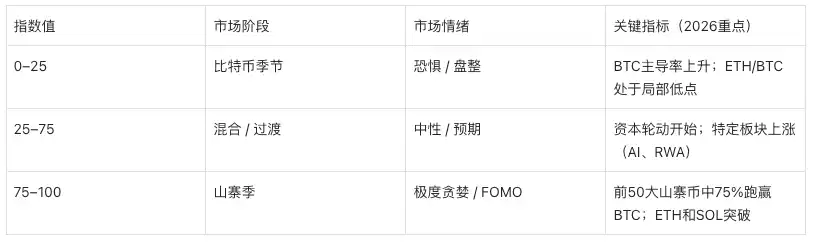
An index below 25 indicates Bitcoin season, 25-75 indicates a mixed market, and when the index rises above 75, the market is usually considered to be in an altcoin season, as most leading altcoins are outperforming BTC.
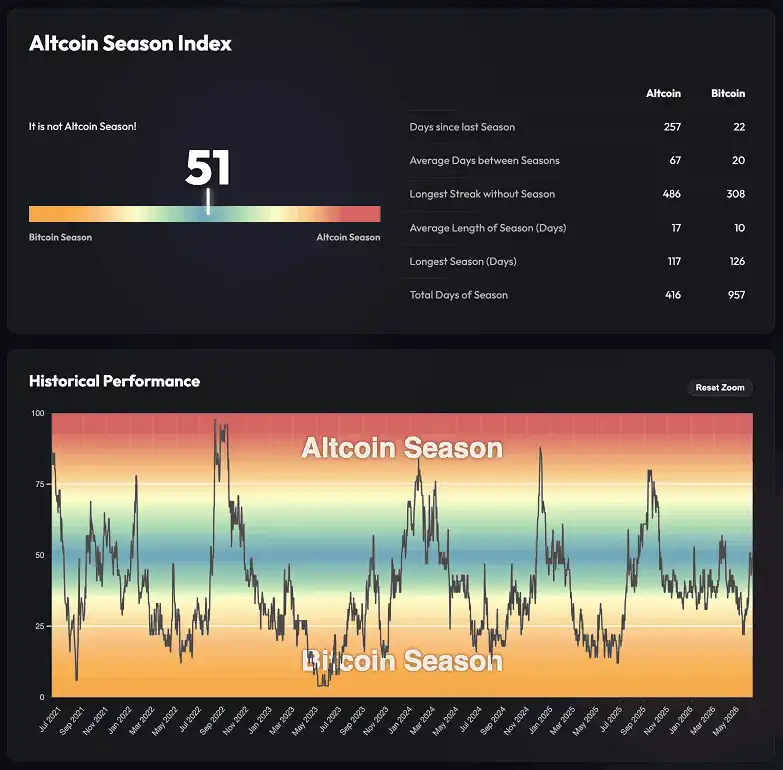
(Chart: Altcoin Season Index, BlockchainCenter, June 10, 2026)
However, the 2026 market requires additional confirmation. Many analysts now also observe the ETH/BTC and SOL/BTC trading pairs. If Ethereum and Solana fail to strengthen against Bitcoin, even if the index exceeds 75, it might only be short-term speculation rather than a sustainable rotation. Strong performance in benchmark pairs often confirms that capital has flowed from Bitcoin into the broader ecosystem.
Table of index values corresponding to market phases:
Key Metrics and Indicators
No single metric can perfectly predict the market. Experienced investors combine multiple signals to judge whether a new rotation is genuinely starting.
One of the strongest indicators is Bitcoin Dominance. When it retreats from above 50% to 40% or lower, it typically means capital is moving away from BTC into altcoins. Simultaneously, the total altcoin market cap growth rate should significantly outpace Bitcoin's, ideally by 2-3 times.
Trading activity also provides important clues. A week-over-week increase in altcoin/BTC trading volume exceeding 50% often indicates growing investor interest. Social media engagement and Google Trends can corroborate this, especially when search terms like "best altcoins" or "altcoin season" grow 30-50% within a few weeks.
When multiple indicators align, the probability of a genuine altcoin season is much higher than relying on the Altcoin Season Index alone.
Historical Altcoin Bull Run Patterns
Each major altcoin rally leaves valuable lessons, helping investors identify recurring trends and avoid emotional decisions in future cycles.
2017-2018 and 2020-2021 Bull Markets
Although both cycles produced astonishing returns, the driving forces behind them were entirely different.
The 2017-2018 altcoin season was driven by the ICO frenzy. Hundreds of new blockchain projects raised funds directly from retail investors, with speculation often outweighing fundamentals. As Bitcoin hit new highs and slowed down, capital quickly shifted to smaller tokens, with many coins surging hundreds of percent within months.
The 2020-2021 cycle followed a different path. Market focus shifted to DeFi protocols, NFT platforms, Layer 1 blockchains, and later, meme coins. Meanwhile, institutional investors entered the crypto space through companies, funds, and regulated products, bringing in capital far exceeding previous levels.
Retail investors still played a significant role in the NFT and meme coin mania, but institutional participation made the market larger and more mature. This shift also changed the way capital rotated, making the leadership role of Ethereum and key sectors more important than broad speculation. Therefore, future altcoin seasons may become increasingly selective rather than lifting all projects simultaneously.
Phases of an Altcoin Season: From BTC to Narrative-Driven
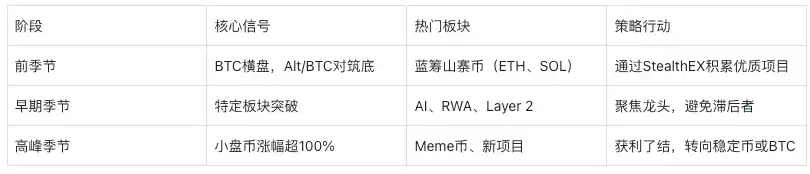
Modern altcoin cycles are no longer about all tokens rising in sync. Capital now rotates among different narratives, rewarding those sectors with the strongest adoption and momentum. Understanding these phases helps investors see where money is flowing, rather than chasing projects that have already peaked.
Phase comparison table:
Pre-Season (Accumulation Phase)
The accumulation phase typically begins when Bitcoin is range-bound or corrects by 10-20%. During this time, many altcoins may fall another 20-40% from their local highs, leading to disappearing retail interest.
Trading volume remains low, social media activity declines, and discussions are filled with negative sentiment. Behind the scenes, experienced investors are gradually accumulating fundamentally strong projects at discounted prices.
This phase often ends when Bitcoin stabilizes, Ethereum starts outperforming BTC, and trading volume slowly recovers. For long-term investors, this is the best time to research projects, build watchlists, and establish positions before widespread market attention returns.
Early Season: Narrative-Led Breakouts
Many investors ask, when does the altcoin season start? In today's market, the answer is often linked to narratives rather than market cap.
Not all top-ten cryptocurrencies will rise simultaneously; capital first flows into the most talked-about sectors. AI agents, Real-World Assets (RWA), and DePIN projects have recently become typical examples of this trend.
The traditional strategy of buying the largest altcoins simply because they are in the top ten is much less effective. Early winners are increasingly those projects with clear use cases, growing ecosystems, and the ability to attract fresh liquidity.
Peak Season (Maximum Activity)
When mid- and small-cap coins achieve 100-500% gains within weeks, does that mean we are in the common altcoin season? In this phase, optimism reaches extremes, and the Fear & Greed Index often exceeds 80.
Retail investors aggressively buy every dip, while experienced traders begin gradually reducing positions and locking in profits. New token launches surge, leverage amplifies, and social media is flooded with unrealistic price predictions.
These conditions are often warning signs rather than buying opportunities. Rising volatility, excessive leverage, and parabolic moves typically indicate the market is approaching exhaustion. Historically, this peak phase lasts 2 to 6 weeks, followed by significant corrections or broader market rotations.
Trading Strategies for Altcoin Season
Successful altcoin investing depends on a clear plan. A structured strategy helps investors manage risk, protect profits, and avoid emotional decisions during extreme volatility.
Portfolio Allocation and Sector Rotation
A balanced portfolio should match your risk tolerance and market environment. Conservative investors allocate more capital to Bitcoin, Ethereum, and stablecoins, while aggressive traders increase exposure to high-growth sectors during strong trends.
Sector rotation is equally important. Capital rarely stays in one narrative for the entire cycle. For example, profits taken from AI-related projects may later rotate into RWA, DePIN, gaming, or other emerging sectors. Following liquidity rather than chasing past winners often yields better long-term results.
Risk Management and Stop-Loss Discipline
Even the strongest altcoin seasons eventually end, so risk management is one of the most crucial parts of any strategy.
Many experienced investors limit single positions to 5-10% of their portfolio to minimize the impact of any one trade failing. Diversifying across 8-12 carefully selected projects further reduces overall risk while maintaining exposure to multiple narratives.
Keeping a portion of the portfolio in stablecoins also provides flexibility. A stablecoin reserve allows you to buy quality assets during pullbacks and protect profits when the market overheats. Combined with preset stop-losses and profit targets, this disciplined approach often leads to more consistent outcomes than trying to maximize gains on every trade.
Altcoin Season vs. Bitcoin Season
Understanding the transition between Bitcoin season and altcoin season helps investors identify market rotations and adjust strategies before capital shifts.
Key Differences and Rotation Signals
The difference between altcoin season and Bitcoin season lies in capital flow. During Bitcoin season, BTC dominance typically rises above 50-60%, showing investor preference for the market's largest, most mature asset. Simultaneously, many altcoins underperform or decline against BTC even if their USD price is stable.
Altcoin season is the opposite story. Bitcoin dominance tends to fall back to 40% or lower, and Ethereum and other major cryptocurrencies begin to attract more liquidity. This rotation eventually spreads to mid-cap and small-cap projects, creating the cycle's strongest gains.
Investor profiles also change. Bitcoin season attracts more conservative investors and institutions seeking lower volatility and long-term exposure. Altcoin season brings more speculative capital, with traders accepting higher risk in pursuit of significantly higher returns.
Historically, Bitcoin dominant phases can last for months, while intense altcoin seasons may only last 2-6 weeks before momentum fades. Therefore, watching BTC dominance is critical. If dominance begins rising again, stablecoin inflows increase, and leading altcoins start weakening against Bitcoin, these are often early signals that capital is flowing back to BTC or defensive positions, signaling the altcoin season is about to end.
Expert Predictions and Future Outlook for Altcoin Season
While all predictions involve uncertainty, understanding altcoin season forecasts and their key catalysts can help investors build smarter long-term strategies.
When Will the Next Altcoin Season Start
Many investors ask when the altcoin season will start, but no indicator can give an exact date. Successful prediction relies on a combination of macroeconomic conditions, Bitcoin market cycles, and capital rotation.
Historically, the strongest altcoin rallies have occurred 18 to 30 months after a Bitcoin market bottom, often following a halving event. Given the most recent Bitcoin halving occurred in April 2024, many analysts believe 2026-2027 could still offer favorable conditions if liquidity continues to improve.
Macroeconomic factors will play a significant role. Lower interest rates, global liquidity expansion, and stronger investor risk appetite may encourage capital flow into high-risk digital assets. Institutional adoption will also support the market, though much investment remains concentrated in Bitcoin ETFs rather than altcoins.
Technological progress will likely shape the next cycle alongside macroeconomics. Narratives like AI infrastructure, real-world asset tokenization, DePIN, next-gen DeFi, and blockchain gaming may become the primary destinations for fresh capital. Investors should not expect all cryptocurrencies to rise in unison but should focus on sectors attracting real users, active developer engagement, and institutional attention.
When Will the 2026 Altcoin Season Start
The official confirmation of a 2026 altcoin season has not yet begun, as Bitcoin currently represents about 56-60% of the total market cap. Analysts predict that a sustained shift to altcoins will only occur when Bitcoin dominance falls below 50-55% and the Altcoin Season Index reaches the 75 threshold.
How to Prepare for the Next Altcoin Season
Preparing during calm market periods often creates better opportunities than reacting after prices have already skyrocketed. A solid plan allows you to act confidently when momentum returns.
Building a Watchlist
The best watchlists focus on quality over quantity. Before adding a project, investors should confirm it has a real product, active users, an experienced and public development team, reasonable valuation, and a strong community supporting long-term growth.
A practical research checklist should include: token utility, ecosystem activity, developer updates, partnerships, liquidity, tokenomics, and competitive advantages. Regularly reviewing these factors makes it easier to distinguish lasting projects from short-term hype.
Frequently Asked Questions
What is the current Altcoin Season Index value?
You can view the Altcoin Season Index in real-time on Blockchaincenter. A score of 0-25 indicates Bitcoin season, 25-75 indicates a mixed market, and 75-100 suggests an altcoin season. Although the index updates daily, checking weekly often provides clearer signals and avoids overtrading due to short-term noise.
When is the altcoin season coming?
Many investors ask when the altcoin season is coming, but there is no fixed date. Historically, major altcoin rallies have often occurred 12-18 months after a Bitcoin halving. While the most recent halving was in April 2024, market conditions, Bitcoin dominance, liquidity, and ETH/BTC strength are more important than the calendar.
If Bitcoin crashes, can an altcoin season still happen?
No. A broad altcoin season requires Bitcoin to remain stable or rise moderately. When Bitcoin drops more than 20% in a short period, capital typically leaves the entire crypto market rather than rotating into altcoins. Historically, significant altcoin rallies have occurred during Bitcoin consolidation or moderate uptrends, with only a few exceptions during minor BTC pullbacks.
When will altcoins surge?
The answer to when altcoins will surge usually depends on market rotation. Altcoins tend to accelerate after Bitcoin dominance peaks above 50-55% and begins to decline, while the ETH/BTC ratio strengthens. A 15-30% rise in ETH/BTC often heralds a broader rally, with capital gradually flowing from Ethereum to large-cap, then mid-cap, and finally small-cap altcoins.