2025 Korean CEX Listing Review: Investing in New Tokens = 70% Loss?

marsbitPublished on 2026-03-12Last updated on 2026-03-12

Abstract

The analysis examines the performance of new tokens listed on major Korean cryptocurrency exchanges (Upbit and Bithumb) in 2025, comparing them with Binance. The study finds that investing $100 in each new KRW trading pair on Upbit (59 tokens) and Bithumb (144 tokens) would have resulted in a portfolio value of only 31% of the original investment by March 11, 2026, equivalent to a 70% loss. Binance (92 tokens) performed similarly with a 29% return. Only two tokens on Upbit (KITE +232.8%, BARD +9.3%) and eight on Bithumb ended in profit. Median returns were -80.9% for Upbit and -82.1% for Bithumb, indicating worse typical performance than the average suggests. Tokens listed in the second half of the year performed better, likely due to shorter exposure to the bear market. Notably, tokens listed on both exchanges (50 tokens) showed nearly identical losses (-69.4%) to those listed only on Bithumb (-68.9%), indicating that multiple listings do not guarantee better performance. The study concludes that the loss is structural: initial buying pressure inflates prices on listing day, followed by a predictable decline. This pattern is global, not specific to Korea or any exchange.

Original Author: @c4lvin, Four Pillars

Original Compilation: AididiaoJP, Foresight News

Core Conclusion

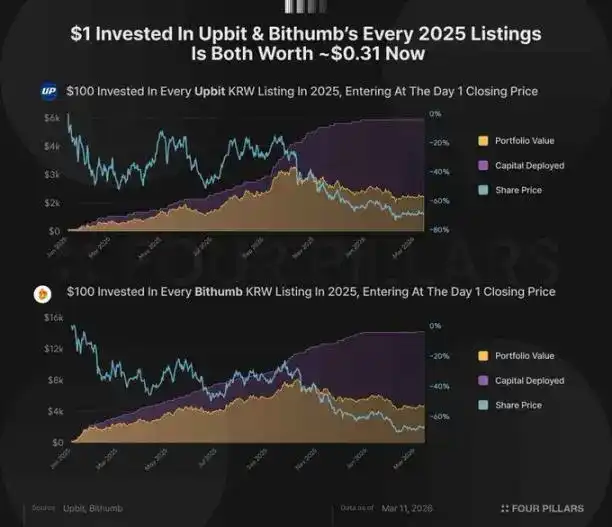
If you invested $100 in each of the 59 new tokens listed for Korean Won (KRW) trading pairs on Upbit in 2025, as of March 11, 2026, the value of this portfolio would be only 31% of the original investment (i.e., each dollar dropped to $0.31). Bithumb (144 tokens) performed identically, also at 31%; Binance (92 tokens) was slightly lower at 29%. All three major exchanges resulted in approximately a 70% loss of capital.

Of the 59 tokens listed on Upbit, only two ultimately turned a profit: KITE (up 232.8%) and BARD (up 9.3%). Bithumb performed slightly better, with 8 out of 144 tokens maintaining positive returns. The median return on Upbit was -80.9%, while on Bithumb it was -82.1%.

For the 50 tokens listed on both major Korean exchanges, their average return (-69.4%) was almost identical to that of the 94 tokens listed only on Bithumb (-68.9%). This data indicates that listing on multiple major exchanges does not guarantee subsequent price performance.

Research Background

The inspiration for this analysis came from a data chart published today by Messari research analyst @Degenerate_DeFi.
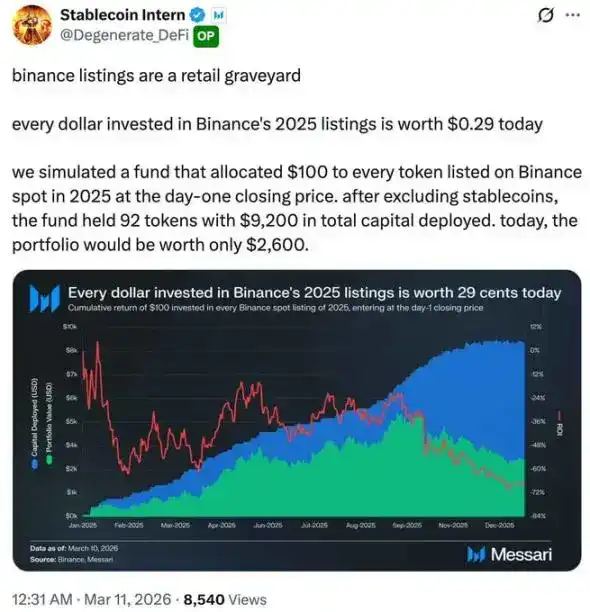
Data Source: @Degenerate_DeFi

The chart shows that if you invested $100 in each of the 92 new tokens listed on Binance in 2025, as of today, each dollar invested is worth only $0.29. This means that out of a total investment of $9,200, the cumulative loss reached 71.7%, leaving a remaining value of approximately $2,600.

As the world's largest cryptocurrency exchange by trading volume, Binance's listing standards are generally considered stricter than those of smaller platforms, and its liquidity advantage is unparalleled. If the data from Binance looks like this, what about the situation on Korean exchanges? The Korean market is retail-investor dominated, with trading patterns significantly different from the global market. Do these differences affect the performance of newly listed tokens? Or will the data ultimately reveal similar patterns?

This article will adopt the same methodology as the Binance analysis to systematically analyze all tokens that gained Korean Won trading pairs on Upbit and Bithumb throughout 2025.

Research Methodology

Scope Definition and Screening Criteria

This study covers all tokens that had new KRW market trading pairs added on Upbit and Bithumb between January 1, 2025, and December 31, 2025. This includes 59 tokens on Upbit and 144 tokens on Bithumb. For tokens listed in 2025 but subsequently delisted, such as Elixir (ELX), Strike (STRIKE), and AI16Z, this study treats them as complete losses.

The investment simulation rules follow the unified framework used in Messari's analysis of Binance listings. We assume an investment of $100 at the closing price on the first day of listing for each token and hold until the present without any selling. By tracking the cumulative value and return rate of this portfolio daily, a time-series dataset is constructed.

Choosing the first day's closing price as the entry point was a deliberate decision. On Korean exchanges, the opening price on the first day is often significantly inflated due to extreme volatility and speculative buying. Using the closing price effectively filters out this short-term noise.

Data Collection

Price data was obtained directly through the public REST APIs of each exchange. For Upbit, we used the daily candlestick (K-line) interface to collect complete daily OHLCV data for each token from its listing date until March 11, 2026, and cross-verified the current price using the ticker interface (/v1/ticker). For Bithumb, the 24-hour K-line interface was used to gather data for the same period. To simplify the model, this study did not consider exchange rate fluctuations between the US Dollar and the Korean Won.

Overall Performance

The chart below visually presents the simulation results. Subsequent sections will provide a detailed interpretation and analysis of this data.

Comparison of the Three Major Exchanges
The performance comparison of new tokens listed in 2025 on the three major exchanges is as follows:
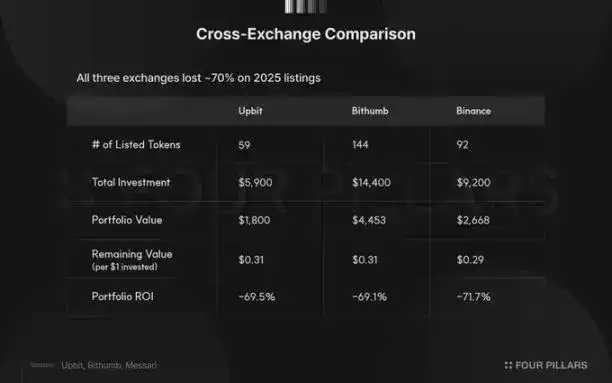
All three exchanges recorded losses of approximately 70%. Upbit (-69.5%) and Bithumb (-69.1%) performed almost equally, with Binance (-71.7%) also being very similar. Regardless of which exchange was chosen, investors buying new tokens at the first day's closing price lost about seventy percent of their initial capital on average.

Return Distribution Characteristics

The overall average is not enough to reveal the differences in individual token performance. The following breaks down the returns of each token in detail by interval:
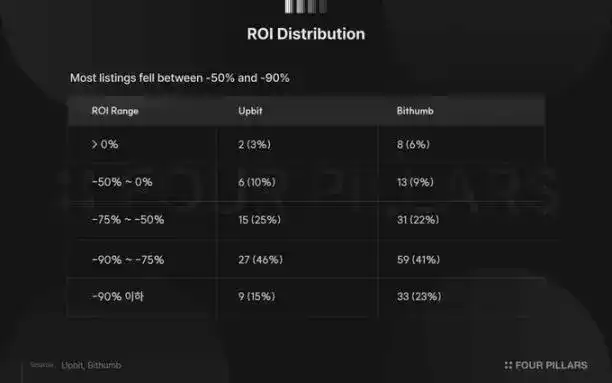
On both exchanges, over 40% of the tokens were concentrated in the loss interval of -75% to -90%. On Upbit, this interval accounted for 46%, with an additional 9 tokens (15%) suffering extreme losses exceeding 90%. Only two tokens ultimately achieved positive returns: Kite (KITE, up 232.8%) and Lombard (BARD, up 9.3%).

Bithumb's return distribution was more dispersed. It had a higher number of profitable tokens, totaling 8, but also had 33 tokens that experienced extreme losses exceeding 90%. This dispersion is partly due to the larger sample size of 144 tokens, but it also reflects that Bithumb's listing strategy covers a wider range of project types compared to Upbit.

The median return reveals a harsher reality: -80.9% for Upbit and -82.1% for Bithumb, both lower than their respective averages. This indicates that a few relatively resilient tokens pulled up the overall average, and the typical performance of newly listed tokens is actually more dismal than the surface data suggests.

Impact of Listing Timing on Performance

To examine whether the timing of listing affects subsequent results, we divided the data into two periods: the first half (January to June) and the second half (July to December) for comparison.
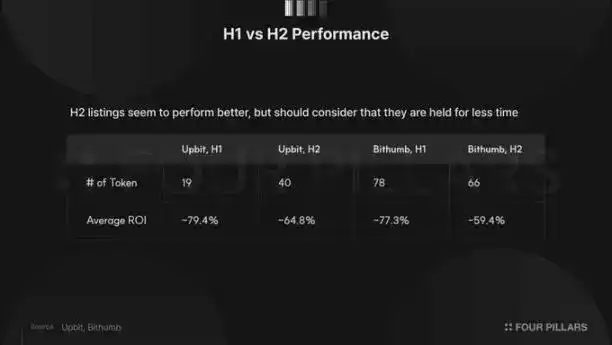
The data shows that tokens listed in the second half performed better on both exchanges. This phenomenon is intuitive: tokens listed earlier in the year experienced a longer period of decline. Given that the overall crypto market was in a downtrend in 2025, the longer the holding period, the higher the natural probability of accumulating greater losses.

It is worth noting that the performance gap between the two halves is quite significant. On Bithumb, the difference in returns between tokens listed in the first half (-77.3%) and those listed in the second half (-59.4%) is about 18 percentage points, a difference that cannot be explained by time factor alone. Possibilities include: tokens listed in the second half indeed had stronger fundamental support, or market expectations had become more rational due to the lessons learned in the first half.

The Paradox of Choice

Relationship Between Number of Listings and Performance

Throughout 2025, Upbit added 59 new KRW trading pairs, while Bithumb added 144. Bithumb's number is more than double that of Upbit and also significantly exceeds Binance's 92. Upbit is renowned for having the strictest listing standards among Korean exchanges. However, despite the vast difference in the number of listings, the portfolio returns of the two exchanges are almost identical: -69.5% for Upbit and -69.1% for Bithumb.

Analysis of Cross-Listed Tokens

To investigate further, we compared the performance of tokens listed on both exchanges with those listed only on Bithumb. The data shows that 50 tokens were listed on both Upbit and Bithumb.
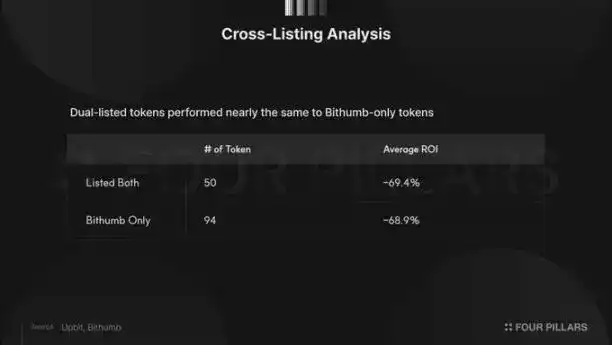
Logically, projects that manage to list on both major exchanges should possess a certain degree of industry recognition. However, the average return of these 50 tokens (-69.4%) is almost exactly the same as that of the 94 tokens listed only on Bithumb (-68.9%).

This finding leads to two conclusions:

First, listing on multiple major exchanges does not provide any guarantee for subsequent price performance.

Second, the first-day price inflation triggered by the listing event is a structural phenomenon, and its occurrence is unrelated to how much attention the project itself receives.

Whether a token has the "honor" of being listed on Upbit as well, or is quietly listed only on Bithumb, the losses ultimately borne by first-day buyers show no significant difference.

Analysis of the Few Survivors

Among the 59 tokens listed on Upbit, only KITE (up 232.8%) and BARD (up 9.3%) ultimately achieved positive returns. Only 8 tokens limited their losses to within 50%.

The 8 profitable tokens on Bithumb constitute a more diverse sample.
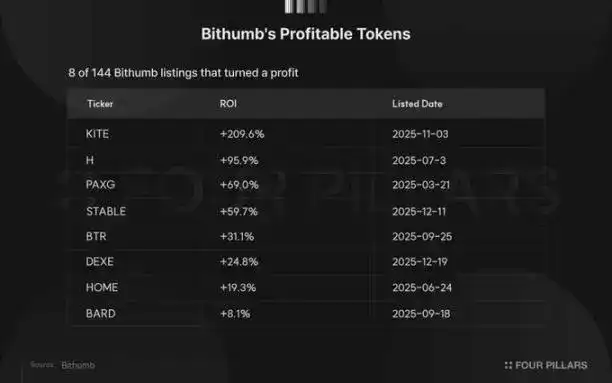
KITE recorded a gain of 209.6%, a significant outlier. However, it should be noted that this token has only been listed for four months; interpreting its performance as a sustainable long-term outcome is premature. STABLE and DEXE also require cautious viewing due to their short tracking record of only three months.

The case of PAXG is more instructive. As a token pegged 1:1 to the spot price of gold, its 69.0% gain was entirely driven by the steady rise in gold prices throughout 2025. This performance has nothing to do with cryptocurrency market fundamentals; it is merely a reflection of macro gold trends. In other words, the most reliable way to achieve profit on Bithumb was ironically not to invest in a cryptocurrency project itself.

Conclusion

This study concludes that the performance of newly listed tokens on Korean exchanges in 2025 is not fundamentally different from that on Binance at a structural level. Although the Korean market is characterized by a high proportion of retail participation, listing strategies vary among exchanges, and the regulatory environment is distinct, the average loss for first-day buyers converges around 70% across all three major exchanges.

We believe the core insight revealed by this data is: the root of the problem lies not in the listing standards of a specific exchange, nor in the quality of individual tokens, but in the structural dynamics inherent to the listing event itself. When a token is newly listed on a major exchange, concentrated retail demand pushes up the price on the first day. Over time, the price naturally regresses, causing losses for first-day buyers. The convergent performance of tokens listed on both exchanges and those listed on only one further confirms that these losses are not due to a specific exchange or token, but are a structural feature of the listing event.

It is important to note that this study measures the performance of one specific strategy: buying at the first day's closing price and holding until now. Strategies that utilize short-term price fluctuations in the days following the listing, or strategies that enter the market after a significant price correction, might yield completely different conclusions. However, such strategies require extremely precise timing, which is far removed from the actual behavior of most retail investors.

The data from 2025 provides a clear message: buying a token simply because it is newly listed on a major exchange is a systematically losing strategy, regardless of which exchange is chosen. This phenomenon is not unique to the Korean market; it is a global structural issue. The reason is not that exchanges are selecting inferior projects, but that the listing event itself creates a dynamic of concentrated demand that is persistently unfavorable to first-day buyers.

Related Questions

QWhat was the average percentage loss for investors who bought new tokens on their first day of listing on major Korean exchanges (Upbit and Bithumb) in 2025 and held until March 11, 2026?

AInvestors experienced an average loss of approximately 70%. The portfolio value dropped to 31% of the original investment on both Upbit and Bithumb, equating to a 69% loss.

QHow many tokens listed on Upbit in 2025 ended up being profitable for investors who bought at the first day's closing price?

AOnly two tokens listed on Upbit in 2025 were profitable: KITE (up 232.8%) and BARD (up 9.3%).

QDid listing on multiple major exchanges (cross-listing) provide any guarantee of better performance for a token?

ANo, listing on multiple major exchanges did not provide any guarantee. The 50 tokens listed on both Upbit and Bithumb had an average return of -69.4%, which was almost identical to the -68.9% return of tokens listed only on Bithumb.

QWhat was a key structural reason identified in the article for the consistent poor performance of newly listed tokens?

AThe poor performance was attributed to a structural dynamic of the listing event itself. Concentrated retail demand artificially inflates the price on the first day, which then naturally corrects downward over time, systematically disadvantaging those who bought at the inflated first-day price.

QBesides KITE and BARD, what was another profitable token on Bithumb and what was the reason for its positive performance?

APAXG was another profitable token on Bithumb, with a gain of 69.0%. Its performance was not related to cryptocurrency market fundamentals but was solely driven by the steady rise in the spot price of gold, to which the token is pegged 1:1.

Related Reads

Retail Ecology Dwindles, ZKsync Bets on Bank Pilots for a Breakthrough

Amidst declining retail activity, ZKsync is pivoting to target institutional banking as its primary growth strategy. The article explores this shift, contrasting it with the competitive "survival of the fittest" narrative by highlighting a cooperative model inspired by naturalist Peter Kropotkin. ZKsync is developing infrastructure like its private, permissioned Prividium suite for banks (e.g., Deutsche Bank's use case via Memento), enabling private transactions with public verifiability via zero-knowledge proofs. This appeals to institutions needing privacy, compliance, and Ethereum-based settlement security, unlike fully private chains (e.g., JPMorgan's Kinaxis) or consortium models (e.g., R3 Corda). However, this strategic focus has coincided with a steep decline in its public DeFi ecosystem, evidenced by plunging TVL and the departure of major protocols like Aave due to low fees. The network's future now hinges on banking adoption, with upcoming pilots like the Cari Network involving regional banks holding over $600 billion in deposits. A significant challenge is balancing this institutional focus with ZKsync's decentralized governance. Banks must operate on a network where rules and fees (denominated in the volatile ZK token) can be changed via community vote, and where a Security Council holds emergency control—a stark contrast to the predictable, contract-bound environments of traditional finance. The coming 18 months will test whether ZKsync can successfully onboard traditional banks onto a dynamically governed public chain or if institutions will ultimately revert to proprietary solutions.

Foresight News14m ago

Retail Ecology Dwindles, ZKsync Bets on Bank Pilots for a Breakthrough

Foresight News14m ago

The Recursive AI Anthropic Warned About: Tian Yuandong's New Company Has Just Taken the "First Step"

Anthropic recently highlighted the rapid progress toward "recursive self-improvement," where AI systems autonomously design and train their successors. In response, Recursive Superintelligence, a new company co-founded by former Meta researcher Tian Yuan Dong, has publicly demonstrated its first step toward automating AI research. The company released a system designed to autonomously execute the full AI research cycle: generating ideas, implementing code, running experiments, and learning from results. It validated this approach by achieving state-of-the-art results on three diverse benchmarks: 1. **NanoChat Autoresearch:** Optimizing a small language model's validation loss under a fixed 5-minute GPU budget, improving upon the community's best result. 2. **NanoGPT Speedrun:** Reducing the time to train a GPT model to a specific loss on 8 H100 GPUs from 79.7 seconds to 77.5 seconds, beating a highly optimized, human-driven community effort. 3. **SOL-ExecBench:** Improving the overall score on NVIDIA's suite of 235 GPU kernel optimization tasks by 18%, closing the gap to the hardware limit. The system discovered novel optimizations in this highly specialized domain without direct human expertise. Recursive's system operates as a general framework, capable of parallel exploration and cross-task knowledge transfer while incorporating safeguards against reward hacking. The company, backed by $650M in funding and a star-studded team including Richard Socher and Alexey Dosovitskiy, aims to create AI that recursively enhances its own research capabilities. This development represents an early but concrete move toward a new paradigm where AI accelerates its own advancement. It occurs alongside Anthropic's warnings about the need for industry coordination and potential pauses when recursive self-improvement thresholds are reached, highlighting the dual trajectory of rapid technical progress and growing calls for careful stewardship.

marsbit22m ago

The Recursive AI Anthropic Warned About: Tian Yuandong's New Company Has Just Taken the "First Step"

marsbit22m ago

The Gold Buy-on-the-Dip Guide: Watch Interest Rates, Not Just War

"Gold Buying Guide: Focus on Interest Rates, Not Just War" Four months ago, gold buyers likely didn't anticipate buying at a peak that even a war couldn't sustain. After hitting a record high of $5,596 on January 29, gold entered a bear market just 91 days later, its fastest decline since 2008. A key trigger was the Fed's hawkish shift, highlighting that monetary policy, not geopolitics, is the primary driver. The article argues that the traditional "buy gold in turmoil" script has changed. While the US-Iran conflict initially boosted prices, the sustained rally in oil prices heightened inflation fears, forcing central banks to maintain or consider tighter policy. Since gold yields no interest, higher rates increase its opportunity cost, eroding its appeal. This dynamic was evident when gold fell sharply on May 18 despite positive peace talks, as lower oil prices eased inflation and thus rate hike pressures. The recent sell-off is also part of a broader market deleveraging. Correlations between gold, Nasdaq, and Bitcoin spiked as leveraged investors sold liquid assets to cover losses, creating a synchronized downturn. Historically, gold bottoms align with policy shifts, not conflict resolutions. The 2008 and 2022 bear markets ended with shifts to extreme easing and peak inflation expectations, respectively. For potential buyers, the author suggests monitoring three signals: 1) Peak interest rate hike expectations, 2) Reopening of the Strait of Hormuz (to ease oil/inflation pressure), and 3) A return to net inflows for Gold ETFs, indicating the end of forced selling. While predicting the exact bottom is impossible, the author's personal strategy involves scaling into a position across price levels like $4000, $3700, and $3500, committing no more than 30% of the intended total allocation initially, and adding the remainder only if key signals emerge. The core conclusion: In turbulent times, watching interest rates is more crucial than watching wars.

marsbit28m ago

The Gold Buy-on-the-Dip Guide: Watch Interest Rates, Not Just War

marsbit28m ago

Recent On-Chain Review: No Clear Narrative Under U.S. Stock Market Pressure, Just Hype

This article analyzes the current state of the Solana meme coin and community token ecosystem, highlighting a market caught between two dominant forces: attention-based PvP and a gradual return to community-centric projects. The first part explores the "Attention PvP" dynamic, where success is driven by celebrity endorsements, viral events, and speed. Examples include $JOTCHUA, which surged after its meme creator's social media activity, and $WORLDCUP, which outperformed a similar Base chain project ($PITCH) largely due to influencer support. The recent "pump.fun GO" feature, allowing bounty tasks for token promotion, is critiqued for fostering sensationalist and often negative stunts—like people getting token tickers tattooed on their bodies for rewards—reminiscent of old internet shock content. In contrast, the article points to a resurgence of organic, community-driven tokens that survive market volatility through strong holder bases and shared ideology, not just hype. Influencer Ansem is cited, arguing that durable meme coins rely on communities willing to endure losses and promote their core message daily. Examples given are older tokens like $neet (anti-work ethos), $troll, $buttcoin, and $triplet, which have maintained relative price stability. A prime example of this community-build model is the new project $KINS, the token for the browser-based MMORPG Kintara. Its success stems not from advanced graphics but from consistently delivering updates, fostering player trust, and creating genuine engagement (e.g., in-game economies, events, property auctions). It has attracted a growing player base and even notable KOLs as participants, demonstrating that sustainable growth can come from building trust rather than orchestrating pumps. The article concludes by questioning whether the market is ultimately a game of mutual trust or mutual deception, expressing hope that such reflection might lead to a healthier ecosystem.

marsbit28m ago

Recent On-Chain Review: No Clear Narrative Under U.S. Stock Market Pressure, Just Hype

marsbit28m ago

Trading

Spot
Futures
活动图片