BTC现货ETF:宛若“春药”的极致诱惑

Odaily星球日报Published on 2023-12-29Last updated on 2023-12-29

Abstract

美国BTC现货ETF悬而未决,香港等不及了。12月22日,香港证监会连发4则通函,最重磅的莫过于宣布将批准虚拟资产现货ETF。

Old Money 难以抗拒的“春药”

美国 BTC 现货 ETF 悬而未决,香港等不及了。12 月 22 日,香港证监会连发 4 则通函,最重磅的莫过于宣布将批准虚拟资产现货 ETF。

BTC 现货 ETF,是加密世界最梦寐以求的一剂“春药”。单是历史上每次讨论,就会引得市场高潮连连。如今,香港要把这瓶猛药打开,将近十年全球表现最好的金融资产裱近 ETF 里,难免引得早就蠢蠢欲动的 Old Money 朝思暮想。
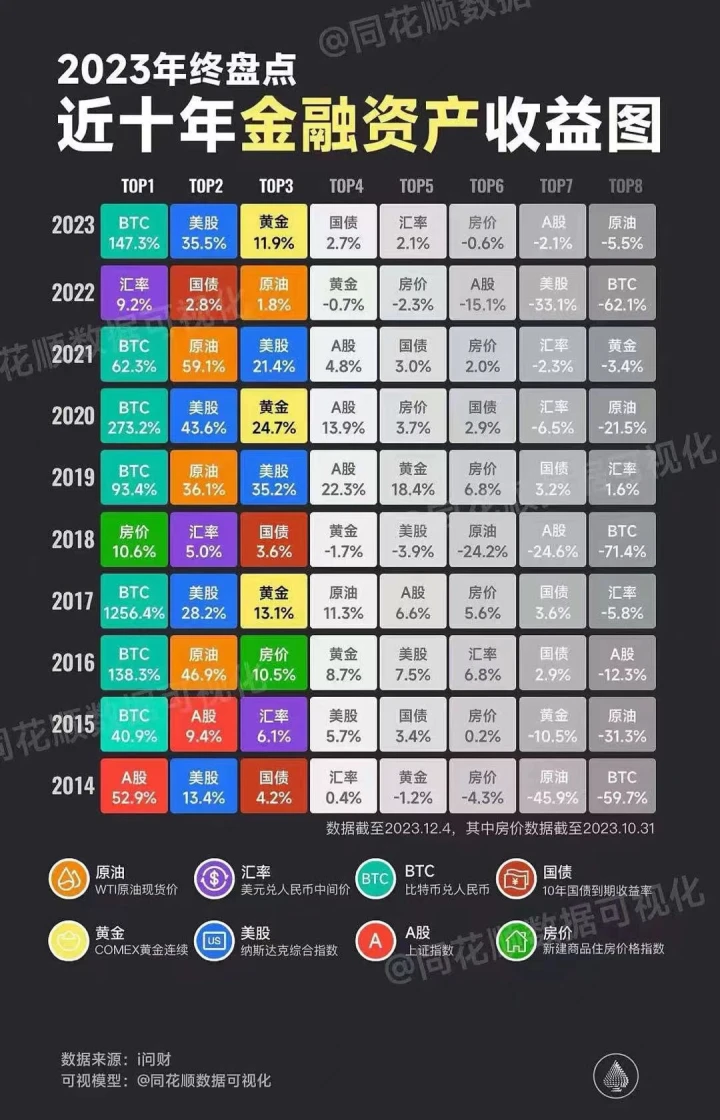
BTC现货ETF:宛若“春药”的极致诱惑

许多传统基金早就馋上了比特币的身子,奈何碍于风险太高,没有合规入场渠道,只能眼瞅着比特币高耸直上,这滋味着实不好受,所以有的机构哪怕只能进不能出,也要把钱交给灰度买 BTC;更有甚者盯上了重仓梭哈 BTC 的上市公司 Microstrategy,狂买它的股票,间接一亲 BTC 的芳泽。

虽然芝加哥商品交易所早就上市了比特币期货 ETF,香港也有南方东英推出的期货 ETF,但压根解不了老财团们的渴。毕竟,绝大多数公募基金都没法炒期货,投资列表里也不能加上 BTC 这种高风险资产的选项。但现货 ETF 不一样,无论是公募、私募基金,现货 ETF 都是常规投资标的,甭管里面装的是 BTC 还是黄金,一概可以出手。

数千亿美金增量带来翻倍涨幅

随着香港、美国放开比特币现货 ETF,BTC ETF 将直接登陆传统证券市场,基金、家族办公室、上市公司不需要修改投资范围,就能在习惯的证券软件中配置 BTC。而在市场优质资产稀缺的当下,比特币作为最红、最热门的新资产,足以靠 ETF 这剂“春药”成为新晋投资标的里的头牌。

美国 401(k)养老金已经跃跃欲试了。华盛顿州斯波坎市哥伦比亚咨询公司的创始人 Steven T. Larsen 称,一旦美国 SEC 对比特币现货 ETF 点头,将有更多公司决定在其 401 (k)产品阵容中提供比特币 ETF。

一旦养老基金这样的庞大资金入场,加密市场将迎来巨大增量。单看美国市场,目前 14 家现货比特币 ETF 申请机构的总资产管理规模为 14 万亿美元,这些资金哪怕有 1% 入场,就能带来千亿美元级别的新增资金。而 401(k)养老金规模超过 7 万亿美元,同样有望带来百亿美元资金。

再看香港市场,港交所市场规模近 5 万亿美元,诸多在港大型资管机构 AUM 达数千亿美金,在香港证监会极力发展Web3的背景下,投资 BTC 现货 ETF 将成为资管机构的一个重要选项,百亿美元级别的资金可能将陆续涌入 BTC ETF。

预计数年之后,全球数千亿美元的资金将注入 BTC 现货 ETF,当前 BTC 市值为 8000 多亿美元,且超过半数都被长期持有者掌握,市场流通盘有限,千亿美元级别资金入场,BTC 有望再度快速翻倍。

谁能上“牌桌?”

虚拟资产现货 ETF 的庞大潜在规模,无疑将为 ETF 发行方提供巨大的机遇。在美国,贝莱德、灰度这样的资管机构已经行动起来,而香港又有哪些机构能抓住这波金融红利?

香港的基金中,嘉实基金、华夏基金实力强劲,前者发行了嘉实中证 500 ETF、后者发行了华夏上证 50 ETF,这两家中资老牌基金拥有足够的实力发行 BTC 现货 ETF。奈何,中资背景一定程度形成桎梏,因中国大陆对 BTC 等虚拟资产严厉监管,中资基金发行 BTC ETF 的审批程序受阻。

而香港当前约有上千家 9 号牌资管机构,但传统持 9 号牌机构仅可管理投资虚拟资产比例小于 10% 的投资组合,只有经过虚拟资产升级以后,才可以管理投资虚拟资产比例 10% -100% 的投资组合。当前,升级 9 号牌的机构不过十余家,分别为老牌本土券商胜利证券、Pando Finance、意博资本亚洲等等。

其中胜利证券在虚拟资产领域布局活跃,不久前成为香港首个面向零售投资者提供虚拟资产交易的券商,还联合 EMC Labs 发行了首个接受稳定币认购的合规 BTC 基金,想必其不会错过这个“上桌”的机会。

除此之外,此前发行 BTC 期货 ETF 的南方东英、持牌虚拟资产交易所 HashKey 也有望从 BTC 现货 ETF 中分得一杯羹。而这波香港的加密浪潮,诸如币安这类交易所巨头一直处于失声状态,基本与其无缘。

预计很快,香港首个 BTC 现货 ETF 就将亮相,届时这剂“春药”的魔力究竟几何,便可知晓。
Related Reads

Why Is the World Nervous About Japan Raising Interest Rates?

In June 2026, the Bank of Japan raised its policy rate to 1%, marking its first hike to this level since 1995. While this rate remains low compared to global peers like the US and Europe, the move signals a profound shift for a nation that has been a global source of ultra-cheap funding for decades. Japan's long-standing near-zero or negative interest rates had facilitated massive "yen carry trades," where international investors borrowed low-cost yen to invest in higher-yielding assets worldwide, such as US tech stocks and emerging market bonds. This made Japan a critical, often overlooked, source of global liquidity. Japan's ultra-loose policy stemmed from structural challenges post-1990s asset bubble: aging demographics, chronic low inflation/deflation, and high public debt. Recent shifts, including sustained wage growth (exceeding 5% in recent years) and inflation consistently above the 2% target, have created a "wage-price spiral" possibility, prompting the policy normalization. The global market's concern lies not in the absolute rate but in the potential unwinding of the yen carry trade. As Japanese borrowing costs rise, the economics of these leveraged global investments change, potentially triggering deleveraging and capital outflows from risk assets. Market anxiety focuses on the end of a thirty-year consensus that Japan would perpetually provide cheap funding. Ultimately, the global impact will depend on the interplay with US monetary policy. While Japan is tightening, the significant interest rate differential with the US remains. The key future dynamic is whether simultaneous Japanese hikes and eventual US rate cuts will narrow this gap, forcing a major recalibration of global capital flows and asset pricing built on an era of abundant, cheap yen liquidity.

marsbit41m ago

Why Is the World Nervous About Japan Raising Interest Rates?

marsbit41m ago

Research Report Analysis: MRVL's Optical AI Booming, Why High Valuation Keeps Morgan Stanley's Star Analyst Sidelined?

Report Recap: MRVL Optical AI Boom - Why High Valuation Led Morgan Stanley's Star Analyst to Stay Neutral? Morgan Stanley analyst Joseph Moore maintained an "Equal-weight" (Neutral) rating on Marvell Technology (MRVL) on May 28, raising the price target from $172 to $195, below the trading price. This stance comes despite Marvell reporting a record quarter and significantly raising its full-year outlook (FY27 revenue ~$11.5B, up ~40%). Moore's neutral view is based on valuation. The $195 target implies ~40x CY2027 P/E. He contrasts MRVL with NVDA: both trade near ~$200, but Nvidia's forward EPS is more than double Marvell's. For MRVL's valuation to hold, it needs consistent earnings upgrades, proof of networking market share gains, or certainty on large-scale custom AI chip shipments—none of which are confirmed yet. Growth is driven by two pillars: **1) Optical Interconnect** (the faster runner): Moore raised FY27 growth expectations to >70%, with the optical module product line nearing a $1B annualized run rate. **2) Custom AI Chips** (the climber): Confidence in FY28 is growing, but a major new customer project only ramps in FY28, with no current revenue visibility. Key risks are the underperforming Storage, Enterprise, and legacy Networking segments. Moore acknowledges the real AI opportunity but believes the current price already reflects it. For the stock to work from here, investors need to see the optical business hit its targets, custom chips ramp as planned, and a recovery in the weaker business units.

marsbit1h ago

Research Report Analysis: MRVL's Optical AI Booming, Why High Valuation Keeps Morgan Stanley's Star Analyst Sidelined?

marsbit1h ago

qinbaFrank: Review and Outlook of the AI Computing Power Wave — From the Three Debates on NVIDIA to Optical Interconnect and SpaceX IPO, How is Capital Rotating?

**Summary: Retrospective and Outlook on the AI Computing Wave - A Framework for Capital Rotation** Based on a presentation by investor qinbaFrank, this analysis reviews the AI computing market trajectory since 2023 and outlines a forward-looking framework. **Key Phases and Market Debates:** The AI bull market progressed through three major debates: 1) The necessity of massive capital expenditure (late 2023). 2) The sustainability of tech giants' spending (early 2024-early 2025). 3) Potential overestimation of compute needs (early 2025). Consensus solidified in late 2025 as model capabilities and utility demonstrably improved. **Core Thesis: Penetration Rate Drives Commercialization.** Unlike the 2000 dot-com bubble, the current AI wave benefits from mature digital infrastructure, enabling faster adoption. The critical threshold is 10% penetration; surpassing it (with recent enterprise intent surveys showing ~18%) indicates entry into a rapid growth "golden period" where user scale and willingness to pay increase simultaneously. **AI vs. Internet: A Fundamental Difference.** While the internet enhanced connection efficiency, AI directly substitutes human cognition and labor. Once AI performance exceeds the "societal average" human level, its commercial value scales exponentially as payment shifts from human labor costs to AI service fees. **Investment Logic Evolution in the Compute Chain.** The focus has expanded from GPUs to a systemic re-rating of the entire hardware stack: storage/HBM, CPUs, interconnects, power, and advanced packaging. The framework is: **short-term "scarcity pricing," mid-term "upgrade pricing" (e.g., optical interconnects, power networks), and long-term "Physical AI" pricing** (edge computing, robotics). **Market Focus Shift and Adjustment Framework.** The market is transitioning from "hardware scarcity" to "commercialization validation." The ultimate anchor for the narrative is sustained high growth in model providers' Annual Recurring Revenue (ARR) and cloud business revenue, which justifies continued capital expenditure. Adjustments are categorized into three levels: * **L1 (Minor):** Driven by valuation compression or macro noise (e.g., single CPI print). Fundamentals intact. * **L2 (Moderate):** Triggered by significant macro events requiring risk repricing. Requires new data for confidence restoration. * **L3 (Major):** Involves a reset of the core industrial narrative or macro regime (e.g., AI commercialization growth stalling). The **crucial dividing line** is whether AI commercialization growth slows. Without a slowdown, pullbacks are likely L1/L2 "repricing" events. A genuine growth deceleration would signal an L2/L3 narrative reset. **Conclusion: A Foundational Civilizational Leap.** AI represents a foundational upgrade to "intelligence" itself—akin to humanity mastering fire—rather than a single-point industrial revolution. This底层能力跃迁 (underlying capability leap) will spawn successive waves of innovation (Agent, robotics, industry workflow重构). The journey will be波浪式的 (wavelike), driven by cycles of scarcity, technological upgrades, and远期兑现 (long-term realization).

marsbit1h ago

qinbaFrank: Review and Outlook of the AI Computing Power Wave — From the Three Debates on NVIDIA to Optical Interconnect and SpaceX IPO, How is Capital Rotating?

marsbit1h ago

A Country That Mined Bitcoin for 8 Years Has Built Its Own Dedicated Crypto Bank

A country that has been mining Bitcoin for eight years has established its own dedicated crypto bank. DK Bank, located in Bhutan's newly developed GMC special administrative zone, aims to fill the significant banking service gap for the cryptocurrency industry. Its CEO, Zheng YD, explained that most banks avoid crypto businesses due to a lack of risk management frameworks for decentralized and anonymous protocols. Operating under a unique "one country, two systems" governance model separate from mainland Bhutan, GMC aspires to become a financial hub for South Asia. DK Bank differentiates itself by offering integrated multi-currency accounts where users can manage both fiat currencies and stablecoins like USDT and USDC in one place, alongside services like Bitcoin-backed loans. The bank faces technical challenges in merging traditional banking systems with 24/7 crypto markets and implements rigorous on-chain and off-chain transaction monitoring for risk control. GMC's regulatory framework draws from Singaporean common law and Abu Dhabi's ADGM rules, offering a fast-track licensing process for already licensed firms while maintaining high standards. The initiative is part of Bhutan's longer-term crypto strategy, which includes Bitcoin mining since 2018. The focus, however, is on building a diversified institutional-grade crypto ecosystem—including custody and asset management—rather than retail speculative tokens. Proponents argue such sovereign crypto infrastructure is necessary, and Bhutan's early, measured approach exemplifies the thoughtful integration needed in global finance.

Foresight News2h ago

A Country That Mined Bitcoin for 8 Years Has Built Its Own Dedicated Crypto Bank

Foresight News2h ago

Trading

Spot
Futures
活动图片