WASHINGTON—A federal appeals court ruled Tuesday that the Securities and Exchange Commission must reconsider the crypto asset manager Grayscale Investments’ application to launch the first bitcoin exchange-traded fund, the latest setback for SEC Chair Gary Gensler’s efforts to regulate the upstart industry.
Bitcoin-related assets surged on the news, with traders betting the decision would pave the way for broad investor access to the cryptocurrency. Coinbase Global, the largest publicly traded crypto exchange, rose 15%, and bitcoin futures climbed more than 7%.
“The denial of Grayscale’s proposal was arbitrary and capricious because the Commission failed to explain its different treatment of similar products,” Circuit Judge Neomi Rao wrote on behalf of the court, noting that the SEC has approved bitcoin futures ETFs. The ruling was unanimous in a three-judge panel. Rao was appointed by President Donald Trump, while the other two judges were appointed by Democratic presidents.
The decision by the U.S. Court of Appeals for the D.C. Circuit marks the latest legal setback to Gensler’s approach to regulating crypto markets. The agency had denied Grayscale’s application to convert its bitcoin trust, known as GBTC, into an ETF on the basis that spot markets for bitcoin are unregulated and subject to market manipulation.
Grayscale called the ruling “a monumental step for American investors, the Bitcoin ecosystem, and all those who have been advocating for Bitcoin exposure through the added protections of the ETF wrapper.” The company said it is reviewing the court’s decision.
An SEC spokeswoman said the agency is “reviewing the court’s decision to determine next steps.” Potential options include appealing to the Supreme Court, granting Grayscale’s application, denying it again based on some other justification, or rescinding its prior approval of bitcoin-futures ETFs.
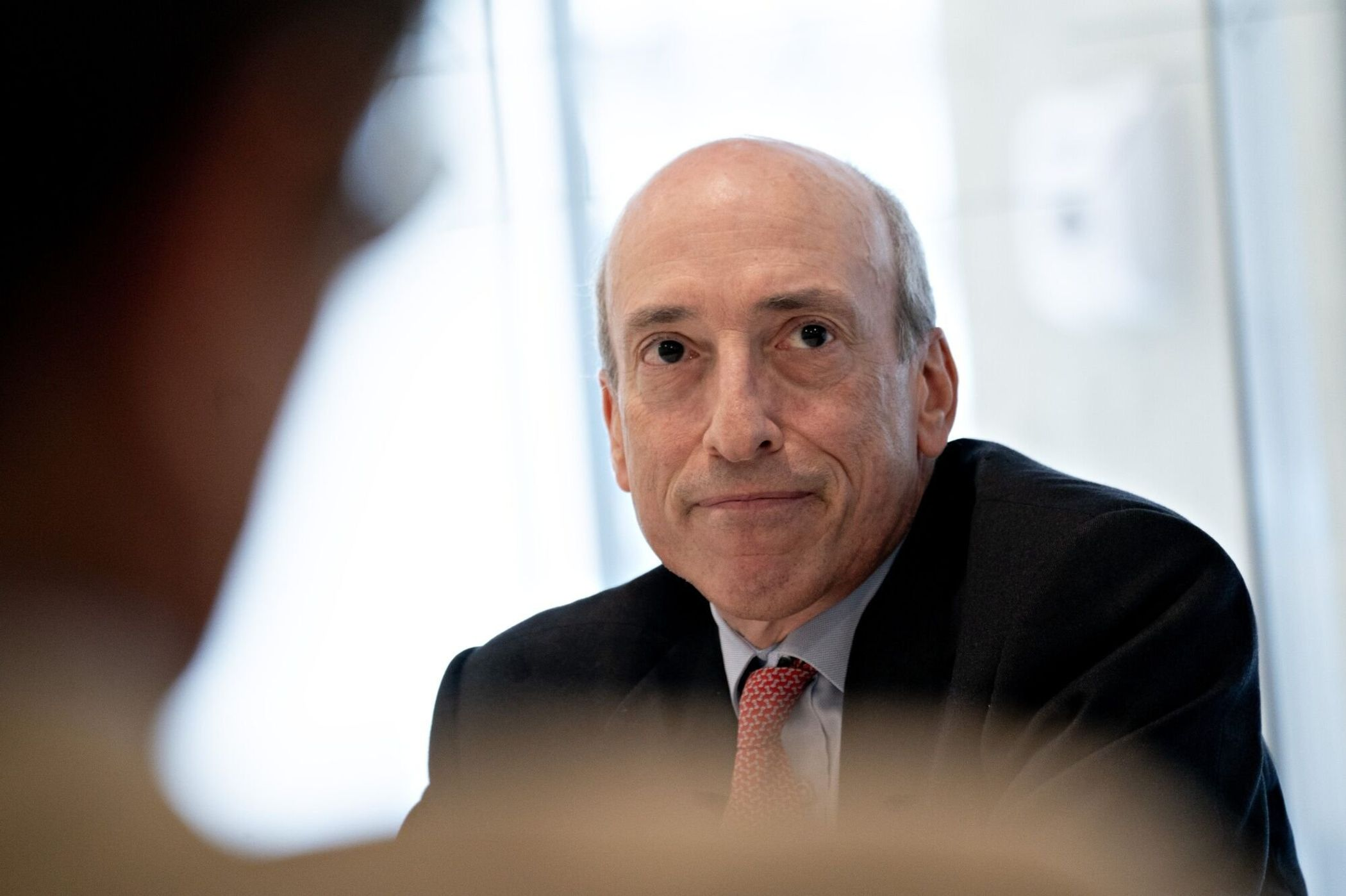
Bitcoin is the only cryptocurrency that Gensler has said is outside the SEC’s jurisdiction, describing it as a commodity rather than a security—the category of assets that includes stocks and bonds. While the Commodity Futures Trading Commission regulates commodity futures, no federal regulator has authority to oversee spot markets for commodities, including cryptocurrencies that fall into this category. Critics of the SEC’s approach say it makes bitcoin spot ETFs all but impossible.
Bringing cryptocurrency markets into compliance with longstanding federal regulations is a priority for Gensler, a veteran policy maker who previously taught a class on cryptocurrency at the Massachusetts Institute of Technology. He has said most cryptocurrencies in circulation are unregistered securities and has beefed up the SEC’s team of crypto-enforcement attorneys. In June, the SEC sued Coinbase and Binance, the largest global crypto trading platform.
Gensler’s approach has had some obstacles. Last month, a federal judge ruled partially against the agency in a long-running court battle against Ripple Labs, whose XRP cryptocurrency is alleged by the SEC to be an unregistered security. The agency is seeking to appeal that ruling, which could undermine the SEC’s case against Coinbase and other trading platforms if it shapes case law.
The nascent digital asset market boomed during the pandemic—and crashed to earth when traders fled high-risk investments. Many of the largest crypto firms have filed for bankruptcy over the past two years.
Reluctant to encourage greater adoption of crypto, the SEC has repeatedly rejected bitcoin ETFs from asset managers such as Fidelity Investments.
Grayscale sued the SEC last year after the agency denied its application, arguing that the agency’s prior approval of bitcoin futures ETFs made its rejection of GBTC “arbitrary and capricious.” It rallied thousands of investors to write comment letters in support of its efforts.
Currently, the only SEC-approved bitcoin ETFs hold futures contracts, which trade on derivatives exchanges regulated by the CFTC.
The crypto world has been eager for spot bitcoin ETFs because futures-based ETFs must be continually rolled forward as the current month’s futures contracts expire and the ETF’s manager replaces them with contracts from the next available month. If the next month’s contract is more expensive than the current month’s contract, the roll process incurs a hidden cost for ETF investors.
Unlike a stock, bitcoin has no way of returning capital to investors through dividends or buybacks. The only thing that causes its price to go up or down is investor demand, which has flagged in recent years in the midst of crypto-market turmoil.
Crypto fans hope that the advent of bitcoin ETFs would bring new investors into the market by making bitcoin as easy to buy as shares of a public company or mutual fund.
In June, the asset manager BlackRock applied for a spot bitcoin ETF, kicking off another wave of applications and speculation that the SEC might reconsider its stance. Fidelity and Invesco are among the recent asset managers that have applied.
Launched in 2013, GBTC is an investment vehicle that buys bitcoin and sells shares to investors, offering them exposure to the cryptocurrency without the challenges of buying and storing it directly. It currently holds $16.2 billion of bitcoin and charges a 2% annual management fee.
For years, GBTC was the only product of its kind—an SEC-registered vehicle for gaining exposure to bitcoin. Its shares traded at a premium to the value of its underlying bitcoin holdings until early 2021, when the SEC approved a similar product. Since then its shares have traded at a discount of up to 49%.
Because of its legal status as a trust, GBTC has refused to sell its bitcoin holdings to meet redemption requests from investors, who have punished its share price as result. Grayscale says a conversion into an ETF would enable the trust to continuously meet redemption requests and eventually eliminate the discount.
Gensler has declined to comment specifically on Grayscale’s product. When asked about potential options for bitcoin ETFs on CNBC in February, he said, “The path forward is well trodden.”
“We have tens of thousands of registrants that properly, in good faith, comply, they register, they make the proper disclosures,” Gensler said. “It’s time for this group to do so.”